
By Ryan Lingenfelter · Cutting Edge Lawn & Landscaping, Garson, Ontario · June 2026
Most of the lawn care content I write is about residential properties in Greater Sudbury — Garson, Val Caron, Hanmer, Lively. City lots with clay-influenced soil, municipal water, and the specific challenges that come with our climate and freeze-thaw cycle.
But a lot of homeowners in the Sudbury region also have a second property — a cottage on one of the hundreds of lakes in our area. Vermilion Lake, Ramsey Lake, Windy Lake, Whitson Lake, McFarlane Lake, dozens of others within an hour of the city. And cottage lawn care is a genuinely different problem from residential lawn care in ways that most generic advice doesn’t address.
Sandy soil. Partial to heavy shade under mature pines and mixed canopy. Irregular access — the property might be visited only on weekends, or only for a few weeks in summer. No municipal water. Proximity to the lake and the shoreline regulations that come with it. These conditions produce a completely different set of challenges and a completely different set of answers than what works on a city lot in Garson.
I’ve worked on cottage properties in the Sudbury lake district. Here’s what I’ve learned about what actually works on these lots — and what never does regardless of how much effort goes into it.
Why cottage lots around Sudbury lakes are a different problem entirely
The starting conditions on a typical Sudbury lake cottage lot are almost the opposite of what I deal with on a residential city property.
City properties: clay-influenced heavy soil that compacts easily, full or partial sun on most of the lawn area, municipal water available, consistent weekly access for maintenance, relatively level grade in most sections.
Cottage lots: sandy or rocky soil with low organic matter and poor moisture retention, heavy shade from mature pine and mixed forest canopy on much of the property, well or lake water rather than municipal supply, irregular access — often just weekends, sometimes just two or three extended stays per summer — and a grade that typically runs toward the water, creating drainage dynamics and sometimes shoreline sensitivity that doesn’t exist on a city lot.
These differences matter for every decision you make about the lawn. The grass variety that performs on a city lot in full sun with clay soil and weekly cutting struggles or fails entirely on a shaded sandy cottage lot visited every other weekend. The watering approach that works on municipal supply — deep weekly sessions from a programmed irrigation controller — doesn’t translate to a property on a well with limited pump capacity and no one there to run it on a schedule. The aeration that’s essential on compacted clay is largely unnecessary on sandy soil that doesn’t compact the same way.
The mistake most cottage owners make is applying city lawn care logic to cottage conditions. They bring in grass seed that works in town, water it the way they’d water a city lawn, aerate because they read that aeration is important, and wonder why the lawn looks rough every time they show up for the weekend. It looks rough because the conditions on a Sudbury lake lot require a fundamentally different approach — not a modified version of city lawn care, but a different starting point entirely.
I covered the principle behind this in the article on why I stopped giving every Sudbury homeowner the same advice — the same inputs produce different outputs in different soil and climate conditions. Cottage lots are the most extreme version of that principle within the Sudbury region.
What actually grows on sandy shaded cottage lots — and what never will
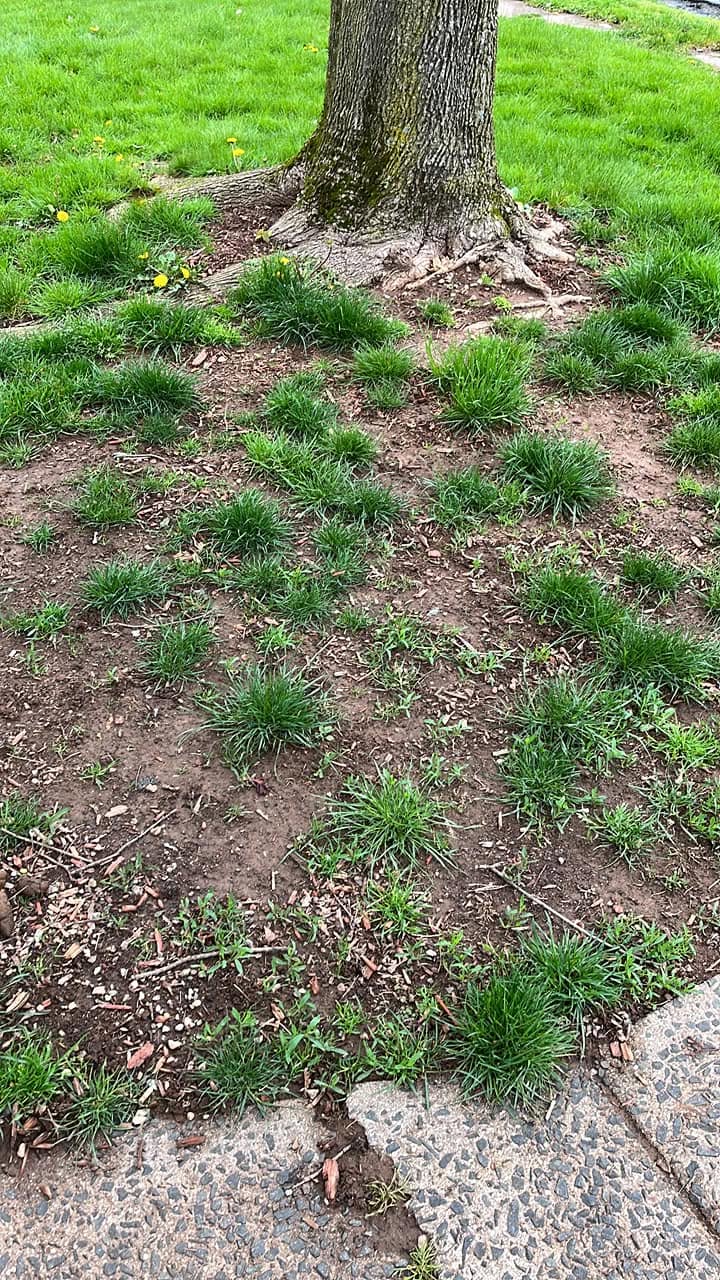
Let me be direct about something before going further: a significant portion of most Sudbury lake cottage lots cannot support a traditional lawn grass under the existing canopy. Not with better seed. Not with more fertilizer. Not with any amount of effort or inputs. The shade and soil conditions in those sections are simply outside the tolerance range of any turf grass that will hold up through a Sudbury winter.
The sections where traditional lawn grass is viable on a typical Sudbury cottage lot are the open areas — near the cottage building itself where the canopy opens up, on any sections that face south or southwest with meaningful direct sun, and in gaps in the tree cover where light penetrates for a significant portion of the day. In those areas, with the right grass variety and the right management approach, you can have something that looks like a lawn and functions like one.
In the heavily shaded sections under mature pine canopy — which covers a large portion of many Sudbury lake lots — the realistic options are ground covers that tolerate deep shade rather than grass that will perpetually struggle. I’ll come back to those alternatives later. For now, the important first step is honestly mapping which sections of your cottage lot are viable for grass and which aren’t. Investing in the viable sections and accepting a different solution for the non-viable ones produces dramatically better results than trying to force grass everywhere.
What grows in the viable sections:
For shaded areas that get two to four hours of direct sun — not the deep shade under mature pines, but the partial shade at the forest edge or under a less dense canopy — creeping red fescue is the best-performing grass variety in the Sudbury lake district. It tolerates shade better than any other cool-season grass, handles sandy soil with low fertility reasonably well, and survives Sudbury winters reliably. Chewings fescue is a close second with similar shade tolerance. Both are available in seed mixes specifically formulated for shade conditions.
For open sunny sections with sandy soil — any area that gets four or more hours of direct sun — a fine fescue and Kentucky bluegrass blend works well. The Kentucky bluegrass spreads laterally to fill thin areas over time, which is valuable on sandy soil where individual plants are more vulnerable to drying out. The fine fescue component provides drought tolerance that suits the moisture retention challenges of sandy soil.
What doesn’t work on cottage lots regardless of how it’s marketed: perennial ryegrass, which germinates fast and looks impressive for one season but has poor winter hardiness in this climate and declines significantly by season two. Kentucky bluegrass in heavy shade, where it simply won’t establish. Any grass marketed primarily for appearance rather than stress tolerance — these varieties are bred for golf courses and managed sports turf, not unirrigated sandy lots visited on weekends.
The seed variety question is the foundation that everything else builds on. The right variety in the wrong soil conditions still struggles. The wrong variety in any conditions fails. Get the variety right first. The overseeding timing and technique I described in the article on when to overseed a Sudbury lawn applies to cottage lots as well — late May to mid-June is the window, soil contact is essential, consistent moisture for three weeks after seeding is what produces establishment.
The maintenance approach that works on these properties
Cottage lawn maintenance has to be designed around the reality of irregular access. You can’t maintain a cottage lot the way you maintain a city property visited daily. The approach that works accepts the irregular schedule and builds a management system that produces good results within it rather than fighting against it.
Cutting height — higher than you’d use in town. On a city lawn I recommend three inches through summer. On a sandy cottage lot, I recommend three and a half to four inches minimum. The extra height does two things that matter more on a cottage lot than on a city property. First, it significantly extends the interval between necessary cuts — at four inches you can go ten to twelve days between cuts in normal growing conditions without the lawn getting to the height where a single cut would violate the one-third rule. For a property you visit every two weeks, that interval matters enormously. Second, the extra blade length shades the sandy soil surface, reducing moisture evaporation between visits. Sandy soil dries out faster than clay in the same heat conditions. Every inch of additional blade height helps retain soil moisture longer.
The risk of leaving a cottage lawn at four inches is that it looks longer than a city lawn. The trade-off is that it handles two-week intervals without the stress damage and extended recovery that comes from cutting a six-inch lawn back to three in one visit. Appearance or resilience — on a cottage lot with irregular access, resilience is the right priority.
Fertilizing — less than you’d apply in town, timed correctly. Sandy soil doesn’t hold nutrients the way clay soil does. Granular fertilizer applied to sandy soil moves through it faster — nutrients leach downward rather than staying in the root zone. Heavy fertilizer applications on sandy cottage lots near Sudbury lakes also raise shoreline sensitivity concerns; nutrient runoff into the lake is a real issue, and several municipalities in the Sudbury area have regulations or guidance around fertilizer use near water. The approach I recommend: one light balanced application per year, in late May when soil temperature is right, at half the rate you’d use on a city property. That’s enough to support growth without the leaching risk of heavier applications. I covered fertilizer timing for Sudbury specifically in the article on what I tell Sudbury homeowners about fertilizing — the timing principles are the same on cottage lots but the rate should be reduced for sandy soil and proximity to water.
Watering — accept what you have and work with it. Most Sudbury lake cottage lots don’t have irrigation systems. They have a well or pump access to the lake, and whoever is there on the weekend runs a sprinkler by hand when they think about it. That’s not a reliable watering system and it shouldn’t be treated as one. The lawn care approach on a cottage lot has to assume that watering will be irregular — sometimes the property gets watered, sometimes it doesn’t, and the grass needs to be species-matched and cut at a height that allows it to handle that variability without failing.
If you do want to establish a basic irrigation system at a cottage — even a simple timer-controlled system on a hose connection — the deep weekly session approach I covered in the article on the Lively homeowner whose lawn declined every summer applies. One deep session that wets the soil four to five inches is more effective than multiple light sessions that only wet the sandy surface. Sandy soil drains fast — a light session may only wet the top inch before gravity pulls the moisture below root depth. Running the water longer lets it saturate the root zone before draining past it.
Aeration — less critical than on city lots, but not irrelevant. Sandy soil doesn’t compact the way clay soil does. The annual aeration that’s essential on a Greater Sudbury residential property is less urgent on a sandy cottage lot. However, aeration on cottage lots serves a secondary purpose that’s still valuable: it breaks up any thatch accumulation and improves seed-to-soil contact for overseeding. On a cottage lot that hasn’t been aerated in several years, one spring aeration before overseeding produces meaningfully better overseeding results than seeding on an un-aerated surface. Once every two to three years rather than annually is a reasonable frequency for most sandy Sudbury cottage lots.
When to stop fighting the grass and do something smarter
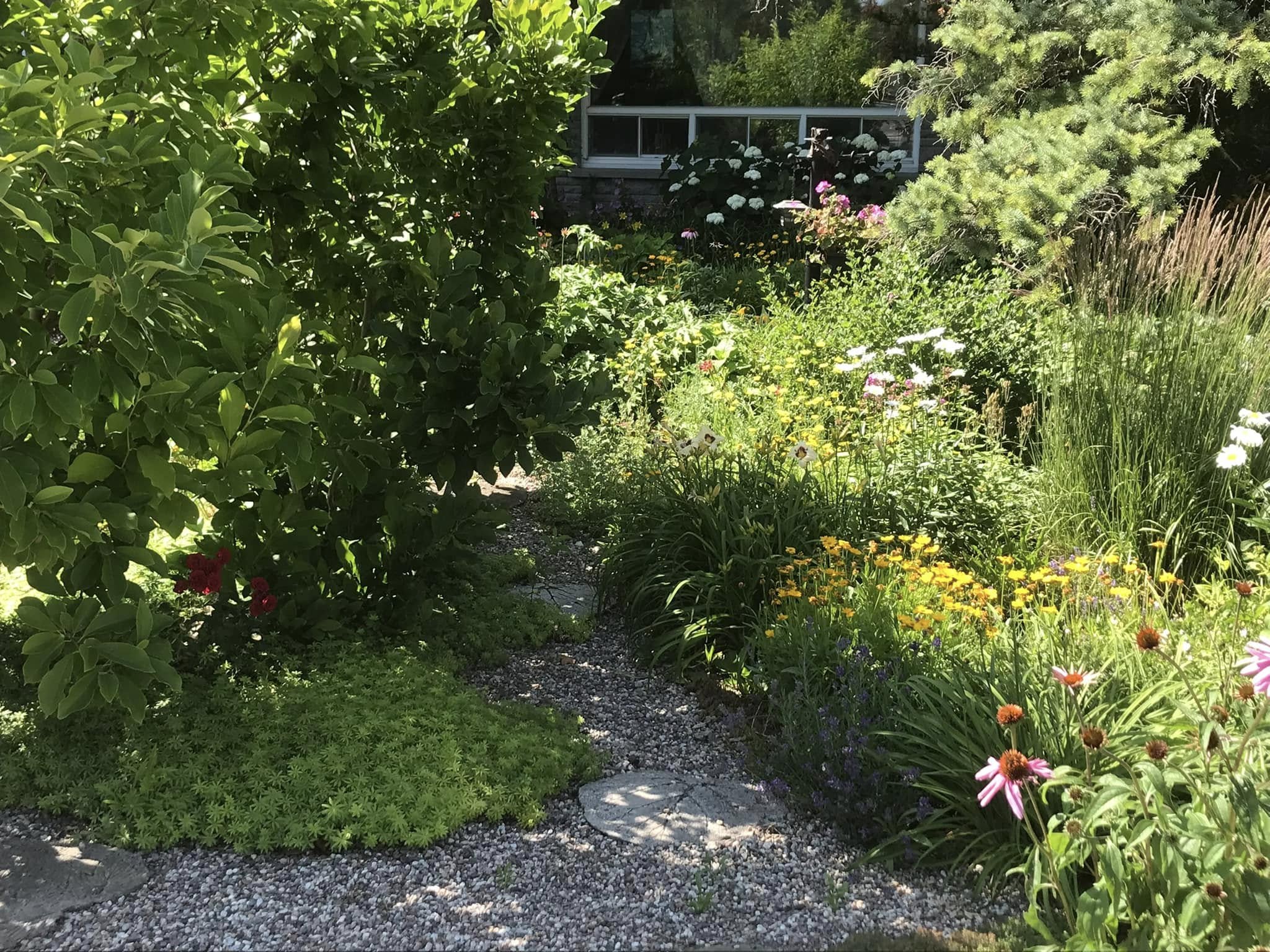
This is the conversation I have with cottage owners that nobody else in the industry seems willing to have: some sections of a Sudbury lake cottage lot should not have grass on them, and continuing to seed and fertilize and try to force grass into those sections is a waste of time and money that will never produce a lasting result.
The sections I’m describing are the ones under heavy pine canopy with needle accumulation on the forest floor, deep shade throughout the day, and sandy or rocky soil with almost no organic matter. These conditions — dense shade, acidic needle-drop soil, low moisture retention — are outside the tolerance range of any turf grass that holds up in our climate. The grass that does germinate in these spots struggles through its first season and doesn’t return in year two.
The smarter approach for those sections is ground cover that’s actually suited to the conditions. Native woodland plants that tolerate deep shade and acidic sandy soil — bunchberry, wild ginger, trillium where it’s already present and needs protection rather than establishment, native ferns along the forest edge. These aren’t difficult plants to establish in conditions where they’re naturally adapted. They require almost no maintenance once established. They look appropriate for a lakeside wooded property in a way that a patchy struggling lawn never does. And they don’t require fighting the natural ecosystem of the lot to maintain.
For the transition zone between the forested sections and the open grass areas — the forest edge where light is partial and soil is somewhere between sandy forest floor and lawn — low-growing fescue mixes allowed to grow slightly longer than a traditional lawn height, with minimal fertilizing, work well. Let the lawn be what it wants to be in those zones rather than trying to force it to match the open sections.
The principle here is the same one I described in the decision guide on lawn repair in Sudbury — when to patch, reseed, or replace: understand which sections are viable for the treatment you’re considering and which aren’t, and stop applying resources to sections that the underlying conditions won’t support. On a cottage lot, that principle applies more dramatically than almost anywhere else.
The result of applying it honestly — grass in the viable open sections with the right variety and management for irregular access, ground cover or natural forest floor in the sections that can’t support grass — is a cottage lot that looks intentional rather than defeated. It’s a lot that you arrive at on a Friday evening and feel good about rather than one that makes you immediately anxious about what’s gotten worse since your last visit.
If you have a cottage property in the Sudbury lake district and you want an honest assessment of what’s realistic on your specific lot — which sections are viable for grass, which aren’t, what variety makes sense for your conditions, and what a realistic maintenance approach looks like — give me a call. I service cottage properties in the Greater Sudbury area and I’ll give you a straight assessment based on what I actually find.
📞 705-507-6787 | Get a free quote online
— Ryan Lingenfelter
Owner, Cutting Edge Lawn & Landscaping
Garson, Ontario · 705-507-6787
