
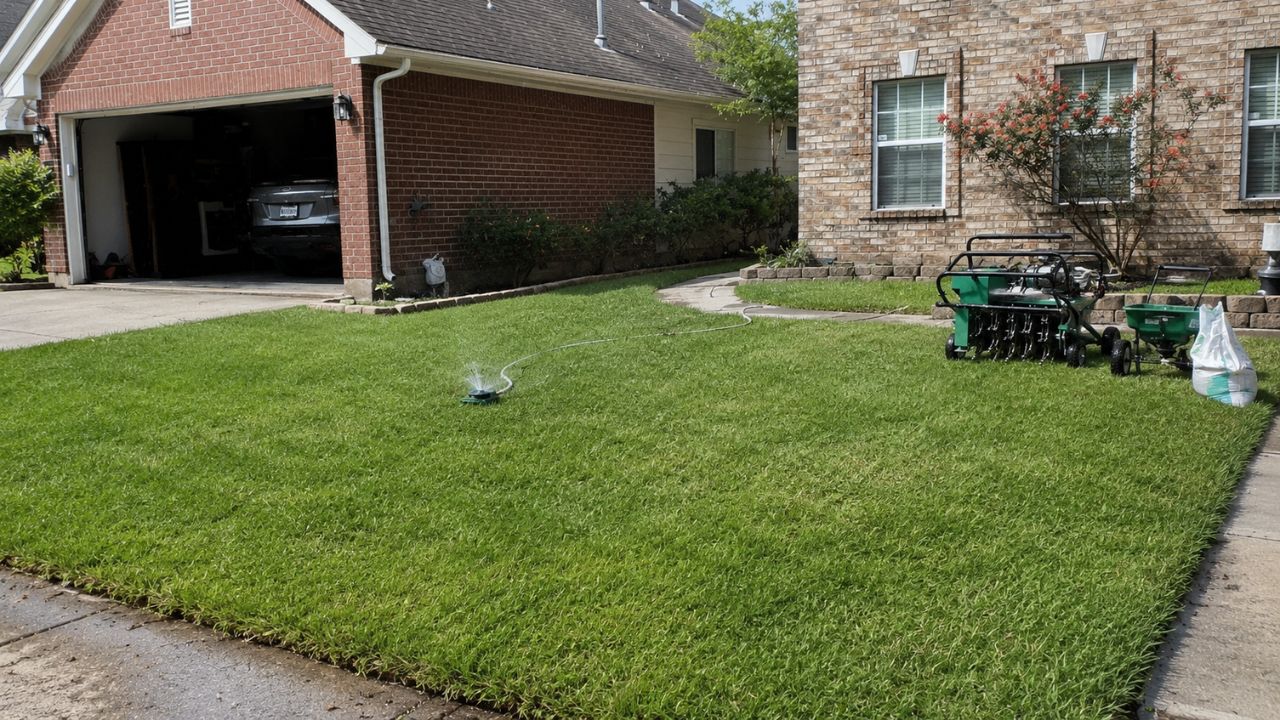
One of the most common questions I get on quote visits is some version of this: my lawn has problems — do I need to replace the whole thing or can I fix what’s there?
It’s a fair question because the stakes are real. Full sod replacement on a standard Sudbury residential property runs $2,000 to $4,000 depending on size and soil preparation needed. That’s a significant investment. If patching or reseeding would solve the problem for $200 to $500, spending four times more for sod replacement is a waste. But if the underlying issue means anything short of replacement will fail again within a season, spending less upfront costs more in the long run.
The answer depends on what’s actually wrong with the lawn — not just what it looks like on the surface. I’ve walked hundreds of Sudbury properties with this exact question. Here’s the framework I use to answer it, and the specific conditions that put a lawn in each category.
How to read what your lawn is actually telling you

Before deciding on patching, reseeding, or replacement, you need to understand what caused the problem. The appearance of a damaged lawn — bare patches, thin areas, dead sections — is a symptom. The cause determines which repair approach will actually hold.
There are four categories of lawn problems I see regularly in Greater Sudbury, and they point to different repair approaches.
Category one: surface damage with healthy underlying soil. The grass is gone or damaged in specific areas, but when you dig a few inches into the soil it’s workable — not compacted to hardpan, reasonable moisture, some earthworm activity. The damage was caused by something external: a harsh winter, grub damage, dog traffic, a parked vehicle, a temporary object sitting on the lawn. The soil is capable of supporting new grass. Repair will hold.
Category two: systemic decline from maintenance issues. The lawn has been thinning gradually over multiple seasons. There are no dramatic dead sections but the overall density and colour are poor. Weeds have moved into gaps throughout. When you check root depth you’re finding less than two inches. This is the pattern that follows from years of cutting too short, inconsistent watering, or no aeration. The lawn declined because of how it was maintained. Fix the maintenance approach and repair holds. Don’t fix the maintenance approach and nothing you do to the surface will last. I covered the maintenance patterns that cause this kind of decline in the article on the Lively homeowner whose lawn looked worse every summer — the same patterns I see on properties across Greater Sudbury.
Category three: structural soil problems. The damage is being driven by something in the soil — compaction severe enough that grass roots can’t penetrate, drainage failure creating consistently wet or dry zones, construction fill under shallow topsoil, contamination from a past use. Surface repairs on a lawn with structural soil problems will fail repeatedly until the soil problem is addressed. This category requires the most diagnosis before any repair decision is made. I wrote about what structural drainage problems look like from the surface in the article on the Sudbury property where I found drainage problems underground — the symptoms that look like lawn problems but are actually soil or drainage problems underneath.
Category four: complete lawn failure beyond viable repair threshold. Less than 30 percent viable grass remaining, widespread grub or disease damage that has killed the root system throughout, or topsoil so degraded that it can’t support establishment without significant amendment. In this category, surface repair is throwing seed into conditions that can’t support it. Replacement with proper soil preparation is the only approach that produces a lasting result.
Knowing which category your lawn is in is the first step. Here’s how each category maps to the three repair approaches.
When patching makes sense — and how to do it right

Patching — addressing specific bare or dead areas without treating the whole lawn — makes sense when the damage is localised, the cause is identifiable and has been resolved, and the surrounding lawn is healthy enough to provide a stable environment for establishment.
Good candidates for patching:
- Bare spots under 50 square feet from dog traffic, temporary vehicle parking, or similar physical causes — where the surrounding grass is dense and healthy
- Grub damage that has been treated and confirmed resolved, in areas under 100 square feet
- Winter kill in specific exposed areas on an otherwise healthy lawn
- Spots where a tree or shrub was removed and the root void has been filled and graded
The patching process that actually works:
The single most common patching mistake I see is homeowners broadcasting seed onto a bare area without any soil preparation. The seed sits on the surface, some of it germinates, and then the new grass comes in thin and sparse because it had no soil contact or protection. Here’s the sequence that produces reliable results:
First, loosen the soil in the bare area to a depth of three to four inches. A garden fork or a flat-head spade works for small areas. You’re breaking up any surface crust and improving the seed bed. If the soil in the bare area is compacted — which it often is, especially in high-traffic spots — work in a thin layer of compost or quality topsoil as you loosen it.
Second, rake the area smooth and level it with the surrounding lawn. The patch needs to be at the same grade as the surrounding turf — a sunken patch will collect water and an elevated patch will dry out faster than the surrounding grass.
Third, apply seed at a heavier rate than bag recommendations suggest — five to six pounds per 1,000 square feet for a bare patch. The bag rate is written for overseeding into existing turf. A bare patch has no existing competition but also no protection for the seed. Go heavier.
Fourth, press the seed lightly into the soil surface — a flat board, a hand roller, even pressing firmly with the back of a rake. Seed that has soil contact germinates at dramatically higher rates than seed sitting on the surface.
Fifth — and this is where most patches fail — water consistently for three weeks. Light, frequent moisture to keep the top half inch of soil from drying out. Once per day minimum in hot weather, twice per day if temperatures are above 28 degrees. I covered the moisture requirements for new seed establishment in the article on when to overseed a Sudbury lawn — the same principles apply to patch seeding, including why the late May to mid-June window in Sudbury gives the best germination results.
When patching won’t work: If the bare area is surrounded by thin, stressed turf rather than healthy dense grass, patching produces a thin result. New seedlings establishing into a weakened lawn don’t have the support environment they need. If more than 30 to 40 percent of the surrounding lawn is thin or weedy, you’re not really doing a patch repair — you’re doing a partial repair of a whole-lawn problem, and the results will reflect that.
When reseeding the full lawn is the right call
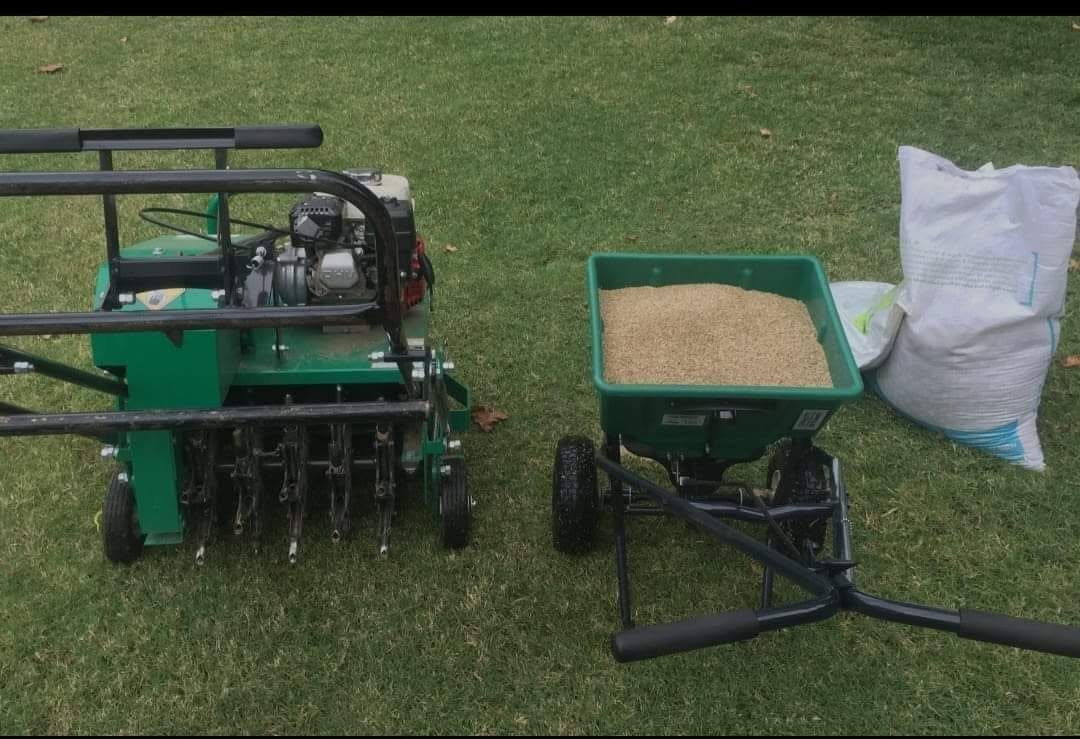
Full lawn overseeding — aerating and seeding the entire property rather than just the problem areas — is the right call when the lawn’s issues are widespread but the underlying soil is workable and the grass, though thin and struggling, is still present across most of the surface.
The threshold I use: if more than 40 percent of your lawn surface is thin, patchy, or weed-dominated, but less than 70 percent is completely bare, and the soil isn’t structurally compromised — full overseeding after aeration is almost always the better choice over patching. You’re treating the whole system rather than spot-fixing individual symptoms, and the results are dramatically more uniform.
The conditions where full overseeding works well:
- Lawn that has thinned gradually from maintenance issues — cutting too short, inconsistent watering, no aeration history
- Lawn with moderate weed coverage — up to 40 percent weed coverage — where the turf is thin enough for weeds to move in but not so far gone that there’s nothing to work with
- Post-renovation where old turf has been scalped or dethatched and the soil is in reasonable condition
- Lawn recovering from a difficult summer — significant browning in July that has begun to recover in August but left the turf density lower than before
The full overseeding sequence for Sudbury:
Aeration is the foundation. Without it, full overseeding produces marginal results because the seed is broadcasting into thatch and existing turf without reliable soil contact. Core aeration creates hundreds of direct seed-to-soil contact points per square metre and opens the soil structure for root development. The timing — late May to mid-June in Greater Sudbury — is critical. I covered the specific reasons this window works in the article on the best time to aerate a Sudbury lawn — the soil temperature and seasonal conditions that make late spring aeration significantly more effective than fall in this climate.
After aeration, broadcast seed at three to four pounds per 1,000 square feet across the full lawn — higher than the bag recommendation to account for competition from existing grass. Use a fescue-dominant blend with Kentucky bluegrass for Sudbury conditions. Apply a starter fertilizer — higher phosphorus — immediately after seeding. Water consistently for three weeks.
The result of a properly sequenced full overseeding on a lawn that was a candidate for it — thin but present, soil workable, maintenance issues identified and corrected — is typically dramatic within four to six weeks. Visible thickening, better colour, weeds beginning to lose ground as the turf density increases around them. By the end of the same season the lawn often looks better than it has in years. By the end of the following season it’s usually excellent.
When full overseeding won’t work: If the soil has structural problems — severe compaction, drainage failure, inadequate topsoil depth — overseeding on top of those problems produces thin, struggling results for the same reason the original lawn declined. Fix the structural issues first. If the lawn is more than 70 percent bare or dead throughout, you’re working against poor odds — replacement gives you a better starting point than trying to establish into a largely failed surface.
When full sod replacement is actually worth it

Full sod replacement is the right call in specific situations — not as a default, and not as a way to avoid the work of proper maintenance, but as the legitimate best option when the conditions call for it.
Situations where replacement is the right choice:
Less than 30 percent viable grass remaining. When most of the lawn is bare, dead, or so thoroughly weed-dominated that the original turf grass is a minority of what’s growing, overseeding is fighting an uphill battle. Sod installation on properly prepared soil gives you a clean, established surface immediately rather than months of establishment uncertainty. The investment is higher but the reliability is significantly better than trying to establish seed into a largely failed lawn.
Grub damage throughout the lawn. When white grubs have killed the root system across most of the property — you can confirm this by pulling on the dead grass; if it lifts like a carpet with no root resistance, grubs have been through it — the dead material needs to come out, the grub problem needs to be treated, and the surface restored. Overseeding into post-grub soil requires the grub treatment to be confirmed effective first and produces slower results. Sod after treatment establishes reliably and produces an immediate visual result. For smaller grub damage sections — under 150 square feet — patching with sod makes sense. For widespread damage across the whole lawn, full replacement is worth considering.
New construction or renovation where topsoil is inadequate. Properties in newer developments across Greater Sudbury often have minimal topsoil — sometimes two to three inches over compacted fill — because builders stripped and sold the original topsoil during construction. Grass established on two inches of topsoil over hardpan will always struggle. If a soil assessment shows inadequate topsoil depth, the right repair is bringing in four to six inches of quality topsoil across the full area before any surface treatment. Once that’s done, sod gives you immediate coverage and faster establishment than seed on the new topsoil. I covered how to assess whether soil preparation needs to precede surface work in the article on buying sod in Sudbury — specifically the soil preparation that needs to be in place before sod installation will produce the results you’re paying for.
Time-sensitive situations. If you have an event, a property sale, or a deadline where the lawn needs to look established and healthy within days rather than weeks, sod is the only option that delivers immediate visual results. Seed takes three to four weeks to even germinate reliably. Sod installed properly looks like lawn the same day. I wrote about a specific case of this — a wedding seven days away — in the article on the Val Caron backyard we prepared for an outdoor wedding. The time constraint made sod the only viable choice for that project.
The cost reality of replacement done right:
Full sod replacement in Greater Sudbury in 2026 — supply and installation with proper soil preparation included — runs roughly $1.40 to $1.95 per square foot all-in for a standard residential property. On a 1,500 square foot lawn that’s $2,100 to $2,900. On a 2,500 square foot lawn it’s $3,500 to $4,875.
Those numbers assume proper soil preparation is included in the scope. Quotes that come in significantly lower than that range are usually leaving out soil preparation — which means the sod is going over unaddressed compaction or inadequate topsoil, and the establishment will reflect it. When you’re evaluating quotes for full replacement, ask specifically what soil preparation is included and what the topsoil depth will be after installation. A quote that includes four inches of quality topsoil and proper grading is worth more than a lower quote that’s just laying sod on whatever is currently there.
The decision in plain language
Here’s the simplified version for anyone who wants a quick read:
- Patch if: damage is localised, under 100 square feet, cause is identified and resolved, surrounding lawn is healthy
- Reseed the full lawn if: widespread thinning across 40 to 70 percent of the surface, soil is workable, maintenance issues are being corrected, no structural soil problems
- Replace with sod if: more than 70 percent bare or dead, grub damage throughout, inadequate topsoil, time-sensitive deadline, or structural soil problems that make surface seeding unreliable
If you’re not sure which category your lawn is in — come out and walk it with me. I’ll tell you what I see, which approach makes sense, and what it’ll cost. No charge for the visit, no obligation to book anything.
📞 705-507-6787 | Get a free quote online
— Ryan Lingenfelter
Owner, Cutting Edge Lawn & Landscaping
Garson, Ontario · 705-507-6787
