

I pull up to a property I’ve never been to before. By the time I’ve walked from my truck to the front lawn — maybe 60 seconds — I already have a working picture of what’s going on with that lawn and what it’s going to need.
Not because I’m doing anything complicated. Because after five years and hundreds of properties across Greater Sudbury, I know what to look for and I look for the same things every time.
I’m Ryan Lingenfelter, owner of Cutting Edge Lawn & Landscaping in Garson, Ontario. Since 2020, I’ve walked properties across Greater Sudbury — Garson, Val Caron, Hanmer, Lively, Chelmsford, Azilda, Capreol. This article is about what I actually notice first on any new property, what those observations tell me about the lawn, and why the first look matters as much as it does.
Some of this is useful if you’re trying to read your own lawn. All of it explains why the diagnosis step matters before anything else is done — and why skipping it is the main reason lawn repair efforts fail.
The First Thing I Look At — Mowing Height and Colour

Before I’ve stepped out of the truck I’m already looking at the grass height and overall colour from the street. These two things together tell me more than almost anything else about how a lawn has been maintained.
Height. Is it at 3 inches or close to it? Or is it cut tight to the ground — 1.5, maybe 2 inches? A lawn cut short doesn’t look neat from the street the way homeowners think it does. It looks pale. The colour is lighter than a properly maintained lawn, almost washed out. And in mid to late summer, it shows stress — that particular brownish-yellow cast that means the root system isn’t deep enough to handle the heat.
Short mowing is the single most common thing I see on first walks across Greater Sudbury. It’s also the single most damaging habit a homeowner can have. I’ve explained why in detail in the May mowing mistake article — the short version is that short grass forces shallow roots, and shallow roots fail in July when Sudbury’s clay surface dries out. The lawn height tells me within seconds whether this is a problem on the property I’m walking.
Colour. A healthy lawn at 3 inches has a deep, consistent green. Not bright artificial green — a natural, dense green that holds its depth all week. A lawn that’s been cut short, or that has soil compaction limiting root access to moisture and nutrients, has a lighter, more uniform pale colour. Yellow-green rather than blue-green. Once you’ve seen enough lawns side by side, the difference is immediately obvious.
Washed-out colour combined with short height tells me: this lawn has been fighting itself for a while. The root system is shallow, the plant is stressed, and the fix starts with raising the mower deck — not with products or treatments.
The Screwdriver Test — What the Soil Is Telling Me

Within the first minute on any property I do the screwdriver test. I carry a standard flathead in my truck specifically for this. I push it firmly into the soil in two or three spots around the property — high traffic areas, the middle of the lawn, near the edges.
On a properly maintained Sudbury lawn that’s been aerated regularly, the screwdriver goes in 4 to 6 inches with moderate force. On a compacted lawn — which is most lawns I walk for the first time in Greater Sudbury — it stops within an inch or two. Sometimes it barely goes in at all. I’ve done this in front of homeowners who look genuinely surprised at how little penetration there is. They knew the lawn was struggling. They didn’t know the soil had become this hard.
What compaction tells me: this is the underlying cause of most problems on this property. Thin grass, weeds moving in, drought stress in July, bare patches that won’t fill in regardless of how many times they’ve been seeded — all of these trace back to compaction on Sudbury’s clay soil. You can address the symptoms all you want. Until the soil is opened up with core aeration, the conditions that produced those symptoms don’t change.
The screwdriver test also tells me what kind of intervention the property needs. A lawn that passes the test — screwdriver goes in easily — is a maintenance conversation. A lawn where the screwdriver stops at half an inch is a soil conversation first, before anything else. The full year-by-year picture of what happens to a Sudbury lawn that’s never been aerated is in the aeration article here.
Weed Distribution — Reading What the Weeds Are Saying
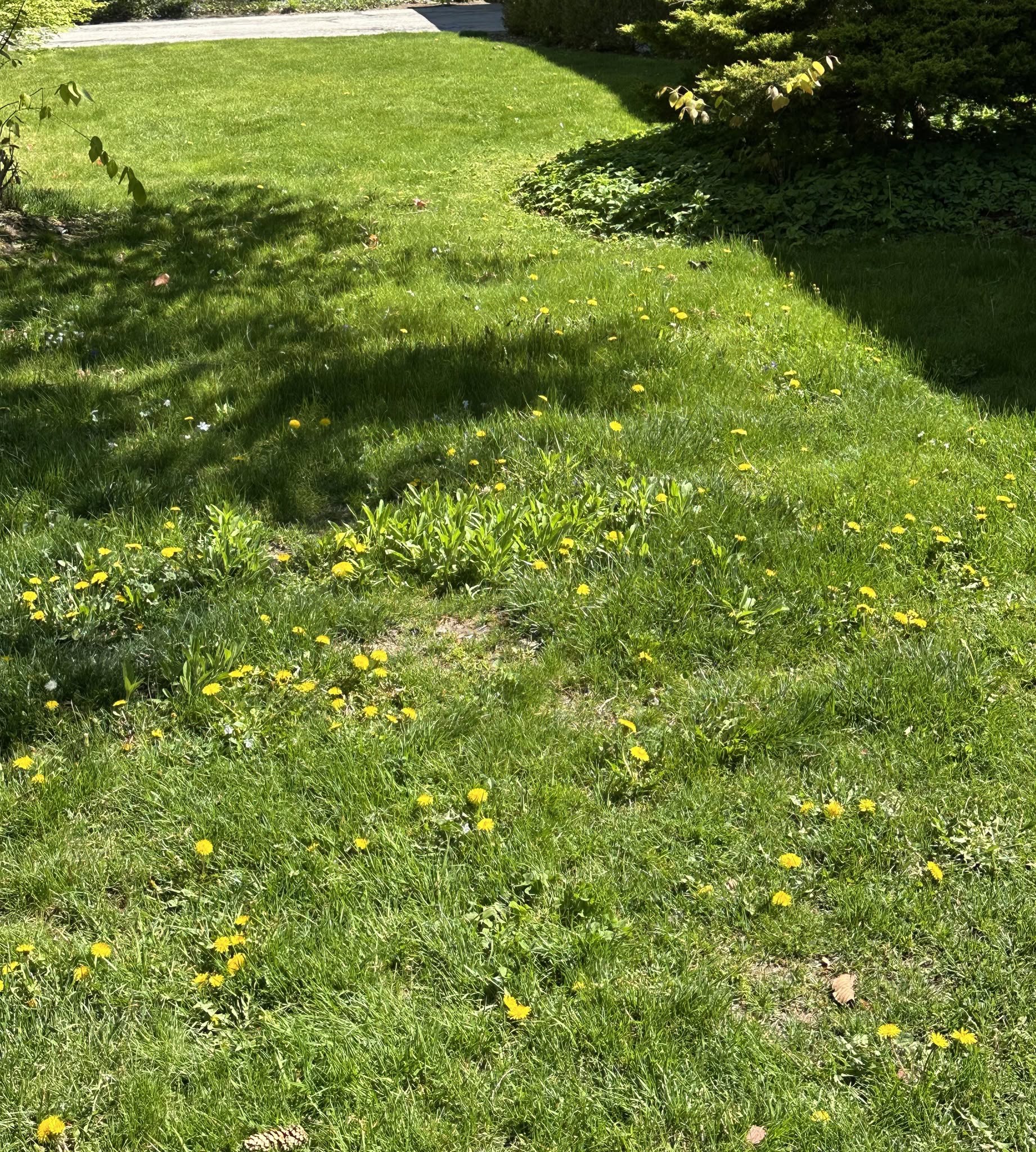
I look at the weeds — not just whether they’re there, but what types they are and where they’re concentrated. Weeds are information. The specific mix of weeds on a property tells me something specific about what the soil and maintenance conditions are doing.
Wall-to-wall dandelions. Almost always compaction. Dandelions thrive in compacted soil — they’ve evolved for exactly these conditions, with a taproot that can push through clay that turf grass can’t penetrate. A property covered in dandelions is telling me the soil is hard, the grass can’t compete, and aeration is the first step — not weed spray. I’ve covered the full weed diagnosis in the weeds article here.
Crabgrass in specific areas. Crabgrass is an annual that germinates where soil is warm and exposed — bare spots, thin areas, high-traffic zones where the turf has given up. Crabgrass distribution tells me where the lawn has been losing the battle for coverage and where I need to focus overseeding after aeration.
Creeping Charlie in shaded areas. Creeping Charlie under trees or along fence lines tells me those areas stay damp and shaded. It’s a signal about the growing conditions in those zones — conditions that may not support turf grass at all, depending on light levels. On Val Caron properties especially, where mature trees are common, creeping Charlie under the canopy often means the shade conversation is coming.
Clover scattered through the lawn. Clover fixes nitrogen from the air — it shows up when soil nitrogen is low, which often indicates the lawn is on a mowing schedule without adequate nutrient return. If clippings are being bagged rather than left on the lawn, or if the lawn has been maintained without any attention to soil health, clover moving in is a nutrient signal.
Weeds only in specific zones. If the weeds are concentrated in high-traffic areas — the path from the door to the gate, the corner where the dog runs — that’s compaction from foot pressure rather than general soil compaction. Those spots need targeted treatment rather than a full-property intervention.
The distribution of weeds gives me a map of where the lawn’s defences have broken down and why. It’s more useful than the overall percentage of weed coverage, which tells me severity but not cause.
Drainage and Low Areas — The Problem That Hides in Plain Sight
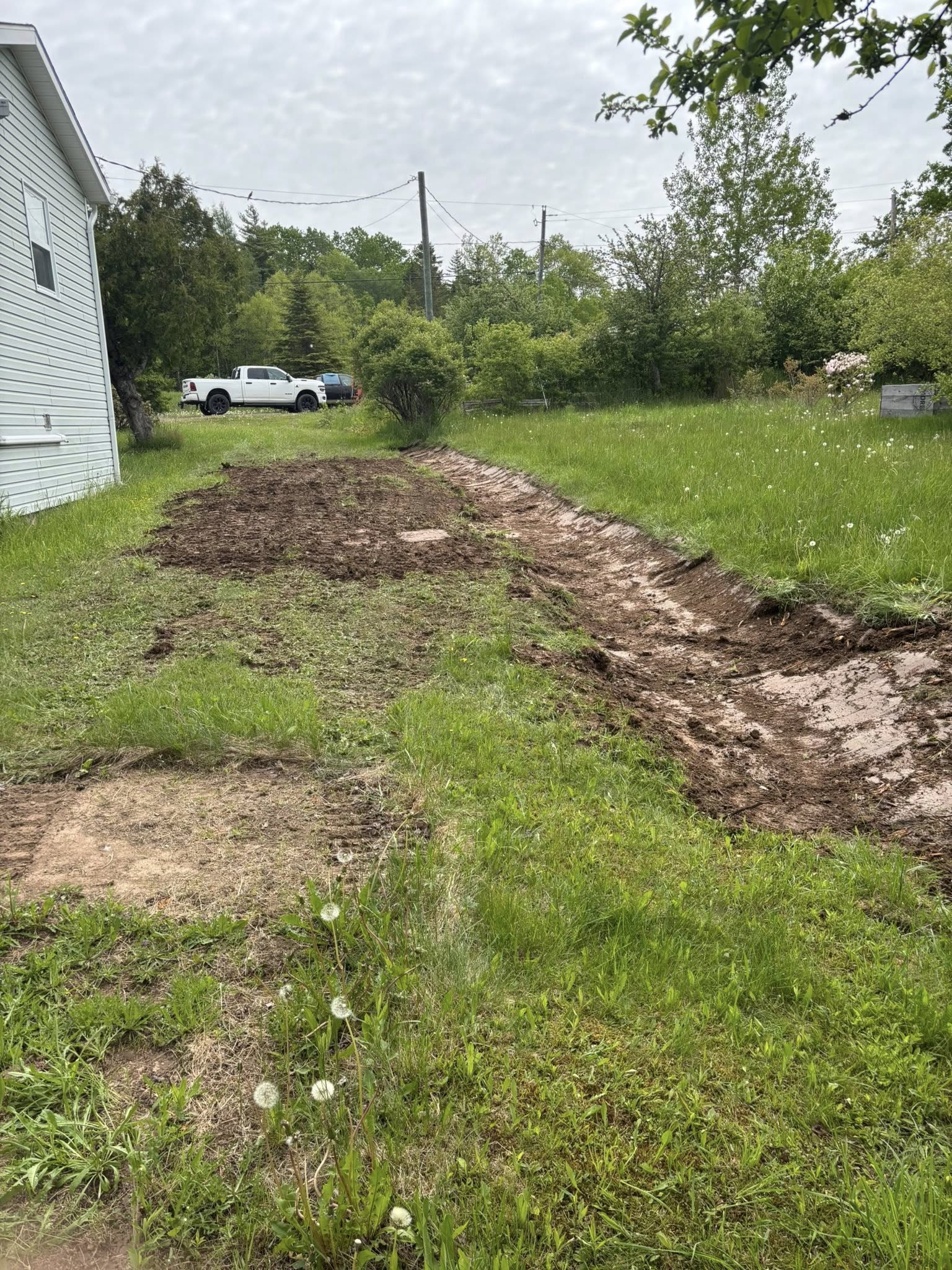
The last thing I check in that first 60 seconds — actually, I’m reading this throughout the walk — is the topography of the property. Are there obvious low spots? Does the grade run toward the house or away from it? Are there dead or thin zones in areas that would logically hold water?
Drainage problems are more common across Greater Sudbury than in many Ontario cities, particularly in Val Caron and parts of Hanmer where lot topography creates low areas. And drainage problems are the most commonly misdiagnosed issue I see — homeowners reseed the same dead zone three times without understanding that the grass dies there every year because of where the water goes, not because of the seed quality or their technique.
The visual clues are usually clear once you know what you’re looking for. A dead oval in a low area of the backyard — same spot every year, same shape, same size — is a drainage problem until proven otherwise. An irregular dead zone along a fence line where water from adjacent properties drains — drainage. Grass that’s consistently thinner near the foundation — potential water movement toward the house, or salt splash from a driveway that’s too close.
Bare patches that won’t fill in despite repeated overseeding are almost always either compaction or drainage. The full diagnosis for persistent bare patches is in the bare patches article here. The fix for drainage is grading — not seed.
I also look at the grade relative to the foundation. On Sudbury properties where the grade runs slightly toward the house — sometimes from settling, sometimes from original construction grading that wasn’t done right — water pools near the foundation in spring. That’s both a lawn problem and a basement problem. I’ll mention it regardless of whether fixing it is in my scope of work, because it’s the kind of thing a homeowner should know about.
What the Edges Tell Me
The edges — along the driveway, walkways, garden beds — tell me something about the maintenance history of the property even before I look at the main lawn surface.
Clean, defined edges mean someone has been paying attention. The edging along driveways and walkways was done on a regular schedule. The borders between lawn and garden beds are sharp. This tells me the lawn has been maintained with intention, not just mowed and forgotten.
Grass flopping over the driveway, ragged borders between lawn and beds, an indistinct transition between turf and garden — these tell me the maintenance has been mow-only. No attention to edges. On properties where edging has been neglected for multiple seasons, the grass has crept into garden beds and the border definition has been lost entirely. It’s a visual signal that the lawn has been on a maintenance schedule that covers the minimum but not the detail.
Edges don’t tell me about soil health or weed pressure — but they tell me immediately about the level of care the property has received. That context matters when I’m assessing what the homeowner is looking for and what the right service approach is. The full service breakdown including edging is in the grass cutting cost and scope article here.
What I Do With What I’ve Seen
By the time I’ve done all of this — 60 seconds of observation — I have a working picture of the property:
- Whether the mowing height has been right or wrong and for how long
- Whether the soil is compacted and how severely
- What the weeds are telling me about the underlying conditions
- Whether there are drainage problems and where
- What level of maintenance attention the property has been getting
That picture determines what I say next. If the soil is severely compacted, I tell the homeowner that aeration is the first step and explain why everything else — overseeding, weed treatment, correct mowing — works better after the soil is open. If there’s a drainage problem creating a recurring bare patch, I explain the grading conversation before we talk about seed. If the mowing height has been short for years, I explain what raising the deck will do and why it takes a full season to see the root depth improvement.
The diagnosis before the prescription. It’s the step that determines whether what comes next actually works or just repeats what hasn’t worked before. The full step-by-step repair sequence for a struggling Sudbury lawn is in the lawn fix guide here.
Walk Your Own Lawn With These Eyes
Everything I’ve described above is something any homeowner can do. You don’t need professional training to push a screwdriver into your own soil and see how far it goes. You don’t need expert knowledge to notice that the lawn is a lighter green than the neighbour’s, or that the dead patch in the back corner reappears in the same spot every spring.
Reading your own lawn with the same observations I use changes the conversation from “why isn’t this working” to “here’s what it’s telling me.” The lawn is always giving you information. The screwdriver test, the weed distribution, the dead zones in low areas — these aren’t mysteries. They’re the lawn communicating what it needs.
If you walk your property and want a second set of eyes on what you’re seeing — or if you want someone to do the full assessment and tell you honestly what the property needs before anything is priced — give me a call.
📞 705-507-6787
🔗 Get a Free Quote
📍 Serving Greater Sudbury — Garson, Val Caron, Hanmer, Lively, Chelmsford, Azilda, Capreol
— Ryan
Frequently Asked Questions
How do I know if my Sudbury lawn has a compaction problem?
Push a standard flathead screwdriver into the soil with moderate force in a few spots across the lawn. On a healthy, properly aerated Sudbury lawn it should penetrate 4 to 6 inches without significant resistance. If it stops at an inch or two — or barely goes in at all — the soil is compacted. Compaction is the underlying cause of most lawn problems in Greater Sudbury, including thin grass, drought stress in July, weeds moving into thin areas, and bare patches that won’t fill in despite repeated seeding.
What do dandelions tell you about a Sudbury lawn?
Wall-to-wall dandelions almost always indicate compacted soil. Dandelions have evolved for exactly these conditions — their taproots push through clay that turf grass roots can’t penetrate. A Sudbury lawn covered in dandelions is a lawn where the grass is losing the competition because the soil conditions favour weeds. Treating the dandelions without addressing the compaction produces the same result the following season. Core aeration to open the soil, followed by overseeding to thicken the turf, is the combination that actually changes the weed pressure over time.
Why does my Sudbury lawn have a dead patch in the same spot every year?
Recurring dead zones in the same location are almost always drainage — a low area where water pools after rain or snowmelt and sits long enough to drown grass roots. The grass dies there every spring because the drainage hasn’t changed. Reseeding without grading the low area produces the same result every year. The fix requires raising the grade in that area with topsoil to redirect water flow away from it. Once the drainage is corrected, grass will establish and hold in that spot.
What does lawn colour tell you about lawn health in Sudbury?
A healthy Sudbury lawn at proper mowing height has a deep, consistent blue-green colour that holds through the week. A lawn that’s been cut too short has a lighter, washed-out yellow-green colour — the plant doesn’t have enough blade surface to produce the chlorophyll that makes grass deeply green. Pale, uniform colour combined with short mowing height is one of the clearest signals that a lawn has been fighting its maintenance rather than being supported by it.
Should I diagnose my lawn before calling a lawn care company in Sudbury?
Yes — the more you can observe and describe about what’s actually happening on the property, the more useful the initial conversation will be. The screwdriver test for compaction, noting where dead or thin zones are concentrated, observing what weed types are dominant and where — these observations tell a lawn care professional what they’re working with before they arrive and help them give you a more accurate assessment and quote. The more specific the information, the more specific the answer can be.
How long does it take to properly assess a Sudbury lawn?
A thorough first look at a standard Greater Sudbury residential property takes 15 to 20 minutes — enough to walk the full perimeter, do the screwdriver test in multiple spots, assess the weed distribution, look at the grade and drainage, and look at the edges and overall maintenance condition. The first 60 seconds gives a working picture. The full walk confirms it or adds detail. I don’t quote Sudbury properties without walking them first — the conditions vary enough property by property that a phone quote based on lot size alone leaves out too much information to be useful.
Ryan Lingenfelter is the owner of Cutting Edge Lawn & Landscaping in Garson, Ontario. Since 2020, his crew has provided full lawn care services across Greater Sudbury — Garson, Val Caron, Hanmer, Lively, Chelmsford, Azilda, and Capreol. Cutting Edge is licensed, insured, BBB A+ rated, and ThreeBest Rated for lawn care services in Sudbury.
📞 Phone: 705-507-6787
📍 Service Area: Greater Sudbury, Ontario
🔗 Free Quote: cuttingedgelawn.ca/quote
Helpful Lawn Care Services in Sudbury
- Grass Cutting Services in Sudbury
- Core Aeration for Healthy Lawns
- Property Cleanup Services
- Sod Installation in Sudbury
- Mulch & Decorative Stone
- Hedge Trimming Services
Continue Reading
- How to Fix a Sudbury Lawn Step by Step — Start Here
- What Happens to a Sudbury Lawn That Never Gets Aerated
- My Sudbury Lawn Has Bare Patches That Won’t Fill In
