

If you’ve been dealing with a Sudbury lawn that looks rough every spring — and you fix it, or try to fix it, and by the following May it looks rough again — I want to talk about what’s actually going on.
Because that pattern, specifically, is telling you something. A lawn that responds to treatment and holds is a lawn with a manageable surface problem. A lawn that responds to treatment and then reverts — year after year, spring after spring — has something underneath the surface that the treatment isn’t reaching.
I’ve worked on enough of these properties across Greater Sudbury to recognize the pattern, and more importantly, to know that most of them are fixable. But the fix has to match the actual cause, and that requires being honest about what’s really going on rather than doing the same spring repair again and hoping for a different result.
Here’s what I’ve learned, and what you can still do before September to change the trajectory.
The Pattern That Tells Me Something Deeper Is Wrong

There’s a specific version of lawn struggle that I think of as the “recovery failure” pattern. It looks like this.
Spring comes. The lawn looks rough — thin, patchy, slow to green up, maybe some bare sections. You do something about it. Maybe you rake it out and overseed. Maybe you hire someone for aeration and seed. Maybe you put down fertilizer. For a few weeks in May and June, things look better. The seeded areas start to show green. The lawn thickens up a bit. By July, it’s looking reasonable.
Then something happens — or nothing happens, specifically. By August the lawn is looking stressed again. Certain sections that greened up in spring are thin again. The areas you overseeded in May didn’t fill in the way you expected, or they filled in and then thinned out. By the following May, you’re standing in the same place looking at the same problem.
The first time this cycle happens, it’s easy to attribute to a bad spring or not doing enough of the right thing. The second time, it starts to feel frustrating. The third time, homeowners start saying what I hear fairly often: “I’ve done everything right and it just keeps coming back the same way.”
That statement, specifically, is the signal. When a lawn keeps reverting to the same state regardless of surface treatment, the problem isn’t on the surface. Something underneath — in the soil, in the root zone, or in an ongoing biological or structural issue — is resetting the lawn’s condition every winter and preventing sustained recovery.
The Five Real Reasons Sudbury Lawns Don’t Recover

In my experience working across Garson, Val Caron, Hanmer, Lively, and the surrounding areas, the recovery failure pattern almost always traces back to one or more of these five causes. Some are simple. Some are more involved. All of them require a different response than standard spring seeding and fertilizer.
1. Chronic Compaction That Never Gets Addressed
This is the most common cause, and the most underestimated. In Sudbury, soil compaction is worse than in most of Ontario — thin soil over the Canadian Shield bedrock means there’s less depth to absorb compaction pressure before the root zone is affected. Freeze-thaw cycles compact further. Heavy snow load compacts further. A lawn that doesn’t get aerated regularly has soil that gets progressively tighter year over year.
In compacted soil, grass roots can’t grow deep. When roots are shallow, the grass is more vulnerable to every other stress — drought, heat, disease, competition from weeds. The spring seeding works because you’re putting seed on top of the compaction, but the resulting grass never develops the root depth to be resilient. When the next stressor comes — summer heat, an extended dry stretch, a heavy frost — the shallow-rooted grass fails, and the cycle starts over.
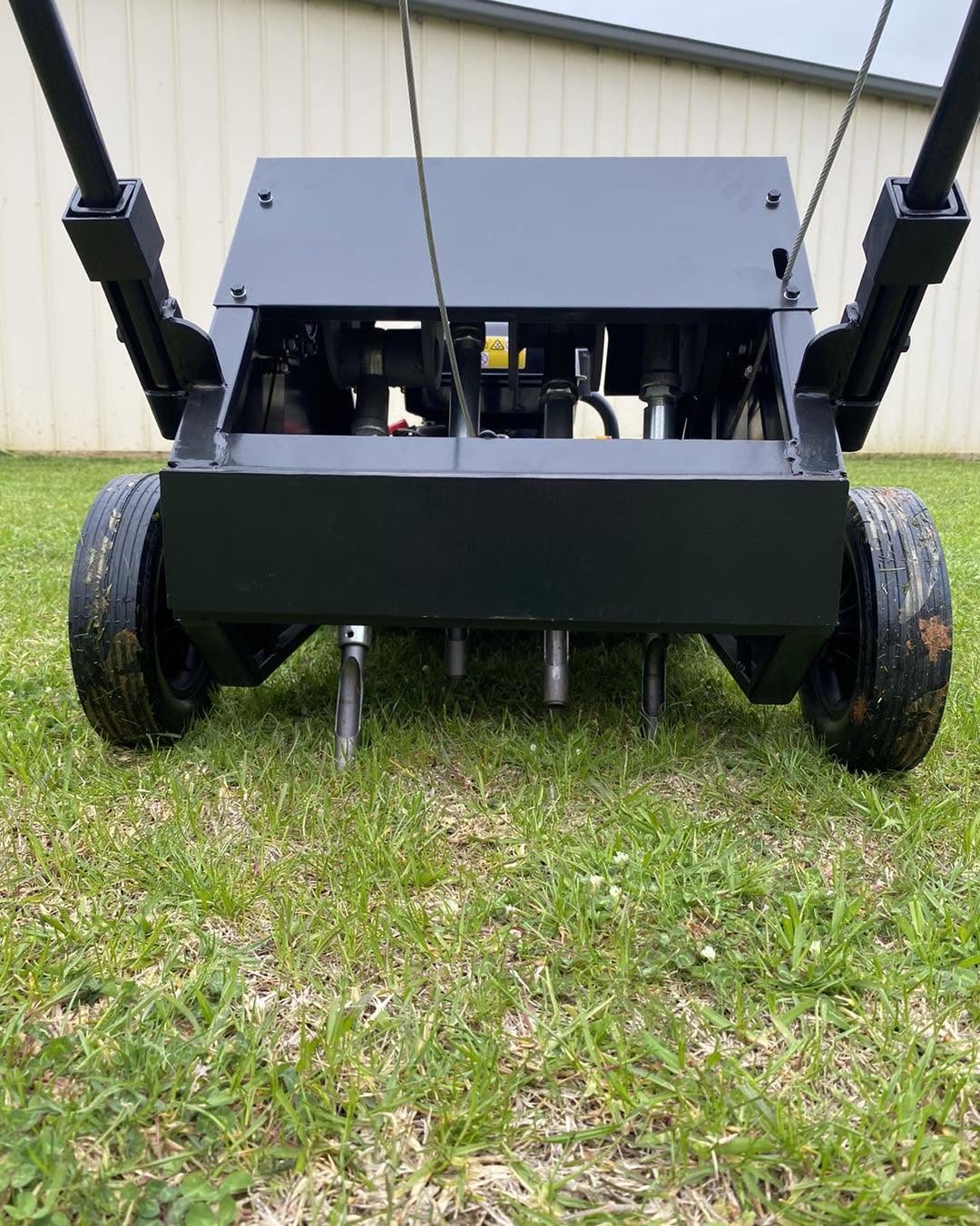
The fix isn’t just one round of aeration. It’s getting the soil genuinely open with core aeration in the right window, and then maintaining that with annual aeration so the compaction doesn’t rebuild. One aeration after years of no aeration improves things — it doesn’t reset the soil to where it should be. That takes a couple of seasons of consistent aeration combined with the other steps below.
2. An Active Grub Problem That’s Never Been Diagnosed
European chafer grubs feed on grass roots underground all fall and winter. The damage reveals itself in spring when sections of lawn lift like carpet and the root system underneath is gone. What’s less obvious is that a grub population doesn’t have to be severe enough to cause visible lifting to cause the recovery failure pattern.
A moderate grub population — below the threshold where you’d notice sections lifting, but above the threshold where it has no impact — can thin a lawn’s root system enough that it’s chronically weak, consistently fails under summer stress, and never builds the density to be resilient going into the following winter. You seed in spring, the grass comes in, and by August the shallow-rooted grass that’s also fighting root damage from a moderate grub population has given most of the ground it gained back.
If your lawn fits the recovery failure pattern and you’ve never specifically checked for grubs, that’s worth doing before the next spring cycle. I’ve written about what grub damage looks like and how to check for it — the probe and pull test I describe there is something any homeowner can do. If you find more than five grubs per square foot in the struggling sections, grubs are part of your story and nematode treatment needs to be part of the plan before the surface repair will hold.
3. Soil Depth That’s Simply Too Thin to Support a Healthy Root System
This one is specific to Sudbury in a way that doesn’t apply to most of Ontario. On properties where bedrock or dense glacial till is close to the surface — sometimes only 3 or 4 inches down — grass simply can’t develop a root system deep enough to be resilient. The roots hit the hard layer and stop. The grass grows on top of an essentially shallow tray of soil, and every time conditions get difficult — heat, drought, disease pressure — it fails, because there’s nowhere for the roots to go.
Seeding or sodding on top of insufficient soil depth produces results that look fine for a few weeks and then decline. The grass doesn’t have the root volume to sustain itself through stress. The cycle continues regardless of what you apply to the surface.
This cause requires a different kind of intervention: bringing in additional topsoil to increase the depth available to roots before any repair seeding or sod goes down. It’s more involved than aeration and overseeding, but on properties where thin soil is genuinely the limiting factor, it’s the only thing that will break the cycle. I probe for soil depth as part of any persistent problem area assessment — it’s one of the first things I check when a lawn’s recovery failure doesn’t have an obvious surface explanation.
4. Drainage Problems That Keep the Root Zone Wet or Dry at the Wrong Times
A lawn with persistent drainage problems — whether that means water pooling in low spots, water running off too fast on a slope, or subsurface drainage along the bedrock that concentrates moisture in specific sections — will have sections that are always too wet or always too dry, and grass doesn’t thrive in either condition long-term.
The key sign of a drainage-related recovery failure is that the struggling sections always correspond to the same areas — not random patches, but consistently the low spots, the base of a slope, or the area near a rock outcrop where subsurface water exits. That geographic consistency is the clue. Random patchy recovery failure is usually compaction or grubs. Consistent location-specific recovery failure that matches a topographic feature is usually drainage.
This cause also needs a different response: grading work to correct the drainage pattern before surface repair. Seeding or sodding into a section that will continue to have standing water or chronic dryness will produce the same result it always has.
5. Wrong Grass Variety for Sudbury’s Conditions
This one sounds basic, but it comes up more than people expect — especially on properties that were seeded or sodded years ago with whatever was available at the time, or with varieties optimized for warmer climates.
Sudbury’s growing season is shorter than southern Ontario’s. Our winters are harder. Our soil, as I’ve described, is thinner and more challenging. A grass variety that’s marginally adequate in a milder climate will fail repeatedly in our conditions, because the cumulative stress over each winter exceeds what the variety can recover from reliably.
For Sudbury properties, a Kentucky bluegrass and perennial ryegrass blend is what I consistently recommend. Kentucky bluegrass is cold-hardy, spreads by rhizomes, and builds a dense root system given time. Perennial ryegrass germinates fast and fills in quickly. Together they produce a lawn that handles our winters better than fine fescue blends or warm-season varieties that sometimes appear in generic bags from hardware stores.
If you’ve been seeding with a generic “sun and shade” mix or whatever was on sale, the variety itself may be part of why the lawn doesn’t sustain its recovery. Switching to a quality northern mix makes a real difference over two or three seasons.
What You Can Still Do Before September
Here’s why I’m writing this in June rather than March, when most lawn advice articles about spring recovery come out: June, July, and August are actually critical windows for addressing the underlying causes of recovery failure, not just the spring symptoms. And September is the last real opportunity to do meaningful repair work before the growing season closes.
Here’s what’s available to you right now, before September.
Grub Diagnosis and Nematode Treatment
If grubs are part of your problem, the time to do the nematode treatment is late July to mid-August — when the new generation of grubs is young, small, and close to the surface. That’s the window where nematodes are most effective. Waiting until spring to deal with grubs means the damage from next winter’s grub generation has already happened by the time you’re thinking about it.
If you haven’t checked for grubs yet this season, do it now. Pull back sections in the struggling areas and count. If you find populations above five per square foot, call me and let’s get the nematode treatment scheduled for late July or August — that’s the intervention that actually breaks the cycle rather than just treating the surface damage after the fact.
Soil Depth Assessment
If you’ve been dealing with recovery failure in specific sections and you’ve never had someone probe the soil depth in those sections, that’s worth doing before you invest in another round of sod or seeding. I can do this on a property walk — it takes minutes and tells you whether thin soil is a factor. If it is, adding topsoil before September gives you the option of doing a meaningful repair in early September rather than waiting until spring.
Drainage Work
Summer is actually a better time for grading and drainage work than spring — the soil is drier, the ground is more workable, and you can see the drainage patterns clearly in how the lawn looks after rain. If chronic wet spots or dry spots are contributing to your recovery failure, addressing the grade this summer sets up a fall repair or spring repair to actually hold.
Preparing for Early September Overseeding or Sod
Early September — the first two weeks — is one of the best times to overseed or install sod in Sudbury. Soil temperatures are warm enough for strong germination and rooting, air temperatures are cooler and more forgiving, and you have six to eight weeks before the ground freezes for the repair to establish.
But that September window only works if the underlying causes have been addressed first. Overseeding in September into soil that’s compacted, has an active grub problem, or has insufficient depth will produce the same recovery failure pattern in spring. The September window is only valuable if it’s the final step of addressing the actual causes, not another round of surface treatment over unresolved underlying issues.
I’ve written about what the August and September sod windows look like in detail — if sod replacement is part of the plan, that article walks through the timing decision and what to expect from each.
The September Window — Last Chance Before Winter

I want to be direct about the timeline here, because I think it helps people take action rather than letting the season slip past again.
The meaningful repair windows before the Sudbury winter are:
- Now through late July: Grub diagnosis and scheduling nematode treatment. Soil depth assessment. Drainage and grading work. Identifying which of the five causes above apply to your property.
- Late July to mid-August: Nematode treatment if grubs were confirmed. Any topsoil or grading work that needs to happen before fall repair. Fall aeration if appropriate — mid-September is the latest I’d recommend for Sudbury.
- First two weeks of September: Overseeding or sod installation, after all underlying causes have been addressed. This is the window. After mid-September, the rooting window for new seed and sod in Sudbury narrows significantly.
- Late September through October: The fall prep and cleanup sequence — final mow height, leaf removal, fall fertilizer. Protecting what’s been done rather than adding new repairs.
If you’re reading this in June or July and you’ve been in the recovery failure cycle for more than one spring, you have time right now to do the diagnostic and preparatory work that makes September repair actually hold. That’s the sequence that breaks the cycle — not more surface treatment on top of unresolved underlying problems.
If You Want Help Figuring Out Which Cause Applies
The hardest part of the recovery failure situation is usually the diagnosis — figuring out which of the five causes above, or which combination of them, is actually driving the pattern on your specific property. Surface symptoms often look similar regardless of the underlying cause, which is why the same spring treatment keeps not working.
I’m happy to come out and walk the property with you, do the soil probe, look at the drainage patterns, check for grubs, and give you an honest assessment of what’s actually going on. That conversation is free and it changes everything about how the repair gets planned — whether it’s a simple aeration and overseed in September, a sod replacement, topsoil addition, nematode treatment, or some combination.
For everything we do across the service range — from diagnosis through repair through ongoing maintenance — the complete service breakdown covers it in one place.
Call or text: 705-507-6787
Or fill out the free quote form on the site.
We cover Garson, Val Caron, Hanmer, Lively, Chelmsford, Azilda, Capreol, and surrounding areas.
— Ryan Lingenfelter
Cutting Edge Lawn & Landscaping
Garson, Ontario
705-507-6787
