

It sounds simple. But the honest answer is that “landscaping” means something different depending on who you ask and what city you’re in. In Sudbury especially, the work that matters most is shaped by our climate, our soil, our shorter growing season, and the specific things that go wrong on properties up here that don’t go wrong the same way further south.
So this is my attempt to answer that question properly — not with a vague list of services, but with a real breakdown of what each service actually involves, when it makes sense, and what you should expect from it. Written from the perspective of someone who’s been doing this work in Greater Sudbury since 2020 and has formed pretty strong opinions about what works and what doesn’t up here.
Lawn Care Services: The Core Work

These are the services that keep a lawn maintained week to week and season to season. They’re not glamorous but they’re the foundation of everything else.
Mowing and Edging
Mowing in Sudbury isn’t just about height. It’s about timing, frequency, and not making the common mistake of cutting too short. I run decks at 3 to 3.5 inches on Sudbury lawns consistently. Taller grass shades the soil surface, retains moisture better through our dry July stretches, and competes more effectively against weeds. Homeowners who scalp their lawns short because it looks cleaner are creating more work for themselves — faster weed establishment, more stress during heat, and a weaker root system heading into fall.
Edging along driveways, walkways, and beds makes a significant difference in how a property looks and keeps turf from creeping into areas it doesn’t belong. It takes time to do right. When it’s skipped or done carelessly, you can always tell.
Core Aeration
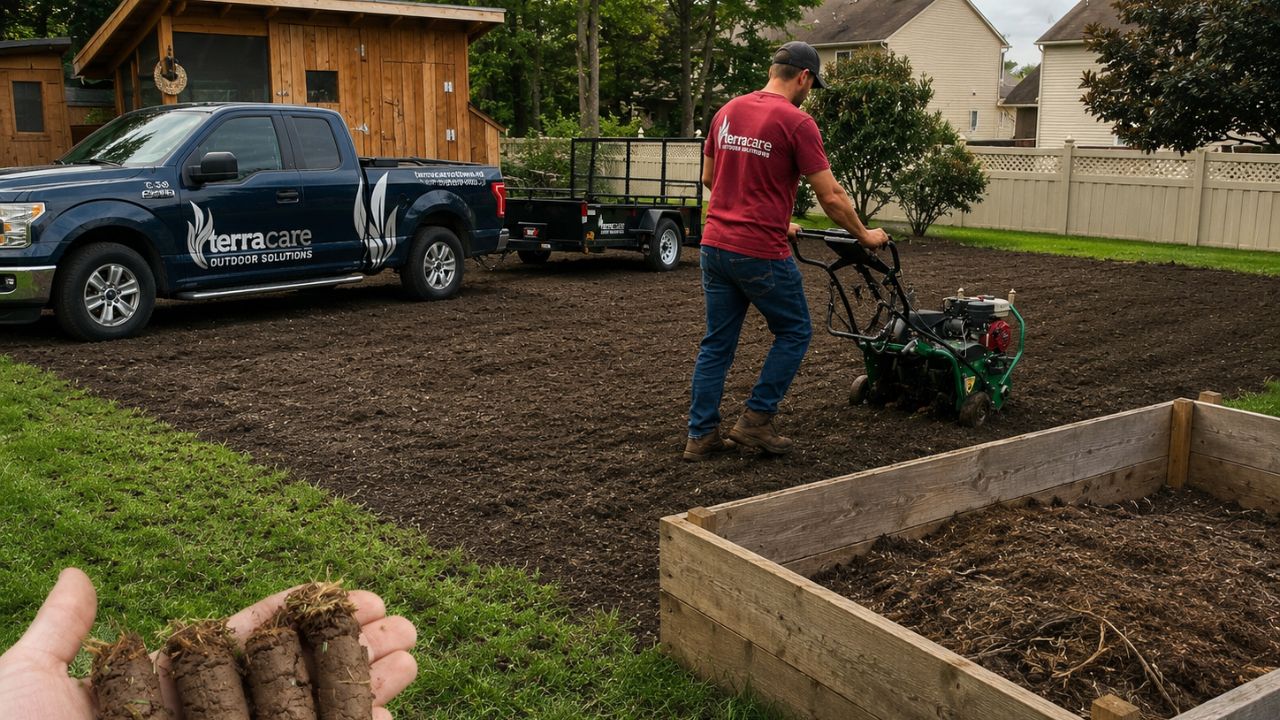
This is the most important single service I offer for established lawns in Sudbury, and it’s the one most homeowners either skip entirely or do at the wrong time. After a Sudbury winter, soil is compacted. Compacted soil chokes roots, blocks water penetration, and slows every other recovery and maintenance effort you make.
Core aeration in the last week of May through the second week of June is the window I’ve found produces the best results on Sudbury properties consistently. I wrote a full breakdown of why that specific window matters up here — the short version is that the soil has firmed up from snowmelt but hasn’t dried out, ground temperatures are rising, and the grass is actively growing and will fill in the aeration holes quickly. Miss the window and you get a fraction of the benefit.
I recommend aeration on most Sudbury properties every year. On properties with heavy clay content, high foot traffic, or a history of compaction issues, it’s not optional — it’s the difference between a lawn that performs and one that struggles regardless of what else you do to it.
Overseeding
Overseeding is almost always paired with aeration on Sudbury properties, and for good reason. The aeration holes are the best seed bed your lawn will ever have — direct soil contact, moisture, and warmth in the same hole. Germination rates in aeration holes are significantly higher than surface seeding on undisturbed soil.
For Sudbury conditions I use a Kentucky bluegrass and perennial ryegrass blend. The bluegrass spreads by rhizomes and fills in bare patches over time. The ryegrass germinates fast and gives you visible coverage quickly. Together they produce a lawn that establishes well in our shorter growing season and handles Sudbury winters better than single-variety seeding.
Fertilization
Timing matters as much as product choice. Spring fertilization after aeration — when the soil channels are open and the grass is actively growing — delivers nutrients to the root zone efficiently. Summer fertilization during heat stress does more harm than good on most Sudbury lawns. Fall fertilization in September builds root reserves heading into winter and is often the most valuable application of the year.
I use slow-release products for the spring and fall applications. Slow-release fertilizer feeds the lawn steadily over weeks rather than spiking growth and then dropping off, which stresses the grass and increases disease susceptibility.
Sod and Seeding: When the Lawn Needs to Start Over

Not every struggling lawn needs to start over. But some do, and knowing the difference early saves a full season of wasted effort.
Sod Installation
Full sod installation is the right call when more than 50 to 60 percent of the lawn is dead, when grub damage has destroyed the root system across large sections, when the grade needs to be corrected and a fresh start makes more sense than trying to repair over a drainage problem, or when the timeline matters — when you need the lawn looking established in weeks rather than a full growing season.
I wrote a complete walkthrough of what a sod installation day actually looks like on a Sudbury property — from soil prep through laying through rolling through the watering schedule I give every customer. If you’re considering sod, that article will tell you exactly what to expect. The short version: soil preparation is what makes a sod job hold. Anyone who skips or shortcuts the prep to lower the price is giving you a short-term result.
For properties where the decision between sod and repair isn’t clear, I’ve broken down the replace vs repair decision in detail. The answer depends on how much of the lawn is still viable, what the soil conditions are like, and whether there’s an underlying problem — like grubs or drainage — that needs to be addressed before any surface fix will hold.
Sod Patching
Not every sod job is a full replacement. When specific sections of an otherwise healthy lawn are dead — from grub damage, ice sheeting, desiccation, or physical damage — patching those sections with sod is faster and more reliable than seeding the same areas. The patch fills in immediately instead of going through a full germination and establishment period, and the colour and texture match is better than seeded areas during the first season.
Patches need the same soil prep as a full installation — you can’t just drop new sod on top of dead material and expect it to root. The affected area needs to be cleared, the soil loosened and amended if needed, and the new piece laid flush and rolled into firm contact. Done right, a patched area is invisible by midsummer.
Seeding and Lawn Renovation
For lawns that are damaged but still have a viable base — more than half the grass alive, soil in workable condition — seeding after aeration is almost always the better call than full sod replacement. It’s less expensive, less disruptive, and on a Sudbury property with reasonable soil, the results in one growing season can be dramatic.
The key variables are timing, seed selection, and soil prep. I’ve written the full step-by-step for this in my article on fixing a Sudbury lawn after a harsh winter — that’s the recovery sequence I use on properties that have significant winter damage but don’t need full replacement.
Property Cleanup: Spring and Fall

Cleanups are the bookends of the Sudbury lawn season. Done properly they set the lawn up for what’s coming. Done poorly or skipped, they create problems that compound through the whole season.
Spring Cleanup
Spring cleanup in Sudbury is more involved than in most Ontario cities because of what our winters leave behind. We’re dealing with snow mould, matted dead grass, debris from freeze-thaw heaving, and sometimes significant branch and material accumulation from snow load on trees.
A proper spring cleanup involves firm raking to break up matted sections and remove thatch buildup — not a gentle pass with a leaf rake, but a real raking that clears the debris layer and allows air and moisture to reach the soil. Debris gets bagged and removed. Beds get cleaned out. Edges get re-defined where winter has blurred them.
Spring cleanup is also when I do the initial assessment of winter damage — walking the property to identify what type of damage is present and what the response should be. The cleanup and the assessment happen at the same time because you can’t properly assess a lawn through a layer of matted dead grass and winter debris.
Fall Cleanup
Fall cleanup timing matters in Sudbury. Too early and you’re cleaning up before the leaves are fully down and you’re doing the job twice. Too late and the leaves have been matting on the lawn through freeze-thaw cycles and you’ve got a smothering problem heading into winter.
The goal in fall cleanup is to go into winter with a clean surface — leaves removed, debris cleared, edges tidy. Leaving a thick layer of leaves on a Sudbury lawn over winter creates ideal conditions for snow mould development and matting that makes spring recovery slower.
Fall is also the best time to apply a final fertilizer if you’re doing annual fertilization. The lawn is still actively growing at the root level even after the blades have stopped. A fall fertilizer application builds carbohydrate reserves in the roots that help the lawn survive winter stress and green up faster in spring.
Hedge Trimming and Shrub Maintenance
Hedge trimming is straightforward service but timing and technique matter more than most people realize.
In Sudbury’s climate, the timing of the last trim of the season is important. Trimming too late in fall — after mid-September in most years — stimulates new growth that doesn’t have time to harden off before frost. That tender new growth gets winter-killed, leaving the hedge damaged and ragged heading into the following spring. I do a final trim in late August to early September and leave the hedges alone after that.
For overgrown hedges that have gotten significantly out of shape over several years, a hard rejuvenation cut is sometimes needed. This means cutting back much further than a normal maintenance trim to reset the shape. Most hedges common in Greater Sudbury — cedars, spirea, lilac — handle rejuvenation cuts well in early spring before new growth starts. Done in the right season, a hard cut produces a much cleaner result over the following two years than continued light trimming of an overgrown plant.
Property Services: The Work That Doesn’t Fit a Simple Category
There are a number of jobs I do that homeowners often don’t know to ask about because they don’t know they fall under landscaping services.
Topsoil Supply and Grading
Low spots in a yard that pool water, grades that direct water toward foundations, areas where topsoil has eroded or was never adequate to begin with — these are fixable problems. Bringing in topsoil and regrading an area correctly solves drainage issues that no amount of seeding or sodding will fix on their own. If your lawn has the same problem spots year after year regardless of what you do to the surface, grade and drainage is almost certainly part of the reason.
Garden Bed Edging and Maintenance
Crisp, well-defined edges between lawn and beds make a significant difference in how a property looks. I re-cut bed edges with a spade or edging tool — not string trimmer edging, which produces a shallow, easily-lost edge — to create a clean vertical wall between turf and bed. That edge holds its definition for the full season with periodic maintenance passes.
Interlock and Walkway Cleaning
Interlock patios and walkways that have developed moss, settled sections, or weed growth in the joints are a common issue on Sudbury properties. The freeze-thaw cycles here shift interlock faster than in milder climates, and the resulting gaps fill with organic material and weeds quickly. Cleaning, re-sanding joints, and resetting shifted sections restores the appearance and prevents further movement.
How to Know Which Service You Actually Need
The most common situation I encounter is a homeowner who knows something is wrong with their property but isn’t sure what the right response is. Should they aerate? Reseed? Sod? Do a cleanup first? Treat for grubs? Get a new grade?
The answer almost always starts with an honest assessment of what’s actually going on. Not a sales call — an actual walk of the property where I look at the soil, the grass, the drainage, the damage patterns, and tell you what I see.
I’ve written detailed guides on the most common situations I encounter on Sudbury properties:
- If your lawn looks rough after this winter and you’re not sure what type of damage you have: How to read winter lawn damage in Sudbury
- If large sections of your lawn are dead and you’re deciding between repair and replacement: Replace vs repair — how I make that call
- If sections of your lawn lifted like carpet this spring: What grub damage looks like and what to do about it
- If the lawn is damaged but still has a viable base and you want to repair rather than replace: The step-by-step recovery sequence for a Sudbury lawn after winter
- If you’ve decided on sod and want to know what the job involves: What a sod installation day looks like start to finish
If you’ve read through those and you’re still not sure, or if you’d just rather have someone come out and look — that’s what I’m here for. I come out, walk the property with you, and give you a straight assessment. No charge, no pressure, no upsell toward the more expensive option if the cheaper one will get the job done.
Who I Work With and Where
I work with residential homeowners across Greater Sudbury. The bulk of my work is in Garson, Val Caron, Hanmer, and Lively, but I cover the full region including Chelmsford, Azilda, Capreol, and surrounding areas. I’m a one-owner operation — when you call me, you’re talking to the person who will actually show up and do the work, not a dispatcher routing you to a crew you’ve never met.
That matters to me. I’ve built this business on repeat customers and referrals, which means every job I do has my name on it directly. If something isn’t right, I want to know and I’ll come back and fix it. That’s not marketing language — it’s just how a small owner-operated business in Sudbury has to work to stay in business.
If you’re ready to book or you want to talk through what your property needs, call or text me at 705-507-6787, or fill out the free quote form on the site.
— Ryan Lingenfelter
Cutting Edge Lawn & Landscaping
Garson, Ontario
705-507-6787
