
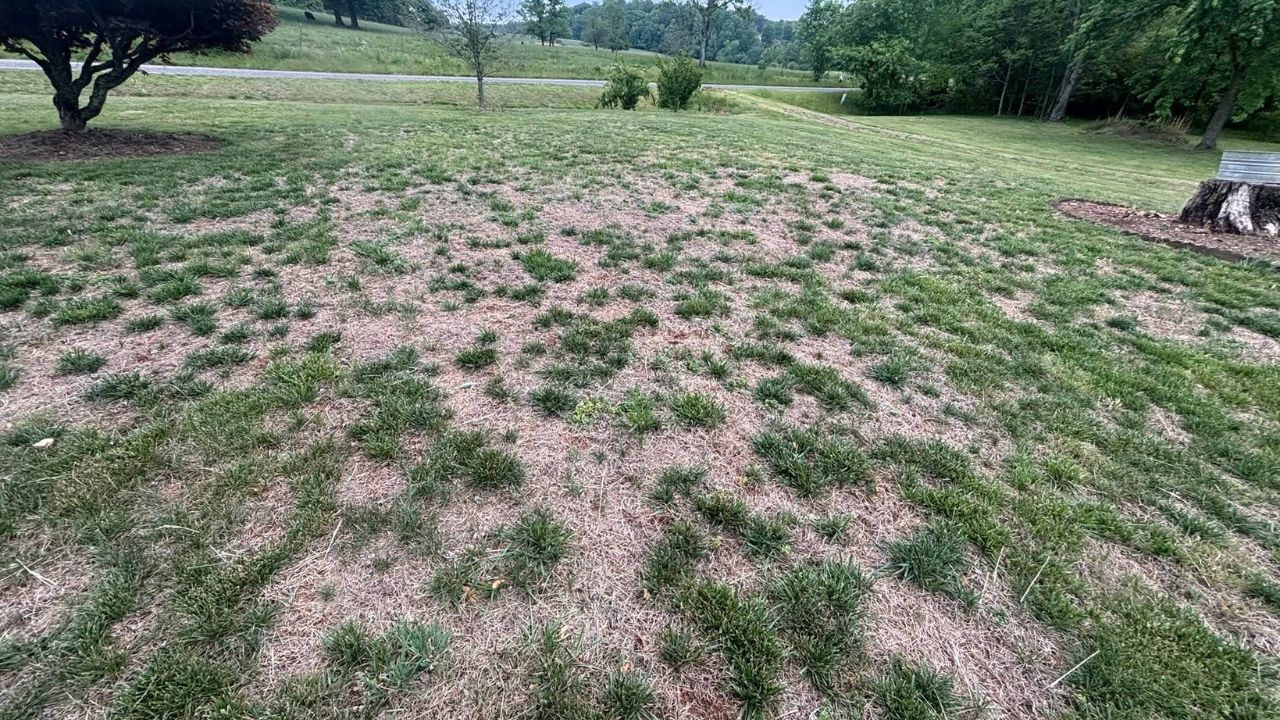
I want to walk you through a specific property because it illustrates something that genuinely surprises people: a lawn can look completely fine for months and then appear to collapse almost overnight. It isn’t actually overnight. The damage has usually been building the whole time, invisibly, until it crosses a threshold and shows up everywhere at once.
This happened on a property in Lively last year. The homeowner, a man named Steve, called me in early August in something close to disbelief. His lawn had looked completely normal in May and June. By the first week of August, roughly half of it was visibly dead — not thin, not stressed, dead.
Nothing about his routine had changed. He’d watered the same way he always had. He’d mowed on the same schedule. From his perspective, the lawn had simply failed without warning.
It hadn’t. I’m Ryan Lingenfelter, owner of Cutting Edge Lawn & Landscaping in Garson, Ontario. Here’s what had actually been happening since May, and why nobody — including Steve — had caught it until it was too late to prevent.
May — What the Lawn Actually Looked Like

When I asked Steve to describe what the lawn had looked like in spring, he was clear: green, even, nothing concerning. He sent me a couple of photos he happened to have taken in late May for an unrelated reason — listing the house for a brief rental, as it turned out, before deciding against it. The photos confirmed what he’d described. A healthy-looking lawn, decent colour, no obvious thin patches.
This is an important detail, because it rules out certain explanations right away. Whatever happened wasn’t a lawn that had been visibly struggling all season and Steve simply hadn’t noticed — the photographic evidence shows genuine health in May. Something changed between then and August, and it changed in a way that wasn’t visible until it reached a tipping point.
This pattern — apparent health followed by sudden, dramatic decline — almost always points toward one of a small number of causes. It’s rarely a soil or watering issue, because those tend to produce gradual decline visible over weeks, not a sudden collapse. Sudden collapse after a period of apparent normalcy points toward something actively progressing beneath the surface that doesn’t show symptoms until the damage reaches a critical mass.
What Was Happening Underneath the Whole Time

When I did the assessment on Steve’s property, the answer became clear quickly. I did the tug test on the dead sections — gently pulling at the dead grass to check root attachment, a diagnostic I’ve described in detail when discussing how to tell dormancy from actual damage. The grass in the dead sections pulled away with almost no resistance, lifting like a loose carpet rather than tearing at the blade the way grass with intact roots does.
That’s the signature of root damage, not heat stress or drought dormancy. And when I looked closely at the soil surface in the affected areas, I found exactly what I suspected: white, C-shaped grub larvae, several per square foot in the worst sections.
Here’s the timeline that explains why this was invisible in May and catastrophic by August. Grub larvae — the immature stage of beetles like the European chafer or June beetle, both present across Greater Sudbury — hatch from eggs laid in early to mid summer and begin feeding on grass roots almost immediately. In May, when Steve’s lawn looked fine, the eggs hadn’t been laid yet or had only just hatched. The grass was still healthy because the damage hadn’t started.
Through June and into July, the larvae fed on the root system continuously, growing larger and consuming more root mass as they developed. During this period, the grass above ground can still look reasonably normal because root damage doesn’t immediately show up as visible decline — the plant draws on whatever reserves it has and continues photosynthesizing with the leaf surface it has left, even as the root system supporting it is being steadily consumed underground.
This is the part that catches people off guard: the lawn isn’t actually fine through June and most of July. It’s failing the entire time. It just isn’t showing it yet, because the visible symptoms of root loss don’t appear until the root damage is severe enough that the plant can no longer support itself — particularly once summer heat increases the plant’s water and nutrient demands beyond what the damaged root system can supply.
That threshold is usually crossed in late July or early August in Sudbury’s climate — right when temperatures peak and the demand on an already-compromised root system becomes more than it can bear. The grass that had been quietly losing its root system for two months suddenly can’t cope with summer heat stress at all, and it dies rapidly, in a way that looks sudden but is actually the visible endpoint of a process that started weeks earlier.
August — When It All Became Visible at Once

By the time Steve called me, the affected areas covered roughly half his backyard — irregular patches, some merging into larger dead zones, with the unaffected sections still reasonably healthy. This pattern, where damage is patchy rather than perfectly uniform, reflects how grubs actually distribute themselves — concentrated in certain areas based on where the adult beetles laid eggs, rather than evenly across the whole property.
Steve had noticed increased bird activity in his backyard through July — crows and starlings pecking at the lawn more than usual — but hadn’t connected it to anything, assuming it was just normal bird behaviour. In retrospect, that bird activity was a meaningful early warning sign. Birds feeding on grub larvae will peck at the turf surface to get at them, and a noticeable increase in that behaviour, especially concentrated in specific areas, is often visible weeks before the grass itself shows any damage.
This is the detail I want to emphasize, because it’s the one piece of this story that could have changed the outcome. The damage wasn’t actually invisible the whole time — there was an observable signal in July, before the grass died, that pointed toward exactly what was happening underground. It just wasn’t a signal most homeowners know to watch for or connect to lawn health.
How to Catch This Before It Looks Like a Crisis

Here’s what I’d recommend watching for, specifically, if you want to catch this kind of hidden root damage before it produces a sudden die-off in August.
Watch for Increased Bird Activity
If crows, starlings, or other birds are spending noticeably more time pecking at specific areas of your lawn through June and July, that’s worth investigating rather than ignoring. It doesn’t automatically mean grubs, but it’s a strong enough signal that a quick check is worthwhile.
Do a Tug Test Periodically Through Summer
Even on a lawn that looks completely healthy, grabbing a small handful of grass in a few different spots and giving it a gentle pull periodically through June and July can catch root damage before it’s visible above ground. Healthy grass with intact roots resists. Grass with grub-damaged roots will pull up easily even while the blades above ground still look green.
Check the Soil Surface Directly
If you’re suspicious about a particular area, pulling back a small section of turf and checking the top inch or two of soil for white, C-shaped grubs gives you a direct answer. A few grubs per square foot is normal and not concerning. Significantly more than that, concentrated in a specific area, indicates a population that’s likely to cause visible damage as the season progresses.
Treat Proactively in Late June Through Mid-July if You’ve Had Grub Problems Before
If a property has a history of grub damage, proactive treatment in the window when larvae are young and most vulnerable — typically late June through mid-July in our climate — is far more effective than treating after damage is already visible. By August, when the damage shows up, the larvae have often matured to a stage where treatment is less effective, and the root damage has already been done regardless of whether the grubs themselves are subsequently eliminated.
What We Did on Steve’s Property
By the time I assessed Steve’s lawn in August, the immediate priority was addressing the active grub population to prevent further spread to the still-healthy sections, followed by repair of the dead areas.
For the dead sections — given the extent of root damage and the size of the affected area — fresh sod was the right call rather than overseeding, similar to the approach I’ve described for other significant restoration situations across Greater Sudbury. Overseeding into soil that may still have an active grub population would risk the same damage happening to the new seedlings before they had a chance to establish.
Steve’s lawn was fully restored by the following spring, and he’s now part of the group of clients who get a mid-summer check specifically aimed at catching this kind of hidden issue before it becomes visible — exactly the kind of proactive monitoring that would have caught his situation in June rather than August.
If Your Lawn Has Been “Fine” All Season — Worth a Second Look
If your lawn looks healthy right now but you’ve noticed unusual bird activity, or you simply want to rule out hidden root damage before it potentially shows up later in the season, a quick assessment now is far more useful than waiting until August to find out something was wrong the whole time.
📞 Call or text me: 705-507-6787
Or fill out the free quote form here — I get back to everyone same day.
— Ryan Lingenfelter
Owner, Cutting Edge Lawn & Landscaping
Garson, Ontario
Related Articles
- Why Your Sudbury Lawn Goes Brown in July — And When to Actually Worry
- I Can Spot a Failing Sudbury Lawn in 10 Seconds — Here’s Exactly What I Look For
- The Sudbury Property That Made Me Call My Supplier and Ask Questions I’d Never Asked Before
- I Replaced a Sudbury Homeowner’s Dead Lawn in 4 Days
- Why I Keep Notes on Every Sudbury Lawn I Work On
- Sod Installation in Greater Sudbury
