

Every July without fail, I get a wave of calls from homeowners across Greater Sudbury who are looking at their lawn and wondering the same thing: is it dead, or is something else going on?
The lawn was green in June. Now it’s brown, or yellowing, or has patches that look completely gone. Nobody touched it differently. Nothing obvious changed. It just happened.
Here’s the good news first: in the majority of cases, a brown Sudbury lawn in July is not dead. There’s a specific reason it looks the way it does, and it has everything to do with how cool-season grass works in our climate. But there are also situations where the browning is a sign of something more serious — and knowing the difference matters, because the response is completely different.
Let me walk you through both.
The Real Reason Most Sudbury Lawns Go Brown in July

Almost every lawn in Greater Sudbury is made up of cool-season grasses — Kentucky bluegrass, fescues, perennial ryegrass. These are the varieties that do well in Ontario’s climate, handle our winters, and green up beautifully in spring and fall.
The catch is that cool-season grass doesn’t love July. When temperatures climb above 28 or 30 degrees and rain gets scarce, cool-season grass has a survival mechanism built in: it goes dormant. Growth slows dramatically or stops. The plant pulls its energy down into the crown — the growing point at the base of each grass blade, just at or below the soil surface — and waits for better conditions.
From above, this looks like the lawn is dying. The blades turn yellow and then brown. The grass stops growing. It feels different underfoot. But underground, the crown is still alive. The root system is intact. The grass is essentially sleeping, not dead.
This is completely normal in Sudbury summers and it happens to healthy, well-maintained lawns just as much as it happens to struggling ones. An established lawn can handle two to four weeks of full dormancy without any permanent damage. When temperatures drop or meaningful rain arrives, the grass comes out of dormancy and greens back up — sometimes within days.
So if your lawn went brown in a dry, hot stretch in July and you haven’t done anything unusual, there’s a very good chance it’s dormant and not dead. The question is how to tell the difference — and that’s where the next section matters.
The 3 Signs Your Lawn Is Actually in Trouble

Dormancy looks like browning. Real damage also looks like browning. Here’s how to tell them apart.
Sign 1 — The tug test fails. Grab a small handful of the brown grass and pull gently upward. Dormant grass holds — the roots are still anchored in the soil even though the blades look dead. Grass that has genuinely died and lost root contact comes out of the ground easily, almost like lifting a mat off a table. If it pulls up with almost no resistance across multiple spots, you’re not looking at dormancy — you’re looking at dead grass that needs to be replaced.
Sign 2 — The browning doesn’t follow the weather pattern. Dormancy browning tends to be fairly uniform across a lawn or concentrated in the driest, most exposed spots — south-facing slopes, areas near pavement that absorbs heat, sections with no shade. If the browning is irregular — random patches scattered across an otherwise reasonable lawn, or concentrated in areas that shouldn’t be the first to dry out — something else is going on. Grubs eating the root system from below, fungal disease, and localized soil problems all create this kind of irregular brown patterning that doesn’t match what drought stress alone would cause.
Sign 3 — It doesn’t recover when conditions improve. After a dry, hot stretch ends — rain returns, temperatures drop — dormant grass should start showing green within one to two weeks. If your lawn stayed brown after the heat broke and after meaningful rain came, the grass didn’t come back from dormancy. That’s a sign the crowns didn’t survive or there’s an underlying problem that’s preventing recovery. At that point, you’re looking at sections that need to be replaced rather than just rested.
If none of those three signs apply — the grass holds when you tug it, the browning follows the drought pattern, and it greens back up when conditions improve — your lawn is dormant and doing exactly what it should be doing. Leave it alone, water if you can, and let it rest.
What Makes Some Sudbury Lawns Go Brown Faster Than Others

Not all Sudbury lawns go brown at the same rate in July. Some hold their colour well into a dry stretch. Others go yellow within days of rain stopping. That difference isn’t random — it comes down to a few specific things.
Root depth. Grass with deep roots can access moisture further down in the soil profile long after the surface has dried out. Grass with shallow roots runs out of accessible moisture fast. Root depth is largely determined by how the lawn has been cared for — specifically whether the soil has been aerated, whether watering has been deep and infrequent rather than shallow and frequent, and whether the grass has been cut at the right height. A lawn on compacted soil that’s been cut short all season has shallow roots and will go dormant faster and more severely than a lawn that’s been properly cared for.
Soil quality and compaction. Core aeration is the most direct way to address compaction and give roots a path to grow deeper. Lawns that have been aerated regularly handle summer stress dramatically better than those that haven’t. The soil holds moisture longer, roots go deeper, and the lawn has reserves to draw on before it tips into dormancy. I’ve seen side-by-side comparisons on the same street in Hanmer and Chelmsford where one property gets aerated every spring and the neighbour’s doesn’t — come mid-July, the difference is obvious.
Cut height. Grass cut at two inches or below has almost no shade over the soil surface. The soil bakes, moisture evaporates fast, and the grass goes dormant — or dies — much sooner than grass kept at three inches or above. Raising your grass cutting height is one of the most straightforward things you can do to slow down summer browning, and it costs nothing.
What to Do — Depending on What You’re Actually Dealing With
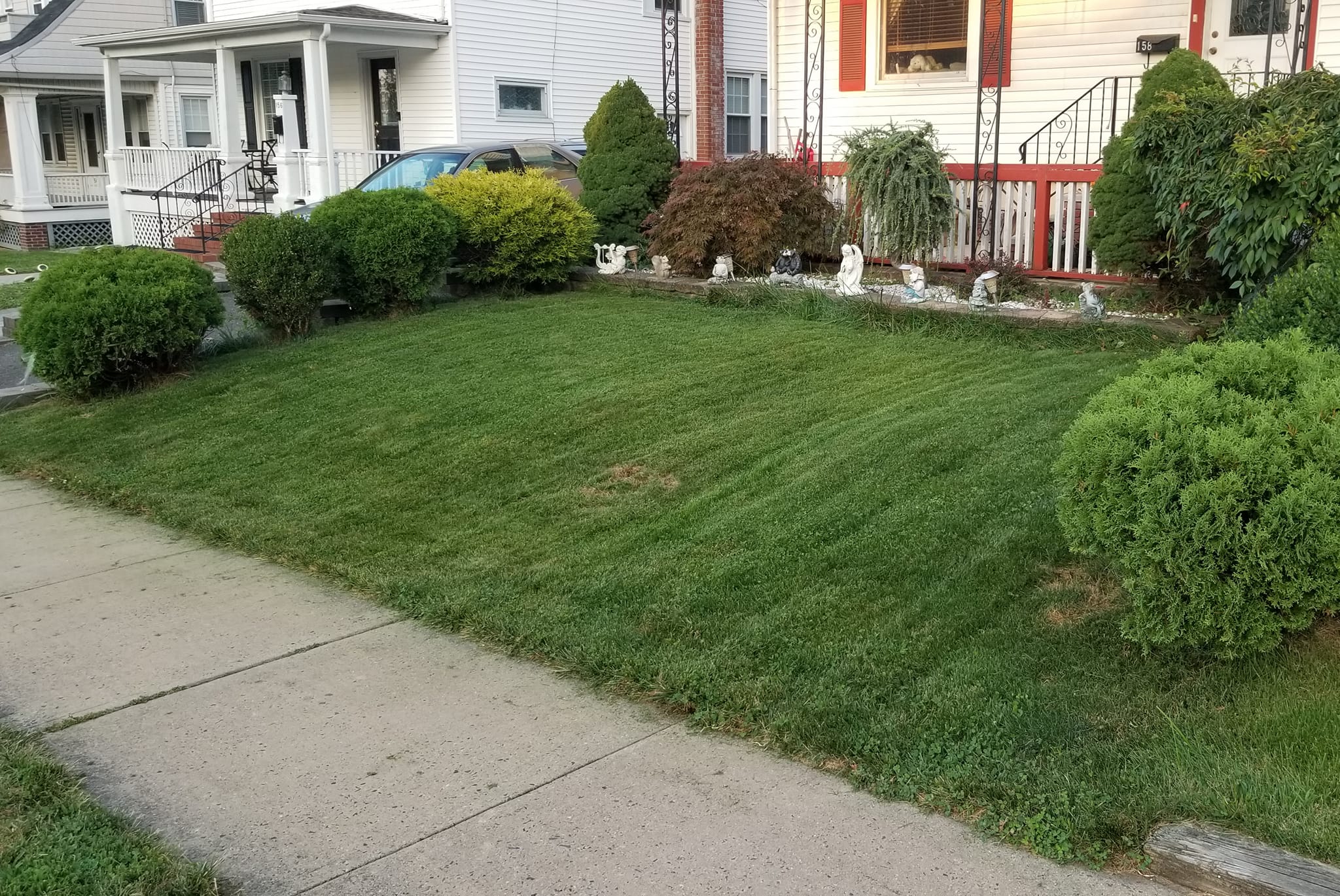
Once you’ve figured out whether you’re looking at dormancy or actual damage, the response is different.
If it’s dormancy: The most important thing is to not panic and not do anything that adds stress. Don’t mow it. Don’t fertilize it — fertilizing a dormant lawn pushes it to try to grow when it doesn’t have the resources, which can kill the crowns. If you have the ability to water, do it deeply — enough to soak 4 to 5 inches into the soil — a couple of times a week. If you can’t water, just leave it. Nature will handle the recovery when rain returns. It almost always does.
If there’s actual damage: Figure out the cause before you start repairing. Random patches that pull up easily with dead roots underneath — check for grubs by digging down a few inches and looking for white C-shaped larvae. Irregular browning with a fuzzy or matted appearance — that’s often fungal disease, which needs to be treated before overseeding makes any sense. Once the cause is addressed, bare sections can be overseeded in late August or early September when conditions are better for germination, or sodded if the damage is extensive enough to warrant it.
Either way — fall is when you fix the underlying problem. Whether your lawn came through July in decent shape or took a beating, September is the time to address whatever allowed the stress to hit as hard as it did. Aeration, overseeding, topdressing — done in fall, these set the lawn up to handle the following summer differently. The work that protects a Sudbury lawn through July happens in September and October, not the following June when it’s already too late.
If you’re not sure what category your lawn is in right now, I’m happy to come take a look and give you a straight answer. No pressure, no upsell — just an honest assessment of what you’re dealing with and what makes sense to do about it.
— Ryan Lingenfelter
Cutting Edge Lawn & Landscaping, Garson, Ontario
📞 705-507-6787
Serving all of Greater Sudbury — Garson, Hanmer, Val Caron, Lively, Chelmsford, Azilda, Capreol, and Sudbury proper. We offer core aeration, grass cutting, sod installation, and full lawn maintenance. Free quotes, no pressure.
Get a Free Quote |
Call 705-507-6787
