
I’ve been doing this work long enough that I know what a certain kind of phone call sounds like before it even starts.
There’s a specific tone people use when they’re embarrassed about their property. They talk faster than they need to. They over-explain. They apologize before I’ve seen anything. They say things like “I know it’s bad” or “I don’t even know where to start” or “I’ve just let it go.”
When Linda called me last summer, she hit every one of those notes within the first thirty seconds.
She had a property in Hanmer. She’d been there twelve years. The lawn had never been great but it had gotten progressively worse over the past few, and this spring it had crossed the line from embarrassing to genuinely bad. She’d been avoiding having people over. She’d stopped sitting outside. She’d driven past her own house a few times and felt the particular kind of low-grade shame that comes from something you can see every day but feel powerless to fix.
She booked a site visit and then called back an hour later to warn me about how bad it was. “I just want you to know what you’re walking into,” she said.
I told her it was fine. I’d seen worse. I’d see it when I got there.
When I arrived and knocked on the door, she opened it and said, before I’d even introduced myself properly: “I’m sorry.”
I told her she had nothing to be sorry about. And I meant it.
The Call — What She Said on the Phone

On the phone, Linda had described the situation as best she could. The front lawn was thin and weedy — more weeds than grass at this point, she said. The backyard was worse. There was one section near the back fence that she described as “basically just dirt and sticks.” The grass that remained was patchy and uneven.
She told me she’d tried a few things over the years. Bag of seed here, bag of fertilizer there. A company had come out two years ago and done what she thought was a cleanup but she couldn’t really tell what they’d actually done and nothing had improved afterward. She’d stopped trying because nothing seemed to work and she didn’t want to keep spending money on things that didn’t help.
That last part is the thing I hear most often from homeowners in her situation. Not laziness — the opposite. They’ve tried. Multiple times. With actual money and actual effort. And nothing has worked. And at some point the combination of effort, money, and continued disappointment adds up to just giving up.
I asked her a few questions. How old was the house? Built in the late nineties. Had the lawn ever looked good in the twelve years she’d been there? She thought about it and said it had looked okay the first year or two, then started declining. Any idea why it had declined? She didn’t know. Had she ever had aeration done? She didn’t think so — she wasn’t completely sure what aeration was.
That told me quite a bit before I’d seen anything.
What I Actually Found When I Got There

The property was a standard Hanmer residential lot — probably 1,500 square feet of lawn across front and back combined. Linda had not been exaggerating. The front was about 60 percent weeds — plantain, creeping charlie, dandelion — with thin, struggling grass filling in the gaps. The backyard was worse, with large bare sections and the section near the back fence she’d described as dirt and sticks living up to that description exactly.
But here’s the thing I want to say clearly: it wasn’t shocking to me. I’ve seen worse. A lot worse. And more importantly, I could see from the moment I walked the property that there were specific, identifiable reasons why it looked the way it did — and that those reasons were all fixable.
The screwdriver test told me the first story. I pushed it into the soil in the front lawn — nearly impossible. The soil was compacted to the point of near-concrete density. In the backyard, same result. Years without aeration on Hanmer’s clay-heavy soil had sealed the surface completely. Water was running off rather than in. Roots couldn’t penetrate. Air couldn’t circulate. Any seed that had been thrown down over the years had tried to germinate in the top half inch of compacted soil and failed.
The thatch was the second story. About three quarters of an inch to an inch throughout — thick enough to act as a barrier between seed and soil. The company that had come out two years ago had apparently done some surface work but hadn’t dethatched, which meant anything they’d done afterward had sat on top of the thatch and achieved nothing.
The back fence section was the third story. Water from the neighbour’s property was running onto Linda’s yard and pooling in that corner. Had been doing it for years. The soil there was waterlogged, compacted, and completely airless. Nothing was ever going to grow there without fixing that drainage issue first.
I walked back to where Linda was standing at the edge of the patio, watching me with the look of someone bracing for bad news.
I told her: everything I’m seeing has a reason. And every reason is fixable. This is going to look completely different.
She asked me if I was serious.
I told her I was.
What We Did — and Why We Did It in That Order

Sequence matters on a restoration job. Doing things in the wrong order wastes time and money. Here’s exactly what we did and why we did it the way we did.
First: The Drainage Problem
Before touching the lawn surface, we fixed the back corner drainage. We regraded the area — built it up with quality topsoil and directed the slope away from the fence corner so water would drain toward the property edge rather than pooling. We also extended the runoff path slightly along the fence line so it could exit the property cleanly.
This had to happen first. There was no point doing any lawn work in that corner until the water problem was solved. Anything we laid over a drainage failure would fail again.
Second: Full Surface Removal
With the drainage sorted, we stripped both the front and back lawns completely. Sod cutter across the entire area. Everything came off — dead grass, thatch mat, the weeds, all of it. Hauled away.
Some people ask about just overseeding into existing thin lawn rather than doing a full removal. On a property like Linda’s — where the thatch was thick, the soil was severely compacted, and the weed coverage was over 50 percent — overseeding doesn’t work. You’re putting seed into conditions that have already demonstrated they can’t support grass. Full removal and starting clean is the right call.
Third: Soil Rehabilitation
We tilled the entire area four to six inches deep. Two passes in different directions. Breaking up compaction that had built up over a decade without aeration takes real mechanical force — a single pass doesn’t get all of it.
Then a layer of quality topsoil worked in across the whole area. Better organic content, better drainage, better structure than the straight clay underneath.
Starter fertilizer incorporated into the top layer before anything went down.
Fourth: Sod Installation
Fresh sod delivered same morning and laid immediately. Front and back — the whole property in one day.
Staggered joints throughout. Tight seams. Extra care around the graded back corner to make sure the sod followed the new contour cleanly with no bridges or gaps. Rolled after installation.
The whole job was two days — one day for drainage, removal, and soil prep, one day for sod installation.
When Linda came home after day two, I was just finishing the cleanup. She stood at the end of her driveway and looked at the front lawn for a long moment without saying anything.
Then she said: “That’s my house?”
I told her it was.
What Her Lawn Looks Like Now

Linda followed the watering schedule carefully — twice daily for the first week, once daily for weeks two and three. The sod rooted in well. By week four she was sending me photos of the back corner — the one that had been “dirt and sticks” — with grass growing in it properly for the first time since she’d moved into the house.
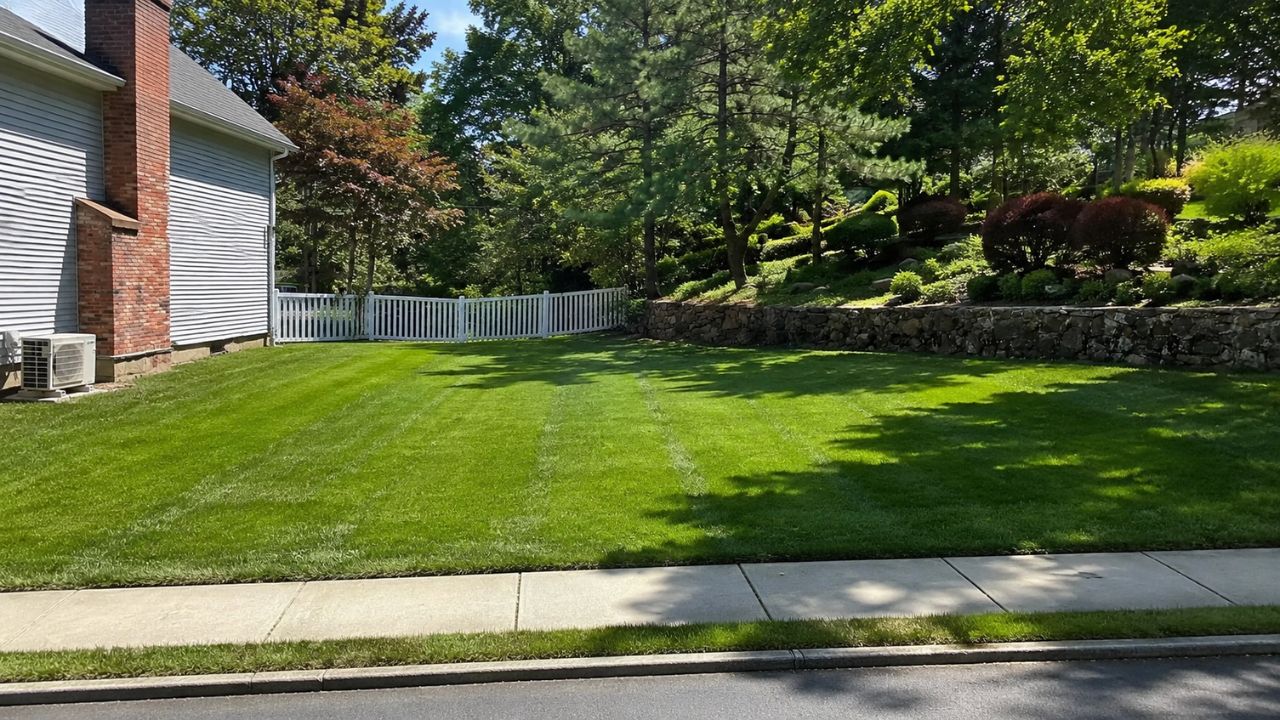
She texted me in August to say she’d had people over for the first time in years. She’d been sitting outside in the evenings. The lawn that had made her feel low every time she drove past her own house was now the thing she noticed first and felt good about.
I think about that a lot when I’m on quote calls with homeowners who are embarrassed about their properties. The embarrassment is real. The sense of helplessness that builds up after trying things that don’t work is real. But in almost every case I’ve seen — and I’ve seen a lot of them — the situation is more fixable than the homeowner believes by the time they finally call someone.
The lawn doesn’t care how long it’s been neglected. It responds to the right treatment regardless of history. What matters is diagnosing the actual problem and addressing it properly — not just treating the surface and hoping for the best.
Why Lawns Get to This Point — And Why It’s Not Your Fault
I want to say something directly to anyone reading this who recognizes themselves in Linda’s situation.
Lawns deteriorate for reasons that aren’t obvious from the surface. Soil compaction builds invisibly over years. Thatch accumulates slowly. Drainage problems develop gradually. None of these things announce themselves — they just quietly make it harder and harder for grass to grow until one year you look at your lawn and it looks like it’s given up.
The homeowner who’s been throwing seed at a compacted, thatchy lawn for five years isn’t doing anything wrong. They just don’t have the information to know that the seed isn’t the problem. The soil is.
That’s not a failure of effort. It’s a lack of diagnosis. And that’s exactly what a proper site visit is for.
If your lawn has gotten to a point where you’re embarrassed about it — or where you’ve stopped trying because nothing works — reach out. I’ll come out, tell you exactly what’s actually going on, and give you a clear picture of what a real fix would involve. No judgment. No upselling. Just a straight answer.
📞 Call or text me: 705-507-6787
Or fill out the free quote form here — I get back to everyone same day.
— Ryan Lingenfelter
Owner, Cutting Edge Lawn & Landscaping
Garson, Ontario
Related Articles
- The Worst Lawn I’ve Ever Seen in Greater Sudbury — And What It Took to Fix It
- A Sudbury Client Wanted Turf — Here’s What We Did Instead
- I Said No to a Lawn Job in Val Caron — Six Weeks Later They Called Me Back
- Sod Installation in Greater Sudbury
- Core Aeration Services in Sudbury
