
May is when I get a particular type of call that I’ve come to recognize immediately.
The caller has just bought their first house. They’ve moved in sometime in the fall or winter, so this is their first real spring at the property. The snow has melted, they’ve walked outside to look at the lawn for the first time as homeowners, and what they’ve seen has alarmed them.
The tone on the phone is a specific kind of overwhelmed — not the overwhelmed of someone whose lawn has been declining for years and they’ve been watching it happen. The overwhelmed of someone who has no frame of reference, doesn’t know what’s normal and what isn’t, and is suddenly responsible for something they’ve never managed before.
The call I want to tell you about came from a woman named Priya. She’d bought a house in Lively in October of last year — her first home, bought with her partner. She called me on the second Saturday of May, speaking quickly, with that particular energy of someone who has been worrying about something for a few days and has finally decided to do something about it.
I’m Ryan Lingenfelter, owner of Cutting Edge Lawn & Landscaping in Garson, Ontario. Here’s exactly what happened and — more importantly — what I told her, because I think it’s useful for any new homeowner in Greater Sudbury facing their first lawn season.
The Call — What She Was Panicking About

Priya described what she was seeing in quick, slightly breathless detail.
The backyard had patches — some areas looked okay, some areas looked thin and brown, one section near the back fence looked like it had almost no grass at all. The front was better but uneven. There were some circular greyish patches she didn’t recognize scattered across both lawns — she’d looked them up and thought they might be some kind of disease. The previous owners hadn’t left any information about the lawn’s maintenance history.
She and her partner had been planning to have people over in July for a housewarming. She was worried the lawn wasn’t going to be ready. She was worried she’d already done something wrong even though she hadn’t touched it yet. She wanted to know if the lawn was salvageable and what she needed to do immediately.
I let her finish, then asked a few clarifying questions.
How long had she been at the property? Since October — so this was genuinely her first spring there. Had she done anything to the lawn yet? No, nothing. Did she know if the previous owners had done any lawn maintenance — aeration, fertilizing, anything like that? She had no idea. The circular patches — what colour were they? Greyish, she said. The grass in them was matted and flat.
The circular patches were almost certainly snow mould — which I’ve covered in detail in snow mould in Sudbury — what it is and whether to worry. Very common in Greater Sudbury after winter, alarming to look at, usually much less serious than it appears. Not what I’d be most concerned about on this property.
What I was more concerned about was everything she hadn’t mentioned: the soil condition, the maintenance history, the drainage. The visible things — the patches, the thin areas — are almost always symptoms. The cause is usually underground.
I told her I’d come out the next morning.
What I Actually Found When I Got There

Priya met me at the front door and walked the property with me. She was visibly relieved that I was there — that particular relief of someone who has been alone with a problem and has finally gotten someone in front of it with them.
I walked the front lawn first, then the back.
The snow mould patches she’d been worried about were exactly what I’d expected — grey snow mould, moderate severity, covering maybe 15 to 20 percent of the total lawn area. Not catastrophic. The kind that responds well to raking and basic spring care. I’ve seen much worse on properties that have been deliberately maintained for years.
But the snow mould wasn’t the real story. The real story was the soil.
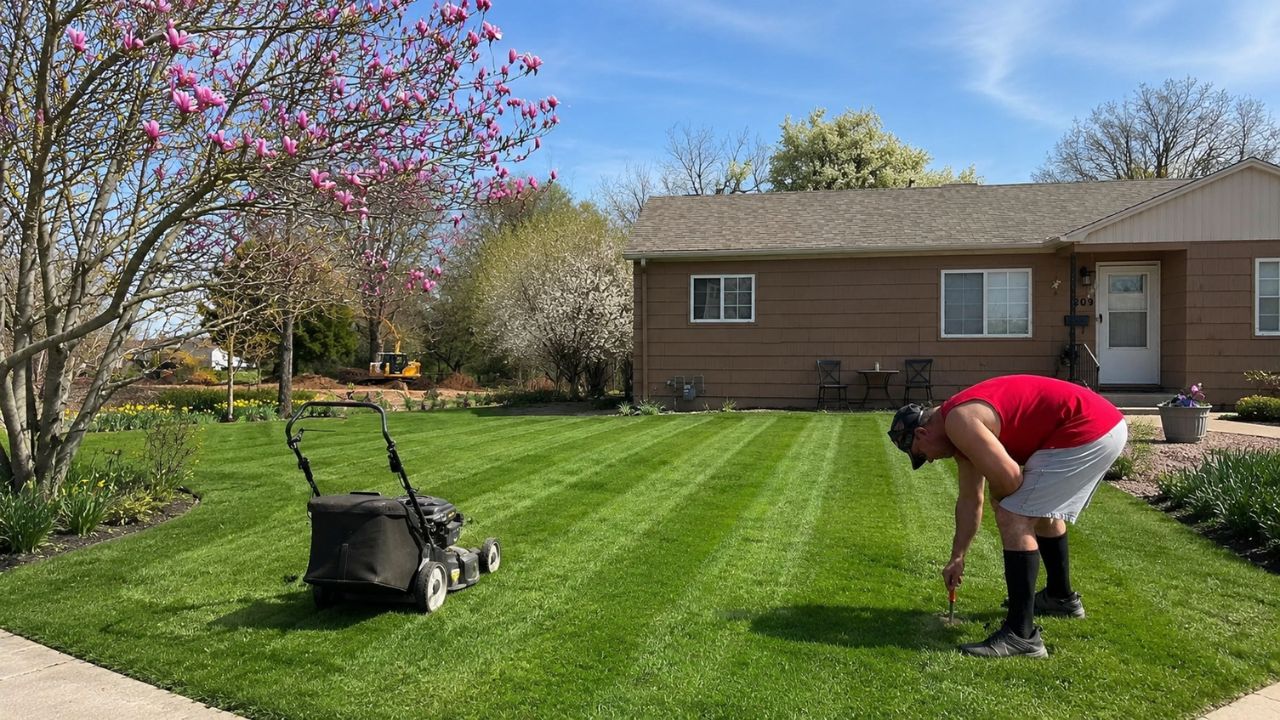
The screwdriver test stopped at about one inch in most parts of the back lawn. The front was slightly better — about one and a half inches. Classic Lively clay, and based on the compaction levels I was reading, this lawn hadn’t seen aeration in at minimum three years. Probably longer.
I found the thatch layer at about three quarters of an inch throughout — thicker than ideal, building toward the point where it starts blocking water and seed from reaching the soil effectively.
And in the back corner — the section that was almost bare — I found the drainage issue. Water was clearly pooling there. The grade sloped toward that corner from two directions and the soil was noticeably different in texture and colour from the rest of the yard — that greyish, dense, slightly sour-smelling clay that has been wet and dry repeatedly for years. Nothing had been growing there for a while. Probably multiple seasons.
I showed Priya each finding as I worked through the property. I watched her connect the pieces — the bare corner wasn’t some mysterious failure. It was a place where water pooled and the soil had become hostile to grass roots over time. Not something she’d caused. Something the property had been dealing with before she got there.
She asked: “Is this bad?”
I told her honestly: it’s not great, but it’s normal for a Greater Sudbury property that hasn’t had proper maintenance in a few years. I see variations of this on a significant proportion of the properties I assess across this region — I’ve documented the patterns in detail in what five years of notes on Sudbury lawns has taught me. What I was looking at on her property was a specific set of fixable problems, not a fundamentally bad lawn.
Then I told her the first thing she needed to do.
The First Thing I Told Her to Do — And Why

The first thing I told Priya to do was nothing.
She looked at me for a moment. “Nothing?”
I explained what I meant.
It’s May. The lawn is coming out of dormancy. The snow mould is drying out and becoming inactive now that the snow is melted and the lawn is exposed to air and light. The grass that survived winter is starting to green up. This is not the moment to panic and start throwing seed and fertilizer at the lawn. This is the moment to let the lawn show you what it’s going to do on its own before you start making decisions about what it needs.
Give it two weeks, I told her. Two weeks of no intervention. Watch what happens to the snow mould patches — do they start showing new green growth at the edges, or do they stay dead? Watch the thin areas — does the grass start filling in, or do the bare patches stay bare? Watch the back corner — does it stay wet after rain, or does it drain?
In two weeks you’ll know whether you’re dealing with a lawn that just needs spring care and some maintenance work, or a lawn that needs more significant intervention in specific areas. Making that distinction before you act saves you from spending money and effort on the wrong things.
The mistake most new homeowners make in this situation is the opposite — they panic, they go to the hardware store, they buy bags of seed and fertilizer, they spread everything immediately in early May. The seed goes on compacted soil through a thatch layer that blocks it from making soil contact. The fertilizer promotes rapid leaf growth on a root system that hasn’t had time to establish properly after winter. Neither does what they’re hoping for and they end up frustrated and further behind than if they’d waited.
This connects directly to what I’ve documented in the 2-week spring window that makes or breaks Sudbury lawns — the timing of spring work matters enormously in our climate. Early May is too early for most intervention. Late May, when soil temperatures have warmed and the lawn’s recovery trajectory is clear, is when the work actually sticks.
Priya nodded slowly. “So you’re saying wait and watch.”
Exactly. And then call me in two weeks with what you’ve seen.
The 5-Step First Season Plan I Give Every New Sudbury Homeowner

After the two-week observation period, here’s the sequence I walked Priya through — and that I give every new homeowner in Greater Sudbury who finds themselves in a similar situation.
Step 1 — Rake the Snow Mould Patches (Early May)
Once the snow is fully melted and the lawn is accessible, rake the snow mould affected areas thoroughly. Break up the matted dead grass, improve air circulation to the soil surface. The fungus can’t survive exposure to air and light — raking accelerates its die-off and gives surviving grass plants room to grow. For a detailed breakdown of what to do with snow mould, I’ve covered it in snow mould in Sudbury — the full guide.
Step 2 — Core Aeration (Late May)
Wait until late May — when soil temperatures are consistently above 10°C — then do core aeration across the entire lawn. On Lively’s clay-heavy soil, this is not optional. The compaction I found on Priya’s property was preventing roots from going deep, water from penetrating, and seed from making soil contact. Aeration addresses all three simultaneously.
Two passes in different directions for the best result. I’ve explained what to expect from professional core aeration in Sudbury in what to expect from lawn aeration near you in Sudbury.
Step 3 — Address the Drainage Problem (Before Sod or Seed)
The back corner drainage issue needed to be fixed before any restoration work in that area. We regraded the corner — brought in quality topsoil to redirect the slope away from the low point toward the fence line. This is the kind of work that only needs to be done once if it’s done properly. The pattern of skipping drainage work and then wondering why the same area fails again is something I’ve documented extensively — including in the Val Caron homeowner I turned down three times before finally saying yes.
Step 4 — Overseed Thin Areas, Sod the Bare Corner
Immediately after aeration, overseed the thin areas. The aeration holes give seed direct soil contact — the single most important factor in germination. Use a quality cool-season blend. Keep consistently moist for 10 to 14 days.
For the back corner — once drainage was corrected — we laid fresh sod rather than relying on overseeding. The bare coverage was too extensive for overseeding to produce a good result in a reasonable timeframe. I’ve covered the overseeding vs sod decision in landscaping services in Sudbury — what’s included and what to expect.
Step 5 — Get on the Right Maintenance Rhythm
This is the step that determines whether the first season’s work holds in year two and year three.
Mowing at 3 inches — non-negotiable for Sudbury’s cool-season turf. Not 2 inches. Not 1.5 inches. 3 inches, every cut. I’ve explained why in the most common lawn mowing mistake I see every week in Sudbury.
Watering deeply and infrequently — two to three times per week, long enough to wet the soil two to three inches down. Not a little every day. I’ve covered what happens when watering isn’t done properly in the week most Sudbury lawns start struggling and how to get ahead of it.
Fall aeration booked — every year. Annual fall aeration on Sudbury clay is what keeps compaction from rebuilding and keeps the lawn health gains from the first season’s work from slowly eroding. The full fall preparation sequence is in how to prepare your Sudbury lawn for winter.
What Priya’s Lawn Looks Like Now
We did the drainage correction and the sod work in late May. Priya followed the watering schedule carefully. She texted me in late June with a photo — the back corner that had been bare soil was green and establishing. The snow mould patches from spring had filled in with new growth. The thin areas had responded well to the overseeding.
She also booked a lawn care company — one that mows at 3 inches — for the weekly cut through summer. And she’s on the schedule for fall aeration in October.
She sent me a message in August: “I actually like looking at the backyard now. I didn’t know how much that would matter.”
It matters more than most people expect until they experience the difference.
Are You a New Homeowner in Greater Sudbury Facing Your First Lawn Season?
If you’ve just bought a house in Sudbury and you’re looking at your lawn for the first time not knowing where to start — reach out. I’ll come out, walk the property, do the assessment, and give you a clear honest picture of what you’re actually dealing with and what the right sequence of work is for your specific lawn.
No panic required. Most lawns, no matter what they look like in early May, are more fixable than they appear.
📞 Call or text me: 705-507-6787
Or fill out the free quote form here — I get back to everyone same day.
— Ryan Lingenfelter
Owner, Cutting Edge Lawn & Landscaping
Garson, Ontario
Related Articles
- Snow Mould in Sudbury — What It Is and Whether to Worry
- The 2-Week Window in Sudbury That Makes or Breaks Your Lawn All Summer
- Lawn Aeration Near Me in Sudbury — Cost, What to Expect, and What to Ask
- The One Lawn Mowing Mistake I See Every Week in Sudbury
- How to Prepare Your Sudbury Lawn for Winter — October Checklist
- Why I Keep Notes on Every Sudbury Lawn I Work On
- Landscaping Services in Sudbury Ontario — What’s Included and What to Expect
- Sod Installation in Greater Sudbury
