

I’m Ryan Lingenfelter — owner of Cutting Edge Lawn & Landscaping in Garson, Ontario.
Here’s something I’ve noticed after five years of working on properties across Greater Sudbury.
Homeowners make the mulch vs stone decision based almost entirely on how each option looks the day it’s installed. And on install day, both look great. Fresh cedar mulch at three inches looks rich, deep, and professionally done. Fresh river rock or decorative stone looks clean, modern, and sharp.
The question nobody asks — and the one I think actually matters — is what each option looks like after three Sudbury winters.
Because Sudbury winters do things to landscape materials that warmer-climate advice doesn’t account for. The freeze-thaw cycles, the snowmelt runoff, the weight of heavy snowpack, the spring mud season — all of it affects mulch and stone differently. And by year three, the two options often look dramatically different from what was installed on day one.
I’ve installed and maintained both on hundreds of properties across Garson, Val Caron, Hanmer, Lively, Chelmsford, Azilda, and Capreol. Here’s the honest three-year picture for each.
What Cedar Mulch Looks Like After 3 Sudbury Winters
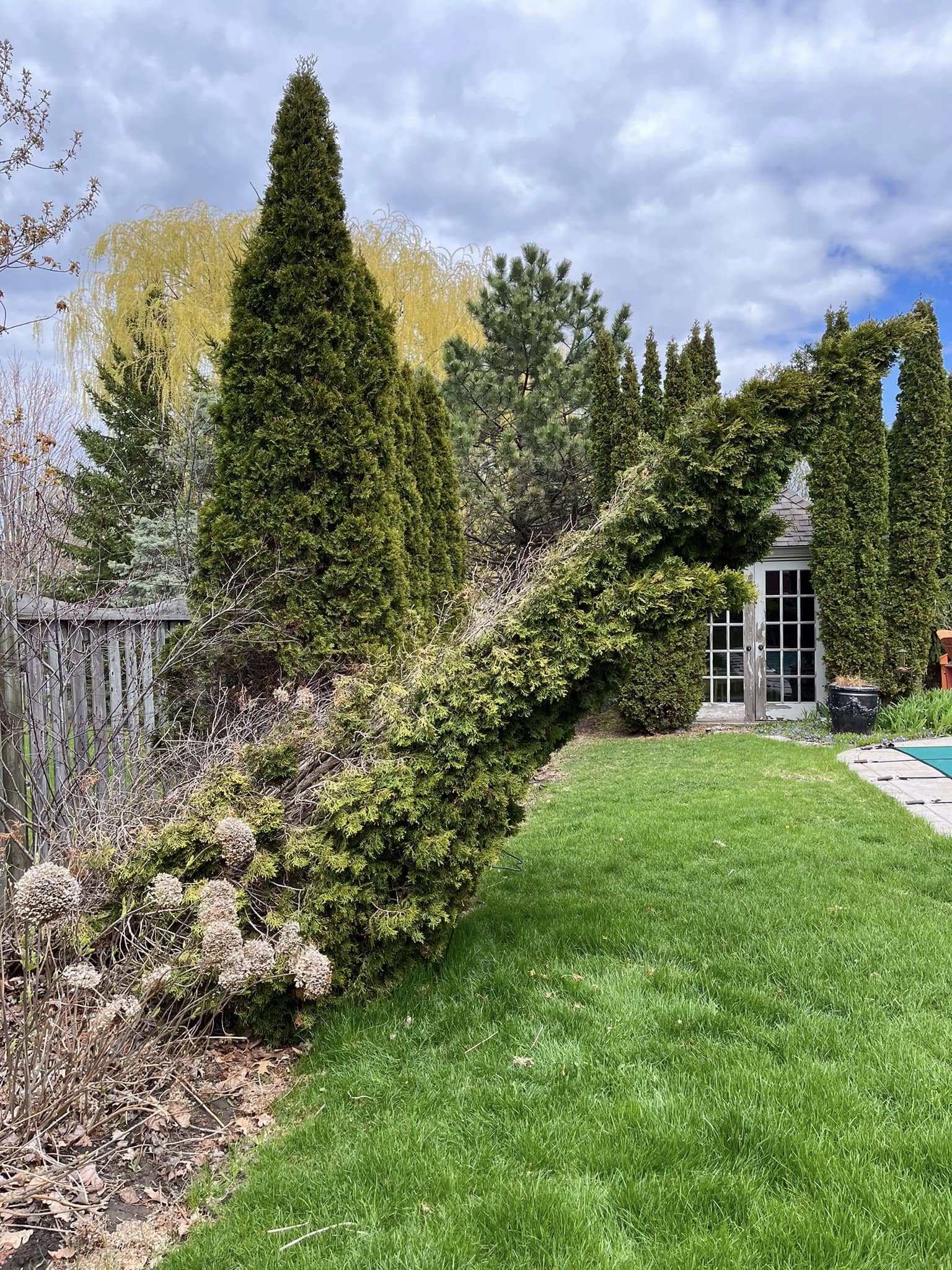
Year one mulch — installed correctly at three inches depth with proper edging — looks excellent. The cedar colour is rich, the surface is even, and it does exactly what mulch is supposed to do: retain moisture, suppress weeds, and give the beds a finished appearance.
By the end of year one, two things have happened. The colour has faded from the fresh cedar tone to a greyed-out brown. This is normal and expected — UV exposure fades organic mulch regardless of type. The depth has reduced from three inches to roughly two inches as the mulch has begun to decompose and compress.
After a Sudbury winter, year two mulch has a few additional changes. The freeze-thaw cycle works through the top layer, breaking down the structure of the individual pieces. In spring, the surface can look matted in spots where snowpack compressed it. The colour is now fully grey-brown. Depth is down to one and a half to two inches in most areas.
By year three, mulch installed without refreshing is thin — typically less than an inch in many spots. Weed breakthrough is happening in the thinner areas because there’s not enough depth for effective suppression. The colour is uniformly grey and flat. In beds with any slope, the mulch has migrated downhill through three seasons of snowmelt runoff, leaving bare soil at the top and a thicker accumulation at the bottom.
The beds look tired. Not terrible, not neglected — but clearly several years old and due for attention.
The honest assessment: Cedar mulch in Sudbury needs refreshing every one to two years to maintain its appearance and effectiveness. The material is doing its job — decomposing organic mulch improves soil biology and fertility, which is genuinely valuable. But the appearance at year three without refreshing is not what it was at installation.
The cost reality: Annual or biennial mulch refresh on a standard set of foundation beds — four to six cubic yards — runs $280 to $400 installed. Over three years that’s $280 to $800 depending on whether you refresh annually or every two years. This ongoing cost is part of the honest picture that the initial mulch quote doesn’t include.
What Decorative Stone Looks Like After 3 Sudbury Winters
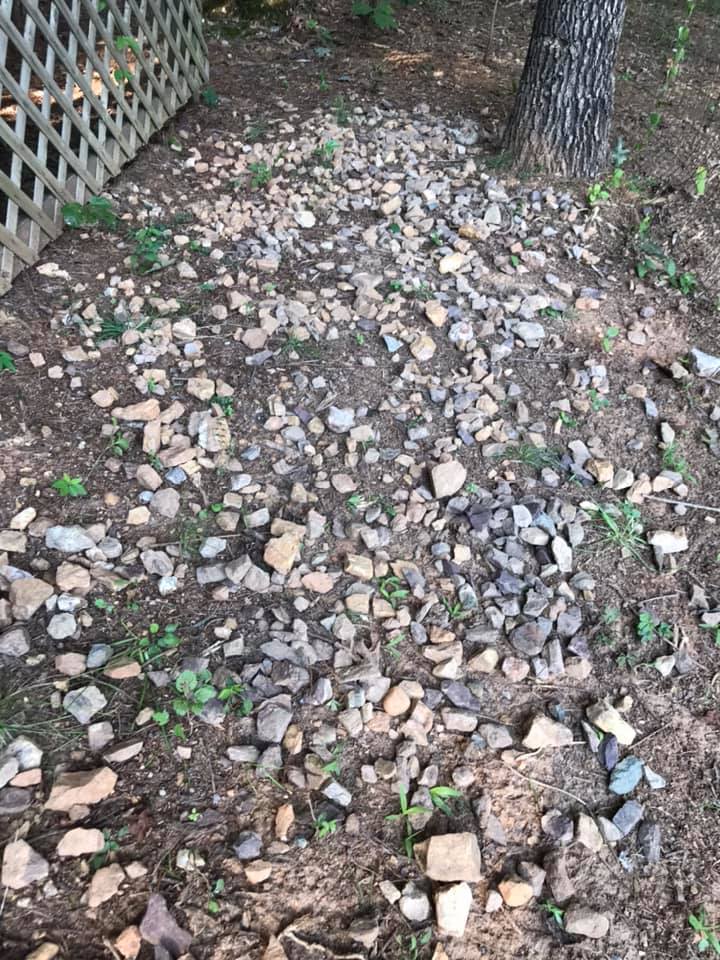
Year one decorative stone — river rock, pea gravel, or crushed stone installed over landscape fabric with clean edging — also looks excellent. The colour is consistent, the surface is even, and it has a clean modern appearance that many homeowners prefer over mulch.
After one Sudbury winter, stone has shifted. This is the part that surprises most homeowners. The freeze-thaw cycle works underneath the stone — the soil freezes, expands, pushes up against the landscape fabric, and when it thaws, the fabric settles slightly differently than it started. By spring, the stone surface has subtle unevenness that wasn’t there in fall. In most cases this is minor and not obvious. In some areas — particularly over clay soil like most of Sudbury has — it can be more pronounced.
Organic debris also begins accumulating in stone beds after the first year. Leaves, seed pods, and small debris blow in and get caught in the stone gaps where they’re much harder to remove than from mulch. On a mulch bed, a leaf blower or light raking handles fall cleanup easily. On stone, fine debris settles between the stones and can only be removed by hand or with significant water pressure. By year two, stone beds near deciduous trees have a noticeable debris accumulation that affects their appearance.
Weeds are the other year-two reality of stone beds. Landscape fabric eventually allows fine particles of organic matter to collect on top — blown in by wind and deposited from decomposing debris. Within two to three years, there’s enough organic accumulation on the fabric surface for weed seeds to germinate in the stone. The weeds root into the landscape fabric and become significantly harder to remove than weeds in mulch.
By year three, stone beds that haven’t been maintained look like this: slightly uneven surface from settling, debris accumulation between stones in areas near trees, and weeds growing through the stone in spots where organic matter has built up on the fabric.
The honest assessment: Decorative stone in Sudbury holds its colour well — stone doesn’t fade the way mulch does — and the base material is still fully present at year three. But the appearance is not zero-maintenance. Debris management and weed control in stone beds is ongoing and can be more labour-intensive than the equivalent work in mulch beds.
The areas where stone genuinely performs better: Near downspouts and drainage areas where mulch washes away. On slopes where mulch migrates with snowmelt runoff. Along the foundation where moisture retention from mulch creates pest problems. In areas with no overhanging trees where debris accumulation is minimal.
The Side-by-Side Honest Comparison After 3 Years
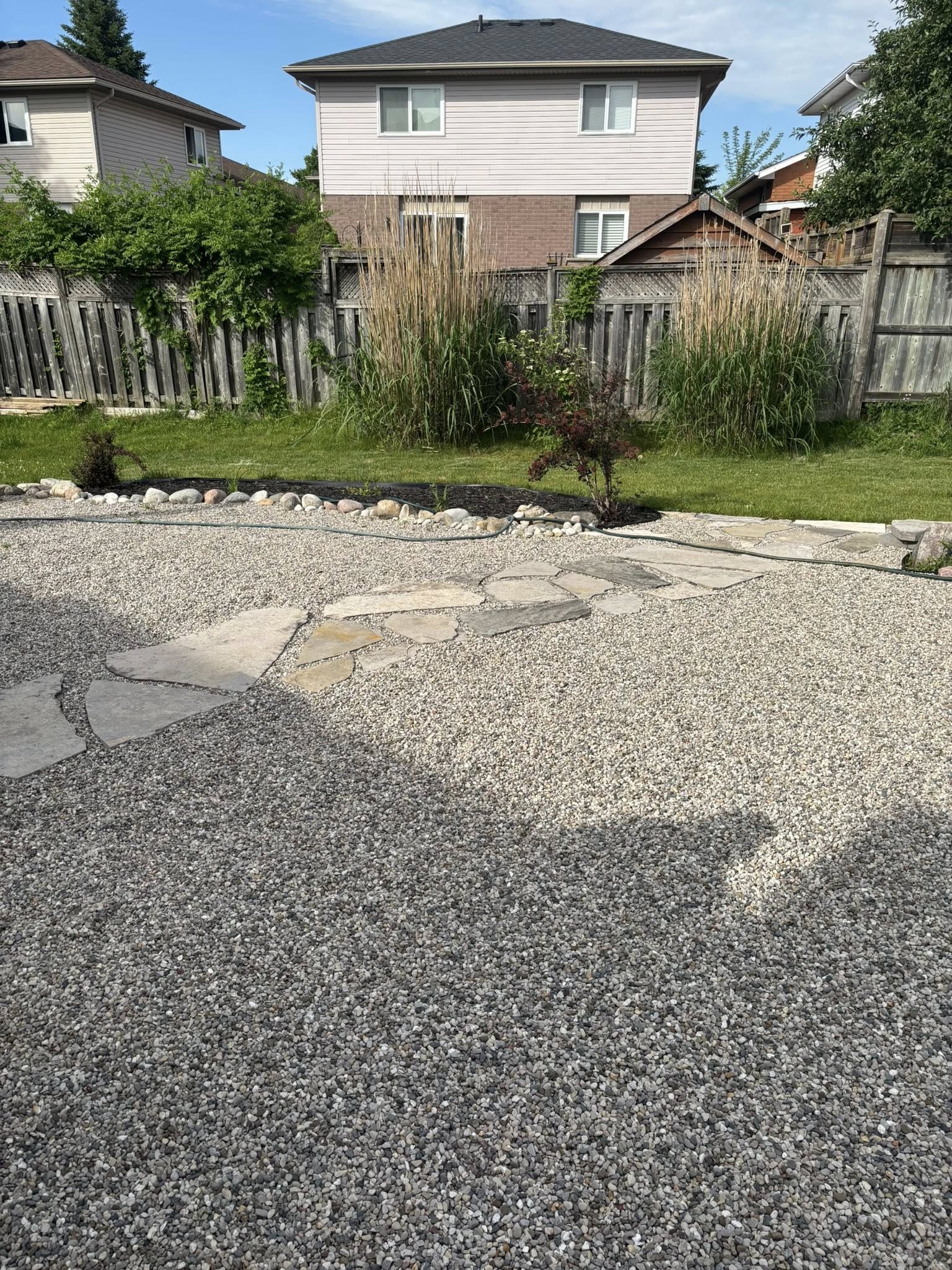
Let me put the three-year picture side by side honestly.
Appearance at year 3:
Mulch without refreshing — grey, thin, weeds breaking through in spots, tired looking. Mulch with annual refresh — looks essentially like year one, rich and maintained.
Stone without maintenance — settled, debris accumulated, weed breakthrough in spots. Stone with maintenance — close to year one appearance since the stone itself doesn’t degrade.
Ongoing cost at year 3:
Mulch — $280 to $800 spent on refreshing over three years, depending on frequency.
Stone — Lower material cost since stone doesn’t need replacing, but labour cost for debris management and weed control is higher than most homeowners expect.
Plant health at year 3:
Mulch — soil biology has improved from three years of decomposing organic matter. Plants in well-mulched beds are often noticeably healthier than at installation.
Stone — soil biology unchanged. Plants perform the same as at installation. In heat-exposed areas, soil temperature under stone can be higher than ideal for some plant varieties.
Sudbury-specific performance:
Mulch — migrates on slopes during snowmelt. Needs to be pulled back from foundation. Breaks down faster in Sudbury’s freeze-thaw than in milder climates.
Stone — settles more on Sudbury clay than on stable soil. Debris accumulation is higher near deciduous trees, which Sudbury properties typically have many of.
The honest winner depends entirely on location and application. There isn’t a universal better option — the right choice for a specific bed depends on what that bed is near, what’s planted in it, and whether you’re willing to do the ongoing maintenance that either option requires.
What I Actually Recommend and Where
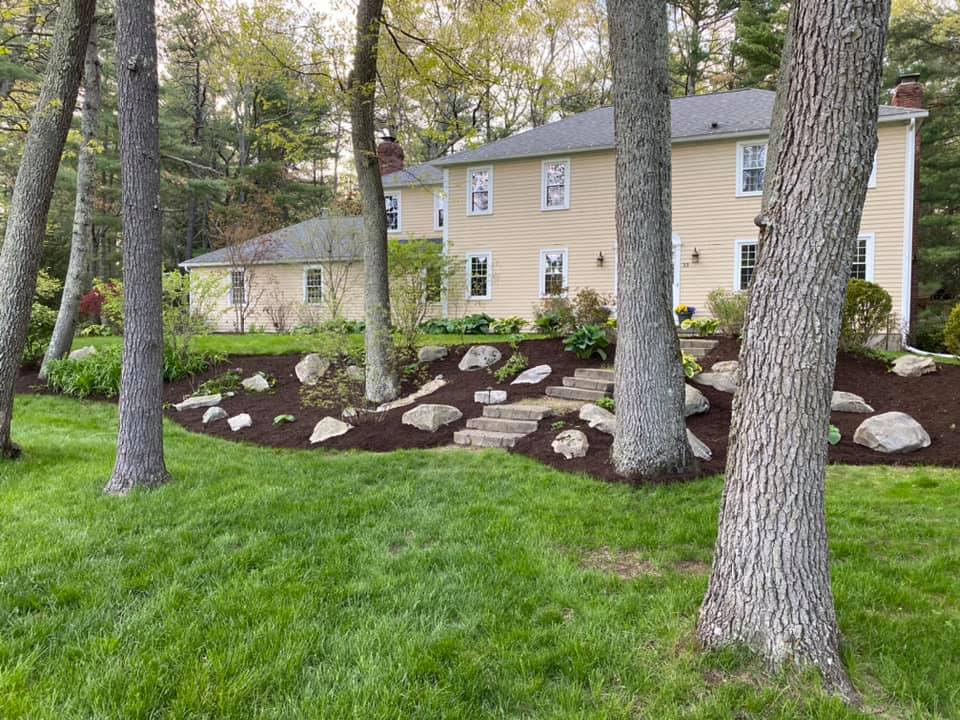
After five years of installing and maintaining both across Greater Sudbury, here’s what I actually recommend by application.
Use cedar mulch for:
Foundation beds with plants. The moisture retention, temperature moderation, and soil improvement that mulch provides makes a real difference to plant health over time. If you’re investing in plants, give them mulch.
Beds under tree canopies. Mulch works with the organic cycle of a tree — fallen leaves decompose into the mulch layer, the mulch decomposes into the soil, the tree benefits. Stone interrupts that cycle and creates a debris management problem.
Beds in shaded areas where the mulch won’t fade as fast. North and east-facing beds that don’t get direct afternoon sun hold their colour significantly longer.
Use decorative stone for:
Downspout areas and drainage zones. This is the clearest case for stone in Sudbury — anywhere that water runs or pools during snowmelt and spring rain. Mulch in these areas washes out repeatedly and never looks right. Stone stays in place.
Slopes and embankments. Same principle — mulch migrates downhill on any slope during Sudbury’s heavy spring runoff. Stone holds its position.
Foundation perimeter strip. A narrow stone strip directly against the foundation — pulled away from the wall by four to six inches — prevents the moisture-retention problem that mulch against a foundation creates. Use stone for the first foot from the foundation and mulch beyond that.
High-traffic narrow areas like side yards and utility zones. These areas see foot traffic, don’t support plants, and just need a clean durable surface. Stone is lower maintenance and more durable in these spots.
The best result on most Sudbury properties: A combination. Mulch in the planted foundation beds and tree rings. Stone at the downspout discharge points, along the foundation perimeter, and on any sloped areas. This isn’t fence-sitting — it’s using each material where it genuinely outperforms the other.
What a Mulch or Stone Refresh Actually Costs in Sudbury 2026
Straight numbers for Greater Sudbury:
Cedar mulch installed: $65 – $90 per cubic yard
Standard foundation bed refresh (4 yards): $280 – $380 installed
River rock / decorative stone installed: $90 – $140 per cubic yard
One-time stone installation (4 yards): $380 – $580 installed
The stone has a higher day-one cost. The mulch has higher ongoing cost if refreshed annually. Over five years, a well-maintained mulch bed and a well-maintained stone bed in similar applications usually come out within a few hundred dollars of each other — the stone doesn’t need replacing but requires more labour for debris and weed management; the mulch needs refreshing but that refreshing takes less time per visit.
If you want a specific quote for your beds — how many yards, which material, what the installation would cost for your specific property — give me a call. I’ll come out, look at what you’re working with, and give you a straight number.
📞 Call or text me directly: 705-507-6787
Or fill out the free quote form here and I’ll get back to you same day.
We service Garson, Val Caron, Hanmer, Lively, Chelmsford, Azilda, Capreol, and all of Greater Sudbury.
— Ryan Lingenfelter
Owner, Cutting Edge Lawn & Landscaping
Garson, Ontario
Frequently Asked Questions
Does mulch or stone look better after several years in Sudbury?
Both require maintenance to look good over time — neither is truly set-and-forget in Sudbury’s climate. Cedar mulch without refreshing looks grey and thin by year three; with annual or biennial refreshing it maintains its appearance well. Decorative stone holds its colour since rock doesn’t fade, but settles on Sudbury clay over freeze-thaw cycles and accumulates organic debris between stones that’s harder to remove than debris from mulch beds. Stone near deciduous trees typically shows the most maintenance demand. The best-looking beds at year three are those where the material was chosen correctly for the application and maintained consistently.
How often does mulch need to be replaced in Sudbury?
Cedar mulch on Sudbury properties typically needs refreshing every one to two years to maintain effective depth and appearance. Sudbury’s freeze-thaw cycles accelerate the breakdown of organic mulch compared to milder climates, and snowmelt runoff causes migration on any slope. A refresh adds one to two inches of new mulch over the remaining base — you don’t need to remove the old mulch, which has broken down and improved the soil. Annual refresh keeps beds looking fresh; biennial refresh is acceptable if appearance isn’t the primary concern.
Does decorative stone settle in Sudbury winters?
Yes — decorative stone on Sudbury clay settles more noticeably than on stable sandy or loamy soil. The freeze-thaw cycle expands and contracts the clay beneath the landscape fabric, causing gradual surface unevenness over multiple winters. In most applications this is minor and not visually obvious. On areas with significant clay depth and multiple freeze-thaw events per winter — which describes most of Greater Sudbury — some settling is expected by year two. Top-dressing the settled areas with matching stone every two to three years maintains the level surface.
Is stone or mulch better near a Sudbury house foundation?
Stone is better in the immediate perimeter adjacent to the foundation — the first 12 to 18 inches from the house wall. Mulch against a foundation retains moisture against the structure, which creates carpenter ant habitat and can contribute to moisture infiltration over time. A narrow stone strip directly against the foundation, transitioning to mulch in the planted bed area beyond it, gives you the plant health benefits of mulch where the plants are and the drainage benefits of stone where water management matters.
Which holds up better to Sudbury spring snowmelt — mulch or stone?
Stone holds up significantly better to snowmelt runoff than mulch. On any sloped area or near downspout discharge points, mulch migrates downhill with spring runoff — the top of the slope gets bare soil and the bottom gets an accumulated pile. Stone stays in place under the same conditions. For this reason I consistently recommend stone for sloped beds, downspout areas, and drainage zones on Sudbury properties regardless of what’s planted there.
Can you mix mulch and stone on the same property in Sudbury?
Yes — and on most Sudbury properties, a combination produces the best overall result. Using mulch in planted foundation beds and around trees for soil health, with stone in drainage areas, near downspouts, on slopes, and along the foundation perimeter, uses each material where it genuinely outperforms the other. The visual result is also often better than all-one-material — the contrast between mulch and stone can define different zones of the property cleanly and intentionally.
Ryan Lingenfelter is the owner of Cutting Edge Lawn & Landscaping in Garson, Ontario. Since 2020, his crew has provided full lawn care and landscaping services across Greater Sudbury — Garson, Val Caron, Hanmer, Lively, Chelmsford, Azilda, and Capreol. Licensed, insured, BBB A+ rated, and ThreeBest Rated for lawn care services in Sudbury.
📞 Phone: 705-507-6787
📍 Service Area: Greater Sudbury, Ontario
🔗 Free Quote: cuttingedgelawn.ca/quote
Related Services
- Mulch & Decorative Stone Services
- Property Cleanup Services
- Grass Cutting Services
- Core Aeration Services
Continue Reading
- Mulch vs Decorative Stone in Sudbury — Which One Should You Pick?
- What Sudbury Landscaping Companies Charge in 2026
- I Tried to Fix My Own Lawn for 3 Years — Here’s What Finally Worked
- How Much Does Lawn Care Actually Cost in Sudbury?
