
There’s a property in Garson I worked on for two full seasons before I finally understood what was actually happening. I want to write about it because I think it illustrates something important — something that I see get missed on difficult lawns across Greater Sudbury, and something that would have saved this homeowner a lot of money and frustration if we’d found it sooner.
I’m not sharing this story to make myself look clever. I’m sharing it because I got it wrong for longer than I should have, and I think being honest about that is more useful than pretending every job goes smoothly from the start.
What We Were Dealing With When I First Arrived

The homeowner — a man in his fifties who’d lived in the house for about twelve years — called me in the spring of my second year in business. He’d had two other lawn care companies before me, neither of whom had been able to sort out a persistent problem with his backyard.
The front yard was fine. Decent coverage, reasonable soil, nothing remarkable in either direction. It responded normally to care — cut it properly, keep it watered, it looked okay. No issues.
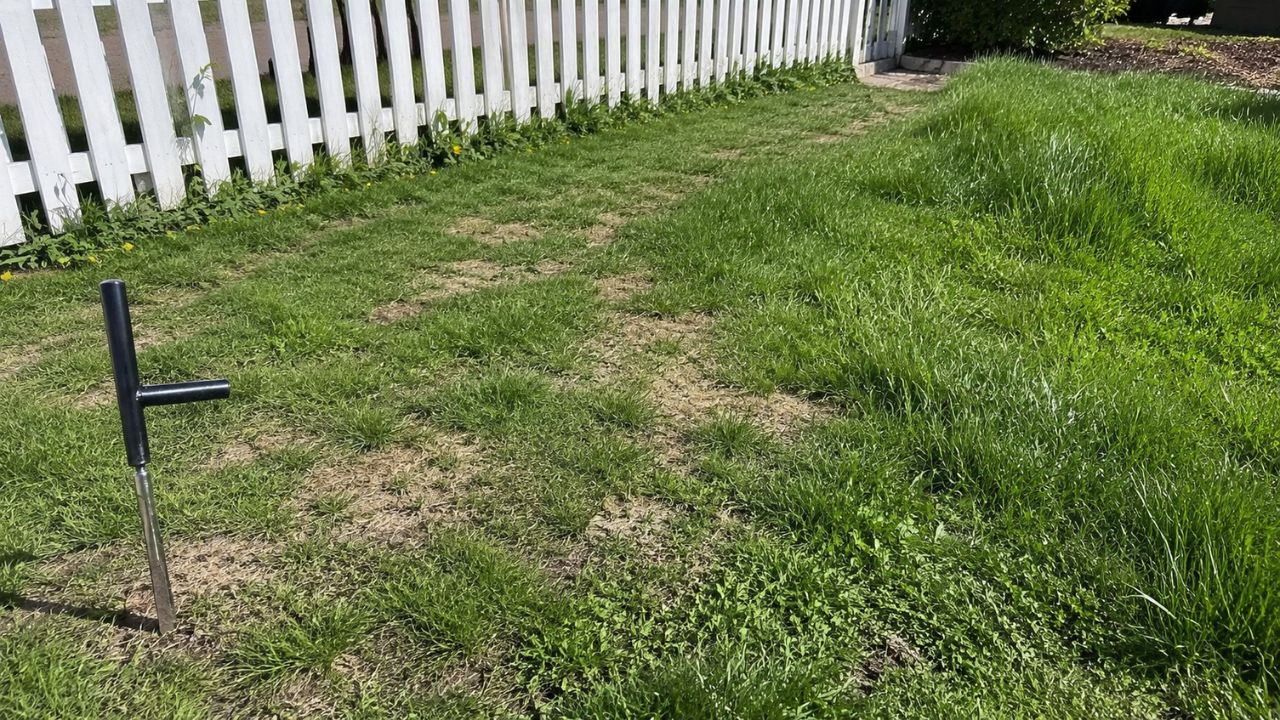
The backyard was a different story entirely. There was a section along the back fence, roughly eight feet wide running the full length of the yard, that consistently failed. Every spring it looked worse than the year before. Bare patches, thin coverage, and a strange colour — not the yellow of drought stress or the brown of dead grass, but a pale, washed-out green that looked perpetually unwell regardless of what was done to it.
He’d overseeded it twice. He’d fertilized it. He’d watered it. He’d had it aerated the previous fall by one of the other companies. Nothing held. The seed would germinate, come up thin, and by August it would look almost exactly the way it did in spring — barely there, pale, struggling.
When I walked the property the first time, I did what I normally do — checked the soil compaction, looked at the thatch layer, assessed the drainage, thought about the sun exposure. Everything seemed explainable. The fence line area got less sun than the open part of the yard. The soil felt a bit compacted. There was some thatch. Nothing that looked unusual for a Sudbury property that had been through a few rough seasons.
So I did what the situation seemed to call for. Thorough spring cleanup, proper core aeration, quality shade-tolerant seed mix into the aeration holes, starter fertilizer, consistent watering protocol. The full proper approach.
By August, that back fence section looked almost exactly the same as it had when I’d first seen it.
The Second Season — More of the Same

I came back the following spring frustrated with myself. Not at the homeowner — he was patient and reasonable throughout — but at the fact that I hadn’t solved the problem. I’d done everything I knew to do and it hadn’t worked. That’s uncomfortable when you’re supposed to be the person with the answers.
This time I tried a different approach. I focused specifically on the shade issue. The fence was on the north side of the property, which meant that section of the yard got minimal direct sun — maybe two or three hours in the afternoon at best. I switched to an even heavier creeping red fescue mix, which is about as shade-tolerant as cool-season grass gets in Sudbury’s climate. I adjusted the cut height along that section — keeping it at three and a half inches rather than three to give the shade-stressed grass more leaf area to work with. I was careful about the watering — not too much, because shade areas don’t dry out as fast and waterlogging was a risk.
Better germination that spring. The section came in fuller than it had before. I thought maybe we’d finally cracked it.
By July it was thinning again. Not as badly as previous years — the fescue held better than what had been there before — but it was declining, and declining in that same pale, washed-out way that didn’t look like shade stress or drought stress. Something was actively working against the grass in that section, not just making conditions difficult.
I started asking different questions.
What We Finally Found

Late that summer, I was on the property doing a regular cut and I noticed something I’d seen before but hadn’t properly registered. Along the base of the fence, at irregular intervals, there were small depressions in the soil — subtle, not dramatic, but consistent. And the grass immediately around those depressions was always the worst. Not just thin — actually dead in small circles, with that pale washed-out colour extending outward.
I got down and looked more carefully. And then I dug down a few inches at one of the worst spots.
The fence posts were rotting. Old pressure-treated posts, twelve years in the ground in Sudbury’s freeze-thaw cycle, and they were breaking down. The wood was decomposing into the soil around each post. And that decomposing treated wood was leaching compounds into the surrounding soil — not in dramatic quantities, but enough to alter the soil chemistry in the immediate area. The grass wasn’t failing because of shade or compaction or drought. It was failing because the soil around those fence posts was chemically hostile to grass growth.
This is one of those things that you can only find by really looking — and I hadn’t looked carefully enough in the first season. The depressions were there. The dead circles around the posts were there. I’d looked at it and filed it under “shade and compaction” without digging deeper.
Once I understood what was actually happening, the solution became obvious. The affected soil around each post needed to be removed and replaced with clean topsoil. Not a large volume — a foot or two around each post base — but it needed to come out entirely and be replaced before any seed would establish and hold in those areas.
We did that in early September. Removed the contaminated soil, brought in clean topsoil, aerated the surrounding area, overseeded with the fescue mix that had been performing reasonably elsewhere in that section.
The following spring — third year on this property — those areas came in and stayed in for the first time. Not perfect, the fence line will always be a challenging area with the shade and the soil history. But the persistent failure stopped. The grass established and held through the summer. The pale washed-out colour that had defined that section of the yard for as long as the homeowner could remember was gone.
What This Story Is Actually About

I tell this story not because rotting fence posts are a common cause of lawn problems — they’re not, this was unusual. I tell it because of what it represents about diagnosing difficult lawns.
When a lawn keeps failing despite doing things right, there’s always a reason. It’s not bad luck. It’s not that the grass is inherently doomed. There’s a specific cause — something in the soil, something in the drainage, something in the conditions — that’s working against establishment and growth. The job is to find that cause, not to keep applying more of the same treatments and hoping for a different result.
The mistake I made in the first season on this property was accepting a surface-level explanation — shade, compaction — that was plausible but incomplete. Those things were real factors. But they weren’t the primary cause of the persistent failure in that specific section. I treated the symptoms instead of the disease, and it cost an extra season of frustration.
What I’ve taken from this into every difficult property I work on since: if the standard approach isn’t working, stop and look harder before trying more of the same. Ask what’s different about the areas that fail versus the areas that don’t. Dig down. Test the soil if needed. Talk to the homeowner about the property’s history — what’s been done, what’s been there, what changed when the problems started.
This approach applies whether the problem is new build soil issues, a shaded corner that won’t grow grass, or something less obvious like decomposing fence posts changing the soil chemistry. The answer is always specific to the property. The job is finding it.
If you have a lawn problem in Greater Sudbury that’s persisted despite doing everything you’ve been told to do — multiple seasons, multiple attempts, same result — reach out. Sometimes a fresh set of eyes looking at the right things makes all the difference. That conversation costs nothing.
— Ryan Lingenfelter
Cutting Edge Lawn & Landscaping, Garson, Ontario
📞 705-507-6787
Serving all of Greater Sudbury — Garson, Hanmer, Val Caron, Lively, Chelmsford, Azilda, Capreol, and Sudbury proper. We offer core aeration, grass cutting, property cleanup, sod installation, and full lawn maintenance. Free quotes, no pressure.
Get a Free Quote |
Call 705-507-6787
