
By Ryan Lingenfelter · Cutting Edge Lawn & Landscaping, Garson, Ontario · June 2026
New Sudbury Centre — the mall on Lasalle Boulevard at Barrydowne — has been the dominant retail anchor for this part of Greater Sudbury since it opened in 1957. The residential neighbourhoods around it developed alongside it, expanding outward through the 1960s, 70s, and 80s as the New Sudbury area became one of the most densely populated and commercially active parts of the city.
What most homeowners in those residential streets near Lasalle don’t know is that the infrastructure built to support sixty-plus years of major retail development in that corridor has created underground and surface drainage patterns that directly affect residential yards in the surrounding area — and that the yard problems they’ve been trying to fix with lawn care products are often being driven by something that has nothing to do with how they’re maintaining the grass.
I’ve worked properties within a kilometre or two of the mall for several years. Here’s what I consistently find, why it’s happening, and what to actually do about it.
What the New Sudbury area actually sits on — the infrastructure layer most homeowners don’t know about
The New Sudbury Centre and its surrounding retail corridor sit on what was originally agricultural and low-lying terrain — the original site was a farm and riding club before the first development permit was issued in 1956. That original low-lying character of the land didn’t disappear when the mall and surrounding commercial development was built. It was managed through infrastructure — storm sewers, grading, impermeable surfaces — that redirected surface water rather than changing the fundamental terrain dynamics.
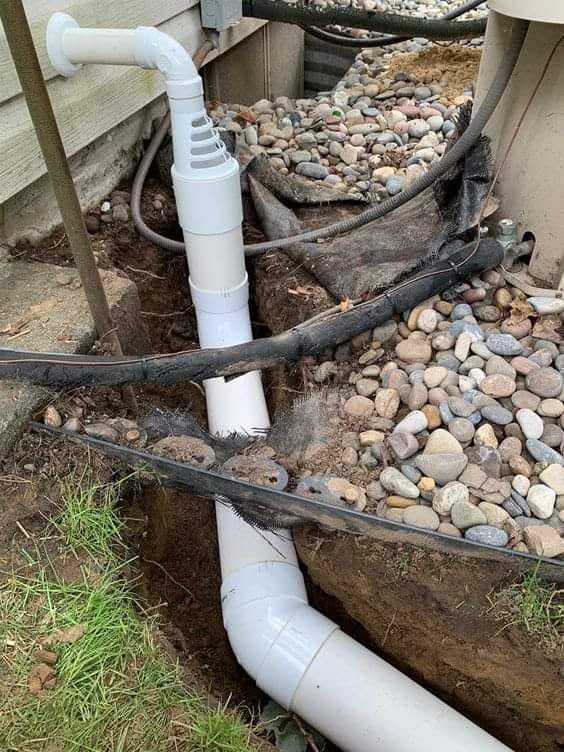
Large impermeable surfaces — parking lots, rooftops, roadways — collect rainfall and direct it rapidly into storm sewer systems rather than allowing it to percolate gradually into the ground the way natural terrain does. The New Sudbury Centre complex, with its extensive parking areas, covers a significant acreage of what would otherwise be water-absorbing ground. That water has to go somewhere. The storm sewer network in the area carries the discharge, but storm systems in older development areas don’t always handle peak events perfectly — and the residential streets adjacent to major commercial development sometimes receive surface water and shallow groundwater that the surrounding impermeable coverage accelerates toward them.
The residential streets immediately north, east, and west of the Lasalle Boulevard corridor — the established neighbourhoods where many Sudbury families have lived for decades — sit downgrade or adjacent to this drainage pattern in ways that produce specific and repeatable yard problems. The problems aren’t random. They’re predictable based on where the properties sit relative to the drainage dynamics of the commercial corridor.
This is a more localised version of what I described in the article on the Sudbury property where I found drainage problems underground — the principle that what’s happening on adjacent land affects what happens in a residential yard, even when the connection isn’t visually obvious. In that case it was a neighbouring property’s grade. In the New Sudbury area, it’s the drainage dynamics of a major commercial corridor that’s been accumulating infrastructure since the 1950s.
The specific yard problems I see consistently on properties in this area
After working properties in the residential streets near Lasalle and the New Sudbury Centre area, several problems show up with enough consistency to be worth describing specifically.
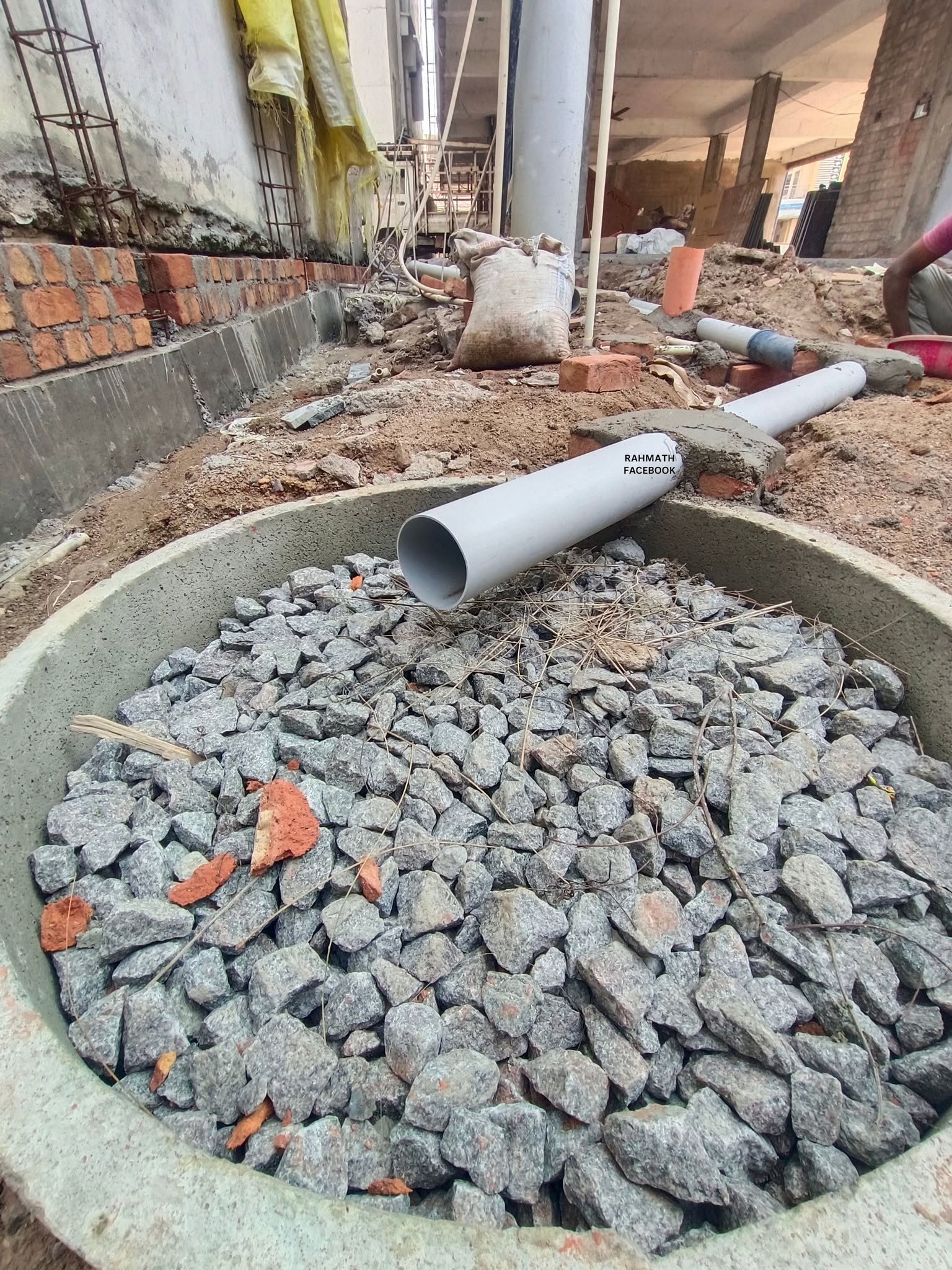
Persistent wet sections in back yards, especially in properties whose back lot lines face toward the commercial corridor. Water that moves across or under the commercial zone finds its way to the residential grade downslope from it. Properties whose backyards are in the path of that movement end up with sections that are wet more often and for longer than properties elsewhere in Greater Sudbury would be under the same rainfall conditions. The wet section isn’t coming from a high water table in the traditional sense — it’s coming from redirected surface and shallow subsurface flow from the impermeable commercial coverage nearby. The grass in that section consistently fails, moss establishes, and no amount of lawn treatment addresses it because the cause is hydrological, not agronomic.
Compaction patterns that are more severe than the property’s own traffic history would explain. In saturated soil, compaction occurs faster and penetrates deeper than in well-drained soil. Properties in the New Sudbury area that receive more moisture than they would on their own — because of the drainage dynamics from the surrounding development — end up with clay soil that stays wet longer and compacts more severely under normal foot traffic than the same soil in a better-drained location. When I do the heel press test on these properties, the result is often more extreme than I’d expect for a property that hasn’t received unusual equipment traffic. The compaction is being accelerated by the sustained moisture from external drainage, not just from the property’s own use patterns.
Grade problems that have developed or worsened over time. Older residential lots in the New Sudbury area were graded at the time of original construction based on the drainage assumptions in place when those houses were built — in many cases the 1960s and 70s. The drainage infrastructure of the surrounding commercial area has been modified, expanded, and redirected multiple times since then. In some cases, changes to the commercial drainage system have altered the flow patterns that the original residential grades were designed around. A grade that drained adequately in 1975 may not drain the same way today because something upstream in the drainage network has changed.
Foundation clearance issues that worsen faster than on comparable properties elsewhere. When soil stays wet longer because of external drainage contributions, the frost heave effects I described in the article on the 12-inch rule around foundations are more pronounced. Wet soil freezes with more expansion force than dry soil. Properties in this area that start with marginal foundation clearance can see that clearance close faster than comparable properties in better-drained parts of the city, because the soil against the foundation is holding moisture from external drainage sources in addition to normal rainfall.
Why the same symptoms show up on properties that seem unrelated to each other
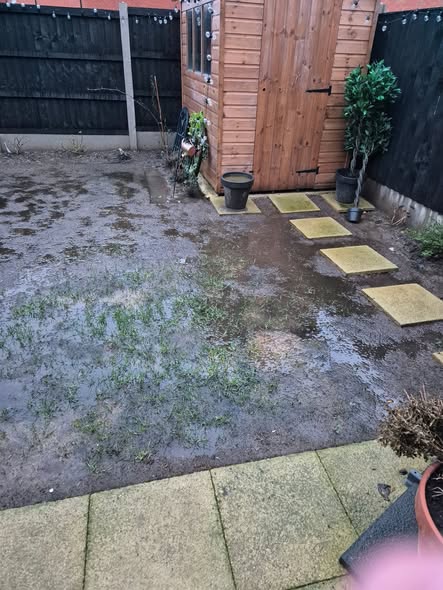
When I describe these patterns to homeowners in the New Sudbury area, a common reaction is surprise that their neighbours have the same problem. They assumed the wet corner or the compaction or the grade issue was specific to their property — something about their lot, their soil, their history. Finding out that three houses in a row have the same wet section in the same corner of the backyard reframes the problem in a way that’s actually useful for understanding what’s driving it.
Drainage patterns follow terrain and infrastructure, not property lines. If a drainage flow from the commercial corridor enters the residential area at a particular point and moves in a particular direction, it affects every property in that path — not just one. The homeowner at the upstream end of the flow sees the problem less severely. The homeowner in the middle sees it consistently. The homeowner at the downstream end, where the flow converges, sees the worst of it.
This shared drainage dynamic is also why individual property-level fixes have limited effectiveness when the underlying cause is external. Regrading one property’s back corner improves that specific property’s situation — but if the drainage source hasn’t changed, the adjacent property continues to receive the same flow, and over time the regraded property may receive diverted flow from neighbours whose grades are now higher. Addressing these problems properly sometimes requires coordination between properties or engagement with the city’s drainage infrastructure — particularly when the source of the problem can be traced to a storm sewer that’s operating at or near capacity during peak events.
I covered the diagnostic approach for identifying whether a yard problem is coming from the property itself versus from external sources in the article on the one thing I check before taking any new lawn customer in Sudbury — the drainage walkthrough that identifies external flow sources before any property-level work is recommended. On properties in the New Sudbury area, this check almost always produces useful information that changes what I recommend.
What to do if your property is in this area — the specific checklist
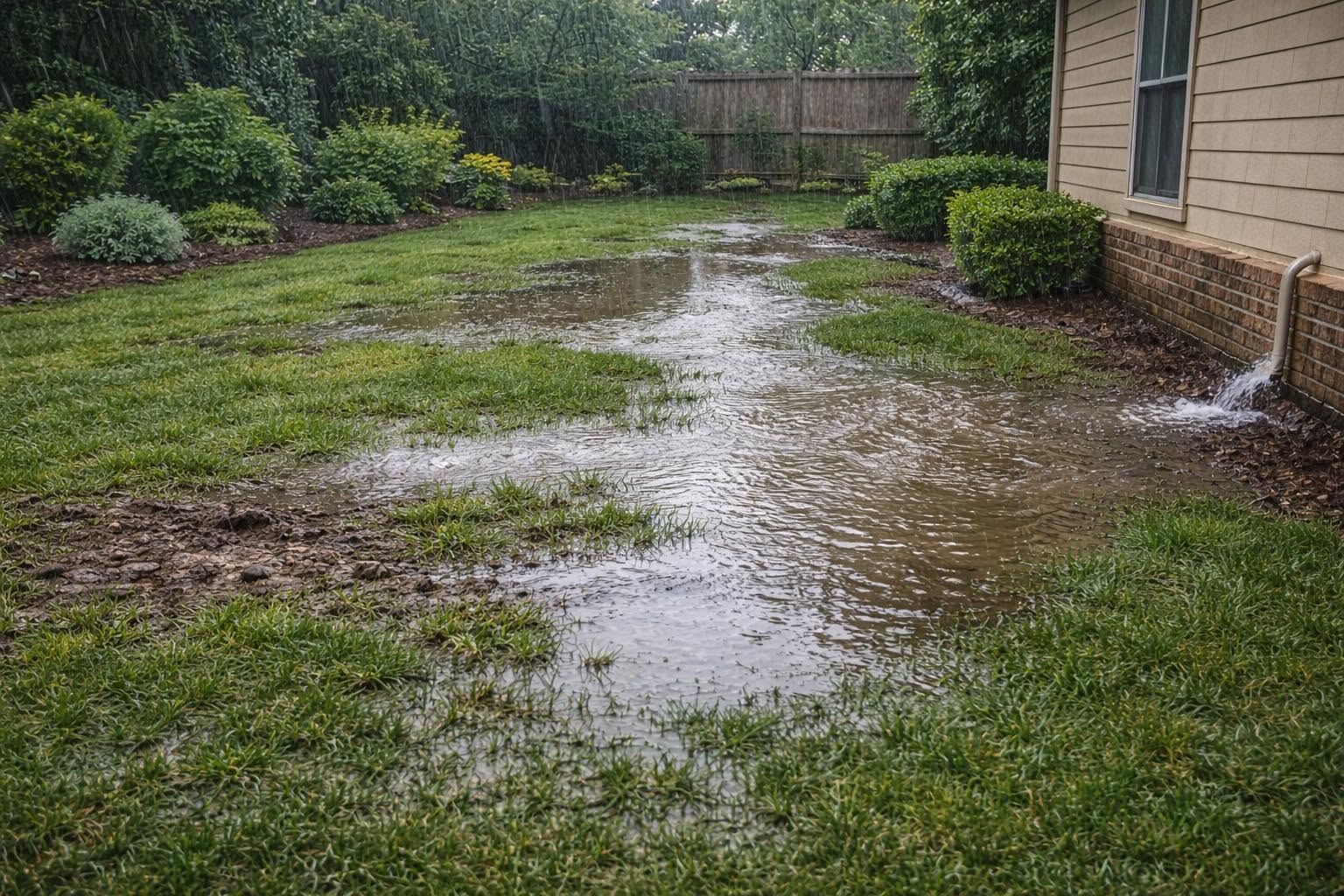
If you’re in a residential property near the New Sudbury Centre corridor and you’ve been dealing with persistent yard problems that haven’t responded to standard lawn care, here’s the specific checklist I’d work through.
Map where the water goes after rain. After the next significant rainfall — an inch or more — walk your property within twenty-four hours and note exactly where water is pooling, where it’s running, and where it seems to disappear into the ground. Do the same in the alley or lane behind your property if there is one. You’re trying to establish whether the water arriving in your yard is primarily from your property’s own impermeable surfaces (roof, driveway, patio) or whether there’s a clear flow arriving from adjacent properties or the street. External flow that you can see moving through or into your yard is the diagnostic indicator of a shared drainage problem rather than a purely local one.
Check the grade along your rear lot line. Specifically look for whether your grade at the rear lot line is lower than the grade at the lot line of the property behind or beside you. Water follows grade. If neighbouring properties are higher at the boundary, water flows toward you at that point. A visual assessment — or a simple level and tape measure if you want to be precise — tells you whether your rear section is receiving drainage from adjacent properties before you’ve done any other work. This is the grade relationship I look for as part of the full drainage assessment, the process I covered in the article on why terrain differences across Greater Sudbury produce different lawn conditions — the same terrain reading that explains community-wide differences also explains property-level drainage at a smaller scale.
Check your foundation clearance, especially at the rear and sides. If your property is receiving more external moisture than its drainage was designed for, the foundation perimeter is where that moisture accumulates most damagingly. The 12-inch rule is the minimum. On properties with confirmed external drainage contributions, I’d want to see 15 to 18 inches of clearance on the sides and rear of the property that face the drainage source. More clearance means more buffer time before the moisture reaches the foundation material.
Don’t aerate during or immediately after wet periods. Properties in this area that have saturated soil from external drainage are the exact properties where premature aeration does the most damage. Aerating saturated clay soil compresses the plug extraction channels rather than opening them, and the tines compact the soil face rather than cutting through it cleanly. Wait for the soil to firm — the heel press test I described in the article on the 4-hour spring window that determines your Sudbury lawn all year applies here — before doing any aeration on a property with persistent moisture from external sources. On these properties, the aeration window may open later in the season than on well-drained properties across the city.
Consider whether the persistent wet section is grass-viable at all. If a section of your yard has been receiving consistent external drainage contribution for years, it may have soil conditions — sustained saturation, oxygen depletion in the root zone, pH changes from anaerobic decomposition — that make it genuinely unsuitable for grass regardless of how well you manage the surface. The most honest assessment in those cases is whether the energy going into trying to maintain grass in that section would be better directed toward a solution that works with the wet condition rather than against it. A rain garden, a native wet-tolerant planting, or a permeable hardscape in that specific section may be more effective than continuing to invest in grass that the external drainage is going to keep defeating. I covered when it makes sense to stop fighting grass conditions and choose a different solution in the article on cottage lawn care around Sudbury lakes — the principle of matching the solution to the actual conditions rather than forcing grass into an unsuitable environment applies equally to these urban drainage situations.
Contact the city’s drainage department if you believe the issue traces to municipal infrastructure. Greater Sudbury’s Public Works department handles complaints and inquiries about storm sewer performance and municipal drainage infrastructure. If you can document that external flow is entering your property from a municipal source — a storm sewer outfall, a road drainage structure, a municipal right-of-way — the city has responsibility to assess that situation. This isn’t always a quick or simple process, but it’s the appropriate channel if the problem source is infrastructure rather than your neighbour’s grade.
If you’re in the New Sudbury area and you want an honest assessment of whether what’s happening in your yard is a lawn care problem or a drainage problem — and what the realistic approach is given what’s actually driving it — give me a call. I’ll walk the property, do the drainage read, and tell you what I actually see before recommending anything.
📞 705-507-6787 | Get a free quote online
— Ryan Lingenfelter
Owner, Cutting Edge Lawn & Landscaping
Garson, Ontario · 705-507-6787
