
By Ryan Lingenfelter · Cutting Edge Lawn & Landscaping, Garson, Ontario · June 2026
In five seasons of working properties across Greater Sudbury, one of the most consistent observations I’ve made is that lawns in Azilda green up and recover from winter meaningfully faster than lawns in Chelmsford — and that the difference isn’t random or property-specific. It shows up reliably, across different streets, different property ages, different maintenance histories. Two communities about fifteen minutes apart, and the spring lawn picture is genuinely different between them.
Most homeowners in both communities have noticed something similar — that their lawn is either ahead of or behind what people in the other area are experiencing — but haven’t had a clear explanation for why. The answer is soil and terrain, and understanding it changes how you time your spring lawn care decisions.
What the terrain difference actually is between these two communities
Azilda and Chelmsford are both in the western part of Greater Sudbury, but they sit on meaningfully different terrain with different underlying geology.
Azilda occupies slightly higher ground along the northern edge of the Sudbury Basin. Properties in Azilda generally have better natural drainage than the lower-lying terrain further into the basin — water moves off the land more readily, the water table is lower relative to the surface, and the soil profile drains faster after snow melt. The terrain has gentle to moderate relief that keeps water moving rather than pooling.
Chelmsford sits on terrain that was historically influenced by glaciolacustrine deposits — the fine-grained clay and silt sediments that settled at the bottom of ancient glacial lakes that occupied the Sudbury Basin after the last ice age. The Sudbury Basin has deeper soils than the surrounding terrain, and Chelmsford specifically is in an area where those deep basin deposits — including the formation that geologists actually named the Chelmsford Formation after this community — create a finer-textured, higher-clay soil profile than you find further north and west toward Azilda.
The practical difference between these two soil profiles shows up most dramatically in spring. Heavy clay soil holds water. After a Sudbury winter — months of frozen ground followed by rapid snowmelt — the clay-influenced soil in Chelmsford holds that melt water for significantly longer than the better-draining soil in Azilda. The Chelmsford soil takes longer to drain, longer to warm up to the temperatures needed for biological activity and root growth, and longer to firm up enough for maintenance equipment to work on it without causing compaction damage.
Azilda’s better-draining soil sheds the snowmelt faster. The ground firms up sooner. Soil temperature at four inches rises earlier in the season. The lawn wakes up and starts active growth a meaningful number of days ahead of a Chelmsford lawn under the same weather conditions.
Why Chelmsford soil takes longer to warm up and drain after winter
The physics behind the Chelmsford recovery delay come down to two properties of clay-heavy soil: water retention and thermal mass.
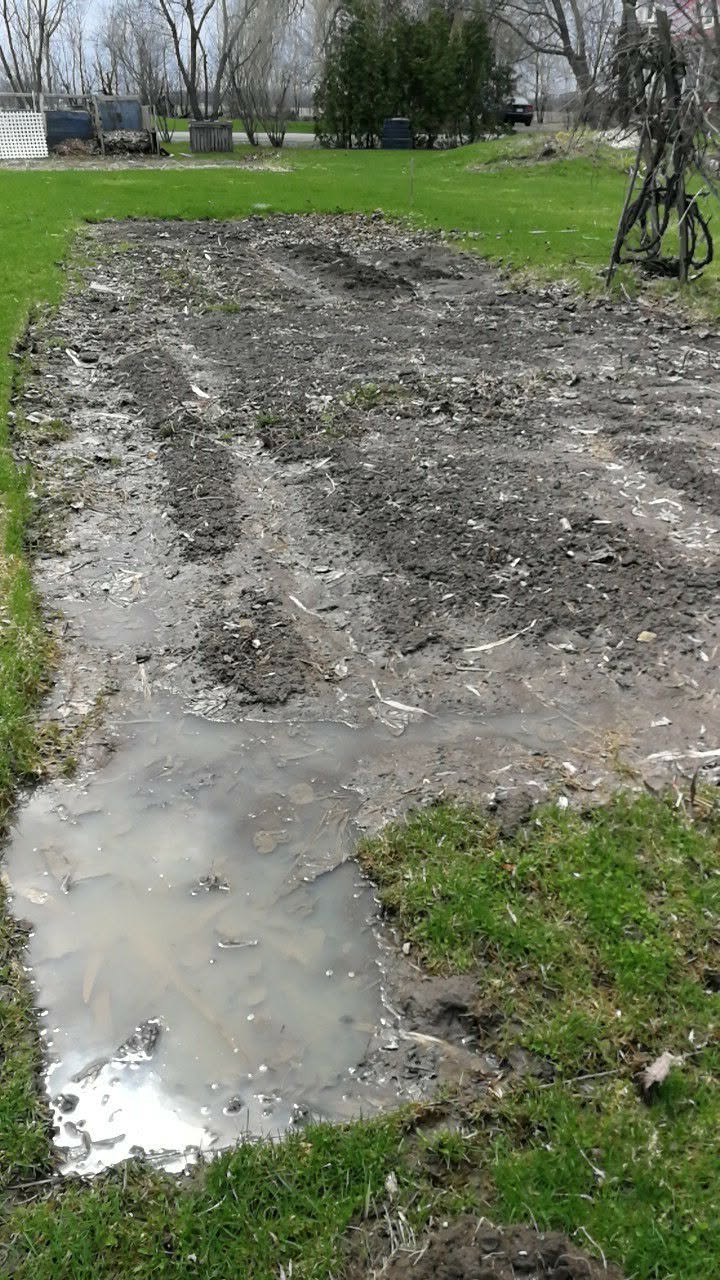
Water retention. Clay particles are much smaller and more electrically charged than sand or silt particles, which means they hold water molecules more tightly and release them more slowly. After spring snowmelt, a clay-heavy Chelmsford soil absorbs the melt water and holds it — not just on the surface, but throughout the soil profile. This water-saturated condition can persist for weeks in cool spring weather because clay doesn’t drain quickly even when drainage conditions are reasonable. The result is a soft, saturated lawn that’s vulnerable to compaction damage from foot traffic and equipment.
Azilda’s slightly coarser, better-draining soil sheds excess water much more quickly. The soil firms up within days of the snowmelt rather than weeks. You can walk on it, assess it, and begin work on it earlier without the compaction risk that saturated clay presents.
Thermal mass. Water has high thermal mass — it takes more energy to raise its temperature than to raise the temperature of dry soil. Chelmsford’s waterlogged clay soil in early spring is essentially a cold water reservoir sitting at or near zero degrees from the winter. Warming that saturated mass from zero to the 10+ degrees Celsius needed for meaningful grass root activity and seed germination takes significantly longer than warming the drier Azilda soil under the same spring temperatures.
The practical consequence: while air temperatures in Azilda and Chelmsford are identical on any given spring day — they’re fifteen minutes apart — the soil temperature at four inches in a Chelmsford lawn on May 1st may be three to five degrees cooler than the soil temperature at the same depth in an Azilda lawn. That temperature difference isn’t trivial. It means the biological activity that drives spring recovery — microbial processes, nutrient availability, root growth initiation — starts earlier in Azilda and later in Chelmsford. Everything downstream of that starting point — visible greening, density recovery, response to fertilizer — follows the same offset.
This is the specific soil science behind what I described more generally in the article on what Sudbury soil actually looks like and why it matters — the glaciolacustrine clay deposits in certain parts of the Sudbury Basin create conditions that are genuinely different from the terrain around them, and those differences have real practical consequences for how lawns behave.
What this means practically — what I see on properties in each community every spring
Here’s the ground-level version of how this plays out when I’m working in both communities in the same spring week.
In late April on a typical year, Azilda properties are already showing the first signs of active growth — the grass has started to green at the tips, the ground has firmed up enough to walk on without leaving footprints, and in warm springs the first cut of the season is approaching. The soil is workable. You could do light cleanup work without damaging the surface.
In the same week, on a Chelmsford property that I maintain under the same conditions, the picture is often different. The lawn may still be soft — pressing your heel in leaves a depression, which on clay soil means the moisture content is too high for equipment without compaction risk. The colour is often still the dull straw of emerging-from-dormancy grass rather than the first green of active growth. And if I pull on a small section to check for root activity, the roots are passive — not yet pushing new growth the way the Azilda grass already is.
The timing differential I consistently observe between Azilda and Chelmsford lawns in spring is roughly one to two weeks, depending on the specific year and how warm and dry the late April weather is. In a cold, wet spring — which Greater Sudbury gets regularly — the differential widens because Chelmsford’s clay holds the cold and wet longer. In a warm, dry spring, the differential narrows because the clay dries and warms faster than usual.
This timing difference has direct implications for when to do spring lawn work in each community. Aeration scheduled for May 5th that’s perfectly timed for an Azilda property may be a week too early for the same work on a Chelmsford property — not because May 5th is wrong for aeration in principle, but because the soil temperature and drainage conditions in Chelmsford on that date haven’t reached the threshold where aeration produces its full benefit. Pulling aeration plugs from cold, saturated clay produces shorter, less effective plugs than pulling from soil that’s at the right temperature and moisture content. I covered the temperature threshold and what it means for the late May aeration window in the article on the best time to aerate a Sudbury lawn — in Chelmsford specifically, I lean toward the later end of that late May to mid-June window rather than the early end.
The same offset applies to overseeding. Seed needs soil temperature at one inch to consistently exceed 10 degrees Celsius for reliable germination. In Azilda that threshold is typically crossed earlier than in Chelmsford under the same calendar conditions. Overseeding the third week of May on an Azilda property often produces excellent germination. The same week on a Chelmsford property may still be marginal — the soil is close to threshold but not reliably over it. Waiting until the last week of May or the first week of June in Chelmsford gives you better odds of consistent germination than pushing to match the earlier schedule that works in Azilda. The overseeding timing principles for Greater Sudbury generally are in the article on when to overseed a Sudbury lawn — the Chelmsford adjustment is to wait for the later end of that window rather than the early end.
How to work with your soil’s recovery pattern — not against it
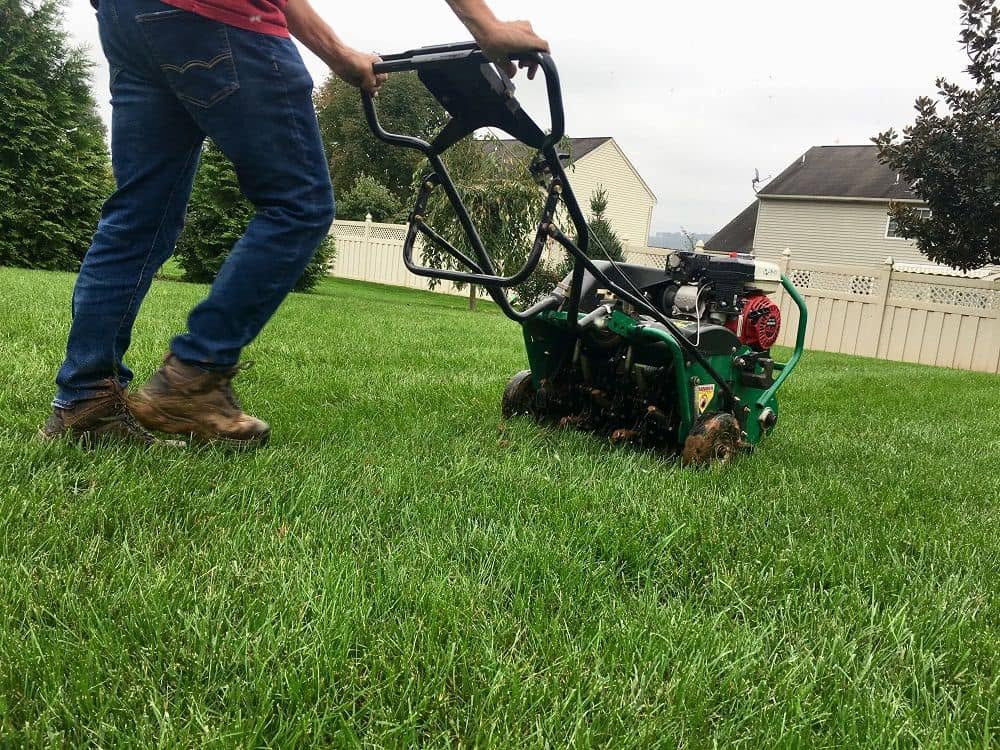
Whether you’re in Azilda, Chelmsford, or anywhere in between, the principle is the same: let the soil tell you when it’s ready rather than letting the calendar tell you. Here’s how I apply that practically in both communities.
The walk test before any spring equipment work. Before scheduling aeration, dethatching, or any work that involves equipment on the lawn, walk across the property and press your heel in firmly in four or five spots. If you leave a depression that doesn’t spring back — if the soil is soft enough that your heel sinks — the moisture content is still too high for equipment without compaction risk, particularly on clay-heavier Chelmsford soil. Wait another week and test again. If the heel press leaves no depression, or only a slight one that partially rebounds, the soil is ready. In Azilda this test passes earlier. In Chelmsford it passes later. Both are fine — just different timelines.
The screwdriver test for aeration readiness. Push a standard screwdriver into the soil and try to reach six inches. On well-drained Azilda soil in late May, a screwdriver typically reaches six inches with moderate pressure. On still-saturated Chelmsford clay in early May, you may only reach three or four inches before the soil is too dense to push through — not because of compaction, but because water-saturated clay is mechanically resistant in a way that warm, well-drained soil isn’t. If you can’t push a screwdriver to six inches with moderate pressure, wait. Aeration tines that can’t reach proper depth produce shorter plugs and less effective results than aeration done when the soil is ready.
The fertilizer timing adjustment for Chelmsford. Applying fertilizer to cold, wet Chelmsford soil in early May doesn’t produce the response that the same product applied to warmer, drier soil in late May does. The biological activity that makes nutrients available to grass roots starts at soil temperatures above 8 to 10 degrees Celsius. In Chelmsford’s cold, saturated spring soil, you may be applying fertilizer to a biologically inactive medium — the nutrients sit there until the soil warms enough to process them, by which point they may have partially leached. Hold the spring fertilizer application in Chelmsford until after the soil has warmed and drained — late May to early June is the right target. The same product applied then produces a dramatically more visible response than the same product applied four weeks earlier when the soil wasn’t biologically ready. I covered why fertilizer timing matters more than product choice in the article on what I tell Sudbury homeowners about fertilizing.
For Chelmsford specifically — manage compaction more actively. The clay-heavy soil that slows spring recovery is the same soil that compacts more aggressively under traffic than Azilda’s better-draining profile. Annual aeration is important in Azilda. In Chelmsford it’s close to essential — the compaction accumulation rate on clay-heavy soil without annual aeration is fast enough that two or three missed years produces significant root depth restriction. The lawn in Chelmsford that gets aerated every May will out-recover its winter dormancy faster each subsequent year as the soil structure improves from consistent treatment. The one that doesn’t aerate will slow down its spring recovery progressively as compaction tightens. The difference between these two trajectories over five years is significant and is the main reason I recommend annual aeration more strongly to Chelmsford clients than to Azilda clients at the same starting point.
For Azilda — don’t mistake faster recovery for permission to skip preparation. Azilda lawns green up faster and dry out faster in spring, which can create a false sense that the soil is in better shape than it actually is. Faster drainage doesn’t mean less compaction. The clay content in Azilda soil, while lower than in Chelmsford, is still higher than in truly sandy soils, and annual aeration is still the right call. The faster spring recovery just means the window opens earlier — not that you need less of what goes into that window.
If you’re in Azilda or Chelmsford and you want to understand exactly where your specific property sits — what the soil is doing, when it’s actually ready for spring work, and what sequence makes sense for your situation — give me a call. I’ve been working both communities long enough to know the differences and adjust accordingly.
📞 705-507-6787 | Get a free quote online
— Ryan Lingenfelter
Owner, Cutting Edge Lawn & Landscaping
Garson, Ontario · 705-507-6787
