
By Ryan Lingenfelter · Cutting Edge Lawn & Landscaping, Garson, Ontario · June 2026
Most lawn care companies quote a new customer the same way. They walk the property, measure the square footage, look at any obvious obstacles, and give you a price. The whole visit takes five minutes. They’re pricing a service, not assessing a lawn.
I do something different before I accept any new customer. It takes about ninety seconds. It doesn’t cost anything. And it’s the single most important thing I do on a quote visit — not because it helps me price the job, but because it tells me whether maintaining that lawn will actually produce the result the homeowner is expecting.
Here’s what it is, why I do it, and what it means for you if you’re looking for lawn care in Greater Sudbury.
What most lawn care companies do on a quote visit — and what I do instead

A standard lawn care quote visit in Sudbury goes like this. The company rep walks the perimeter, notes the rough dimensions, looks for gate width and equipment access, asks what services you want, and gives you a price. Sometimes they take photos. Sometimes they ask about existing problems. Usually they’re back in their truck within five to ten minutes.
That process prices a job. It doesn’t evaluate whether the job will succeed.
The problem with that approach is that a lawn care service applied to a property with an underlying structural problem — drainage failure, severe compaction, inadequate topsoil — will produce disappointing results regardless of how well the service is executed. The grass stays thin. The same sections fail every season. The homeowner is paying for maintenance on a lawn that can’t respond to maintenance properly. The company keeps cutting and collecting payment. Nothing improves.
I’ve seen this dynamic play out on properties across Greater Sudbury. Homeowners who’ve had the same lawn care company for two or three years and the lawn looks essentially the same as when they started — or worse. Not because the company was doing bad work, but because nobody diagnosed the underlying problem before the maintenance contract started.
The check I do on every new customer visit is the thing that would have caught those problems before the contract started. It takes ninety seconds. Most companies don’t do it because it’s not necessary to price a job — and pricing the job is all most companies are there to do.
The one thing I check — and why it determines everything
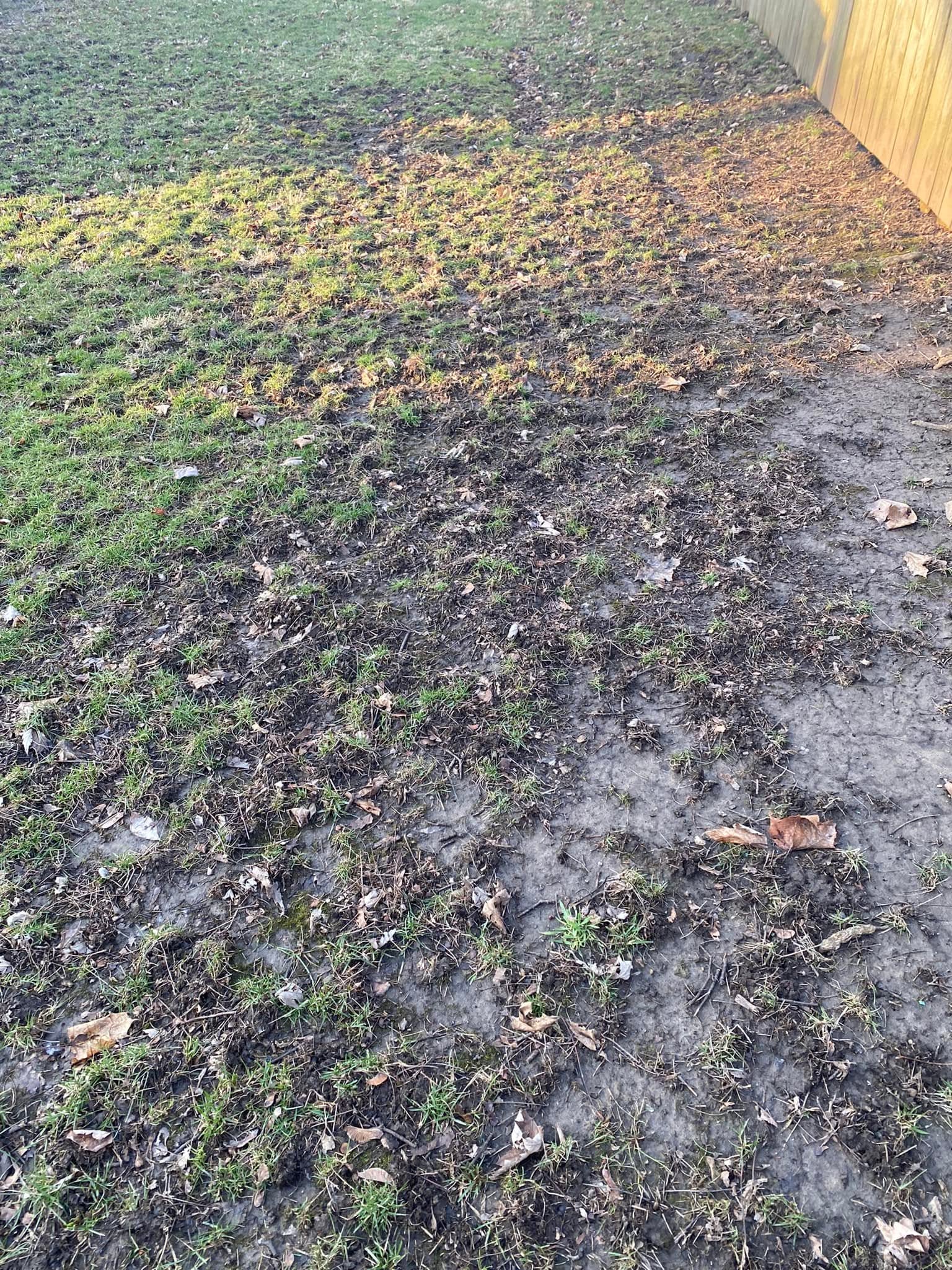
The check is drainage. Specifically — I look at whether water moves off this property correctly after rain, or whether it collects somewhere it shouldn’t.
I do four things in sequence. The whole process takes sixty to ninety seconds once you’ve done it enough times.
First — I walk the perimeter and look at the grade. Does the lawn slope away from the house foundation? Are there obvious low points where water would collect? Is there a corner, a fence line, or a section near a neighbour’s property that sits lower than everything around it? Grade problems are often visible just from walking the perimeter with your eyes open to elevation changes.
Second — I look for moss. Moss doesn’t lie. Anywhere moss is establishing on a Sudbury lawn — especially in a defined area rather than scattered randomly — there is persistent moisture. The grass in that area is wet more consistently than grass can tolerate. Moss is the indicator species for a drainage problem that hasn’t been identified yet.
Third — I press my heel into the soil in any suspect area. Soil that gives too easily — that soft, slightly spongy feel even on a day without recent rain — has water in it that isn’t leaving. That feeling, in a defined section of the lawn, tells me there’s either a drainage failure underground or a grade directing water into that spot and keeping it there.
Fourth — I ask the homeowner directly. “Is there any part of the yard that stays wet or soft longer than the rest after it rains?” Most homeowners know exactly what I’m about to describe before I finish the sentence. They’ve been walking around that corner or avoiding that section for months. They just didn’t know it mattered for lawn maintenance.
The reason drainage determines everything is that no lawn care service — no amount of cutting, fertilizing, aerating, or overseeding — produces lasting results on a lawn with unresolved drainage failure. The grass in that section keeps dying because the soil conditions keep killing it. Not because the maintenance is wrong. Because the water that shouldn’t be there keeps coming back.
I went into the full detail of what drainage failure looks like from the surface and what it takes underground to create it in the article on the Sudbury property where I found drainage problems underground — a case where every symptom on the surface traced back to a collapsed pipe that nobody had found for years. The lawn care on that property had been good. The drainage underneath it had not.
What I’ve found when I do this check — and what it’s saved me from

In six seasons of doing this check on every new customer visit, I’ve found significant drainage problems on a meaningful number of properties. Some were obvious — standing water marks on the fence, moss across a full corner section, soil so soft it left footprints on a dry day. Others were subtle — a slight low point that I only noticed because I was looking for it, or a homeowner comment about a section that “always takes forever to dry out after rain.”
In each of those cases, the drainage check changed what happened next. Instead of starting a maintenance contract on a lawn with a hidden problem, I had an honest conversation with the homeowner about what I’d found and what needed to happen before regular maintenance would produce the results they were expecting.
Some of those conversations led to drainage correction work first — regrading a section, extending a downspout, in one case excavating to find and repair a failed underground pipe. After the drainage was fixed, the maintenance contract started on a property that could actually respond to it.
Some of those conversations led to a homeowner deciding they weren’t ready to address the drainage problem yet — and me declining to take the maintenance contract until they were. Not because I didn’t want the work, but because taking a maintenance contract on a property with a known unfixed drainage problem means collecting payment for a service that won’t deliver what the homeowner is paying for. I’ve written about the situations where I tell Sudbury homeowners not to hire me in the article on why I sometimes turn down lawn care jobs in Sudbury — the drainage situation is one of the clearest examples of when professional maintenance isn’t the right answer yet.
What the check has saved me from is the pattern I described above — a homeowner paying for maintenance month after month, the lawn not improving in the sections that were always going to fail, and eventually a frustrated customer who feels like the service didn’t work. It almost always did work on the sections without drainage problems. It just couldn’t work on the section with an unfixed structural issue. That conversation is much harder to have after six months of a maintenance contract than before it starts.
The check also occasionally finds things the homeowner knows about but assumed weren’t relevant to lawn care. One property in Hanmer had a consistently soft section along the back fence that the homeowner had dismissed as “just how that corner is.” When I pressed into the soil there and felt how saturated it was, then asked whether it had always been like that — she said yes, for as long as she’d owned the property. That corner had been failing at grass for years. She’d been overseeding it annually, spending money on seed that couldn’t establish in waterlogged soil. The fix was a simple grade correction that redirected the water from the neighbour’s property that was draining into that corner. After the correction, the overseeding she did the following spring took fully for the first time. Same seed. Same application. Different drainage outcome.
What this means for you as a homeowner looking for lawn care in Sudbury
If you’re evaluating lawn care companies in Greater Sudbury, the drainage check is a useful test for how thoroughly a company is actually assessing your property versus just measuring it for a price.
Ask them directly: did you check the drainage? Did you notice any areas where water might be collecting or not moving off the property properly? Do you see anything that would prevent this lawn from responding to regular maintenance?
A company that assessed your property properly will have answers to those questions — even if the answers are “no, the drainage looks fine throughout.” A company that just measured for square footage won’t, because they weren’t looking for it.
This matters because the quality of the initial assessment determines the quality of the service that follows. A company that catches a drainage problem before starting a contract will either address it first or tell you honestly that maintenance won’t produce the expected results until it’s fixed. A company that misses it will maintain a lawn that keeps partially failing and collect payment for a service that can’t fully deliver.
The same principle applies to the other checks I do in the first sixty seconds and first five minutes on any property — the colour read, the edge assessment, the thatch check, the root depth pull. I walked through all of those in the article on what I notice in the first 60 seconds on any Sudbury property. The drainage check is the one I’d add specifically to the question of whether to accept a new maintenance customer — because it’s the problem that most reliably prevents lawn care from working regardless of how well everything else is done.
If you want a quote visit that includes a proper assessment — not just square footage and a price — give me a call. I’ll walk the property, do the drainage check, tell you what I find, and give you an honest read on what the lawn needs before any service starts.
That conversation is free. It takes about thirty minutes. And it’s the difference between starting a maintenance relationship with accurate expectations or spending a season finding out the hard way what wasn’t caught at the beginning.
📞 705-507-6787 | Get a free quote online
— Ryan Lingenfelter
Owner, Cutting Edge Lawn & Landscaping
Garson, Ontario · 705-507-6787
