

By Ryan Lingenfelter · Cutting Edge Lawn & Landscaping, Garson, Ontario · June 2026
I’ve been walking Sudbury lawns since 2020. Hundreds of them — quote visits, assessment calls, emergency calls in August from homeowners whose lawns had gone wrong. After enough repetitions, the first sixty seconds on a property tell you most of what you need to know before you’ve touched anything.
Not everything. But most.
People sometimes ask me during quote visits how I can tell so quickly what’s going on. The honest answer is pattern recognition — the same problems show up in the same ways often enough that you start reading them almost automatically. The colour of the grass. Where the stress is concentrated. How the edges look. The way the surface responds when you walk across it.
None of this is complicated. It’s just a checklist that most homeowners have never been given. So here it is — exactly what I look at in the first sixty seconds on any Sudbury property, what each thing tells me, and how you can use the same read on your own lawn.
The first thing I look at — colour and what it tells me

Before I get out of the truck I’m already reading the colour of the lawn. Not the general greenness — the specific shade and quality of the colour, because different problems produce different colour signatures.
Pale yellow-green, uniform across the whole lawn. This is the most common colour I see on struggling Sudbury properties. Uniform paleness — not patchy, not in sections, but a general dullness across most of the surface — almost always means one of two things: cutting height is too low, or the lawn is significantly compacted and struggling to process nutrients efficiently. These two problems often appear together. At two inches or below, the grass blade doesn’t have enough surface area to produce good colour. At the same time, compacted soil is limiting fertilizer uptake so even a fed lawn looks underfed. I’ve covered what cutting height does to a Sudbury lawn over a full season in the article on the lawn that looked fine in May and was dead by August — the colour progression from pale to yellow to brown follows directly from this.
Blue-grey tint, especially visible in afternoon. This is an acute stress signal. Grass turns blue-grey when it’s losing more water than it’s taking in — the plant is beginning to close its stomata to conserve moisture. You’ll see this most in the height of summer during a dry stretch. A blue-grey lawn is telling you it needs water within the next twelve to twenty-four hours. If it stays blue-grey despite watering, the water isn’t reaching the roots — which means either thatch is blocking it or the roots are too shallow to access what’s being applied. Both of those underlying causes are something I look for in the more detailed assessment that follows the sixty-second read.
Uneven colour — dark green in some sections, pale or yellow in others. Patchy colour variation usually indicates an inconsistent history — sections that were treated differently, areas with different soil depth or drainage, spots that had previous damage (grub damage, vehicle traffic, something sitting on the lawn) that never fully recovered. Patchy colour tells me to look at each section separately rather than treating the lawn as a uniform system.
Deep consistent green, even density. A healthy lawn. It sounds obvious but it’s worth stating — a correctly maintained lawn in Greater Sudbury is a consistent mid-to-deep green from edge to edge. When I see this I’m already thinking about what’s keeping it there and whether the maintenance approach is sustainable, not about what’s wrong with it.
Colour takes about five seconds to read from the street. In those five seconds I already have a hypothesis about what category of problem — if any — I’m walking into.
The second thing — edge quality and what it reveals about the whole property
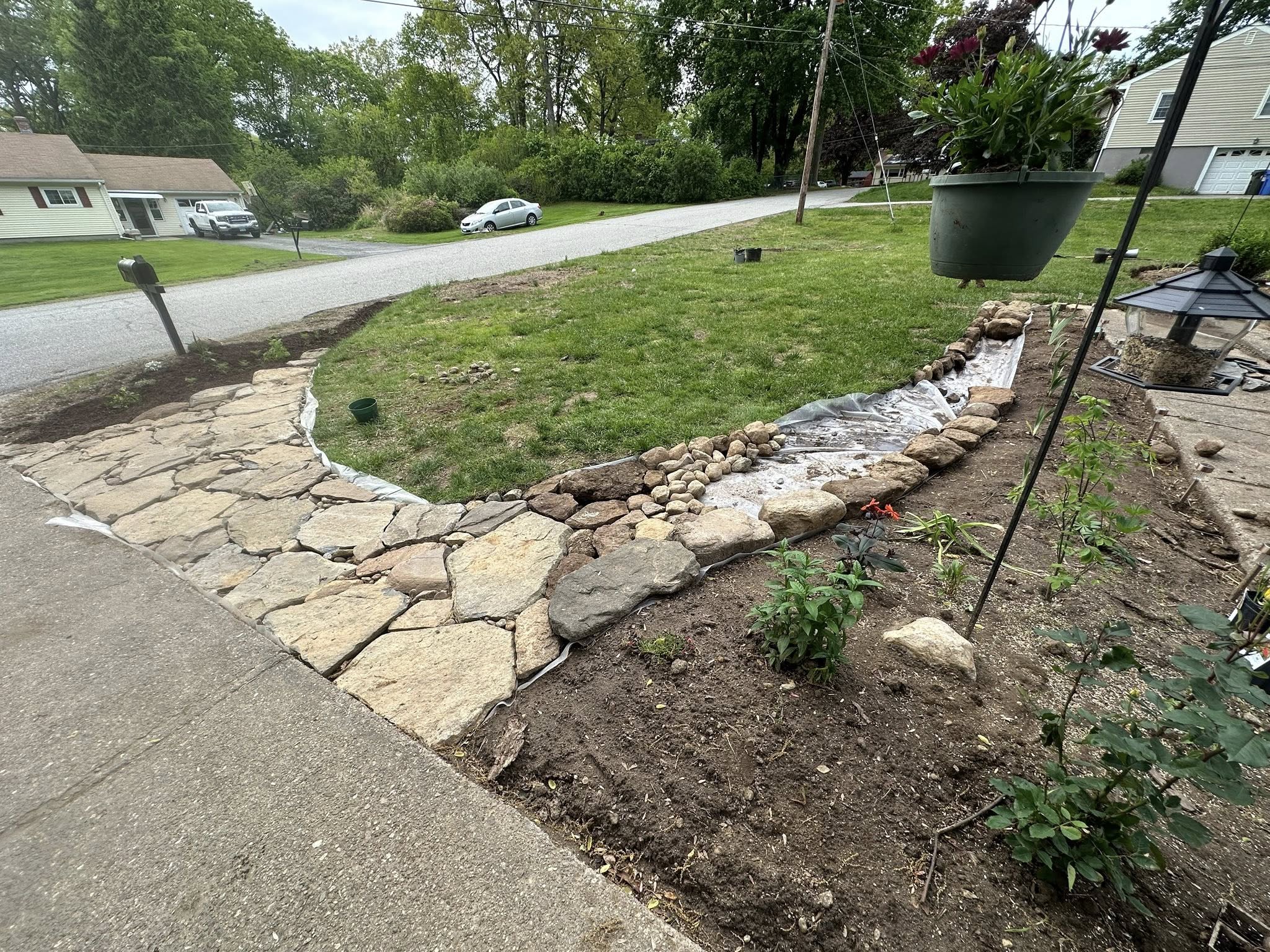
Edges are a diagnostic tool that most homeowners underestimate. The quality of edging along the driveway, walkways, and fence line tells me something important about how the lawn has been maintained — not just aesthetically, but practically.
Sharp, clean edges along hard surfaces — a defined line where the grass meets the driveway or walkway, maintained consistently — tell me the person or company doing the maintenance is paying attention to detail. It takes time and equipment to edge properly. When it’s being done well, other things usually are too: consistent cut scheduling, correct height, proper cleanup. Edge quality is a proxy for overall maintenance discipline.
Ragged, spreading edges — where the grass has crept two or three inches onto the driveway, or where the edge line is soft and uneven — tell me the detail work has been skipped. And when detail work is being skipped, I start looking harder at everything else. Is the cutting height correct? Is the thatch being managed? Has the lawn been aerated recently? Usually the answer to at least one of those is no.
Edges along garden beds are particularly telling. A clean, defined edge between the lawn and a planting bed means someone has been actively maintaining the border — either with a spade or a mechanical edger. When the bed border has disappeared and the lawn is growing into the mulch, it usually means the maintenance has been inconsistent or incomplete for at least one full season.
What edge quality doesn’t tell me is what to do about the lawn’s health problems. It just adjusts how carefully I look at everything else. A property with perfect edges but pale colour gets the same root depth check and thatch assessment as a property with ragged edges. The edges just set my expectations for what I’m likely to find.
Edge quality also matters practically for what the lawn will look like at any given moment regardless of grass health. A thin lawn with sharp clean edges reads as maintained. A thick healthy lawn with ragged edges reads as neglected. The edges are the frame. I touched on this in the wedding preparation article — the Val Caron backyard we prepared for an outdoor wedding — where the deep edging we did on day one produced an immediate visual transformation before we’d even made the first cut. Edges matter more than most homeowners realise.
The third thing — the pattern of where problems are concentrated
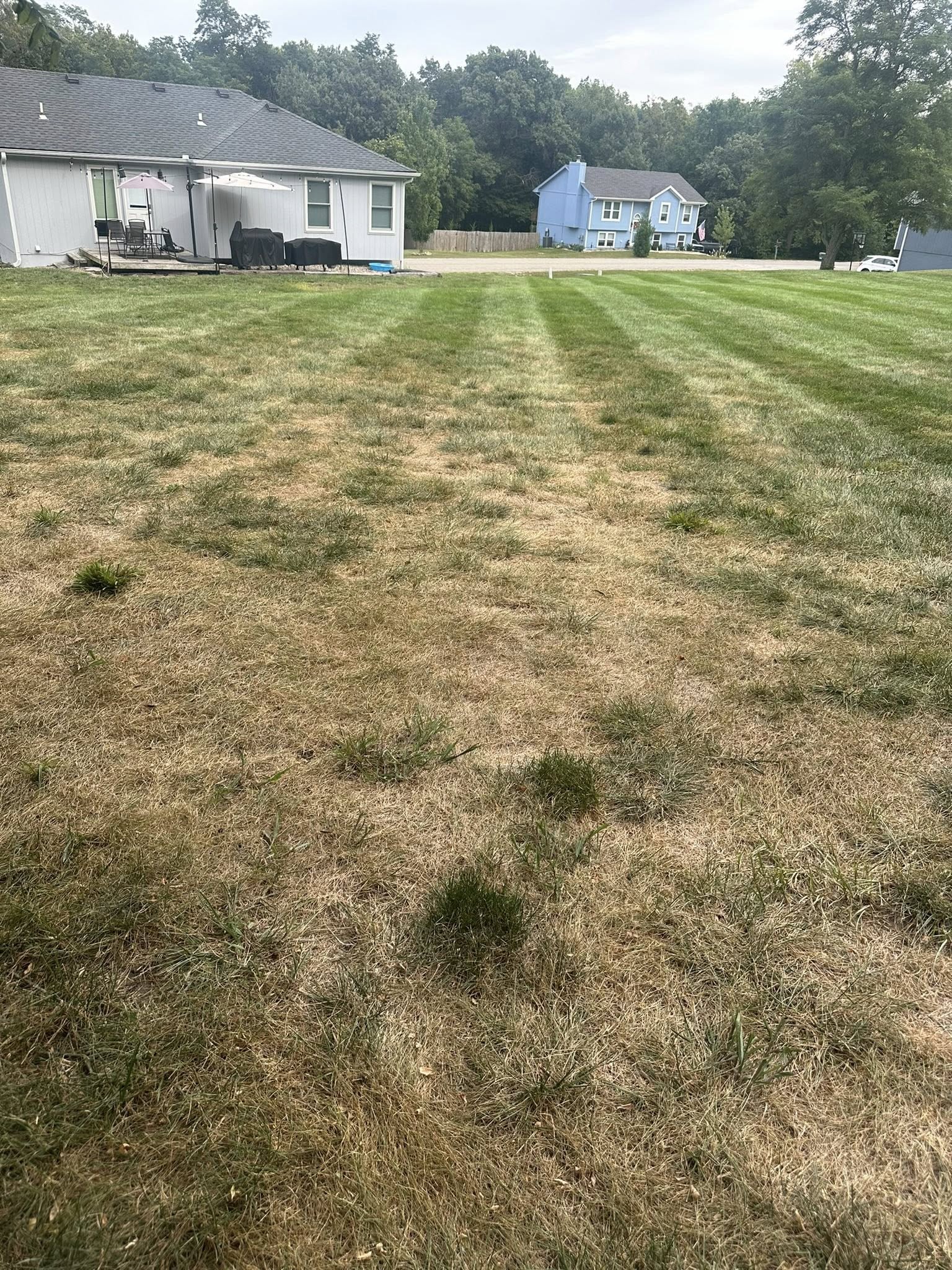
The location of stress or damage on a lawn is as diagnostic as the nature of the damage itself. I’m looking at where the problems are — not just what they look like — because the geography of the problem tells me what’s causing it.
Stress concentrated along the sunny side of the yard. A defined strip of browning or thin grass on the south or west-facing section while the rest of the lawn is relatively healthy. This almost always means shallow roots. The sun-facing section dries out faster than the shaded sections, and a lawn with roots at one to two inches simply doesn’t have the depth to hold moisture through afternoon heat on that side. The shaded sections look better not because they’re healthier but because they’re not being stressed as hard. Both sections have the same shallow root problem — the shaded section just hasn’t hit its failure threshold yet. The fix is root depth, which means aeration and correct cutting height — exactly what I covered in the article on the 10 free assessments I did across Sudbury where compaction and shallow roots appeared on every single property.
Stress concentrated in high-traffic areas. Paths where dogs run, the strip alongside the driveway where people walk to their cars, the area near the back door. Compaction under repeated traffic is the cause. The rest of the lawn may look fine. The traffic areas are hardpan. The fix is targeted aeration in those specific sections — sometimes a double pass — plus overseeding to fill in where the grass has been worn away. I covered the most extreme version of this in the property assessment article — a Hanmer lawn with a large dog where the compaction in the traffic paths was the worst I found across ten properties.
Stress concentrated in a specific corner or low area. Same section fails every year. Moss establishing at the edges. The grass there is a different, duller shade than the rest of the lawn. This pattern points to drainage — water collecting in that area and staying there long enough to exclude the oxygen that grass roots need. This is not a lawn care problem. Surface maintenance won’t fix it. The drainage or grading needs to be addressed first. I went through exactly what underground drainage failure looks like from the surface — and why it gets misdiagnosed as a soil or maintenance problem — in the article on the Sudbury property where I found drainage problems underground.
Stress scattered randomly across the lawn with no geographic pattern. Random distribution of thin or dead patches without a clear location logic usually points to one of three things: thatch (which creates inconsistent water penetration across the surface), grub damage (which kills roots in irregular patterns as the grubs feed), or inconsistent past treatments (fertilizer or weed control applied unevenly). Of these, thatch is by far the most common in Greater Sudbury — I found it on 38 of 52 properties in my spring assessment round, as I described in the article on what I found on 52 Sudbury lawns this spring.
What I do in the next five minutes after those first 60 seconds

The sixty-second read gives me a hypothesis. The next five minutes confirm or revise it. Here’s the sequence.
The heel press test. I walk across the lawn pressing my heel down firmly in four or five spots — a sunny open section, a shaded section, a high-traffic area, and the problem area if there is one. Soil that barely gives means compaction. Soil that gives too easily in a specific spot means moisture retention or drainage issue. Soil that gives appropriately — firm but not hard — is in reasonable condition. Five seconds per spot, four spots, twenty seconds total. By the end of this I know the compaction profile across the property.
The thatch check. I crouch down in an open section, part the grass with my fingers, and push toward the soil surface. If my fingers reach soil easily with minimal resistance, the thatch is under half an inch and not a significant issue. If I feel a dense springy layer before reaching soil, I measure it — under half an inch is fine, half an inch to an inch is worth managing, over an inch needs active intervention. This takes about thirty seconds. I do it in two or three spots across the property to get a representative picture. The full explanation of what thatch does to a lawn over a Sudbury summer — and why it’s so consistently underdiagnosed — is in the article on what I found on 52 Sudbury properties.
The root pull. In any section that showed stress on the colour or pattern read, I pull a small plug of turf and hold it up. Root depth is the single most important number for predicting how a lawn will perform through a Sudbury summer. Under two inches means the lawn is one bad heat stretch away from serious damage. Two to four inches is functional but below optimal. Four to six inches is healthy and resilient. The root pull takes ten seconds and confirms whether the problem I identified in the sixty-second read is a surface issue or a soil depth issue.
The mower check. If there’s a mower on the property — in a garage or shed — I ask to see the deck height setting. This one action resolves ambiguity in more cases than any other single check. A mower set below two and a half inches explains pale colour, shallow roots, summer browning, and weed pressure simultaneously. Knowing the cutting height tells me whether the primary fix is free — move the deck lever — or requires professional intervention. I’ve written about how consistently wrong cutting height shows up as the root cause of lawn problems across Greater Sudbury in the article on the homeowner whose lawn problem was a 10-second fix and in the story of the homeowner I stopped to help who wasn’t my customer — both cases where the mower deck was the entire diagnosis.
After those five minutes I have a complete picture: compaction level, thatch depth, root depth, and cutting height. Combined with the colour and pattern read from the first sixty seconds, I can tell a homeowner exactly what their lawn needs, in what order, and why. Not a guess. A diagnosis based on what I actually found.
If you want me to do this assessment on your property — walk it, check everything, tell you what I find — give me a call. No charge, no obligation. I’ll come out and tell you exactly what I see.
📞 705-507-6787 | Get a free quote online
— Ryan Lingenfelter
Owner, Cutting Edge Lawn & Landscaping
Garson, Ontario · 705-507-6787
