
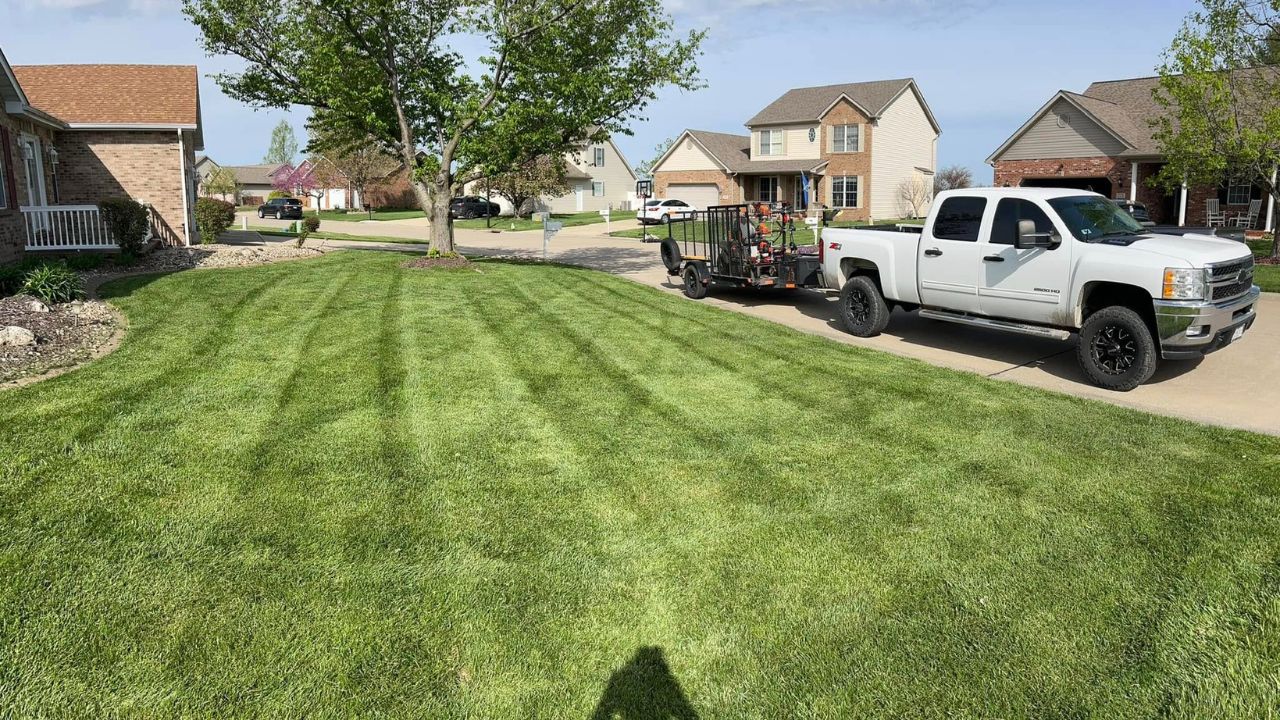
By Ryan Lingenfelter · Cutting Edge Lawn & Landscaping, Garson, Ontario · June 2026
In six seasons of working lawns across Greater Sudbury, I’ve come to think of late May as a single window — not a period, not a season, but a specific window that opens and closes faster than most homeowners realise. What you do inside that window determines the trajectory of your lawn for the entire growing year. What you skip inside it, or do too early, or do too late, you’re compensating for all season.
The window itself takes about four hours to work through if you’re doing it right. Not four days. Not four weekends. Four hours of focused, correctly sequenced work on one late May morning is the single most impactful thing you can do for a Sudbury lawn all year.
Here’s what’s in that window, how to know it’s open, what most people get wrong about it, and exactly what the four hours look like when they’re done correctly.
What the 4-hour window actually is — and what happens in it
The four-hour window is the convergence of three conditions that only exist simultaneously for a specific period in late May in Greater Sudbury. When all three are present at the same time — and you take advantage of them in a specific sequence — the work you do produces results that are dramatically better than the same work done before or after the convergence.
Condition one: soil temperature at four inches has crossed 10 degrees Celsius and is holding. Below this threshold, the biological activity that makes lawn inputs work — microbial decomposition of thatch, root growth initiation, nutrient uptake — is slow or dormant. Fertilizer applied to cold soil sits. Seed germinated in cold soil produces weak seedlings that struggle to establish. Aeration done when the soil is still cold and saturated doesn’t produce the full-depth plug extraction that makes aeration effective. At 10 degrees and above, all of that changes. The soil is biologically alive. Inputs work the way they’re supposed to.
Condition two: the soil has drained and firmed from snowmelt and spring rain but hasn’t yet dried to the point of surface hardening. There’s a specific moisture range in late May when soil is at its most workable. Not saturated — which damages soil structure when you work equipment on it and produces shallow, compressed aeration plugs. Not dry — which makes aeration tines work harder and produce shorter plugs while the surface cracks resist seed settling into contact with soil. The late May window typically catches this moisture range in Greater Sudbury because snowmelt has had time to drain but July’s drying heat hasn’t arrived yet.
Condition three: the grass is in active growth but hasn’t yet been stressed by summer heat. Late May grass is growing hard — actively pushing new blade and root material, metabolically ready to respond to inputs. Aeration done when the grass is growing actively produces faster recovery from the disturbance. Overseed dropped into active-growth conditions germinates and establishes faster than seed dropped in marginal conditions. Fertilizer taken up by actively growing roots produces a visible response within weeks rather than sitting until conditions improve.
When these three conditions are present simultaneously, a four-hour sequence of aeration, overseeding, and starter fertilizer produces results that wouldn’t be achievable by doing any of those things separately, or by doing all of them in a different order, or by doing them outside this specific window.
In Greater Sudbury, that convergence typically occurs between May 20 and June 10 in most years. Some years a warm spring opens it earlier. A cold wet spring delays it. But that three-week range is where I plan my entire spring booking schedule — every aeration job, every overseeding, every starter fertilizer application — because hitting the convergence is worth rearranging everything else to achieve.
How to know the window has opened on your specific Sudbury property

The window doesn’t open on the same date for every property. The terrain and soil type variation across Greater Sudbury means a property in Azilda — on better-draining higher ground — may be ready a week before a property in Chelmsford on clay-heavy soil. A south-facing slope warms faster than a north-facing low-lying area. A property with established tree cover retains soil moisture longer than an open property in the same neighbourhood.
These are not abstractions — they’re the specific differences I described in the article on why Azilda lawns recover faster than Chelmsford lawns after winter. The window opens at a different point in the season on different properties, and chasing the calendar rather than the conditions is one of the most consistent timing errors I see.
Here are the three checks I do to confirm the window is open before booking any aeration and overseeding work on a property.
The screwdriver test. Push a standard screwdriver into the soil and aim for six inches. If it reaches six inches with moderate hand pressure — not forcing, not wrestling with it, just steady pressure — the soil temperature and moisture content are in the right range. If it stops at three or four inches despite moderate pressure, either the soil is still too cold and dense, or it’s too dry and the surface has hardened. Both mean wait. This test takes thirty seconds. I do it in three spots across the property — a sunny section, a shaded section, and a section that drained last — because the window may be open in part of the property and not yet in another part.
The heel press test. Press your heel firmly into the lawn surface and lift. If you leave a clear depression that doesn’t spring back, the soil is still too wet — equipment will compact the surface and produce compromised aeration results. If the surface springs back mostly within a few seconds, the moisture is right. If the surface is completely rigid with no give at all, it’s too dry. The right condition is a surface that yields slightly to heel pressure but rebounds within a few seconds — firm but not hard, moist but not saturated.
The growth check. Is the grass actively growing? Not just green — actively extending. Blades that are clearly longer than they were a week ago. Tips that are fresh and upright rather than the blunted, weathered tips of winter-dormant grass. Active growth tells you the grass is in the metabolically engaged state where it will respond to aeration disturbance by filling in the holes rather than leaving them open for weeks. It tells you seed dropped now will germinate into actively supporting conditions rather than just sitting and waiting.
When all three checks pass — screwdriver to six inches, heel press springs back, grass actively growing — the window is open. Book the work for as soon as possible from that point.
What most Sudbury homeowners do wrong with this window — and what it costs them
The most consistent timing error I see across Greater Sudbury is doing the right things outside the window — usually too early — and then being puzzled when the results are underwhelming.
Aerating in April. April in Greater Sudbury is cold. The soil at four inches is still frequently below 8 degrees Celsius. Aeration done in cold soil produces compressed, shallow plugs that close back up quickly rather than staying open long enough for the soil microbes and root growth that make aeration worth doing. The homeowner aerates, it looks like they aerated, and by June the soil is compacted again because the plugs never produced the extended benefit they would have in warmer conditions. The same aeration done in the last week of May on the same property produces plugs that stay open for weeks, supports root channel development through the full growing season, and produces visible results by mid-June. Different calendar date, same technique, dramatically different outcome.
Fertilizing in early May. The bag says to fertilize when the grass is green. The grass is green in early May in Sudbury. The soil temperature at four inches is still well below 10 degrees. Fertilizer applied to biologically inactive soil in early May either washes away with spring rain before the soil is warm enough to process it, or sits in the root zone releasing slowly into still-cold soil that can’t take it up efficiently. The homeowner fertilizes in early May, sees modest results, and assumes the product isn’t strong enough. The product was fine. The timing was wrong. The same product applied after aeration in late May, into biologically active warm soil with open aeration channels, produces a response that’s visible within two weeks. I covered the specific reasons early fertilizing fails in Sudbury’s soil conditions in the article on what I found under a Sudbury lawn maintained for ten years — a property that had been fertilized every spring for a decade into cold soil and showed the cumulative result of a decade of mistimed inputs.
Overseeding in late June or July. Some homeowners miss the May window for overseeding — life gets busy, the window isn’t obvious until it’s closing — and seed in June or July instead. June overseeding in Greater Sudbury is marginal because the seedlings that germinate immediately face their first summer heat stress before they’ve had time to establish roots. July overseeding is worse — germination is slower in summer heat, the seedlings that do emerge face the hardest conditions of the year within their first week, and establishment rates are genuinely poor. The window for overseeding in Sudbury is late May to mid-June and the drop-off in results outside that range is steep. This is the core argument in the article on when to overseed a Sudbury lawn — the window is real and the results outside it tell you why it matters.
Doing everything in the wrong sequence. Even homeowners who get the timing right sometimes do the components out of order. Fertilizing before aerating means the fertilizer is applied to an unopen surface and then the aeration disturbs it — some of it stays in the holes, some of it gets thrown around by the aeration equipment, and the efficiency is reduced. Overseeding before aerating means the seed goes onto an unprepared surface and the aeration that follows buries some of it too deep and exposes other seed to the surface. The right sequence — aerate first, overseed into the open holes immediately after, fertilize on top of the seed at the same time — is the sequence that produces the best results because each step creates the best conditions for the next step.
The exact sequence inside the window — done right, it takes about four hours
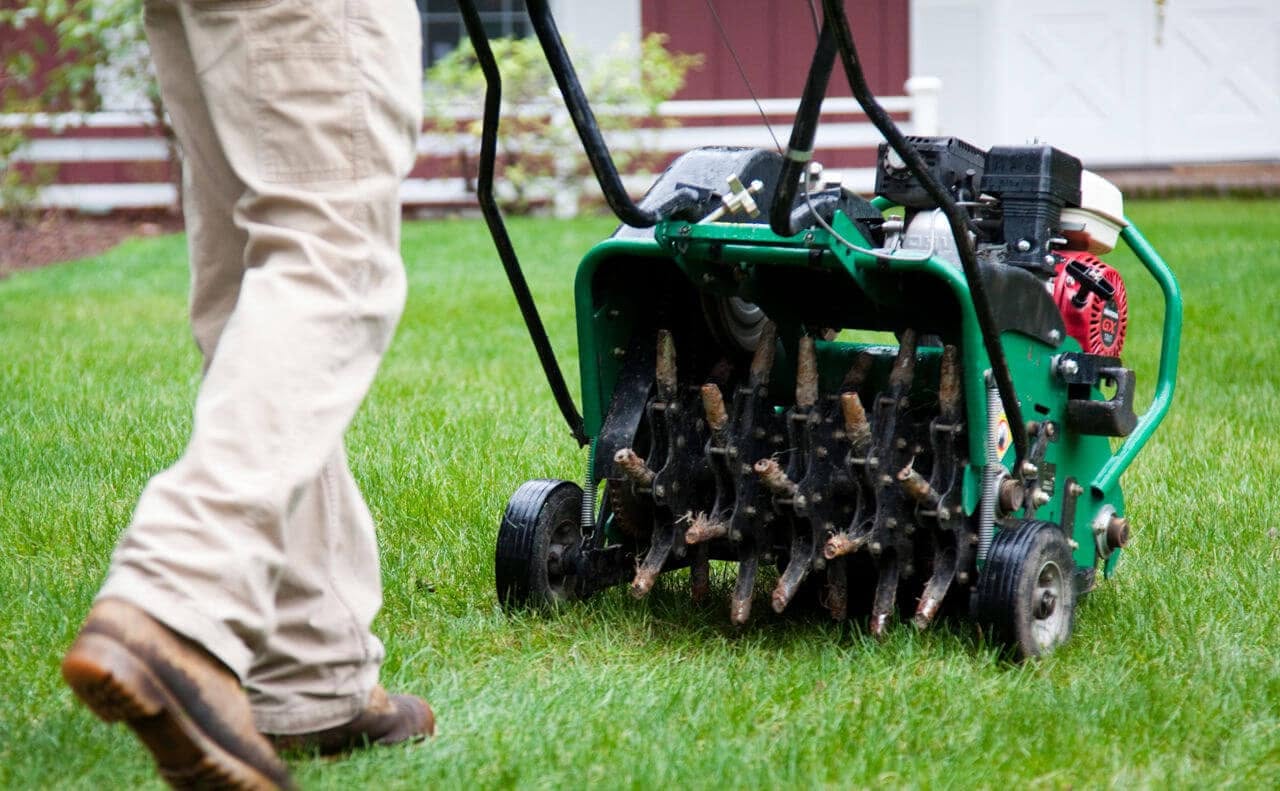
Here is the exact four-hour sequence I follow on every residential property in Greater Sudbury during the late May window. This is the sequence I book my spring schedule around. It doesn’t require exotic equipment or specialty products. It requires doing the right things in the right order at the right time.
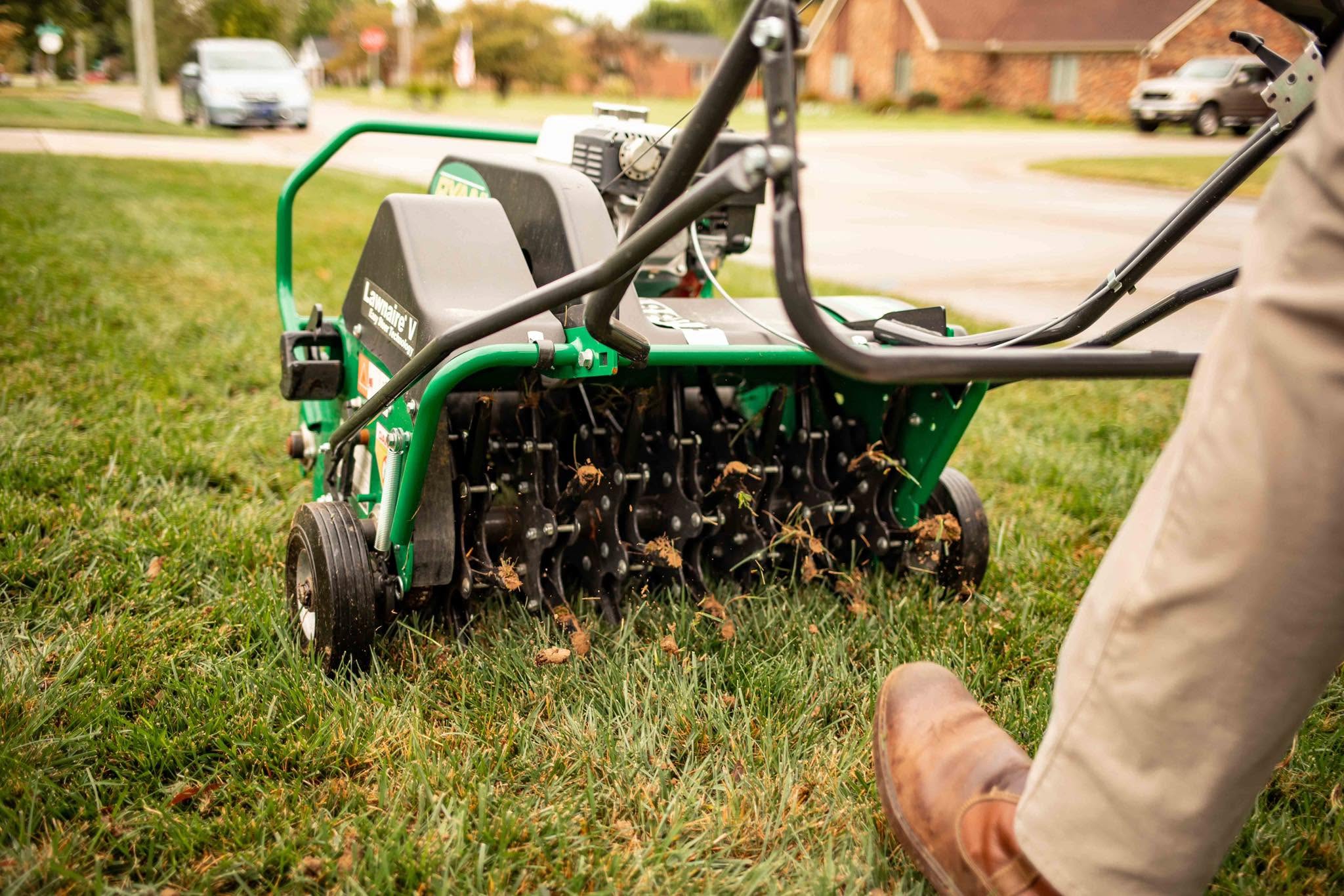
Hour one — core aeration, full property. Double-pass on heavily compacted sections — high-traffic paths, areas near the house foundation, any section where the heel press test showed very limited rebound. Single-pass everywhere else. The aeration should produce plugs of at least two to three inches in length — shorter plugs indicate either soil that’s too dry or too wet, or a machine that’s not penetrating properly. Leave the plugs on the surface. They decompose back into the lawn within two to three weeks and return organic matter and soil microbes to the surface, which accelerates thatch decomposition. Do not rake the plugs off. This is the step that opens the soil for everything that follows. Without aeration first, the subsequent steps produce a fraction of their potential result.
Why aeration first and not after overseeding or fertilizing: aeration on an un-seeded surface allows the tines to operate freely without disturbing seed placement. It creates the open holes that become the landing zones for the seed that follows. Aerating after seeding buries some seed too deeply and throws other seed around unpredictably.
Hour two — overseeding immediately after aeration. Broadcast a fescue-dominant blend with Kentucky Bluegrass across the full property — the variety combination that performs in Sudbury’s climate. Three to four pounds per thousand square feet over the full lawn. Five to six pounds per thousand square feet on bare or thin sections where establishment is the priority. Broadcast in two passes at right angles to each other for even coverage — one pass north-south, one pass east-west.
The reason to overseed immediately after aeration rather than days later: the aeration holes are freshly open. Seed dropping into fresh holes in warm, moist soil has direct soil contact and protection from the elements. Seed broadcast onto an un-aerated surface relies on working its way down through thatch and existing grass to reach soil — which many seeds never accomplish. Seed into fresh aeration holes germinates at dramatically higher rates than seed on an unprepared surface. The article on cottage lawn care around Sudbury lakes touches on why seed-to-soil contact is the critical variable — the same principle applies to every overseeding situation, not just cottage lots.
Hour three — starter fertilizer application. Broadcast a starter fertilizer — one with zero in the middle number to comply with Greater Sudbury’s phosphorus bylaw, and a higher third number to support root development — over the seeded surface. Apply it at the rate on the bag for new lawn establishment rather than the maintenance rate. The starter fertilizer applied immediately after overseeding settles into the same aeration holes as the seed, making nutrients available at the root zone rather than at the surface.
The phosphorus bylaw exception: starter fertilizer for new establishment — which this is, in the sense that you’re establishing new grass from seed — is permitted to contain phosphorus under the Greater Sudbury bylaw. This is the one application in the lawn year where the middle number can be non-zero. For all subsequent fertilizer applications through the season, it must return to zero. The full bylaw details are in the article on Sudbury lawn care news mid-2026.
Hour four — first watering and establishment setup. Water immediately and thoroughly — the first watering after the aeration, overseeding, and fertilizer application should be a full deep session that wets the soil profile to four to five inches. This settles the seed into the aeration holes, activates the starter fertilizer, and gives the existing grass the deep moisture it needs to respond to the aeration disturbance. From this point, switch to the establishment watering schedule — light, frequent moisture twice daily for the first three weeks to keep the germination zone from drying out between sessions on your permitted bylaw days. After three weeks, revert to the standard deep weekly schedule.
Four hours. That’s the window. When it’s done in the right conditions, in the right sequence, it produces results that every other thing you do to your lawn all season builds on. The aeration improves everything else’s efficiency. The overseeding produces new grass density that makes the existing lawn more competitive against weeds. The starter fertilizer supports root development that makes the lawn more drought-resilient through July. All of it compounds through the growing season.
Missing the window doesn’t mean the season is lost. It means you’re playing catch-up — doing things that work, but not as well as they would have in the late May convergence. For homeowners who want to stop playing catch-up and start building the kind of lawn that consistently improves year over year, the four-hour window in late May is where that trajectory starts. I described what that long-game approach produces over a decade in the article on the 5 things every great Sudbury lawn has in common — annual spring aeration is the first and most consistent thing on that list.
If you want the four-hour window handled properly on your property this season — without having to coordinate the timing, the equipment, and the sequence yourself — give me a call. I’ll tell you when your specific property is ready and take care of everything in it.
📞 705-507-6787 | Get a free quote online
— Ryan Lingenfelter
Owner, Cutting Edge Lawn & Landscaping
Garson, Ontario · 705-507-6787
