
I service properties in both Val Caron and Chelmsford regularly. They’re fifteen minutes apart on Highway 69. They’re both part of Greater Sudbury. They both have the same general climate, the same municipal water, the same general access to the same products from the same stores. And they are not the same lawn care environment.
The differences between a typical Val Caron property and a typical Chelmsford property are not dramatic enough to make one neighbourhood impossible and the other easy. But they’re consistent enough that when I arrive at a new property and the homeowner tells me their address, I’ve already adjusted my expectations for what I’m likely to find before I’ve stepped out of the truck. Not because I’m making assumptions about individual properties — every property has its own specific conditions and the walk always confirms or adjusts what I expect — but because the geological and drainage patterns that run through those two communities produce predictable tendencies in the soil and terrain that I’ve seen enough times to recognize.
Here’s what those tendencies actually are, why they exist, and what they mean for how a property in each community actually needs to be maintained.
Why Two Communities 15 Minutes Apart Can Have Completely Different Lawn Challenges

The reason two communities fifteen minutes apart can present different lawn care environments comes down to where the Canadian Shield bedrock sits relative to the surface and how the terrain above it handles water movement. Neither of these things follows municipal boundaries or respects the fact that both communities are part of the same city. The Shield is ancient and indifferent to postal codes.
Val Caron sits in a corridor where the Shield geology is more directly expressed at and near the surface across a larger proportion of residential lots. The bedrock in many Val Caron properties is close — sometimes visibly close, in sections where rock outcroppings appear in yards or where the terrain steps up over a shelf of exposed Shield. The topsoil depth across Val Caron properties is on average thinner than in Chelmsford, and the variation within individual properties can be significant — a yard might have eight inches of soil on one side and two inches on the other, following the contours of the bedrock underneath in a way that doesn’t track with anything visible at the surface.
Chelmsford’s geography is different. The community sits in a slightly lower, flatter position relative to the Shield terrain, with more of what geologists would describe as glacial overburden — the clay and silt material deposited by glacial meltwater that filled in the lower areas as the glaciers retreated after the last ice age. Chelmsford properties tend to have more consistent soil depth than Val Caron properties, but that soil is clay-heavy in ways that create a different set of challenges. Clay holds water. Clay compacts under load. Clay drains slowly. These are not the same challenges as thin soil over bedrock, but they are their own set of real constraints on how a lawn performs and how it needs to be managed.
I described the foundational geology that shapes all of Greater Sudbury in the why Sudbury is different piece — the Canadian Shield and its implications for lawn care across the whole city. Val Caron and Chelmsford represent two different expressions of that geology, and understanding which one you’re dealing with changes what you do on a property. The same principle I described in the Sudbury lawns next door piece — that dramatically different results on adjacent properties trace back to what’s underground, not to what’s done on the surface — applies at the neighbourhood scale just as much as it does at the property line scale.
What Val Caron Lawns Deal With That Chelmsford Lawns Usually Don’t

The defining challenge on a typical Val Caron property is thin, variable soil depth over Shield bedrock that creates unpredictable moisture and root depth conditions within the same yard. Understanding this challenge changes almost every decision about how to manage a Val Caron lawn.
The drought vulnerability is real and location-specific within the property
A Val Caron lawn in a dry July doesn’t go brown uniformly. It goes brown in specific sections — the ones where the bedrock is closest to the surface — while other sections of the same lawn hold green. This pattern is consistent year after year on the same property because the bedrock topology that causes it doesn’t change. The section over the shallow bedrock shelf dries out fastest every time because it has the smallest moisture reserve. The section over the deeper soil pocket holds longer every time for the same reason.
The practical consequence is that a Val Caron homeowner who sees patchy browning in the same section every July isn’t looking at a problem they can fix with more water or better products. They’re looking at the ground underneath. The section is going brown because of what it’s sitting on top of, not because of what’s been done or not done on the surface. This is the same dynamic I described in the drought survival piece — the sections that hold and the sections that go dormant during a dry stretch map almost exactly onto the bedrock depth variation underneath, and the only way to address it is to understand the soil profile before making a maintenance plan.
Aeration needs on Val Caron properties
Val Caron’s thin soil over bedrock compacts more severely under winter load than deeper-profile soils because there’s less depth to buffer the compression. Annual spring aeration is not optional on a Val Caron property — it’s the maintenance intervention that prevents the already-thin soil profile from closing up completely over a sequence of winters. I’ve described why this is specifically critical on Sudbury’s Shield-derived soils in the core aeration page. On a Val Caron property with two to four inches of topsoil, the compaction that builds without annual aeration reaches a limiting threshold faster than on a Chelmsford property with more soil depth to absorb the same annual winter load.
Seed selection on Val Caron properties
The sections of a Val Caron property over shallow bedrock need drought-tolerant seed varieties — specifically fine fescue blends that develop deep, lateral root systems and tolerate the dry periods that thin-soil sections experience every summer. Kentucky bluegrass blends that perform well on deeper soil struggle in the shallow-bedrock sections of Val Caron properties because they need consistent moisture access at depths that aren’t always available. Matching the seed variety to the soil depth in each specific section of a Val Caron property, rather than using a single mix across the whole yard, is a detail that makes a noticeable difference in how the lawn holds through July. I described the importance of this kind of section-specific approach in the 300 Sudbury quotes piece — the initial assessment that identifies where the bedrock sits is what makes the seed selection decision possible.
What Chelmsford Lawns Deal With That Val Caron Lawns Usually Don’t
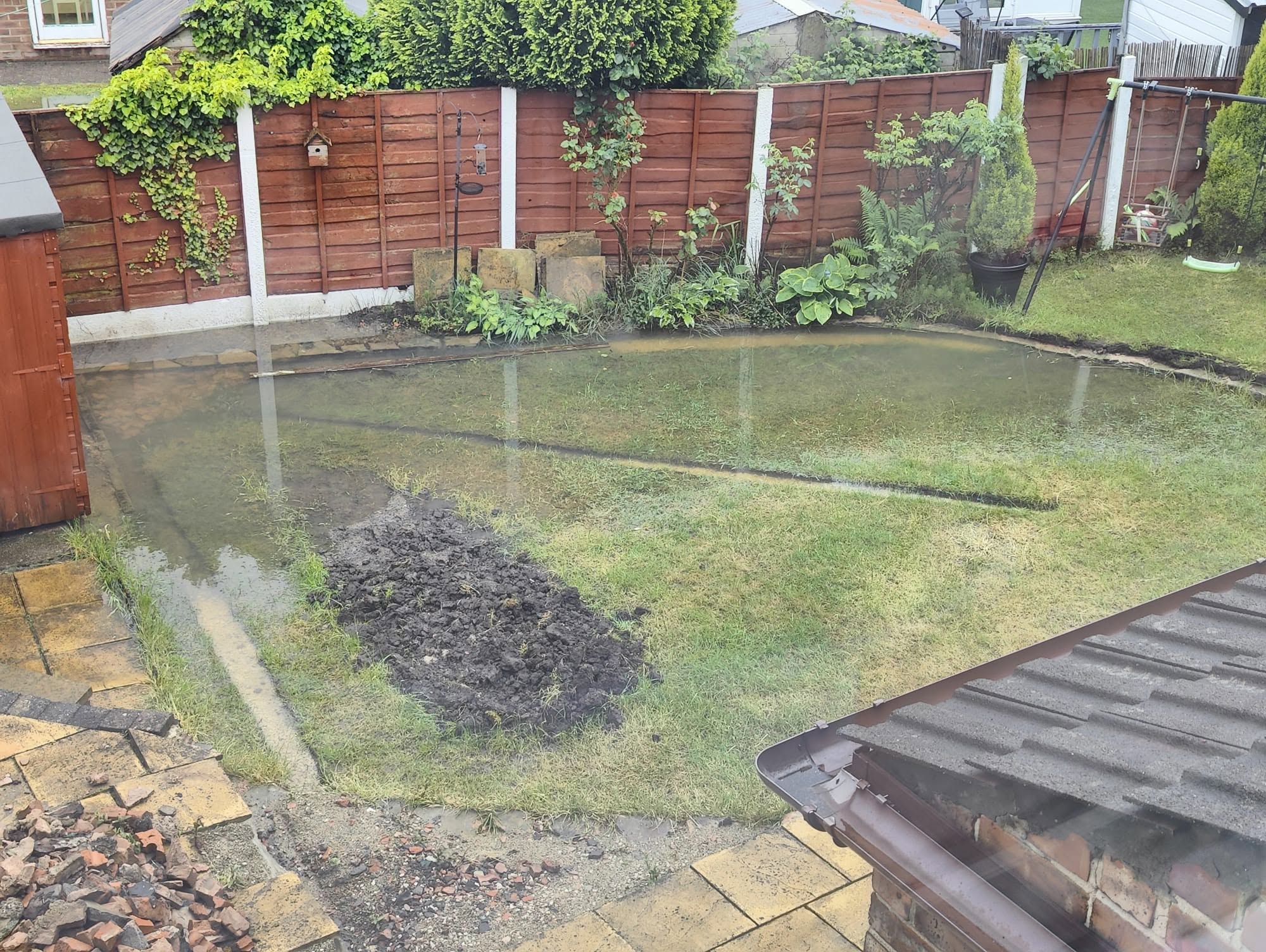
The defining challenge on a typical Chelmsford property is clay-heavy soil that holds water longer than it should, drains slowly in low sections, and compacts aggressively under any load — construction equipment, vehicle traffic, or the sustained weight of a Sudbury winter snowpack. The challenges are different from Val Caron’s but they’re equally real, and they require a different set of responses.
Drainage management is more critical on Chelmsford properties
Clay soil doesn’t drain quickly. On a Chelmsford property with a low section or a drainage channel that carries runoff from the higher parts of the lot, water pools and holds longer than it would on a sandy or well-draining soil. In spring, this means sections of a Chelmsford lawn can stay saturated for days after the snow melts or after a heavy rain event — long enough to create the oxygen-depleted root conditions that damage grass even when visible water is no longer present on the surface.
The new subdivisions built in and around the Chelmsford area compound this. The construction compaction I described in the new subdivisions piece interacts badly with clay soil — the clay compacts more severely under heavy equipment than sandy or mixed soil does, and the thin imported topsoil layer over that compacted clay base creates a drainage-blocked profile that holds water at the interface between the topsoil and the compacted subgrade. New build homeowners in Chelmsford are dealing with both the construction compaction challenge and the clay drainage challenge simultaneously, which is a difficult starting point that requires specific intervention rather than standard new-build care.
Compaction on Chelmsford properties accumulates differently
Clay soil compacts more easily than mixed or sandy soil under the same load. A Chelmsford property that gets vehicle traffic on the lawn — delivery trucks, service vehicles, even repeated foot traffic in the same path — shows compaction damage faster than a Val Caron property with mixed soil at greater depth. The freeze-thaw cycle that every Sudbury property goes through in spring also works clay soil harder than it works other soil types — the expansion of water as it freezes in clay pores is greater, and the compression as it thaws is more significant.
Annual aeration on a Chelmsford property is important for a different reason than on a Val Caron property. On Val Caron, aeration keeps the thin soil profile open. On Chelmsford, aeration breaks up the clay structure that closes under load and restores the drainage pathways that clay soil loses when it compacts. The mechanism is the same — physical opening of the soil — but the soil condition it’s addressing is clay compaction rather than thin-profile compression. Either way the intervention is the same and it needs to happen every spring.
The summer experience on Chelmsford lawns
Chelmsford properties have more total soil depth and more moisture reserve than Val Caron properties, which means they generally handle July dry stretches better. But the clay that creates that depth also creates a different summer challenge: when clay soil dries out after a period of sustained heat, it shrinks and cracks, and the cracking can be visible at the surface as fine lines running through the lawn. This cracking disrupts the root system in the affected sections — roots that cross a crack line lose continuity with the moisture on the other side of it — and in severe cases the surface cracking creates pathways for air to reach root depth directly, drying out the root zone from below.
A Chelmsford property on a deep infrequent watering schedule handles this better than one that’s watered lightly and frequently, because deep watering saturates the clay profile consistently enough to prevent the severe drying that causes cracking. The same watering principle I described in the drought survival piece applies on Chelmsford properties, but the specific reason it matters is different — on Val Caron it’s about pushing roots past shallow bedrock, on Chelmsford it’s about keeping clay from drying and cracking between water events.
What This Means for How Each Property Actually Gets Managed
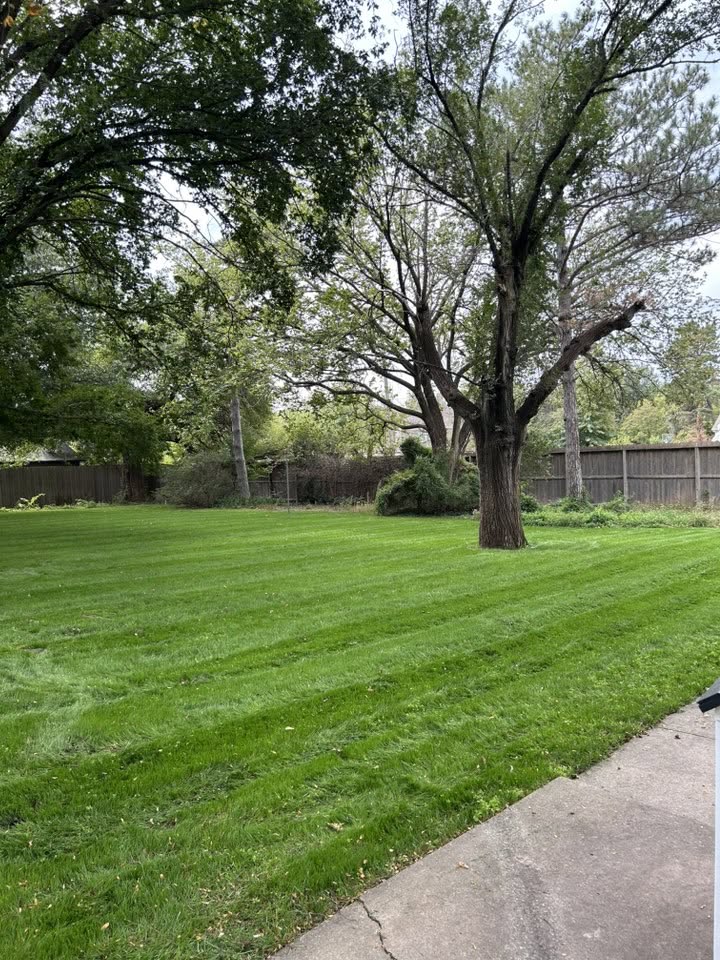
The practical implication of all of this is that a lawn care plan that works on a typical Val Caron property needs specific adjustments to work on a typical Chelmsford property, and vice versa. Not different products or different equipment — different priorities, different sequences, and different expectations about which sections will challenge and which sections will respond easily.
On a Val Caron property, the priority sequence starts with soil depth mapping — understanding where the bedrock sits before making any other decision about seed, watering, or maintenance frequency. The sections over shallow bedrock need drought-tolerant seed, careful watering management, and realistic expectations about summer dormancy in the driest stretches. The sections over deeper soil can be managed more aggressively. Treating a Val Caron property as a single uniform surface produces results that satisfy nobody because the property isn’t a single uniform surface.
On a Chelmsford property, the priority sequence starts with drainage and compaction. Where does water pool after a heavy rain? Which sections stay wet longest? Where is the compaction most severe from the previous winter or from vehicle traffic? Those questions determine what gets aerated most aggressively, where drainage intervention is needed, and which sections need the deepest overseeding to recover from clay-compaction damage. When multiple interventions are needed on a Chelmsford property, the sequencing matters as much as on any other Sudbury property — I described how to sequence multiple services correctly in the 4 services in one week piece. Drainage and compaction intervention always leads, seed always follows aeration, and fertilizer always trails the seeding rather than preceding it.
The honest assessment of any property in either community starts with the same three things I check first on every property I walk — mowing height, edges, and the persistent problem spot — which I described in the 300 Sudbury quotes piece. Those three things tell me the surface history. The soil conditions specific to Val Caron or Chelmsford tell me the context that explains why the surface history looks the way it does. Both together are what make the plan accurate rather than generic.
If you’re in Val Caron or Chelmsford and the lawn care advice you’ve been following isn’t producing results that match the effort, the most likely explanation is that the advice was written for a different soil environment than the one you’re actually dealing with. A property walk tells me what environment you’re actually in and what response that environment requires. For everything we offer across Greater Sudbury, the complete 2026 service breakdown is the right starting point.
Call or text: 705-507-6787
Or fill out the free quote form on the site.
We cover Garson, Val Caron, Hanmer, Lively, Chelmsford, Azilda, Capreol, and surrounding areas.
— Ryan Lingenfelter
Cutting Edge Lawn & Landscaping
Garson, Ontario
705-507-6787
