

This past summer, Greater Sudbury went without meaningful rain for just over two weeks in July. Not unusual for us — most years have at least one dry stretch that runs ten days to two weeks through the middle of summer. But this one hit harder than most because it came after a dry June that had already put stress on properties that weren’t in good shape going in.
By day ten, I was driving through Garson, Hanmer, and Val Caron on service visits and the neighbourhood pattern was the same everywhere: most lawns were visibly stressed, the thinner ones were already brown in the full-sun sections, and the ones over shallow bedrock were dormant in patches that matched almost exactly the spots I’d have predicted if someone had asked me to map the Shield contours underneath each street.
One property in Hanmer stood out. I was maintaining it that summer, and it was holding. Green across the full-sun sections. No dormant patches in the areas where the bedrock sits closest to the surface. The surrounding properties on both sides were showing significant browning. This one looked like the drought hadn’t touched it yet, at a point where it had been going for twelve days.
The homeowner noticed and asked me about it. Here’s what I told him — and what it actually means for any Sudbury property going into next summer’s dry stretch.
What Two Weeks Without Rain Looks Like Across a Sudbury Neighbourhood

A drought in Sudbury hits differently than a drought anywhere else in Ontario, and the reason is the same reason Sudbury lawn care is different from the rest of the province in general. When the rain stops and the heat continues, grass survives by drawing on the moisture reserve stored in the soil below the surface. In deep-soil southern Ontario, that reserve is significant — roots can push down into cooler, moister soil layers that retain water long after the surface has dried out, and the lawn can sustain itself through two or three weeks of dry weather without going dormant.
On a Sudbury property with Canadian Shield bedrock close to the surface, that reserve is a fraction of what it is on a deep-soil property. Three or four inches of topsoil holds a fraction of the moisture that three feet of deep soil holds. When the surface dries out, there’s nowhere deeper for the roots to reach. The grass goes dormant — not dead, just shut down — and the lawn goes brown while it waits for rain to return. This is the fundamental vulnerability of our properties in July, and it’s the one I described in the why Sudbury is different piece. It’s not poor lawn care. It’s physics — a thin moisture reserve drying out faster than a deep one does.
What makes the neighbourhood pattern interesting during a drought is that the variation from property to property reveals the bedrock topography underneath. The lawns that go brown first and most severely are the ones sitting over the shallowest soil. The ones that hold longest are either sitting over deeper soil pockets, were in better condition going into the drought, or both. The dry stretch doesn’t create variation between neighbouring properties — it reveals variation that was already there underground.
I covered exactly this dynamic in the Sudbury lawns next door piece. A drought is the most honest stress test a neighbourhood gets — it strips away everything except what the soil can actually hold and what the root system is actually capable of drawing on.
The Lawn That Held — What Was Different Going Into the Drought

The Hanmer property that held through twelve days of drought without going brown in the full-sun sections wasn’t on particularly deep soil. I know this property well — the bedrock in the front section sits at about five inches, and in the side yard it’s closer to three and a half. Not exceptional for Hanmer. Not dramatically better than the properties on either side.
What was different was the condition the lawn was in going into the drought, which is almost always the real answer when one property holds and the neighbours don’t. Drought resistance on a Sudbury lawn is not something you build during a drought. It’s something that either exists or doesn’t based on decisions made in spring and through the early part of the season. By the time the rain stops, you’re working with whatever root depth, soil structure, and turf density the lawn came in with. There’s nothing left to do at that point except water if you can and wait if you can’t.
This property had been aerated in spring. It had been mowed consistently at three and a half inches through May and June. It had been watered on a deep, infrequent schedule rather than a light daily one. And it had gone into the season without any persistent bare patches or compaction problems that hadn’t been addressed. None of those things sound dramatic. Together, they built a lawn that was capable of handling two weeks without rain in a way that the surrounding properties, which hadn’t had those inputs, weren’t.
The Three Decisions That Built Drought Resistance Before It Was Needed
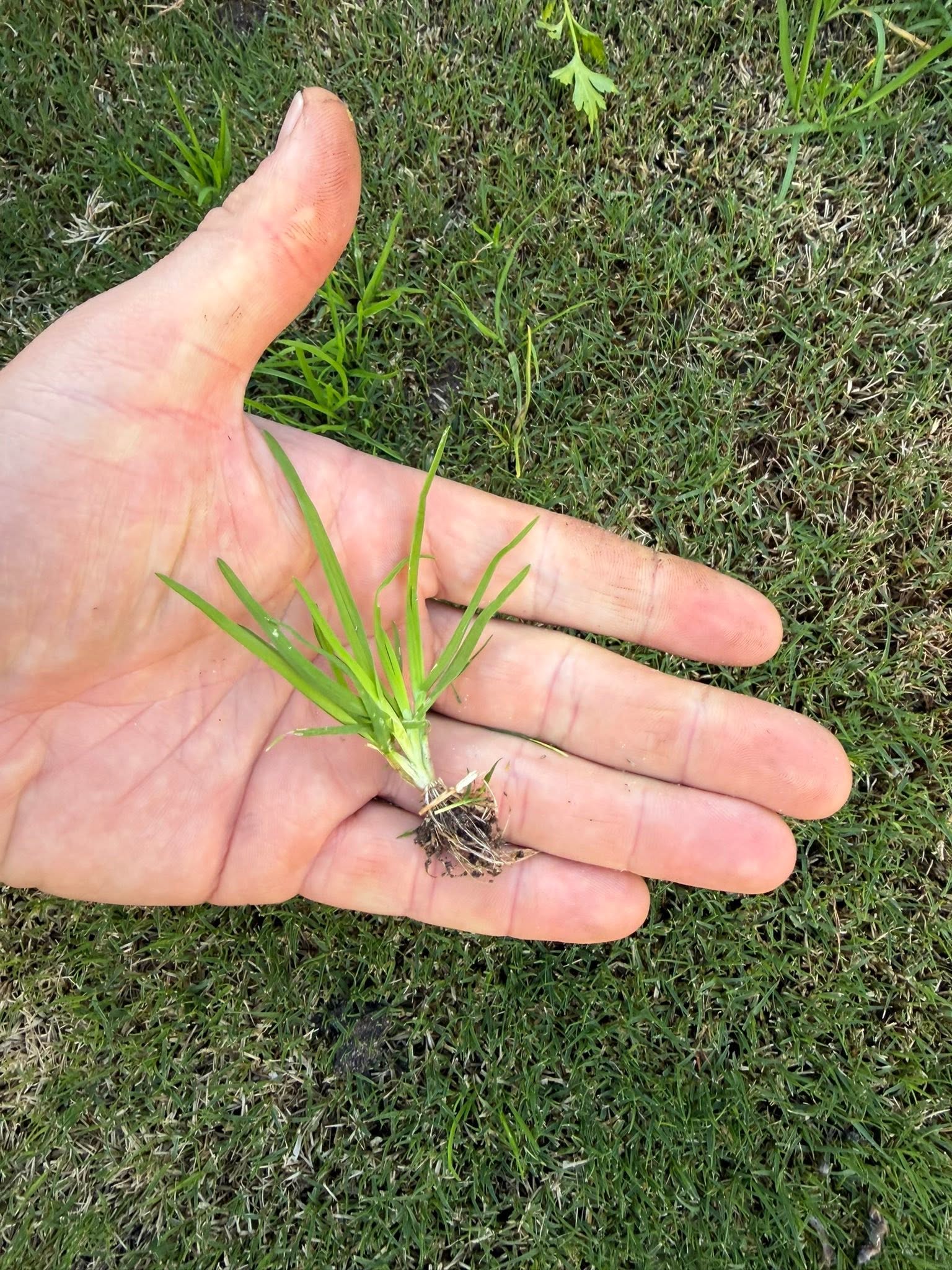
When I explained to the homeowner why his lawn was holding, I broke it down into three specific decisions that had compounded into the result he was seeing. These aren’t complicated. But they’re also not the instinctive moves most homeowners make, and on a Sudbury property the margin for error in July is smaller than it is on more forgiving soil.
Decision one: Spring aeration before anything else
The spring aeration is the single most important thing this property had going into the drought that many of its neighbours didn’t. Core aeration opens the soil — it creates channels for water to move through compacted soil rather than running off the surface, and it gives roots the open pathways they need to push as deep as the available soil allows. On a Sudbury property where winter compacts the soil more severely than anywhere else in Ontario, aeration in spring is what resets the soil structure before the growing season starts. I’ve described why it’s specifically non-optional on our properties in the core aeration page.
The direct drought connection is this: water moves through aerated soil and reaches the root zone efficiently. On compacted soil, water runs off the surface or sits on top without penetrating. Every watering on a compacted property is less effective than every watering on an aerated one. Going into a two-week dry stretch, the property that had been aerating annually had a root system that had been drawing on deep soil moisture all season. The ones that hadn’t were drawing on whatever the compacted surface layer held — which dries out first and fastest.
Decision two: Three and a half inches, every single cut
Mowing height is the drought variable that surprises people the most, because the connection between how tall you cut the grass in May and whether it goes brown in July isn’t obvious until you understand the root system mechanics. Grass cut at the correct height — three to three and a half inches — produces a longer blade that shades the soil underneath, reducing the rate at which surface moisture evaporates in direct sun. More importantly, it forces the plant to develop a deeper root system to support that blade length, which means the roots are reaching further into the available soil depth when the surface dries out.
Grass cut short — an inch and a half, two inches — has a shallow root system because the plant doesn’t need deep roots to support a short blade. In normal conditions, that’s not visible. The lawn looks fine. During a drought, it’s the difference between a root system that can draw on moisture five inches down and one that runs out of access at two inches. On a Sudbury property with limited total soil depth, every inch of root depth the lawn can reach is significant. The mowing height decision in May and June is already shaping the drought outcome in July. I covered why this is specifically more consequential in Sudbury than elsewhere in the 300 Sudbury quotes piece — it’s the first thing I check on any property I’m assessing and the one variable that tells me the most about how the lawn is being managed.
Decision three: Deep watering twice a week, not a little every day
The watering rhythm going into the drought mattered as much as the aeration and the mowing height. This property was on a schedule of deep watering twice a week through May and June — enough water each time to move moisture through the full available soil depth, applied infrequently enough that the roots had to reach for it rather than finding it at the surface every day.
Frequent light watering trains roots to stay shallow, because the moisture they need is always available near the surface. Deep infrequent watering trains roots to go looking, which means they establish at depth rather than near the surface. Going into a drought, a lawn watered deeply and infrequently has a root system accustomed to reaching through the full soil profile. A lawn watered lightly every day has a root system concentrated at the surface — which is exactly where moisture disappears first when the rain stops.
Combined with the aeration that had been done in spring, the deep watering schedule meant this lawn’s root system had open channels to move through and the habit of using them. That combination is what held the lawn green at day twelve when the surrounding properties were already dormant.
What Happens After the Rain Returns — and Why It Returns Differently on This Lawn

The rain came back at day fourteen. Within three days, the surrounding properties started greening up from dormancy — grass doesn’t die in a two-week drought, it just shuts down, and it recovers once moisture returns. The recovery on most of the neighbouring properties was visible but uneven: the thin sections and the areas over shallow bedrock came back more slowly, and the bare patches that had been there before the drought were more established after it.
The Hanmer property never fully went dormant, so its recovery was immediate rather than gradual. But the more significant difference was in what the drought revealed about the bare-patch situation across the neighbourhood. Properties that had persistent thin sections before the dry stretch came out of it with those sections more established and harder to recover. The stress of the drought had widened the gap between the healthy sections and the struggling ones. On the properties that had unaddressed underlying problems — the kind I described in the 4 services in one week piece — the drought accelerated the timeline on problems that were already there.
The lesson from every July dry stretch I’ve watched in Sudbury is the same: drought resistance is built in spring, not in July. The decisions that determine whether a lawn holds or goes brown are made months before the rain stops. Aeration in April, correct mowing height from the first cut, a watering rhythm that builds root depth rather than surface dependency — those three things, done consistently before the heat arrives, are what separate the lawns that hold from the ones that don’t on a street where the soil variation between neighbouring properties tells the rest of the story.
If your property went brown this summer in sections that didn’t recover as quickly as you’d expected, the fall window is exactly the right time to address the underlying conditions before next year’s dry stretch arrives. For a full picture of what that looks like across the season, the complete 2026 service breakdown is the right starting point.
Call or text: 705-507-6787
Or fill out the free quote form on the site.
We cover Garson, Val Caron, Hanmer, Lively, Chelmsford, Azilda, Capreol, and surrounding areas.
— Ryan Lingenfelter
Cutting Edge Lawn & Landscaping
Garson, Ontario
705-507-6787
