

Last season I got a call from a homeowner in Val Caron who had put off lawn care for longer than she’d planned to. Not through neglect — through a difficult year where the lawn was simply not at the top of the list. By the time she called me, the property needed aeration, overseeding, fertilizing, and a full debris cleanup from a winter that had left more behind than usual. She knew it needed all of it. She wanted to know if it could all happen in the same week.
The honest answer was yes — but the order mattered completely. Done in the right sequence, four services in one week compounds the benefit of each one. Done in the wrong sequence, some of them cancel each other out or actively work against the others. Getting the order right on a Sudbury property, with our soil conditions and our compressed seasonal window, is not a minor detail. It’s the difference between a week of work that moves the lawn forward significantly and a week of work that produces a fraction of what it should.
Here’s exactly how we sequenced it and why each decision in the order was made.
The Property and What It Actually Needed

When I walked the Val Caron property for the first time, the picture was clear within the first two minutes. Compaction was significant — the surface was running off after rain rather than absorbing, which on a Sudbury property with our clay-heavy, Shield-derived soil is a reliable sign that the air pockets the roots need to move through have been compressed shut. Bare patches in three separate areas, all in high-sun sections where shallow soil over bedrock dries out fastest. A debris layer from the previous fall and winter that was heavy enough to be blocking light in the shaded sections along the fence. And the grass that was still growing was thin enough that weeds had started moving into the gaps.
Four services: core aeration, overseeding, fertilizing, debris cleanup. All of them genuinely needed. None of them optional if the goal was a lawn that was going to hold up through the rest of the season rather than limp along at the same baseline.
The first conversation I had with her wasn’t about scheduling. It was about sequence. Because the instinct most homeowners have — cleanup first, then fix the lawn — is actually the wrong order for a Sudbury property when aeration and overseeding are in the mix. And getting that wrong would have meant the seed we put down had significantly lower odds of establishing properly.
I run the same initial read on every property before talking about services — the three things I check first are described in detail in the 300 Sudbury quotes piece. All three flagged clearly on this property before I’d been there five minutes.
Why Sequence Matters More Than the Services Themselves
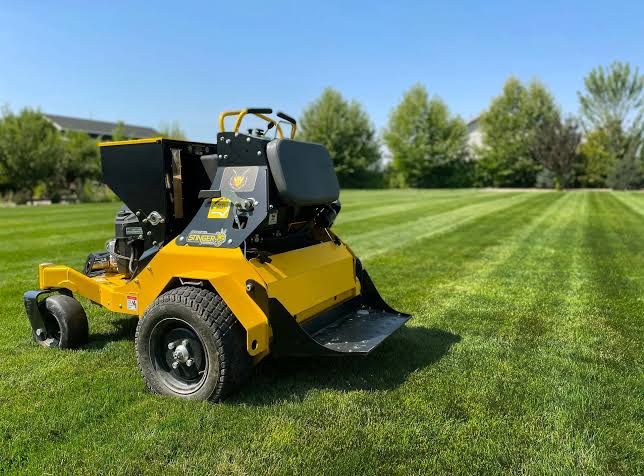
The reason sequence matters as much as it does comes down to how each service affects the conditions the next one is working in. Lawn care services are not independent of each other. Each one changes the environment — the soil structure, the surface condition, the available moisture — that the following service is applied to. Do them in the right order and each one creates better conditions for the next. Do them in the wrong order and you’re applying services to conditions that actively limit their effectiveness.
Why aeration has to come before everything else
Aeration is the first service, always, when it’s in the mix. The reason is structural. Core aeration physically opens the soil — it pulls plugs out of the surface and creates channels for air, water, and roots to move through compacted soil that’s been closed up by winter and foot traffic. On a Sudbury property, where our winters compact the soil more severely than in most of Ontario, this opening up of the soil profile is the foundation that makes every other service more effective. I’ve described why aeration is specifically non-optional on our Shield-derived soils in the core aeration page.
If you fertilize before aerating, you’re applying nutrients to compacted soil where water and roots are already struggling to move. Some of those nutrients reach the grass. A significant portion runs off or sits on top of soil that can’t absorb it efficiently. If you overseed before aerating, the seed lands on a compacted surface with limited contact with the soil underneath — germination rates drop significantly because seed needs soil contact to establish. Aeration first means fertilizer goes into open soil channels and seed falls into or adjacent to the cores, where soil contact is direct and immediate.
Why overseeding comes immediately after aeration
The window after aeration is the best seeding window a Sudbury property will have all season. The cores have been pulled, the surface is open, and the channels created by the aerator give seed direct access to soil that hasn’t been compacted shut. Seed that goes down in this window has significantly better germination rates than seed applied to an undisturbed surface, because the physical contact between seed and soil that germination requires is already there rather than something the seed has to fight to establish.
On a Sudbury property specifically, where our soil depth is limited and the window before summer heat or fall cold closes is shorter than in southern Ontario, this timing advantage is not a luxury — it’s the difference between seed that establishes in time to survive its first season and seed that germinates too late or too shallowly to hold. I covered the specific soil conditions that make this timing critical in the why Sudbury is different piece.
Why fertilizing follows overseeding rather than leading it
The instinct is often to fertilize first — feed the lawn, then fix it. The problem with that order when overseeding is in the plan is that the wrong fertilizer applied before new seed goes down can actually suppress germination. High-nitrogen fertilizers applied to established grass before overseeding create conditions that favour the existing grass over new seedlings — the established grass responds vigorously to the nitrogen and competes more aggressively with the germinating seed for light and space.
Applied after overseeding, with a starter fertilizer formulation designed to support root development rather than top growth, fertilizer does the opposite — it gives the new seedlings the phosphorus they need to establish root systems before the first mow. The timing and formulation together are what make the fertilizer step productive rather than counterproductive in a multi-service week.
How We Ran the Four Services That Week

Day one was aeration. The full property, including the bare patches and the sections along the fence that had been under debris. Not skipping the shaded sections — those needed the soil opening as much as the sun-exposed sections did, even though they weren’t the most visually damaged areas. The debris layer in the shaded sections was coming out, but aeration needed to happen before cleanup in those areas specifically, because the debris had been compressing the soil underneath and the aeration cores needed to come from compacted soil rather than from a surface that had just been raked clear.
This is the counterintuitive part of the sequence that most homeowners don’t expect: cleanup doesn’t automatically come first. When there’s a debris layer sitting on compacted soil that also needs aeration, the aeration happens first in those sections, and the debris comes out afterward. The cores that come up in the aeration process bring compacted soil to the surface — those break down and work back into the lawn over the following weeks, improving the soil structure as they do. Cleanup after means those cores stay on the lawn rather than getting raked away with the debris.
Day two was overseeding into the open aerator channels, with particular attention to the three bare patches I’d identified on the initial walk. Shade-tolerant mix in the sections along the fence where the cedar hedge blocks direct sun for most of the day. Standard cool-season blend in the open sections. Using different seed varieties in different sections of the same property is something I do on most Sudbury jobs — the soil variation from one end of a lot to the other is significant enough that a single seed type rarely serves the whole property equally well. The same variation I described in the Sudbury lawns next door piece exists within a single property, not just between neighbours.
Day three was fertilizing with a starter formula across the seeded areas and a standard slow-release on the established sections. Keeping the two formulations separate matters — the seedlings need phosphorus for root development, the established grass needs nitrogen for recovery, and applying the same product across both gives neither exactly what it needs.
Day four was full debris cleanup — removing what remained after the aeration and overseeding work, clearing the fence line sections last, and doing a final pass to confirm the cores from the aeration were distributed across the lawn surface rather than concentrated in piles.
The one thing I adjusted mid-week
On day two, when I was overseeding the bare patch nearest the driveway, I dug a test hole in the centre of the patch — same process I always run on any persistent dead section, as I described in the contractor missed three years piece. Found the bedrock sitting at three and a half inches in that specific spot versus six to seven inches across the rest of the front yard. That section needed a thin layer of additional topsoil before the seed went down — without it, the seed would be germinating into soil too shallow to hold through its first dry stretch. Added topsoil to that section specifically, seeded on top of it, and flagged it for the homeowner so she’d know that corner needed slightly more careful watering during establishment than the rest of the overseeded areas.
That kind of mid-job adjustment is exactly what a proper initial walk is supposed to catch — but some things only show up when you actually dig. The sequence gave me the right moment to catch it before the seed was down.
What the Property Looked Like After — and What the Homeowner Said
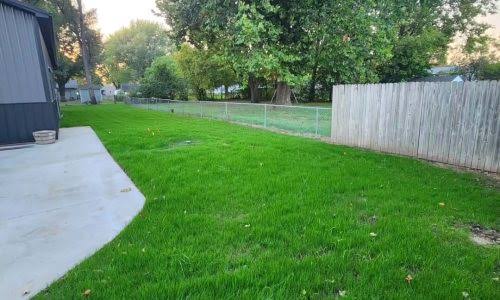
Two weeks after the four services, the bare patches in the sun-exposed sections were showing germination. The fence line sections were coming in more slowly — shade seed always does — but the growth that was showing was even rather than patchy, which told me the soil contact from the aeration channels was doing its job. The main lawn had responded visibly to the starter fertilizer, with the thin sections thickening noticeably compared to what I’d seen on the initial walk.
What the homeowner said when I called her at the two-week mark was that the lawn looked more like it had ten years ago than anything she’d tried in the last three seasons. She’d been doing one or two services at a time, in whatever order seemed logical, without a plan for how they connected to each other. Nothing she’d tried had held. Four services in the right sequence, in one week, moved the lawn further than three seasons of disconnected attempts.
The sequence isn’t complicated once you understand why each service affects the conditions the next one is working in. But it’s also not something that shows up in general lawn care advice, because most of that advice is written for one service at a time on properties with soil conditions that are more forgiving than what we’re working with in Sudbury. Our compressed season, our thin soil, our compaction cycle — all of it means the order of operations matters more here than it would in most of Ontario.
If you’re looking at a property that needs more than one service this season and you’re not sure what order makes sense for your specific situation, that’s exactly the kind of conversation worth having before anything gets scheduled. The complete 2026 service breakdown covers everything we offer and how the services connect to each other across a season.
Call or text: 705-507-6787
Or fill out the free quote form on the site.
We cover Garson, Val Caron, Hanmer, Lively, Chelmsford, Azilda, Capreol, and surrounding areas.
— Ryan Lingenfelter
Cutting Edge Lawn & Landscaping
Garson, Ontario
705-507-6787
