

I’ll be upfront about something before this story starts: I don’t enjoy talking about other lawn care companies. I’m not in the business of tearing down competitors. I’d rather spend that energy explaining what we do and why we do it the way we do.
But occasionally a situation arises where the most honest thing I can do for a homeowner is tell them what I actually see — even when what I see is a problem with work proposed by someone else.
This is one of those situations.
It was a Thursday afternoon in late May. A homeowner named Janet had called me for a quote on a lawn restoration job at her property in Val Caron. When I arrived for the site visit, she met me at the door holding a piece of paper.
“I already have one quote,” she said. “I want to get a second opinion before I decide.”
She handed me the paper. I read it while she watched my face.
I’m Ryan Lingenfelter, owner of Cutting Edge Lawn & Landscaping in Garson, Ontario. Here’s what was on that quote, what I told Janet, and why I think the honest version of this conversation is useful for anyone trying to hire a lawn care company in Greater Sudbury.
The Quote — What She Showed Me
The quote was from a company I recognized — a mid-sized operation serving Greater Sudbury. The document was professionally formatted. It had a company logo, contact information, line items with descriptions, and a total price.
The scope described in the quote was: supply and install sod over approximately 900 square feet, backyard only. Price: $2,850 plus HST.
I read through the line items carefully.
Sod supply — listed. Sod installation labour — listed. Cleanup and haul-away — listed.
Soil preparation — not listed. No mention of tilling. No mention of topsoil. No mention of aeration or compaction assessment. No mention of drainage evaluation. No mention of starter fertilizer.
I looked up from the paper. Janet was watching me.
“What do you think?” she asked.
I told her I had some questions before I could give her my honest assessment. Could she tell me what the quoting company had done during their site visit — specifically, had they looked at the soil or just measured the area?
She thought about it. They’d walked the backyard, she said. One of them had measured the dimensions. They’d spent about ten minutes total. Nobody had tested the soil. Nobody had mentioned drainage. They’d given her the quote by email two days later.
Ten minutes. No soil test. Quote by email.
I handed the paper back to her and told her what I was going to do differently, and why the difference mattered.
What Was Missing From That Quote — The Real Problem

Before I explain what was missing, I want to be fair to the company that wrote that quote. It’s possible — I can’t know for certain — that they do include proper soil preparation in their standard process and simply didn’t itemize it on the quote document. Some companies price things as a package rather than line by line.
But here’s the problem with that possibility: if proper soil preparation was included, it should be mentioned. Because whether or not it appears on the invoice, it determines whether the job works or fails. And a homeowner who’s spending $2,850 deserves to know specifically what they’re getting.
More importantly: you can’t quote sod installation properly without assessing the soil first. The soil condition determines what preparation is needed. A lawn that needs aggressive tilling and significant topsoil amendment costs more to prepare than a lawn that needs a basic aeration pass. A lawn with a drainage problem needs grade correction before sod goes down — or the sod will fail in the problem area within a season or two regardless of quality.
None of that can be determined in ten minutes of measuring and a quote sent by email two days later.
I’ve documented what proper soil assessment actually involves in what almost every struggling Sudbury property has in common — the screwdriver test, the thatch check, the drainage assessment. These take time on site. They can’t be done from a distance.
What’s missing from a quote that doesn’t include soil preparation isn’t just a line item. It’s the foundation of whether the job produces a result that lasts or a result that fails and needs to be redone. I’ve seen this play out specifically in the Val Caron homeowner I turned down three times — the drainage problem that hadn’t been addressed had caused sod to fail twice before the underlying issue was finally fixed. The sod installation itself had been done, presumably at a reasonable price, both times. Without the diagnosis and the foundation work, it hadn’t mattered.
What I Found on Janet’s Property
After I’d explained my concern about the quote, I asked Janet if she’d like me to do a proper site assessment before we talked about pricing. She said yes.
I walked the backyard carefully.
The screwdriver test: stopped at about one and a half inches across most of the yard. Not as severe as some properties I see, but meaningful compaction that would need addressing before sod would establish properly. Roots in unbroken clay at that compaction level can’t go deep. Shallow roots on Val Caron’s clay soil means a lawn that struggles in summer heat every year.
The thatch: about half an inch throughout — manageable but worth addressing as part of the preparation to improve soil contact for the new sod.
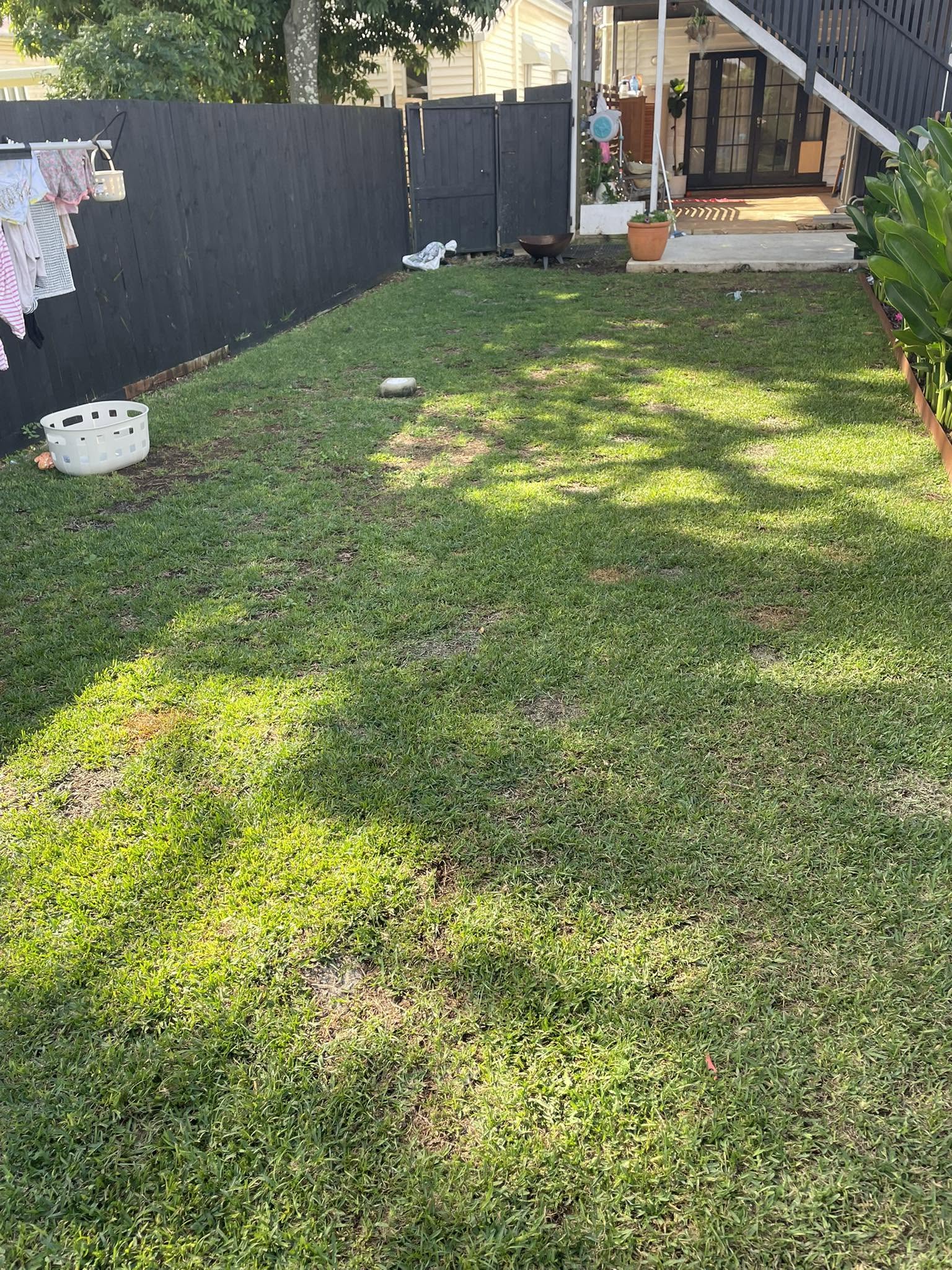
The drainage: this was the significant finding. The back left corner of the yard had a grade issue — water was directing toward it from two sides and pooling after rain. The soil in that corner was visibly different — denser, darker, with the sour clay smell of soil that stays wet intermittently. Anything laid in that corner without grade correction would fail. It had probably already failed once, which was why she was calling me for a restoration job in the first place.
I asked Janet: “When you look at the bare sections, are they in one specific part of the yard more than others?”
She pointed to the back left corner. “That’s the worst area.”
The drainage problem I’d found was directly under the worst bare section. The sod that had presumably been in that area before had failed there specifically because of water pooling conditions the soil couldn’t handle.
The other company’s quote had proposed laying new sod over that same corner without any mention of drainage correction. It would have looked good for a season. Then it would have failed again in the same spot.
What a Proper Lawn Quote Should Actually Include

I want to be specific about what I think a proper lawn restoration quote should include — not to sell my services, but because I think homeowners deserve to know what standard to expect when they’re comparing quotes.
A site visit where soil is actually assessed. Not a measurement and a photo. A proper site visit includes the screwdriver compaction test in multiple locations, a thatch depth check, drainage observation, and grade assessment. This is the minimum required to quote accurately. I can’t know what soil preparation is needed without knowing the soil condition. Nobody can.
Explicit mention of soil preparation scope. What tilling depth? What topsoil volume? Will starter fertilizer be applied? These should be specified, not assumed. If a quote doesn’t mention soil preparation, ask specifically: “What soil preparation is included?” The answer will tell you what you’re actually getting.
Drainage assessment and correction if needed. Any company quoting sod installation should have checked your drainage during the site visit and addressed it in the quote if a problem was found. If the quote was done remotely or in ten minutes without a drainage check — ask directly: “Did you check the drainage in the back corner?” or wherever your problem areas are.
Clear scope of what’s included. Mowing, trimming, cleanup — what’s part of the job and what’s extra? The number on the quote should reflect a complete scope, not a starting price that grows when the work starts. I’ve covered what to look for in what professional lawn care actually means in Sudbury and how to spot it.
Aftercare guidance. What watering schedule is recommended after installation? Any company that installs sod should provide this — it’s as important as the installation itself. I’ve detailed exactly what new sod needs in what happens if you don’t water new sod in Sudbury’s first two weeks.
The questions that separate a well-considered quote from a surface-level one are the same ones I’ve listed in what I tell people who ask if we’re the cheapest. Price is one factor. The scope behind the price is what actually determines whether the job works.
What We Did — and How It Compared to the Original Quote

Janet decided to go with Cutting Edge after the site visit. Our quote was higher than the other company’s — primarily because it included the drainage correction work and the full soil preparation that the property needed.
The sequence we followed is the same one I use on every restoration job across Greater Sudbury. I’ve documented it in full in how I replaced a Sudbury homeowner’s dead lawn in 4 days.
The drainage correction in the back left corner came first — regrading with quality topsoil to redirect water away from the low point toward the fence line. This needed to be done and confirmed before any sod went down in that area. I’ve explained why this sequencing matters in the Val Caron homeowner I turned down three times — the drainage fix is non-negotiable if the sod is going to hold.
Then full soil preparation: tilling four to six inches deep across the entire 900 square feet, quality topsoil incorporated throughout, starter fertilizer applied before the sod went down.
Fresh sod, same-day delivery and installation. Every roll in the ground the day it arrived — I’ve explained why sod timing matters so much in how long sod can stay rolled up before it dies.
The job took a day and a half. Janet followed the watering schedule carefully. By six weeks after installation, the whole backyard was established — including the back left corner that had been persistently bare.
She texted me in September: “The corner is finally green. It’s never been green in the three years I’ve lived here.”
That corner had presumably received at least one sod installation before — it was part of the reason the lawn needed restoration. Without the drainage correction, the new sod would have failed in the same spot again. With it, it’s holding.
What I Want You to Take From This
I’m not telling this story to make the other company look bad. I genuinely don’t know whether they would have included proper soil prep in their process or not — the quote didn’t say, and they didn’t do a proper site visit, so there’s no way to know what they would have found if they had.
What I want you to take from this is practical: when you’re comparing lawn care quotes in Sudbury, the number is only one dimension. The scope behind the number — what preparation is included, what was assessed during the site visit, what drainage work is addressed — is what determines whether the job produces a result that lasts.
A quote done after a ten-minute visit without a soil test can only be priced for the visible work. It can’t account for what the soil actually needs — because that wasn’t checked.
Ask the questions. Get specifics. Compare scopes, not just prices. A quote that’s $400 more but includes drainage correction and full soil prep is almost always a better investment than one that’s $400 less and lays sod on top of conditions that will cause it to fail.
If you want a quote done properly — with an actual site visit, soil assessment, and honest scope — reach out.
📞 Call or text me: 705-507-6787
Or fill out the free quote form here — I get back to everyone same day.
— Ryan Lingenfelter
Owner, Cutting Edge Lawn & Landscaping
Garson, Ontario
Related Articles
- What Professional Lawn Care Actually Means in Sudbury — How to Spot the Difference
- I Replaced a Sudbury Homeowner’s Dead Lawn in 4 Days
- What Happens If You Don’t Water New Sod in Sudbury’s First Two Weeks
- How Long Can Sod Stay Rolled Up Before It Dies?
- 1,000 Lawn Jobs in Greater Sudbury — What Almost Every Property Has in Common
- Sod Installation in Greater Sudbury — Services and Pricing
