
When you do enough of the same type of work, patterns start to emerge. Not just occasionally. Consistently. The same things showing up on different properties, in different neighbourhoods, owned by different people who’ve never met each other and have no idea they’re dealing with the exact same problems.
I’m Ryan Lingenfelter, owner of Cutting Edge Lawn & Landscaping in Garson, Ontario. In five years of working across Greater Sudbury — grass cutting, sod installation, core aeration, full restorations, property cleanups — I’ve been on well over a thousand properties.
And in that time, three things keep showing up on struggling lawns across this area with a consistency that I can no longer call coincidence. These aren’t rare problems. They’re the norm. And understanding them — really understanding them — is the difference between a lawn that keeps declining no matter what you do and one that actually gets better.
Here’s what almost every struggling Sudbury property has in common.
The Pattern I Keep Seeing — Property After Property
Before I get into the specifics, I want to give you context for why this pattern exists in Sudbury specifically — because I don’t think it’s random.
Greater Sudbury has a specific combination of factors that sets residential lawns up for failure in ways that aren’t obvious. Heavy clay soil that compacts easily. A short, compressed growing season. Winters that are genuinely hard on turf — deep freeze, significant snow load, aggressive freeze-thaw cycles in shoulder seasons. And a local lawn care market that, for a long time, didn’t prioritize the kind of preventive maintenance work that addresses these specific challenges.
The result is that a lot of Sudbury residential lawns have been in a slow, gradual decline for years — sometimes decades — without the homeowner fully understanding why. They see the symptoms. They treat the symptoms. The symptoms come back. The underlying causes go unaddressed.
These are the three underlying causes I find on almost every struggling lawn in this area.
Thing 1 — Nobody Has Ever Aerated
I ask this question on every single assessment: when was the last time this lawn was aerated?
The most common answer I get, by a significant margin, is some version of “I don’t think it ever has been.” Sometimes the homeowner has been in the house for five years. Sometimes twenty-five years. Either way — no aeration, ever.
On Sudbury’s clay-heavy soil, that’s a serious problem. Clay compacts easily under normal use — foot traffic, mowing equipment, the weight of snow, freeze-thaw cycles that physically press soil particles together over years and decades. Without aeration to periodically break up that compaction, the soil slowly seals itself.
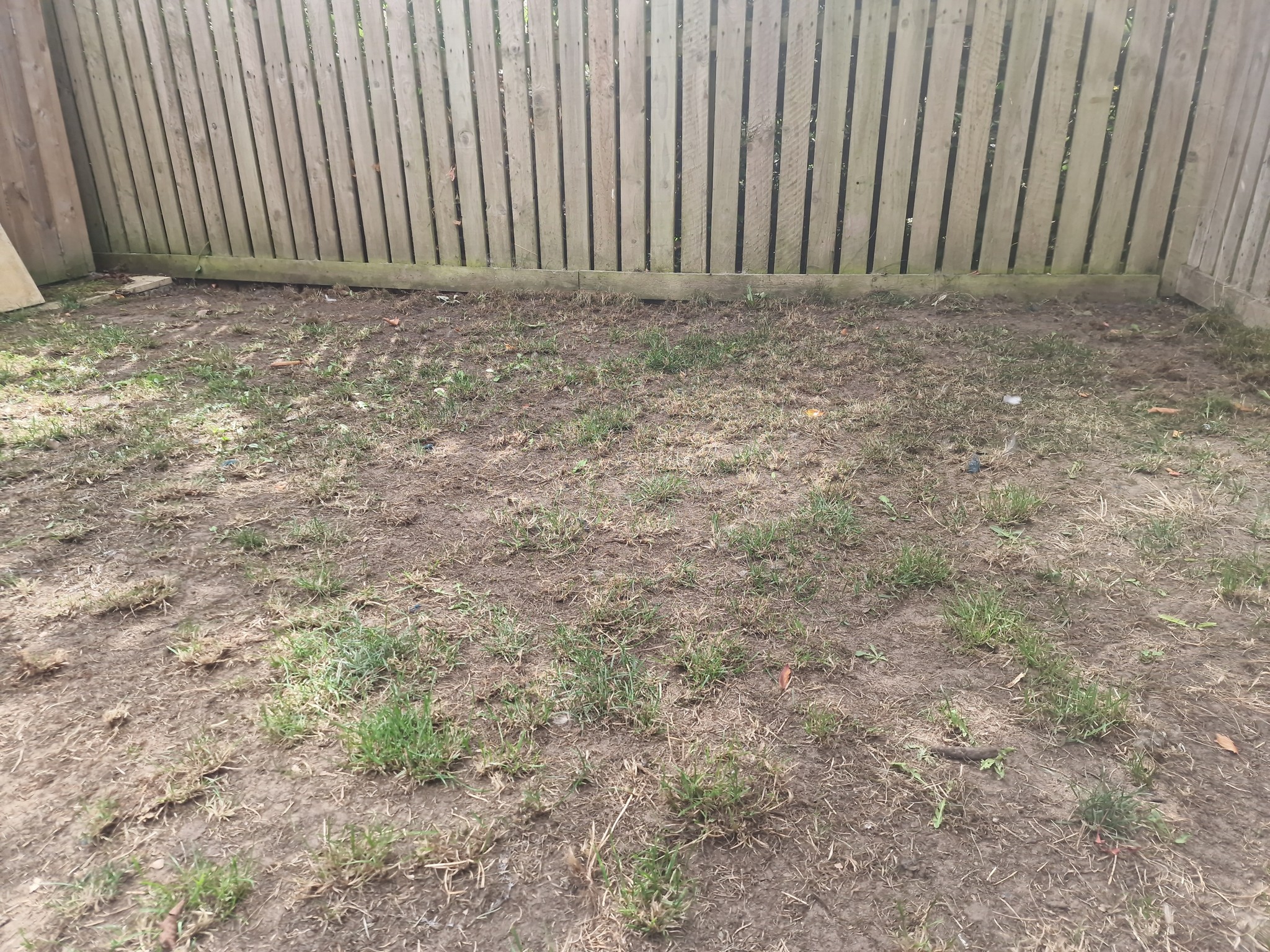
By the time I’m standing in someone’s backyard doing the screwdriver test — pushing a flathead screwdriver into the soil to check compaction depth — on a lawn that’s never been aerated in ten or fifteen years of Sudbury winters, I’m sometimes barely getting the tip in. The soil is that dense. Water can’t get through. Roots can’t go deep. Air can’t reach the root zone.
And the homeowner has spent years wondering why their lawn keeps dying despite watering, seeding, and fertilizing. Because all of those things require functional soil to work. You can’t water a sealed surface into health. You can’t seed into compacted clay and expect germination. You can’t fertilize a root system that’s suffocating two inches down.
Aeration is the most important single maintenance task for a Sudbury lawn and it’s the one that gets skipped most consistently. Every year without it, the compaction gets a little worse. Every Sudbury winter adds to it. And the lawn gets a little thinner, a little patchier, a little harder to revive.
What to do about it: If your lawn has never been aerated — or hasn’t been in more than two years — book core aeration this season. Spring and fall are both excellent times in Sudbury. Do it before overseeding so the seed has direct soil contact through the holes. Do it consistently, not as a one-time fix. Annual aeration on Sudbury clay is what keeps compaction from rebuilding.
Thing 2 — The Lawn Is Being Cut Too Short
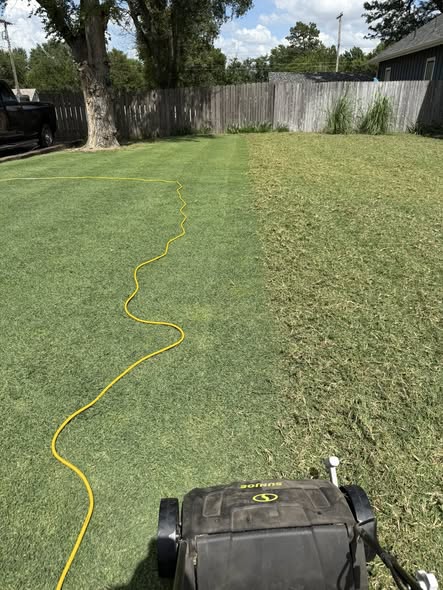
The second thing I find consistently — and this one surprises people more than the compaction — is that the lawn is being cut too short. Often significantly too short.
I see this on properties where the homeowner mows their own lawn, and I see it on properties that have been maintained by other lawn companies. It’s everywhere. And it does more cumulative damage to Sudbury lawns than almost anything else I encounter.
Here’s the problem. People cut short for understandable reasons — they want to go longer between cuts, or they think shorter looks neater, or they’ve just always done it that way. What they don’t realize is that every time they cut the grass below about 2.5 to 3 inches, they’re removing most of the leaf surface the plant uses for photosynthesis. They’re forcing the plant to redirect all available energy from root development into emergency leaf regrowth. They’re exposing the soil surface to direct sunlight, which dries it out fast and creates perfect conditions for weed germination.
Over a season, repeated short cutting creates a lawn with shallow roots, thin coverage, high weed pressure, and almost no ability to handle summer heat stress. The lawn looks okay right after a cut and then deteriorates quickly. By July it’s brown and thin and the homeowner assumes it’s a watering problem or a disease problem or just a bad lawn.
It’s a cutting height problem.
In Sudbury specifically — where our summers get genuinely hot in July and August — cutting height matters even more than in milder climates. A lawn maintained at 3 inches has blades that shade the soil surface, keeping it cooler and retaining moisture longer during dry stretches. A lawn cut to an inch and a half has bare soil baking in the sun, drying out fast, and losing whatever moisture it had within a day of watering.
What to do about it: Raise your deck height. For cool-season turf in Sudbury — which is what almost every residential lawn here is — the target is 3 inches through most of the season, 3 to 3.5 inches in July and August. Never remove more than a third of the blade in a single mow. And if you’ve been cutting short for a while, raise the height gradually over two or three cuts rather than all at once.
Thing 3 — There Is a Drainage Problem Nobody Has Addressed
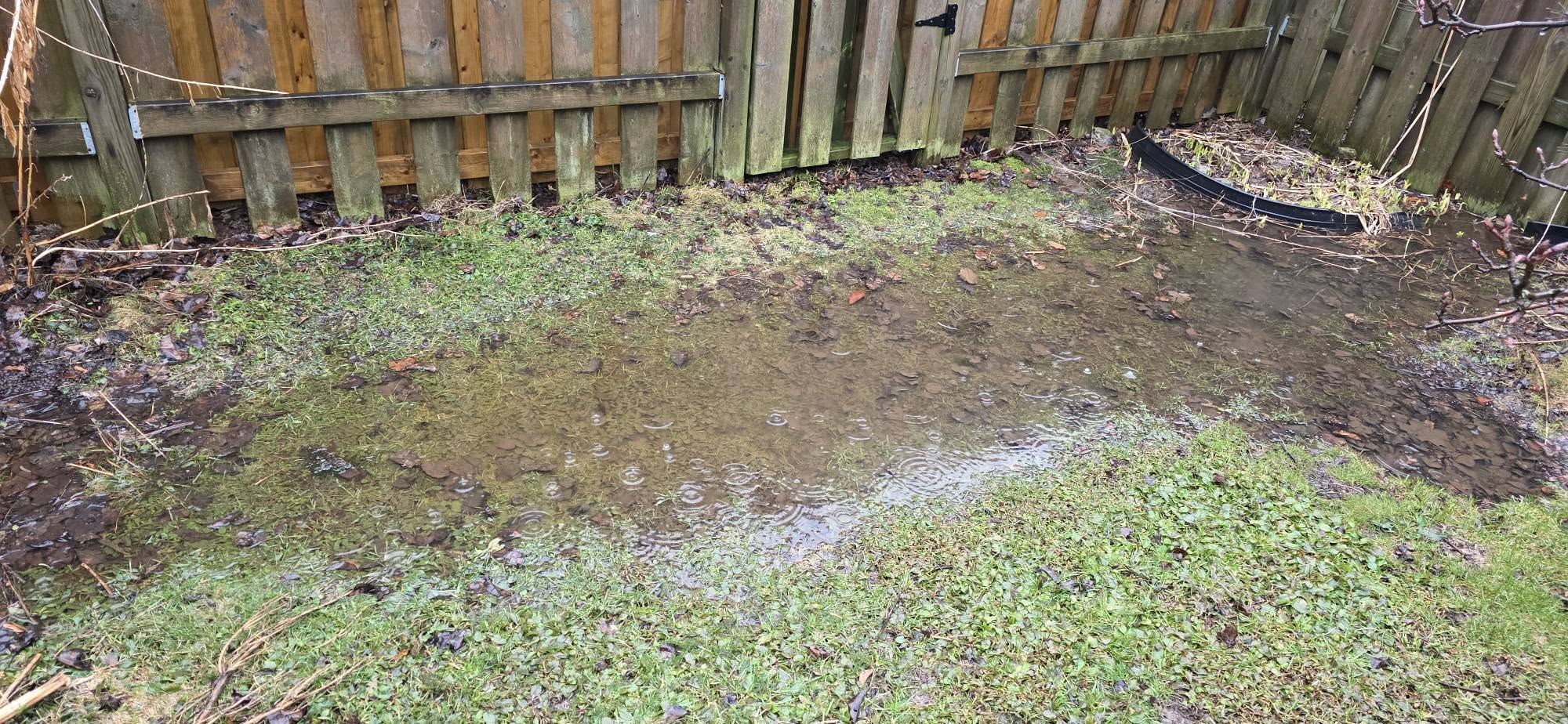
The third thing — and this one is the most consequential because it’s the hardest to fix without professional help — is a drainage problem that’s been sitting unaddressed, sometimes for years, sometimes for the entire time the homeowner has lived in the house.
Drainage problems on Sudbury residential lots take a few different forms. Sometimes it’s a low spot in the lawn where water pools after rain and sits for days. Sometimes it’s a grade that directs runoff from a neighbouring property onto the lawn. Sometimes it’s an eavestrough discharging directly onto the lawn rather than away from the house. Sometimes it’s all three.
What they all have in common is this: they create areas on the lawn that alternate between waterlogged and bone dry — depending on whether it’s just rained or been dry for a week — and neither state supports grass growth. Roots in waterlogged soil suffocate from lack of oxygen. Roots in soil that’s dried out after being saturated are sitting in hard, cracked clay with nothing to hold moisture.
The grass in those areas dies. Every single year, reliably, in the same spots. The homeowner resods or reseeds. It works for a season. The following spring the same patches are dead again. Because the drainage problem is still there.
I find this on a significant majority of the properties I assess — not always severe, but present. And in almost every case, the homeowner has noticed the problem spots but hasn’t connected the dead grass to the underlying drainage issue. They’ve been treating the dead grass as a grass problem when it’s a water management problem.
On Sudbury’s clay-heavy soil, this is particularly stubborn because clay doesn’t drain naturally even in areas with good grade. The combination of difficult drainage soil and low spots or runoff issues creates persistent problem areas that no amount of overseeding or sod work will permanently fix without addressing the grade first.
What to do about it: Walk your lawn after the next significant rain event — an hour after, two hours after. Look for where water is pooling and sitting. Look for where it’s coming from. If it’s coming off a neighbouring property or from an eaverstrough, those sources need to be redirected. If there are low spots, they need to be built up and graded toward natural drainage paths. This work needs to happen before any lawn restoration in those areas — otherwise you’re just setting yourself up for the same failure again.
Why These Three Things Keep Showing Up Together
It’s worth explaining why these three problems so often appear together on the same property rather than in isolation.
They reinforce each other. Compacted soil drains worse — which makes drainage problems worse. Poor drainage saturates and then dries out soil — which worsens compaction through repeated wet-dry cycles. Short cutting produces shallow roots — which means the lawn has no buffer against either the compaction or the drainage stress.
A lawn dealing with all three at the same time is essentially fighting on every front simultaneously. It doesn’t matter how much seed you put down or how well you fertilize — the conditions underneath are working against everything you’re trying to do from the surface.
Fixing one helps. Fixing all three is what actually turns a lawn around permanently.
What This Means for Your Lawn
I want to give you a simple framework for assessing your own lawn based on these three things:
Compaction check: Screwdriver test. Push it in, see how far it goes. Less than three inches with normal hand pressure means compaction is a problem. Less than one inch means it’s severe.
Cutting height check: Stand beside your mower after a cut. Is the grass 3 inches tall? If you can see a lot of soil surface between grass plants, or if the lawn browns out within a week of cutting in summer, the height is too low.
Drainage check: Walk the lawn after the next rain. Any area with standing water after an hour is a drainage problem. Any area with dead grass that reappears in the same spot every season — look at the drainage in that specific area before you resod or reseed it.
Not every lawn will have all three. But if yours is struggling and you’ve tried the obvious things without improvement, it’s worth checking each one specifically. The answer to why your lawn isn’t responding is almost always in one of these three places.
Want Me to Check Your Property?
If you want a proper assessment — someone who will actually walk your lawn, do the screwdriver test, check your cutting height situation, and look at your drainage — reach out. I’ll tell you exactly what I find and what it would take to address it. No guessing from the surface. No treating symptoms. Finding the actual cause.
📞 Call or text me: 705-507-6787
Or fill out the free quote form here — I get back to everyone same day.
— Ryan Lingenfelter
Owner, Cutting Edge Lawn & Landscaping
Garson, Ontario
Related Articles
- The One Thing I Always Find Under a Dead Sudbury Lawn
- The One Lawn Mowing Mistake I See Every Week in Sudbury
- Core Aeration Services in Greater Sudbury
- The 2-Week Window in Sudbury That Makes or Breaks Your Lawn All Summer
- The Worst Lawn I’ve Ever Seen in Greater Sudbury
