
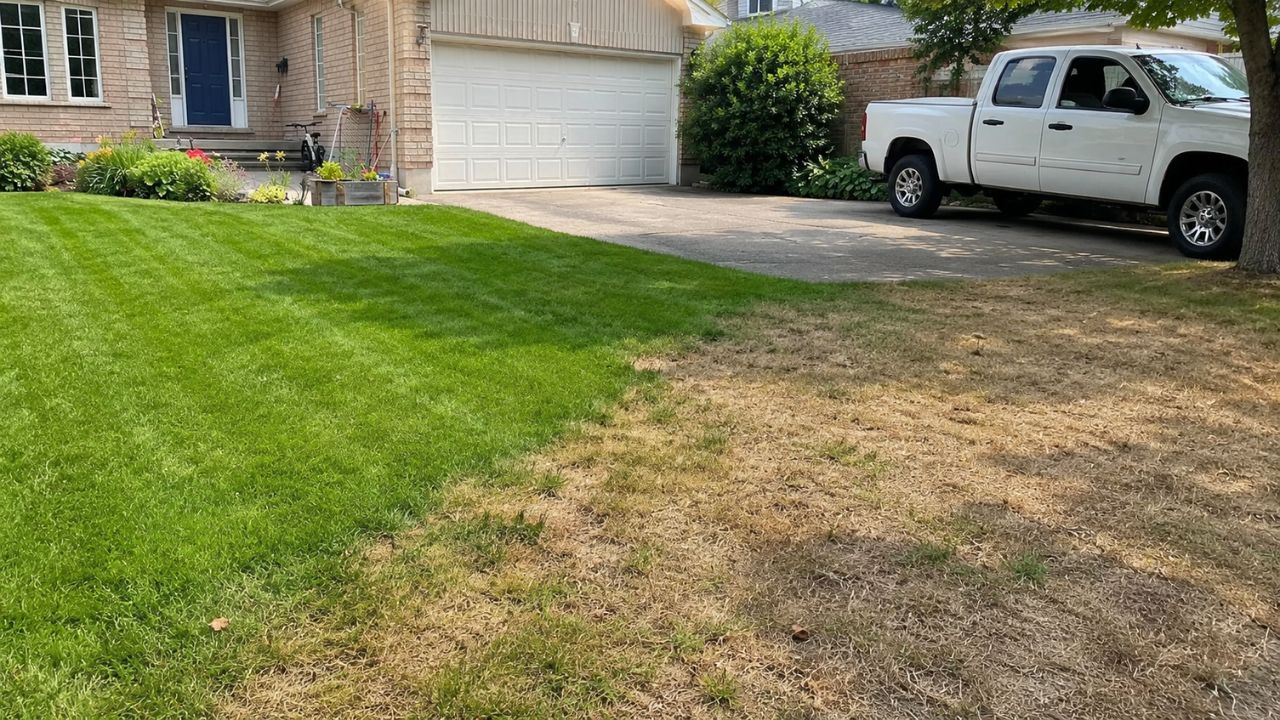
I drove past three properties in Val Caron last week. All three had the same thing going on — grass that looked decent a month ago is now starting to thin out, go a bit pale in spots, and in one case there were already small dry patches forming along the edges of the lawn where it meets the driveway.
The homeowners probably think it’s the weather. A dry stretch, maybe. Or something they did wrong.
Most of the time, it’s neither.
I’m Ryan Lingenfelter — I own Cutting Edge Lawn & Landscaping in Garson, Ontario. I’ve been taking care of lawns across Greater Sudbury since 2020, and I want to talk to you about something that happens every single year around this time — something I see on property after property — that most homeowners don’t see coming until it’s already a problem.
There’s a specific week, usually landing somewhere in early June, where Sudbury lawns start to struggle. Not all of them. But most of the ones that weren’t set up right in spring. And the difference between lawns that push through it and lawns that spend the rest of the summer looking rough is almost always the same two or three things.
Let me walk you through exactly what’s happening and what you can still do about it right now.
Why June Is the Week Everything Changes in Sudbury

Sudbury lawns are cool-season lawns. The grass varieties growing on most residential properties here — Kentucky bluegrass, fine fescue, perennial ryegrass — do their best work when soil temperatures are between roughly 10°C and 18°C.
In spring, that’s exactly what we get. The ground warms up slowly after the thaw, soil temps move into that range, and grass responds. It fills in, it greens up, it looks great. That’s why lawns look so good in May.
Then June hits.
Daytime temperatures climb. The ground warms up faster than the grass can adapt. Soil temperatures push past 20°C and keep going. And the cool-season grass that was thriving a few weeks ago starts to slow down, pull back, and in some cases go into early stress.
This is normal. It happens every year. The lawns that handle it best are the ones that went into this transition period with deep roots, good soil structure, and enough density to hold moisture. The lawns that struggle are the ones that spent all of spring on compacted ground with shallow roots and thin coverage — they have nothing in reserve when the heat comes.
By the time most homeowners notice the lawn starting to look rough, the transition has already started. You’re not too late to help it — but you need to move now, not next month.
What’s Actually Happening to Your Grass Right Now
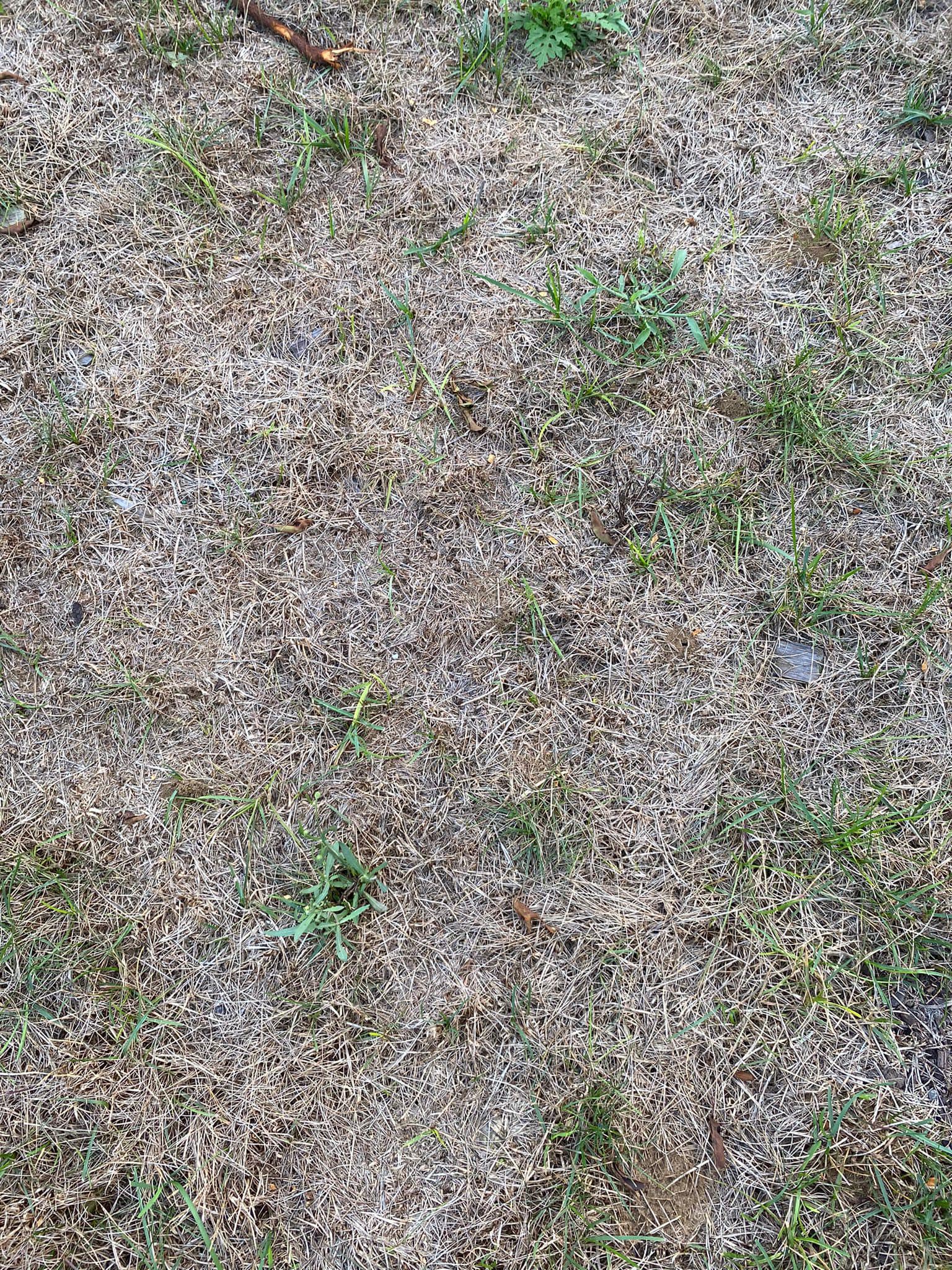
When I walk a property in early June and the lawn is already struggling, I know before I even get down and look at the soil what I’m going to find.
Compaction. Almost every time.
Sudbury’s clay-heavy soil compacts hard over winter. Freeze-thaw cycles push the particles together, foot traffic presses them tighter, and by the time spring arrives the ground beneath the lawn is dense enough that water runs off the surface instead of soaking in. Roots can’t push through it. They stay shallow — two or three inches at most in bad cases — and shallow roots mean the grass has almost no ability to pull moisture from deeper in the soil.
So what happens when June gets warm and dry? The shallow root zone dries out fast. The grass can’t reach water that’s sitting deeper in the ground because its roots never got there. It starts to thin, it starts to pale, and if you get a week without rain during a stretch of 25+ degree days, you start seeing brown.
A few other things I commonly find on struggling June lawns:
- Thatch buildup that was never addressed in spring. A thick thatch layer blocks water from reaching soil at all. It also creates a warm, moist environment at the surface that promotes disease.
- Mowing too short. I see this constantly. Homeowners cut the lawn down to an inch and a half because it “looks neater.” Short grass in heat stress is a disaster. The blade is what shades the soil and slows evaporation.
- Watering at the wrong time. Evening watering leaves moisture on the blade overnight, which encourages fungal disease. Midday watering evaporates before it soaks in. Neither one helps as much as it should.
- No fertilizer applied in spring. A lawn going into summer heat with no nutrient reserves is running on empty. It has nothing to draw on when conditions get hard.
None of these are catastrophic on their own. Put two or three of them together and you get a lawn that looks fine in May and starts falling apart in June.
The Three Things I Tell Every Sudbury Homeowner to Do This Week
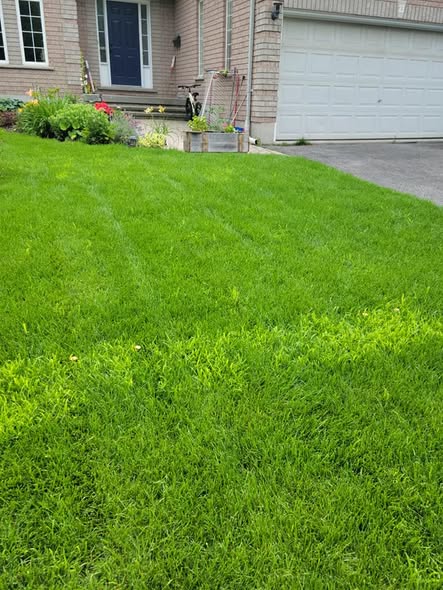
If your lawn is starting to show stress — or even if it’s still looking decent and you want to keep it that way through the summer — here’s what I’d tell you to do right now.
1. Raise Your Mowing Height Immediately
This is the fastest, cheapest thing you can do and it makes a bigger difference than almost anything else.
Set your mower deck to 3 to 3.5 inches. Not lower. In summer heat, longer grass shades the soil and reduces evaporation. It also means more leaf surface for photosynthesis, which supports root development. Longer grass looks different — maybe not as tight and manicured as you’re used to — but it’s dramatically more resilient in heat and dry conditions.
Never cut more than a third of the blade in a single mow. If your lawn has gotten long and you want to bring it down, do it over two or three mows a few days apart. Taking off too much at once puts the plant into immediate stress.
And if your mower blade hasn’t been sharpened this season, do it this week. A dull blade tears grass. Torn grass browns at the tips, stresses faster, and is more susceptible to disease. A sharp cut is a clean cut — the plant heals faster and stays healthier.
2. Change How You’re Watering
Early morning. That’s when you water. Not evening, not midday — morning.
Morning watering means the moisture soaks into the soil before the heat of the day can evaporate it. The grass blade has time to dry out during the day, which prevents the fungal disease that comes from leaving moisture on the surface overnight.
Water deeply and infrequently. Most Sudbury lawns need about an inch of water per week. One deep watering of an inch is far more effective than three light ones. Shallow, frequent watering keeps moisture in the top inch of soil — which is exactly where you don’t want it, because that trains roots to stay shallow instead of pushing deeper to find water.
A simple way to measure: put an empty tuna can on the lawn while you water. When it’s full, you’ve hit roughly an inch. Takes about 20–30 minutes with most sprinklers.
3. If You Haven’t Fertilized Yet, Do It Now — But Use the Right Product
A lawn going into early summer heat with no fertilizer is going to struggle harder than it has to. Nutrients support root development, help the plant respond to stress, and maintain the density that keeps weeds from moving into bare spots.
But — and this matters — do not apply a quick-release high-nitrogen fertilizer in warm, dry conditions. It will burn the lawn. I’ve seen it happen and I’ve been called out to properties to assess “mysterious brown patches” that turned out to be fertilizer burn from someone trying to help their lawn in July with the wrong product.
Use a slow-release granular fertilizer. Apply it in the morning when it’s cooler, then water it in. The nutrients release gradually over weeks instead of all at once, which is exactly what a lawn under heat stress needs.
If you’re not sure what product to use or how much to apply, call me before you do anything. A few minutes of conversation can save you a month of dealing with a burned lawn.
What I See on Properties That Hold Up Through Summer
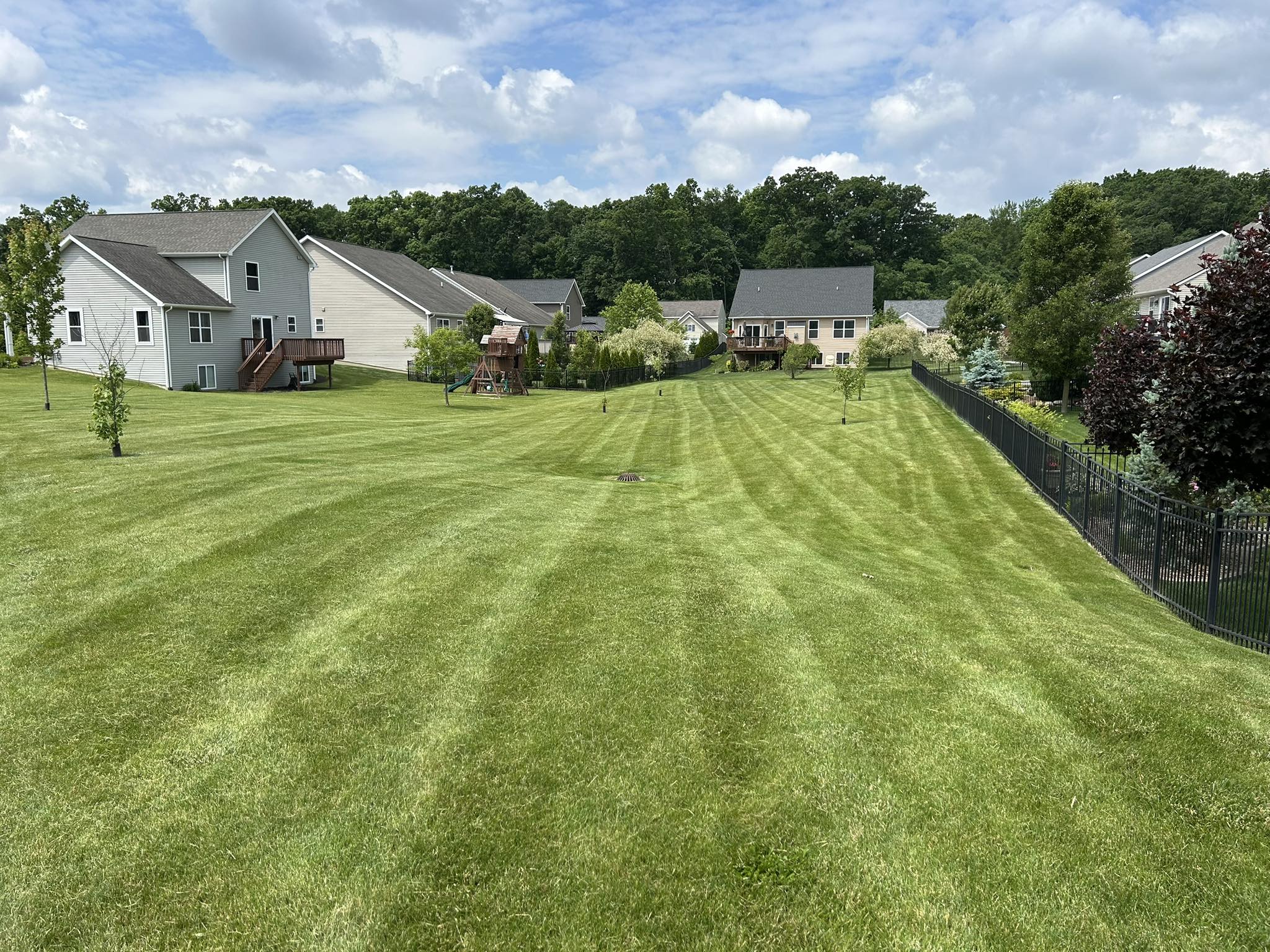
I’ve been on enough properties in Greater Sudbury over the last six years to know what the lawns that look good in August have in common. It’s not a mystery and it’s not expensive.
They were aerated in spring. The soil structure going into summer is loose enough for roots to push deep and for water to move through. When a dry stretch hits in July, the grass can still find moisture because its roots are where the moisture is.
They were seeded or sodded where needed, so there are no thin areas for weeds to move into. A dense lawn is the best weed control there is.
They get mowed at the right height, consistently. Not scalped down tight every two weeks — kept at 3 to 3.5 inches, cut regularly so it never gets so long that a single mow takes off more than a third.
And the homeowner pays attention to it. Not obsessively — I’m not talking about daily monitoring. Just enough to notice when something looks off before it becomes a bigger problem. The lawn that gets looked at and gets help when it needs it always looks better than the lawn that gets ignored until it’s in rough shape.
The good news is that most of what separates a struggling summer lawn from a healthy one is entirely fixable. Sometimes the window to fix it easily is narrow — but you’re reading this in early June, which means you’re still in it.
Where Your Lawn Is Right Now — And What to Do Next
Take a walk across your lawn this week. Not a glance from the driveway — actually walk it, look at it up close, push your foot into the soil in a few spots and feel whether it’s hard or whether there’s some give.
If it’s hard and the grass is already thinning in spots: aeration should have happened in spring and probably didn’t. You can still aerate now — summer aeration isn’t ideal but it’s better than leaving compacted soil for another four months. Follow it immediately with deep watering and keep traffic off the lawn for a few days while it recovers.
If the grass is pale or starting to yellow slightly but still dense: you likely need water and possibly a slow-release fertilizer application. Raise your mowing height and switch to morning watering if you haven’t already.
If there are bare or thin patches forming: this is where weeds move in. Overseeding works in early June if the patches are small — keep the seed consistently moist for two weeks. For larger bare areas, especially anything bigger than a couple of square feet, sod is the faster and more reliable answer.
And if you’re standing on your lawn right now thinking “I’m not sure what I’m looking at” — that’s exactly what I’m here for.
I’ll come out, I’ll walk the property with you, and I’ll tell you straight what’s going on and what makes sense to do. No pitch, no pressure — just an honest look at your lawn from someone who’s been working in Sudbury soil for six years.
📞 Call or text me: 705-507-6787
Or fill out the free quote form here — I get back to everyone same day.
— Ryan Lingenfelter
Owner, Cutting Edge Lawn & Landscaping
Garson, Ontario
Related Articles
- Core Aeration Services in Greater Sudbury
- Grass Cutting Services in Sudbury
- Why Sudbury Lawns Die in July (It’s Not the Heat)
- Sod Installation in Sudbury — When It Makes Sense
