
I’m Ryan Lingenfelter — owner of Cutting Edge Lawn & Landscaping in Garson, Ontario.
I want to tell you about a street in Hanmer.
Three houses in a row. Same builder, same year, same soil underneath, same Sudbury winters. One lawn looks genuinely excellent — thick, green, the kind of lawn you notice when you drive past. The second lawn is thin and patchy — struggling, not dead, but clearly not right. The third lawn is mostly weeds and bare spots. The homeowner has given up on it and is already thinking about sod.
All three of these homeowners have the same starting conditions. Different results.
I worked on two of these properties last season. I talked to all three homeowners at different points. And the differences I found weren’t random. They weren’t luck. They weren’t about who had more money to spend.
They were about three specific decisions — one per property — that compounded over time into dramatically different lawns.
Here’s what I found and what it means for your own lawn.
Property One — The Lawn That Looks Perfect

The homeowner on property one — I’ll call him Mark — moved in four years ago. The lawn was average when he bought the house. Decent but not exceptional. He asked me to come out in his first spring because he wanted to understand what he was working with before he did anything.
We walked it together. Compaction was present but not severe. About 70% live grass. No obvious drainage issues. No grub damage. A lawn that had potential but needed consistent care to realize it.
Mark asked me what the single most important thing he could do was. I told him core aeration every spring and cut it at 3 inches, every single time, all season.
He did both. Every year for four years without skipping.
That’s the whole story of why his lawn looks the way it does. No premium fertilizer program. No expensive treatments. No dramatic interventions. Just annual aeration on Sudbury clay that would otherwise compact harder every winter, and a consistent cutting height that built the deep root system that keeps his lawn green through July when everyone else’s is going dormant.
When I walk his lawn now and push the screwdriver in, it goes in six inches easily. The soil biology has improved every year as the aeration opened the clay and organic matter started building up in the top layer. The grass roots are deep because they’ve had four years of growing at the right height without being scalped.
The one thing Mark did that most of his neighbours didn’t was decide in year one that he was going to do the right things consistently rather than reactively. He didn’t wait until the lawn looked bad to act. He maintained it before it needed fixing.
The decision that made the difference: Annual aeration from year one, combined with correct mowing height maintained consistently.
Property Two — The Lawn That’s Struggling
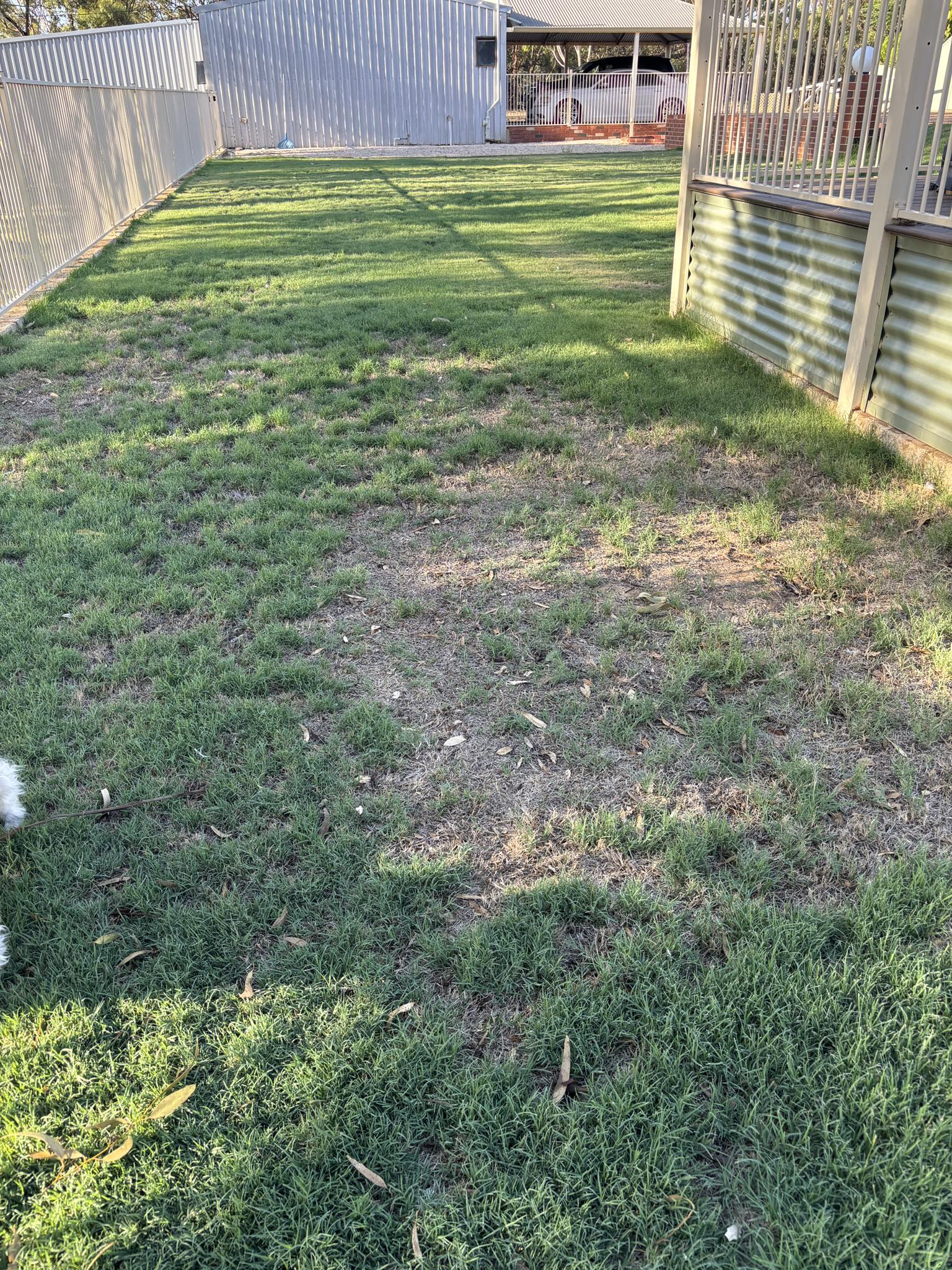
The homeowner on property two — I’ll call her Sandra — also moved in four years ago. Same starting conditions as Mark. Average lawn, decent soil, no major structural problems.
Sandra’s approach was reactive. When the lawn looked thin, she overseeded. When it went brown in July, she watered more. When weeds showed up, she bought weed killer. She was responsive to problems as they appeared. She just never addressed what was actually causing them.
I walked her property last spring. The screwdriver test told the story immediately — it stopped at about an inch and a half in most of the lawn. Four winters of freeze-thaw compaction with no aeration had turned the clay soil into something close to concrete six inches down. The roots couldn’t go anywhere. The lawn had been fighting a soil problem for four years that no surface treatment was going to fix.
The overseeding hadn’t worked because seed dropped on compacted Sudbury clay doesn’t establish well — it sits on the surface without proper soil contact and mostly fails to germinate. The extra watering hadn’t helped the July browning because shallow roots on compacted clay can’t access moisture below the surface layer no matter how much you water. The weed killer had knocked back the dandelions temporarily, but dandelions thrive in compacted clay — kill them and new ones find exactly the same favorable conditions waiting.
Every dollar Sandra spent on surface treatments was going toward symptoms. The cause — compacted soil — was getting worse every year.
We aerated her property last May and overseeded properly into the aeration holes afterward. By September it was noticeably better. Not as good as Mark’s — four years of compaction takes more than one season to fully reverse — but clearly improved. She’ll see continued improvement over the next two seasons as the soil structure recovers.
The decision that made the difference: Four years of reactive treatment instead of fixing the underlying compaction. One aeration would have changed the trajectory in year one.
Property Three — The Lawn That’s Mostly Given Up

The homeowner on property three — I’ll call him Phil — has a different situation entirely. Same street, same soil, same starting conditions. But Phil’s lawn is mostly weeds and bare patches. He’s been spending money on it and it keeps getting worse.
When I walked his property, I found the compaction problem that Sandra had — but I also found something else. A low area along the back fence line that showed clear water marks. A section near the side yard that was noticeably wetter than the rest of the property even in mid-May. And when I pulled on the grass in the worst dead sections, it came up in mats — root system gone underneath.
Grubs. The previous fall had clearly had a grub problem that nobody treated, and the damage had spread through the winter. Phil had noticed dead patches in spring and overseeded them. The seed had mostly failed because he was dropping it into soil where grubs were still active and the drainage problem was still present.
Phil’s lawn has three separate problems operating at once. Compaction. Active grub damage. A drainage issue. Each one alone would be manageable. Together they’ve systematically destroyed the lawn over four years.
The fix for Phil is more involved than for Sandra. The grub population needs to be treated before any new grass goes down. The drainage corner needs regrading. The worst sections need sod rather than overseeding. And then annual aeration going forward to prevent the compaction from returning.
It’s not cheap. But it’s a one-time fix that solves all three problems permanently. What Phil has been spending on annual overseeding and weed control that isn’t working is good money going toward problems that aren’t being solved. The cost of doing it right is actually less than the cumulative cost of doing it wrong for another three years.
The decision that made the difference: Three separate problems that were never diagnosed. Every dollar went toward surface treatments while the actual causes — grubs, drainage, compaction — continued operating unchecked.
What These Three Lawns Actually Tell You

Same street. Same soil. Same Sudbury winters. Three completely different outcomes. And none of it was luck.
Mark’s lawn looks good because he addressed the foundation in year one and maintained it consistently. Sandra’s lawn is struggling because she treated symptoms without fixing the underlying compaction. Phil’s lawn is in rough shape because multiple structural problems were never diagnosed and every treatment went toward the wrong target.
The lesson isn’t complicated. But it’s one the lawn care product industry doesn’t want you to hear, because the answer almost never involves buying something off a shelf.
Most Sudbury lawn problems are soil problems. Compaction, drainage, grub damage — these are structural issues that live below the surface. Fertilizer, seed, and weed killer address the surface. They work on healthy soil. They produce temporary or no results on a soil that has a structural problem.
The gap between Mark’s lawn and Phil’s lawn after four years isn’t the product of dramatically different effort or dramatically different spending. It’s the product of effort and spending directed at the right problems versus the wrong ones.
If you’ve been spending money on your lawn and not seeing results that match the effort, the most useful question you can ask is not “what product should I try next?” It’s “what is actually causing this, and have I addressed that cause?”
That question — asked honestly and answered correctly — is what separates the lawns that look good from the ones that don’t. On the same street. With the same soil. In the same Sudbury winters.
How to Figure Out Which Situation Your Lawn Is In
You don’t need me to tell you which of these three situations you’re in. The tools are simple and the test takes about ten minutes.
The screwdriver test: Push a standard flathead screwdriver straight into the soil in your problem areas. If it stops before three or four inches, compaction is a significant factor. If it goes in easily, compaction isn’t the primary issue.
The pull test: Grab handfuls of grass in the dead or struggling sections and pull. If it comes up like a loose carpet with no root resistance — grubs. If it’s rooted but thin and stressed — compaction or maintenance issue.
The drainage check: After a rain, walk the property and note any areas that hold water longer than the rest of the lawn. Those areas will consistently underperform until the grade is corrected.
The mower check: Park your mower on the driveway and measure the deck height. If it’s below 2.5 inches, cutting height may be part of the problem regardless of what else is going on.
If you’re not sure what you’re looking at, or you’ve got a combination of problems like Phil does and you want a straight answer about what to tackle first — give me a call. I’ll walk the property, do the tests, and tell you honestly what I see.
📞 Call or text me directly: 705-507-6787
Or fill out the free quote form here and I’ll get back to you same day.
We service Garson, Val Caron, Hanmer, Lively, Chelmsford, Azilda, Capreol, and all of Greater Sudbury.
— Ryan Lingenfelter
Owner, Cutting Edge Lawn & Landscaping
Garson, Ontario
Frequently Asked Questions
Why does my neighbour’s lawn look better than mine in Sudbury?
The most common reasons one Sudbury lawn looks better than another on the same street come down to three things: whether the soil has been aerated regularly, whether the grass is being cut at the right height, and whether any structural problems like grubs or drainage issues have been identified and addressed. A lawn that’s been aerated annually on Sudbury’s clay soil has significantly better soil structure, deeper roots, and better drought resistance than one that hasn’t — even if both lawns receive similar surface treatments like fertilizer and watering.
What is the single most important thing I can do to improve my Sudbury lawn?
Annual core aeration is the highest-return lawn care service on Sudbury properties. Sudbury’s clay-heavy Canadian Shield soil compacts severely every winter. Without aeration, fertilizer can’t reach the root zone, water runs off instead of soaking in, and roots stay shallow — producing the browning and thinning that most homeowners try to fix with surface treatments that can’t address the underlying problem. One aeration per year consistently produces better long-term results than any combination of fertilizer programs, weed control products, or overseeding on compacted soil.
Why isn’t my Sudbury lawn responding to fertilizer and overseeding?
If you’ve been applying fertilizer and overseeding without seeing lasting improvement, the likely cause is compacted soil that the treatments can’t penetrate. Fertilizer applied to the surface of compacted Sudbury clay sits on top rather than reaching the root zone. Seed dropped on compacted soil without aeration fails to establish because it can’t make proper contact with the soil. The treatments aren’t wrong — the soil condition underneath them is preventing them from working. Core aeration before overseeding and fertilizing produces dramatically different results on the same lawn.
How do I know if my Sudbury lawn has grub damage?
The clearest sign is dead sections that pull up like a loose carpet — the grass comes up with no root resistance because the grubs have eaten the root system from below. You can confirm by cutting a one-foot square of turf in a suspect area and counting the white larvae in the soil. More than five to eight larvae per square foot in Sudbury is typically above the damage threshold. Grub damage needs to be treated before any new grass is established — putting down seed or sod without treating the grub population produces the same damage the following season.
Can a neglected Sudbury lawn actually be fixed, or does it need full replacement?
It depends on how much live grass remains and what caused the damage. If more than 50% of the lawn is still alive, fixing the underlying cause — aeration for compaction, drainage correction for water problems, grub treatment for pest damage — combined with overseeding of thin spots typically produces significant improvement within one season. If less than 40% is alive, partial or full sod replacement on the damaged sections is usually the more cost-effective long-term approach. The key is diagnosing what caused the damage before deciding on the approach — the same surface looks can have very different underlying causes that need different responses.
Is it too late to fix a Sudbury lawn that’s been neglected for several years?
No — but the scope of the fix depends on how much damage has accumulated. Compaction from multiple years without aeration can be substantially reversed within two seasons of annual aeration. Grub damage on specific sections can be fixed with treatment and sod. Drainage issues can be corrected with regrading. The longer a structural problem has been present, the more work it takes to reverse — but none of these problems are permanent. The mistake is continuing to apply surface treatments to structural problems. Correct the diagnosis and the right fix almost always produces results.
Ryan Lingenfelter is the owner of Cutting Edge Lawn & Landscaping in Garson, Ontario. Since 2020, his crew has provided full lawn care and landscaping services across Greater Sudbury — Garson, Val Caron, Hanmer, Lively, Chelmsford, Azilda, and Capreol. Licensed, insured, BBB A+ rated, and ThreeBest Rated for lawn care services in Sudbury.
📞 Phone: 705-507-6787
📍 Service Area: Greater Sudbury, Ontario
🔗 Free Quote: cuttingedgelawn.ca/quote
Related Services
Continue Reading
- 5 Lawn Care Mistakes Sudbury Homeowners Make Every Spring
- The $35 Fix That Saved a Sudbury Lawn
- When Should You Actually Aerate Your Sudbury Lawn?
- Sod vs Seed in Sudbury — Which One Is Right for Your Lawn?
