
By Ryan Lingenfelter · Cutting Edge Lawn & Landscaping, Garson, Ontario · June 2026
Most lawn care diagnosis is visual — colour, pattern, density, edge quality. I’ve written a lot about what to look for because that’s where most of the diagnostic information lives. But after six seasons of working lawns across Greater Sudbury, I’ve developed a set of secondary diagnostics that rely on a different sense entirely.
What you hear and feel through your feet when you walk a lawn tells you things the surface appearance doesn’t — often earlier than the visual signs develop. These aren’t dramatic signals. They’re subtle. Most homeowners don’t know to listen for them because nobody has ever pointed them out. Once you know what they mean, you start catching problems in the week they’re developing rather than in the month they become visible.
Here are the four sounds and sensations I pay attention to — what each one means, what’s causing it, and what to do when you find it.
Sound one — the crunch underfoot that tells you it’s too dry before the colour tells you
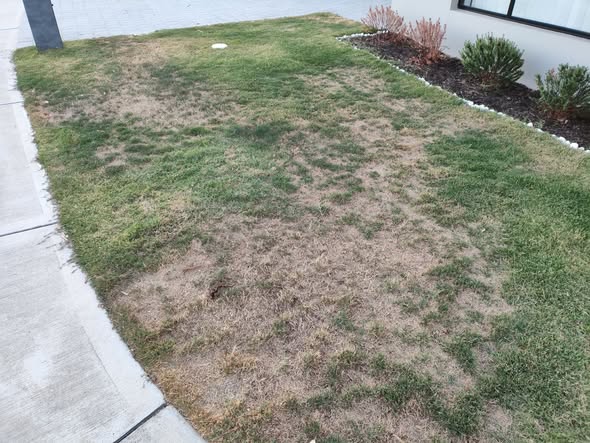
Walk slowly across your lawn in the afternoon of a warm day — the kind of afternoon where the temperature has been above 25 degrees for several hours. Listen to what your feet are doing.
A healthy, adequately moistened lawn makes almost no sound underfoot. The grass blades compress under your weight and spring back. There’s a soft, slightly yielding quality to the surface. No sound except the grass bending.
A lawn that is approaching moisture stress makes a faint but distinct crunching sound when you walk on it. Not the loud crunch of walking on dry leaves — subtler than that. A slight crisp compression underfoot, almost like walking on very thin dry grass. The blades are beginning to lose their turgor — the internal water pressure that keeps plant cells rigid — and as they bend under foot pressure they crunch instead of flexing silently.
This crunch appears before the colour change. The visual indicator of moisture stress — the blue-grey tint that I described in the article on the 5 things I notice in the first 30 seconds at any Sudbury property — follows the crunch by twelve to twenty-four hours in most conditions. If you hear the crunch but don’t see the colour change yet, the colour change is coming. You’re in the early warning window.
The crunch is particularly valuable on Greater Sudbury properties where the soil dries at different rates across the lawn — faster in the open sun-exposed sections, slower under partial shade. By walking the property and listening, you can identify which sections are approaching stress before any of them look stressed visually. The section that crunches first is the section that needs water most urgently. The section that’s still silent may have another day before it reaches the same point.
What to do when you hear it: water on your next permitted bylaw day. Not aggressively — a standard deep session that wets the soil to four to five inches. If you’re hearing the crunch on a day that’s not a permitted watering day under Greater Sudbury’s odd-even schedule, the situation isn’t yet an emergency — it’s an early warning. The following permitted day is soon enough if the crunch hasn’t progressed to blue-grey colour. If you see the colour change too, water that day regardless of the bylaw day — the bylaw’s total ban provision doesn’t apply to normal heat stress events, and the scheduled watering restriction allows permitted-day watering at any hour. The full bylaw details are in the article on Sudbury lawn care news mid-2026.
Sound two — the squish that means drainage is failing somewhere you haven’t found yet
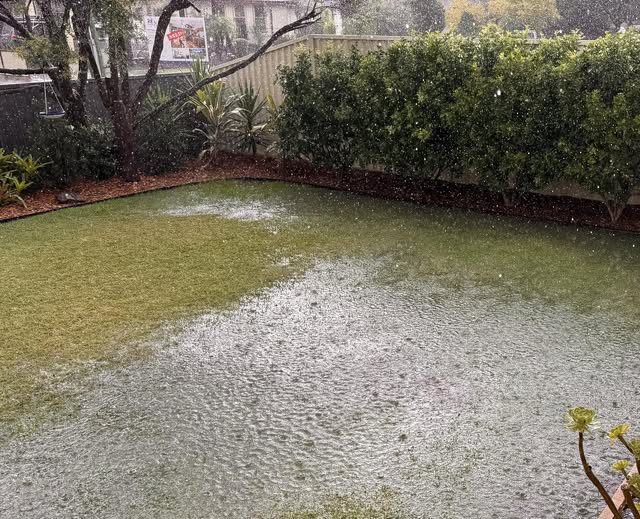
The opposite of the crunch is the squish — and it’s just as diagnostic, but for a completely different problem.
A lawn that squishes underfoot — that produces a soft, wet compression sound when you walk on it, with water visibly moving around your footprint or pressing up from the soil — has more water in it than it should. Not after a heavy rain that happened an hour ago. The diagnostic squish is the one that appears on a day when it hasn’t rained recently, or when the surrounding lawn is dry and firm but a specific section squishes.
That spatial specificity is what makes the squish diagnostic. If the entire lawn is squelching after three days of heavy rain, that’s weather. If a specific section of the lawn squishes while the rest is firm on a dry afternoon two days after the last rain, that section has a water source that the rest of the lawn doesn’t have. Something is directing water into that area — or holding water in that area — in a way that the surrounding soil isn’t experiencing.
The causes fall into three categories. The most common in Greater Sudbury residential areas is a grade problem — a low spot or a grading pattern that directs surface runoff from a neighbour’s property, a downspout, or a driveway into that section rather than away from it. Water flows in after rain and pools in the low area because there’s nowhere for it to go. The second cause is a drainage infrastructure problem — a failed perforated pipe, a collapsed French drain section, or a deteriorated weeping tile that was moving water away from the foundation and is no longer doing so. The third is a high water table situation in lower-lying properties near valleys or lake edges, where groundwater is close enough to the surface that it saturates the soil from below in certain conditions.
I covered the most dramatic version of this diagnostic — the squish that turned out to be a collapsed underground drainage pipe affecting an entire neighbourhood — in the article on the Sudbury property where I found drainage problems underground. The squish was the surface signal. What was causing it was eighteen inches below ground. The squish caught it before the surface damage became extensive.
What to do when you find it: mark the location, note the extent, and pay attention to whether it persists. A squish that appears after a heavy rain and dries within twenty-four hours on clay-heavy Chelmsford soil is normal — that soil holds water and drains slowly. A squish that persists for three or four days after rain, or that appears without recent rain, warrants investigation before you invest anything in lawn care on that section. Overseeding a squishing area is wasted effort. Aerating it is counterproductive — aerating saturated soil produces compressed plugs rather than clean channels. Fix the water source first.
Sound three — the hollow thud that reveals compaction worse than the surface suggests
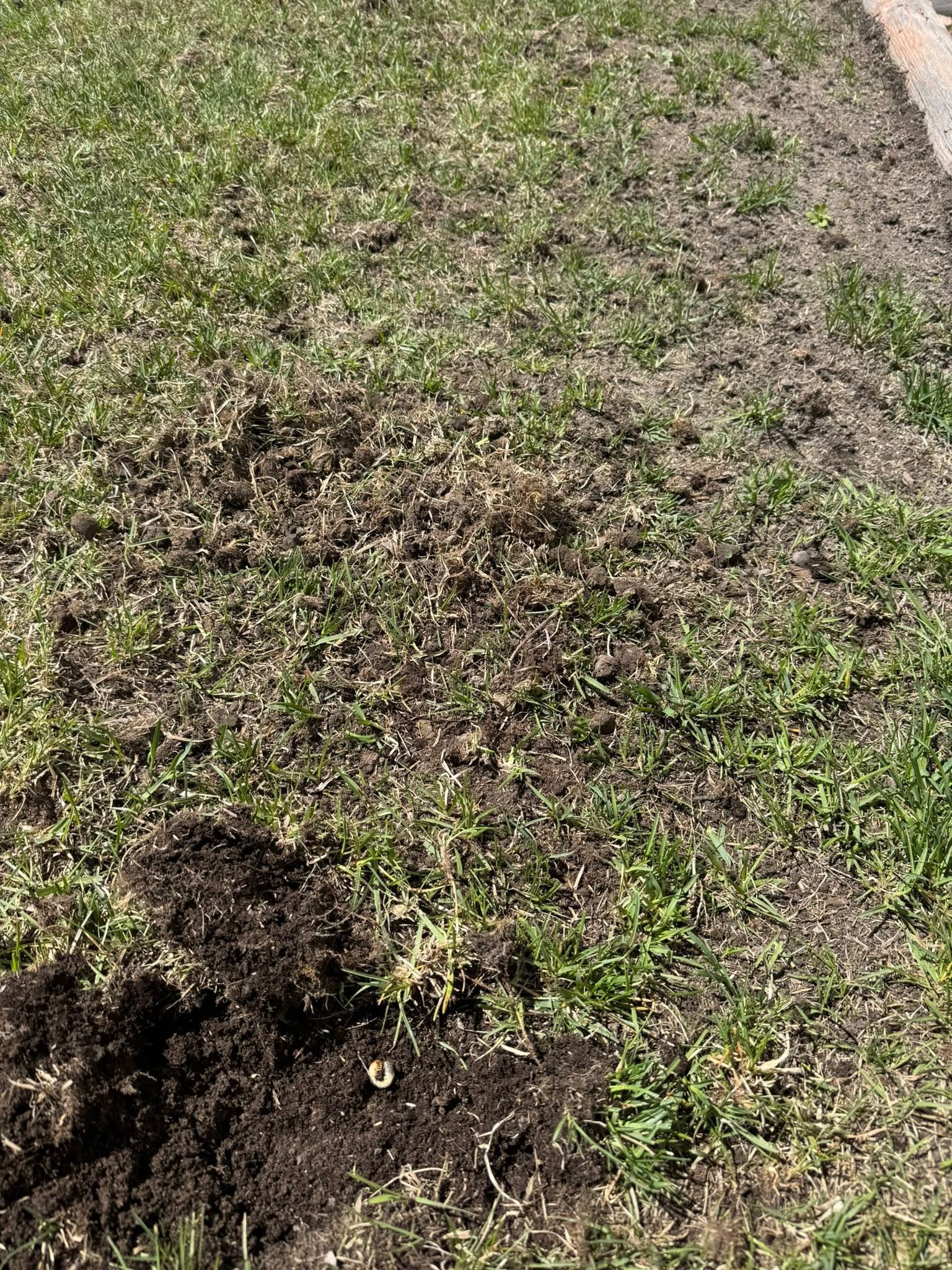
This one requires deliberate testing rather than just noticing as you walk. Press the heel of your foot down firmly on the lawn surface in several spots across the property — not a normal walking step, an intentional firm heel press. Listen to the sound it makes.
On soil with reasonable structure — not compacted to hardpan, some organic matter present, adequate moisture for the season — a firm heel press produces almost no sound. The soil gives slightly, absorbs the pressure, and the grass bends.
On severely compacted soil, the heel press produces a different sound. A dull, flat thud. The kind of sound you’d get pressing a hard surface. No give, no absorption, just impact. In very severe cases — hardpan conditions — it produces a slightly hollow resonance, like tapping on a dense material with nothing behind it.
This hollow thud is telling you that the soil structure at that point has collapsed to the degree where there’s no biological cushion left. No aggregated soil particles with air and water in the gaps between them. Just dense, compressed material that transmits pressure directly rather than absorbing it. This is the soil condition that produces root depths of three quarters of an inch to an inch — roots that can’t push through what the screwdriver can’t push through either.
The value of doing this test in multiple spots across the property is that it maps the compaction variation across the lawn. Compaction in Greater Sudbury is rarely uniform — it concentrates in traffic paths, near the house foundation, in spots where equipment has repeatedly parked or turned, and in low-drainage areas where saturated clay has been repeatedly compressed. The hollow thud locations are a map of where double-pass aeration is most urgently needed versus where single-pass is sufficient.
I described what years of compaction accumulation looks like when you finally excavate it in the article on what I found under a Sudbury lawn maintained for ten years — the screwdriver stopped at an inch and a half in the worst sections, and the hollow thud was audible before I’d even tried the screwdriver. The sound preceded the measurement and confirmed what the measurement found. If you hear the hollow thud on your lawn before your spring aeration this season, mark those sections for double-pass treatment. They need more intervention than the sections that give silently.
Sound four — the mower pitch change that tells you where the hidden high spots are

This is the diagnostic that most homeowners have noticed without knowing what it means. When you’re mowing and the mower engine sound changes — a brief increase in pitch and load as the deck hits something, followed by a return to normal as you pass — you’ve just found a hidden high spot in your lawn grade.
The mower blade is set at a specific height. When it passes over a section of lawn where the ground is slightly higher than the surrounding area — a frost heave, a tree root that has pushed up, a spot where soil has settled differently, an area where the grade was uneven to begin with — the blade contacts the grass at a slightly lower point than it would on the surrounding surface. The deck load increases momentarily. The engine compensates. You hear the pitch change.
On a consistent flat lawn, you hear a steady pitch throughout the mowing pass. On a lawn with hidden high spots, you hear the pitch change at the same locations every time you mow. Same spot, week after week. The consistency is the diagnostic — random pitch changes from debris or uneven thatch don’t happen at exactly the same point. Grade-related pitch changes do.
What the hidden high spot means for the lawn: that section is being scalped. The mower blade is cutting closer to the crown of the grass plant at that point than it is everywhere else. On a lawn maintained at three inches, the high spot may be getting cut at two inches or even one and a half depending on how pronounced the elevation difference is. That section is under more stress than the surrounding lawn, browns faster in heat, has shallower roots, and is more weed-vulnerable — because it’s been getting the wrong cutting height every single visit without the homeowner realising it.
The fix depends on what’s causing the high spot. Frost heave — very common in Greater Sudbury after our freeze-thaw winters — often self-corrects partially through the season as the soil settles, but can be helped along by topdressing with a thin layer of quality compost over the elevated area to gradually build up the surrounding grade to match. Tree root heaving requires either accepting the grade variation and raising the mower deck slightly for the entire lawn, or addressing it with topdressing over multiple seasons. Settlement-pattern high spots are usually corrected by topdressing.
The mower pitch change is worth paying attention to even if you’re not actively planning grade work this season. Map where the changes happen — make a mental note or a rough sketch. Those locations are the ones where the scalping is happening, where the stress is concentrated, and where you’ll eventually see the thinner, paler grass that appears in sections cut too low. Understanding that the grade is causing it, rather than a random soil problem, changes what you do about it. The grade assessment I do as part of every new property walkthrough — described in the article on the one thing I check before taking any new lawn customer — includes noting these pitch-change locations when I do the first mowing pass on a new property. They’re in the assessment because they matter for long-term lawn health, not just for how the surface looks today.
What listening adds to what you’re already seeing
The four sounds don’t replace the visual read. They add to it. The crunch tells you about moisture status before the colour tells you. The squish tells you about drainage before the dead grass tells you. The hollow thud tells you about compaction before the thin sections tell you. The pitch change tells you about grade before the scalped brown circles tell you.
All of these signals exist before the problem is visible on the surface. Which means catching them early — in the week they’re developing rather than the month they become obvious — keeps the corrective work smaller, cheaper, and faster.
Walk your lawn this week. Slowly. Press your heel deliberately in several spots. Listen while you mow. You’ll hear things you’ve been walking past without noticing. Some of them will tell you something useful.
If you want someone to do this walkthrough on your property — the full diagnostic read that combines what I see, what I hear, and what I feel underfoot — give me a call. No charge, no obligation. Just an honest read on what your lawn is telling you.
📞 705-507-6787 | Get a free quote online
— Ryan Lingenfelter
Owner, Cutting Edge Lawn & Landscaping
Garson, Ontario · 705-507-6787
