

She had already done the research. Had two quotes from irrigation companies. Was ready to move forward. She called me because she wanted a lawn care opinion before she committed — specifically, whether a sprinkler system would finally solve the summer browning problem she’d been dealing with on her Azilda property for three years running.
I told her to wait.
Not forever. Not “don’t do it.” Just — wait. Do one thing first. Because if she put that irrigation system in right now, on the lawn as it currently sat, she was going to spend $4,000 on a system that would water her compaction problem more efficiently without actually fixing it.
I’m Ryan Lingenfelter, owner of Cutting Edge Lawn & Landscaping in Garson, Ontario. I’ve been servicing properties across Greater Sudbury since 2020 — Garson, Val Caron, Hanmer, Lively, Chelmsford, Azilda, Capreol. I’m not an irrigation contractor. I don’t install sprinkler systems. I have no financial reason to tell someone not to get one.
Which is exactly why I’m the right person to tell you when getting one first is the wrong move.
What Her Property Actually Looked Like

She described the situation over the phone before I drove by. Brown patches every July and August. Grass that looked fine in spring and then faded as soon as the heat arrived. She’d tried watering manually with a hose-end sprinkler but could never stay consistent — she traveled for work, missed stretches, and by the time she returned the damage was already done. The irrigation system idea made complete sense from where she was standing: set it, forget it, problem solved.
It’s a logical conclusion. And it’s wrong — or at least, it’s premature.
When I walked the property I found what I find on the majority of Sudbury lawns that have been in place for more than three or four years without proper maintenance: significant compaction throughout the soil profile, particularly in the areas around the driveway, along the side of the house, and in the back corner where foot traffic concentrated over winter. The soil surface was dense and hard. In the worst sections I could barely push a screwdriver two inches into the ground before hitting resistance.
Compacted soil doesn’t absorb water properly. It sheds it. Water hits the surface, runs toward the low points on the property, and the grass roots — sitting in that top inch of soil that never gets penetrated — stay dry. It doesn’t matter how good your irrigation system is. If the soil can’t take the water in, the system is just moving the runoff around more consistently.
That’s what she would have been buying. A very efficient way to water her driveway edge and the base of her fence.
Why Compaction Is the Real Problem on Most Sudbury Lawns
This is worth understanding properly because it changes the way you think about almost every lawn problem in Greater Sudbury.
Sudbury sits on the Canadian Shield. The soil here is dense, clay-heavy, and compacts faster and more completely than almost anywhere else in Ontario. Every winter the freeze-thaw cycle pushes the soil through repeated contraction and expansion. Every spring the snowmelt saturates the clay and foot traffic across the softened surface compresses it further. By May, the top several inches of soil on an unmaintained Sudbury property are often as dense as hardpan — water-resistant, root-resistant, and effectively closed to anything you put on the surface.
On her Azilda property, that compaction had been building for at least three seasons without intervention. The grass was surviving in the top half-inch of soil. Roots couldn’t go deeper because the clay beneath was too dense to penetrate. When July heat arrived and that thin surface layer dried out — as it does every year on Sudbury clay without adequate root depth — the grass had nowhere to draw moisture from and it browned out.
An irrigation system delivers water to the surface. What happens to that water after it hits the surface depends entirely on the soil underneath. On compacted Sudbury clay, the answer is: most of it runs off.
A sprinkler system on a compacted Sudbury lawn is like putting a better tap on a clogged pipe. The water pressure isn’t the problem. The blockage is the problem. Fix the blockage first.
The fix for compaction in Greater Sudbury is core aeration — and it’s the single most important thing I do on properties across this city every spring. I’ve written about why it matters more here than anywhere else in Ontario in detail: I’ve Fixed 200+ Sudbury Lawns — This Is the #1 Mistake I See Every Spring.
What I Told Her to Do Instead — Step by Step

Once the actual problem was identified, the sequence became clear. It wasn’t complicated — it just had to be done in the right order.
Step 1: Deep core aeration across the entire lawn.
Core aeration pulls plugs of compacted soil out across the lawn surface — on a four-to-six inch grid pattern — and opens direct channels through the compaction layer down into the root zone. On Sudbury’s Canadian Shield clay, this is the only mechanical way to break up years of built-up compaction. On a properly aerated lawn, water that was running off the surface in thirty seconds will soak in after treatment. The difference in water absorption is immediate and significant. That changes everything about how irrigation performs afterward.
Step 2: Topdress the aeration holes.
After aerating I work a light layer of compost across the lawn so the channels we’ve opened up have organic material to hold. Over time this builds real soil structure in the Canadian Shield clay — better water retention, better drainage between rain events, and slower compaction rebuild between aeration cycles. Most companies skip this step because it adds material cost and time. It’s also the step that makes aeration last significantly longer before compaction rebuilds.
Step 3: Address the shallow soil in the back corner.
The back corner with two inches of soil depth was not going to respond to aeration alone — there simply wasn’t enough soil for a root system to establish and survive July heat. I recommended building that section up with imported topsoil to a minimum six-inch depth before laying sod. Overseeding into shallow soil over rock shelf fails every summer on schedule regardless of how well everything else is done. I’ve documented exactly this pattern on a Hanmer property that failed for four years until we found the rock shelf underneath: The Sudbury Lawn I Almost Gave Up On — And Why I’m Glad I Didn’t.
Step 4: Set a proper manual watering schedule for one season.
I set her up with a specific schedule — one inch per week, applied in a single deep session early in the morning, not short bursts every two or three days. Inconsistent shallow watering on a lawn coming out of compaction repair is one of the worst things you can do. It wakes the grass up without sustaining it and burns through the energy reserves the root system needs to establish. Consistent deep watering lets the roots follow the moisture downward into the newly opened soil channels. I covered exactly why this matters in detail here: I Let a Customer’s Lawn Go Brown on Purpose. Here’s Why It Was the Right Call.
Step 5: Then get the irrigation system.
After one full season with aerated, topdressed, properly depth-built soil — then yes, absolutely install the irrigation system. At that point it performs the way it’s designed to. Water penetrates and reaches the root zone. The system maintains a lawn that can actually hold moisture rather than running it off. The investment makes complete sense and delivers what the homeowner wanted from the beginning.
What Happened When She Followed That Sequence
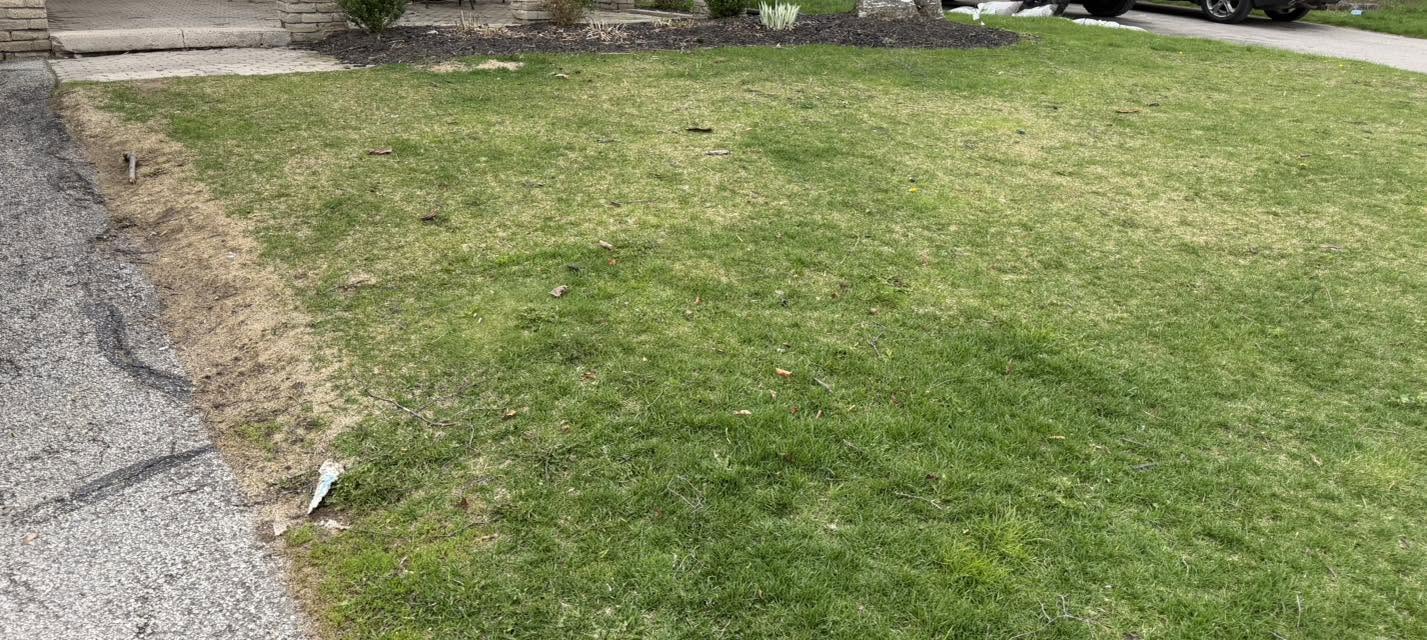
We aerated and topdressed in late May. Repaired the back corner with topsoil and sod. I walked her through the one-inch-per-week deep watering schedule and she committed to it through the summer.
She traveled for work three times that season. Came back each time to a lawn that had held better than it ever had across three previous summers — including one eleven-day stretch with no rain and no watering while she was away. The aerated soil had enough structure to retain residual moisture through that stretch. The back corner sod had rooted properly into the new topsoil and came through it without dying.
The lawn that had browned out every July for three years came through the whole summer without it.
She called me that fall. She was ready to book the irrigation install for the following spring — on a lawn that was now actually capable of using it properly.
That’s the right sequence. Prepare the soil. Prove it can hold water. Then add the system to automate what’s been built. Not the other way around.
When a Sprinkler System Is Worth It — And When to Wait

To be clear: I’m not anti-irrigation. A properly installed sprinkler system on a properly prepared Sudbury lawn is a genuine quality-of-life improvement — especially for larger properties or homeowners who travel. Consistent deep watering automated on a schedule, without manual management, is a real benefit when the soil underneath can actually receive and use the water.
The system performs in direct proportion to the condition of the soil it’s watering. Here’s how I think about the decision honestly:
A sprinkler system is worth installing when:
- The lawn has been properly aerated within the last one to two seasons
- Soil depth across the property is adequate — minimum six inches throughout
- Drainage and grading are in order — no areas that pool water after rain
- There are no unresolved bare zones from failed seeding — irrigation doesn’t establish grass where there isn’t any
- The homeowner has a genuine consistency challenge — traveling, large lot, busy schedule
Wait on the sprinkler system if:
- The lawn hasn’t been aerated — you’ll be investing in efficient surface runoff
- There are bare or dead zones — address those first or the irrigation system won’t fix them
- There are drainage issues — pooling water plus added irrigation creates disease and rot problems
- The soil is new sod or recently overseeded — establishment watering is different from maintenance irrigation and benefits from manual monitoring
If you’re unsure which category your property falls into, start with the screwdriver test I described earlier: push it into the ground in three or four areas. If you’re consistently hitting hard resistance below three to four inches, aeration comes before irrigation. Every time. For the full picture of what Sudbury’s summer puts lawns through and what the right preparation looks like before the dry months arrive: July Is Coming. Here’s Why Your Sudbury Lawn Is Already Behind.
Questions About Your Sudbury Lawn or Watering Setup?
Cutting Edge Lawn & Landscaping handles core aeration, sod installation, property cleanup, and weekly grass cutting across Greater Sudbury — Garson, Val Caron, Hanmer, Lively, Chelmsford, Azilda, and Capreol.
— Ryan Lingenfelter
Owner, Cutting Edge Lawn & Landscaping
Garson, Ontario
📞 705-507-6787
🌐 Free Quote — No Obligation
Licensed & Insured | Owner-Operated | BBB A+ Rated | Serving Greater Sudbury Since 2020
Frequently Asked Questions
Should I get a sprinkler system if my Sudbury lawn keeps browning in summer?
Not immediately — and not without first addressing the soil condition underneath. Most Sudbury lawns that brown out in summer are doing so because compacted Canadian Shield clay is preventing water from reaching the root zone, not because they’re not getting enough water applied to the surface. An irrigation system delivers water to the surface. If the soil can’t absorb it, the system doesn’t fix the problem. Core aeration to break up the compaction layer comes first. Once the soil can absorb water properly, irrigation maintains what’s been built — and performs the way it’s supposed to.
How much does a sprinkler system cost in Sudbury?
Residential irrigation system installation in Greater Sudbury typically runs $3,000 to $6,000 depending on lot size, number of zones, and access conditions. That’s a meaningful investment — and one that performs in direct proportion to the condition of the soil it’s watering. Spending that money on a compacted lawn is spending it on a system that won’t deliver the results you’re expecting. Spending $300 to $500 on aeration first changes what that irrigation investment actually does for you.
How do I know if my Sudbury lawn has a compaction problem?
The screwdriver test is the quickest check: push a standard screwdriver into the soil in several spots across your lawn. On healthy soil you should be able to push it in four to six inches without significant force. On compacted Sudbury clay, you’ll hit hard resistance at two to three inches — sometimes less. If that’s what you’re finding, compaction is almost certainly affecting how water, air, and nutrients reach your grass roots. Core aeration is the fix.
How often does a Sudbury lawn need aeration?
On most Sudbury properties — Canadian Shield clay, heavy freeze-thaw cycling, typical residential foot traffic — I recommend aeration every one to two years. Properties with heavy use, clay soil over shallow rock shelf, or a history of compaction issues benefit from annual aeration. Properties in better soil conditions with lighter use can go to every two years. The goal is to stay ahead of compaction rebuilding rather than waiting until it’s severe enough to cause visible damage. A lawn that gets aerated consistently holds moisture better, responds better to whatever you put on it, and handles Sudbury summers significantly better than one that doesn’t.
Can I aerate and install a sprinkler system in the same season?
Yes — and that’s often the right sequence if the irrigation install is planned. Aerate in late May or early June, topdress, let the soil settle and start opening up through June, then have the irrigation system installed in June or early July. By the time the irrigation is running, the soil has had four to six weeks of improved absorption. That timing works well and means you’re running the system on soil that can actually use it from the first week of operation.
What’s the best watering schedule for a Sudbury lawn without irrigation?
One inch per week, applied in a single deep session early in the morning — not spread across multiple short sessions. Deep infrequent watering trains roots to grow downward in search of moisture, which is exactly what you want on Sudbury’s shallow-over-rock-shelf soil. Frequent shallow watering keeps roots near the surface where they dry out fastest in heat. If you can’t commit to one inch per week consistently — whether from travel, schedule, or water restrictions — it’s often better to let the lawn go dormant through dry stretches than to water lightly and irregularly. I explained exactly why in detail here: I Let a Customer’s Lawn Go Brown on Purpose. Here’s Why It Was the Right Call.
Ryan Lingenfelter is the owner of Cutting Edge Lawn & Landscaping in Garson, Ontario. Since 2020, his crew has provided full lawn care and landscaping services across Greater Sudbury — Garson, Val Caron, Hanmer, Lively, Chelmsford, Azilda, and Capreol. Licensed, insured, BBB A+ rated.
📞 Phone: 705-507-6787
📍 Service Area: Greater Sudbury, Ontario
🔗 Free Quote: cuttingedgelawn.ca/quote
Related Services
- Core Aeration — Greater Sudbury
- Sod Installation — Greater Sudbury
- Spring & Fall Property Cleanup
- Weekly Grass Cutting
- Mulch & Decorative Stone
Continue Reading
- I’ve Fixed 200+ Sudbury Lawns — This Is the #1 Mistake I See Every Spring
- I Let a Customer’s Lawn Go Brown on Purpose. Here’s Why It Was the Right Call.
- July Is Coming. Here’s Why Your Sudbury Lawn Is Already Behind.
- The Sudbury Lawn I Almost Gave Up On — And Why I’m Glad I Didn’t
- Sudbury Lawn Care News — Mid-2026 Updates Every Homeowner Should Know
