

Every year, around the second week of June, I start having the same conversation on properties across Greater Sudbury.
Homeowner walks out with me. Lawn looks okay — not great, but okay. And they say some version of: “It’ll be fine once it warms up a bit more, right?”
And I have to tell them the truth. Which is that if we’re standing in mid-June and certain things haven’t been done yet, the lawn isn’t going to get better when July arrives. It’s going to get worse. Significantly worse. And by the time that becomes obvious, the window to do anything meaningful about it will have already closed for the season.
I’m Ryan Lingenfelter, owner of Cutting Edge Lawn & Landscaping in Garson, Ontario. Since 2020, I’ve serviced hundreds of properties across Greater Sudbury — Garson, Val Caron, Hanmer, Lively, Chelmsford, Azilda, Capreol. I know exactly what a Sudbury lawn looks like in mid-June when it’s behind schedule. And I know what it looks like in August when the owner is left wishing they’d made different calls six weeks earlier.
Here’s what I mean — and what you can still do about it right now.
Why July Is the Hardest Month for a Sudbury Lawn

Sudbury’s growing season is short — roughly 120 to 130 frost-free days in a good year. That means the window between “too cold to grow” and “too hot and dry to grow well” is narrower here than almost anywhere else in Ontario.
July is when that window closes. Here’s what typically happens on an unprepared Sudbury lawn once July heat sets in:
The soil — already dense Canadian Shield clay — has been compacted further by snowmelt, spring foot traffic, and early-season mowing. Water from rain or irrigation hits that compacted surface and runs off instead of soaking in. The grass roots, which never had the chance to go deep because the soil channels were never opened up, sit in the top inch or two of soil. That layer dries out first and fastest in heat. The grass goes into stress, growth slows or stops, and the thin areas that were borderline in June become bare patches by August.
Meanwhile, the homeowner is watering — maybe even watering correctly — but none of it is reaching the root zone because the soil is too compacted to absorb it.
This year, the Ontario summer forecast is pointing toward a dry stretch in July and August. That makes the preparation window right now — mid-June — more important than a typical year. Lawns that go into July with compacted soil and shallow roots are going to feel this summer harder than ones that were properly set up in spring.
The 3 Things That Should Have Been Done in May — And Can Still Be Done Now
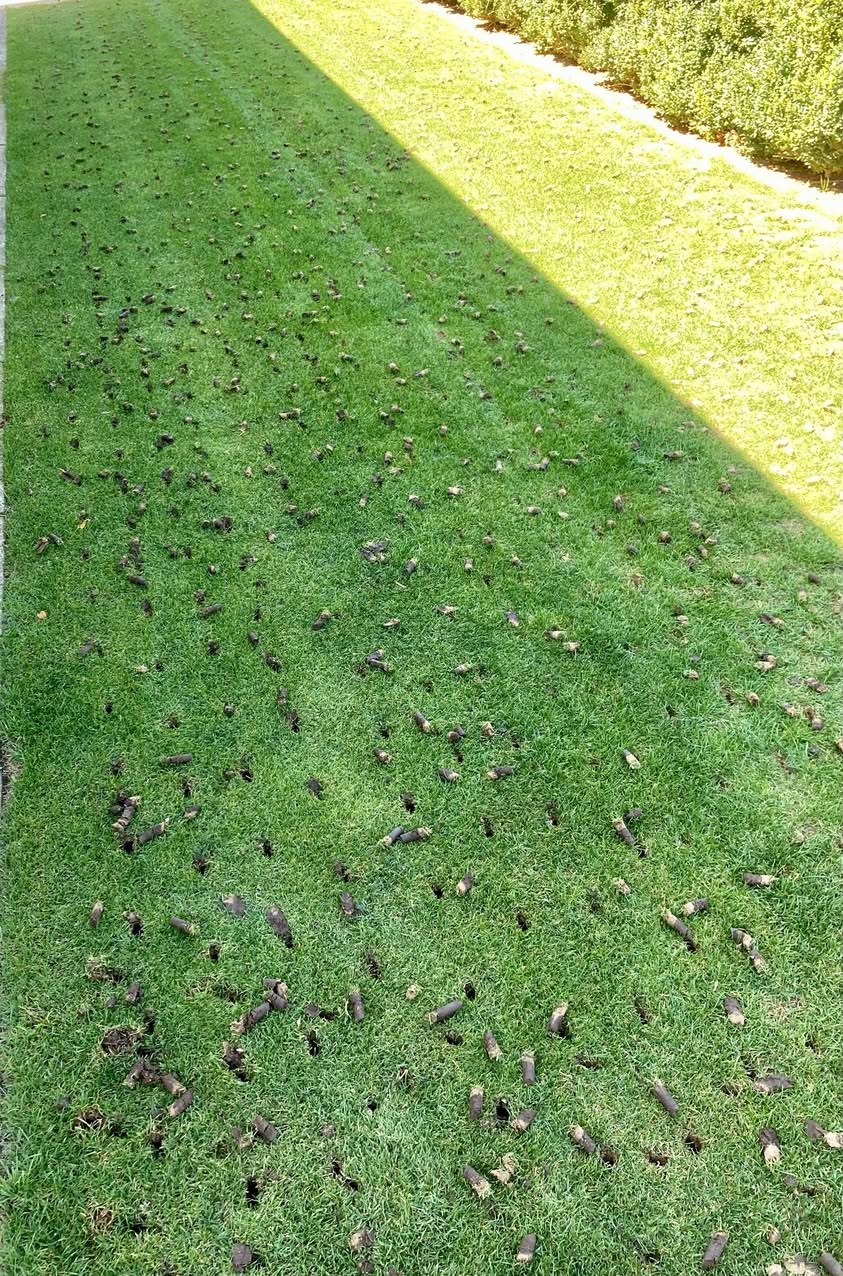
If your lawn didn’t get these done in May, June is your last realistic window before July shuts the door. I want to be direct about that — not to create panic, but because I’d rather you hear it now than in August.
1. Core aeration — this is the most urgent one.
Core aeration pulls small plugs of soil out across the entire lawn, breaking up the compaction layer and opening direct channels for water, air, and nutrients to reach the root zone. On Sudbury’s clay-heavy Canadian Shield soil, this is not optional maintenance — it’s the single thing that determines whether everything else you do to your lawn this season actually works.
An aerated lawn going into July drought has root systems that can reach moisture six to eight inches down. An unaerated lawn has roots in the top inch or two, sitting in soil that dries out completely in three days of heat. The difference in how those two lawns look in late July is dramatic.
June aeration still gives the grass four to six weeks of prime growing season to fill in the channels and strengthen before the July heat peaks. That’s enough. But it needs to happen now — not in two weeks.
2. Addressing bare and thin zones.
Bare patches from last fall or winter that haven’t filled in by mid-June are not going to fill themselves. The window for overseeding has essentially closed — seed that goes down now has to germinate and establish before July heat arrives, and that’s a tight timeline on a good year.
If you have bare zones larger than a dinner plate, sod installation is the right call at this point in the season. Sod goes in established — it doesn’t need a germination window, it doesn’t compete with summer heat during establishment the way seed does, and it gives you immediate coverage that will be rooted and holding by the time July arrives. Mid-June to early July is still a viable sod window in Sudbury with proper watering.
I covered exactly this decision — when to seed versus when to sod — in the story of a Hanmer property that had failed for four years before we figured out what was actually wrong: The Sudbury Lawn I Almost Gave Up On — And Why I’m Glad I Didn’t.
3. Raising your mow height — right now, today.
This costs nothing and takes thirty seconds. If your mower is set below three inches, raise it. For the rest of the summer, I run every property I service at 3 to 3.5 inches minimum. Taller grass shades the soil surface, reduces moisture evaporation, and handles heat stress far better than a short-cut lawn. A scalped lawn in July on compacted clay is one of the most reliably bad outcomes I see every single season.
Never remove more than one-third of the blade height in a single cut. If the lawn got long during a wet stretch, don’t try to get it back to height in one pass — cut it down gradually over two or three mows.
What “Behind Schedule” Actually Costs You
I want to put a real number on this because I think it helps make the decision clearer.
A proper spring aeration on an average Sudbury residential lot runs somewhere in the range of what you’d spend on a single restaurant dinner for two. Done in May or June, it sets the lawn up for the whole season. Done in August — if it gets done at all — it provides some fall recovery benefit but the summer damage is already done.
Sod repair on sections that died over summer because they weren’t addressed in June costs significantly more. I’ve quoted fall repairs on properties where two or three bare zones — the kind that could have been sodded in June for a few hundred dollars — had expanded through summer stress into sections requiring twice the material and labour to fix properly.
Being behind schedule in June doesn’t mean your lawn is unsalvageable. It means the cost of fixing it goes up every week you wait.
The most expensive lawn care is the kind you do reactively in August to fix problems that could have been prevented in June. I’ve seen this play out on enough Sudbury properties that I can say it with complete confidence.
The Exact Checklist — What to Do This Week

If I were walking your property this week, here is exactly what I’d be looking at and what I’d tell you to do:
- Book aeration immediately if it hasn’t been done this season. This is the highest-priority item on this entire list. Everything else performs better after aeration.
- Assess every bare zone — anything larger than a dinner plate, book sod now. Don’t overseed after mid-June and expect meaningful results before July.
- Raise the mow height to 3–3.5 inches and leave it there for the rest of the season.
- Decide on your watering approach — either commit to one inch per week consistently, or plan to let the lawn go dormant through dry stretches. Do not water lightly and irregularly. That is the worst outcome. I wrote about exactly why here: I Let a Customer’s Lawn Go Brown on Purpose. Here’s Why It Was the Right Call.
- Do a drainage check on any area that pools water after rain — those zones will struggle hardest in July heat when the wet-dry cycle is most extreme. If the pooling is a grading issue, it’s worth addressing now.
None of these are complicated. They’re just time-sensitive. The window that’s open right now in mid-June will not be open in three weeks.
One More Thing About This Specific Summer

I don’t usually factor weather forecasts heavily into lawn care advice — too many variables, too much can change. But the 2026 Ontario summer forecast is specific enough that I think it’s worth mentioning directly.
The Weather Network’s seasonal forecast for Ontario is calling for a “tug-of-war” summer — heat building at times, with June rainfall potentially falling short of what’s needed, and real drought implications for July and August if that rainfall deficit carries forward.
For Sudbury specifically, that means a summer that will stress unprepared lawns harder than a typical year. The properties that will come through it looking good are the ones with deep root systems developed through proper spring aeration, correct mow heights, and a clear watering plan going into the dry months.
The properties that will need the most repair work this fall are the ones where those steps got skipped or delayed until it was too late to matter.
I covered the full detail of what this summer’s forecast means for Sudbury lawns — including the pesticide rules, the aeration window, and the sod timeline — in this article: Sudbury Lawn Care News — Mid-2026 Updates Every Homeowner Should Know.
And for the full picture of what the right spring and early-summer process looks like on a Sudbury property — the sequence that sets a lawn up to handle whatever summer brings — this is the one to read: I’ve Fixed 200+ Sudbury Lawns — This Is the #1 Mistake I See Every Spring.
Don’t Wait Until August to Make the Call
Cutting Edge Lawn & Landscaping handles core aeration, sod installation, property cleanup, and weekly grass cutting across Greater Sudbury — Garson, Val Caron, Hanmer, Lively, Chelmsford, Azilda, and Capreol.
📞 Call or text Ryan directly: 705-507-6787
🌐 Free quote: cuttingedgelawn.ca/quote
Licensed & Insured | Owner-Operated | BBB A+ Rated | Garson, Ontario | Serving Sudbury Since 2020
