
I’ve been doing this work long enough that I’ve developed a feel for what I’m walking into before I even get out of the truck. The neighbourhood, the property, the way the lawn looks from the street — all of it gives you information before you’ve done a single assessment.
But occasionally something catches me off guard. Not the lawn — the person.
This is one of those times.
It was a Tuesday morning in early June. I was doing a first-visit assessment at a property in Hanmer — a homeowner named Susan who had called a few days earlier after finding us through a Google search. She’d told me on the phone that she had a recurring lawn problem she hadn’t been able to fix and wanted someone to come out and give her an honest assessment.
She mentioned she’d be at work when I arrived and had left the gate unlocked for access to the backyard. Standard enough — I do plenty of assessments when homeowners aren’t home.
What I didn’t expect was the note on the front door.
The Note — What It Said

It was a small piece of paper, folded once, with my name written on the outside. “For Ryan — Cutting Edge Lawn.”
I opened it.
It said: “Ryan — I’ve had three companies look at this lawn in the past two years. None of them told me anything useful. I read your articles before calling. Please just be honest with me about what’s actually going on. I can handle the truth. — Susan”
I stood at the door for a moment and read it a second time.
I’ve received thank-you texts after jobs. I’ve received photos of lawns that looked better than expected. I’ve received referrals. But I’d never received a note like this — written the night before, left on the door for someone she’d never met — asking for honesty.
It stayed with me through the entire assessment. And it changed how I approached writing up what I found — I was even more specific than I might otherwise have been, because Susan had been direct about what she needed and she deserved the same in return.
Here’s the full story of what I found and what I told her.
The Background — Why She Had Left That Note

When Susan and I spoke on the phone after the assessment, she told me the full background.
She’d bought the house in Hanmer four years earlier. The lawn had looked decent at purchase — the sale was in summer, everything was green, nothing alarming. By the following spring, she was already noticing problems. Thin patches developing in the back. A section along the side of the house that was refusing to grow. General thinning across the front that seemed to get a little worse each year.
She’d had three different lawn care companies come out over the past two years to look at it.
The first one had told her she needed to fertilize more aggressively and sold her a four-visit fertilizing program. She’d done it. The lawn hadn’t improved meaningfully.
The second company had told her the seed she’d been using was wrong and sold her a bag of their premium blend. She’d overseeded twice with it. Nothing had taken.
The third company had told her she probably just had a shaded lawn problem and there wasn’t much that could be done. She should consider replacing the grass with ground cover.
Not one of them had done the screwdriver test. Not one of them had checked the drainage. Not one of them had asked about the maintenance history of the property.
They’d looked at the surface and treated the surface. The causes — which were all underground — had never been identified.
Two years of paying for work that didn’t help. That’s why she’d left the note. She was done with vague answers and surface treatments that didn’t address whatever was actually wrong.
I told her I understood completely. And I told her what I’d found.
What the Lawn Actually Needed — The Assessment

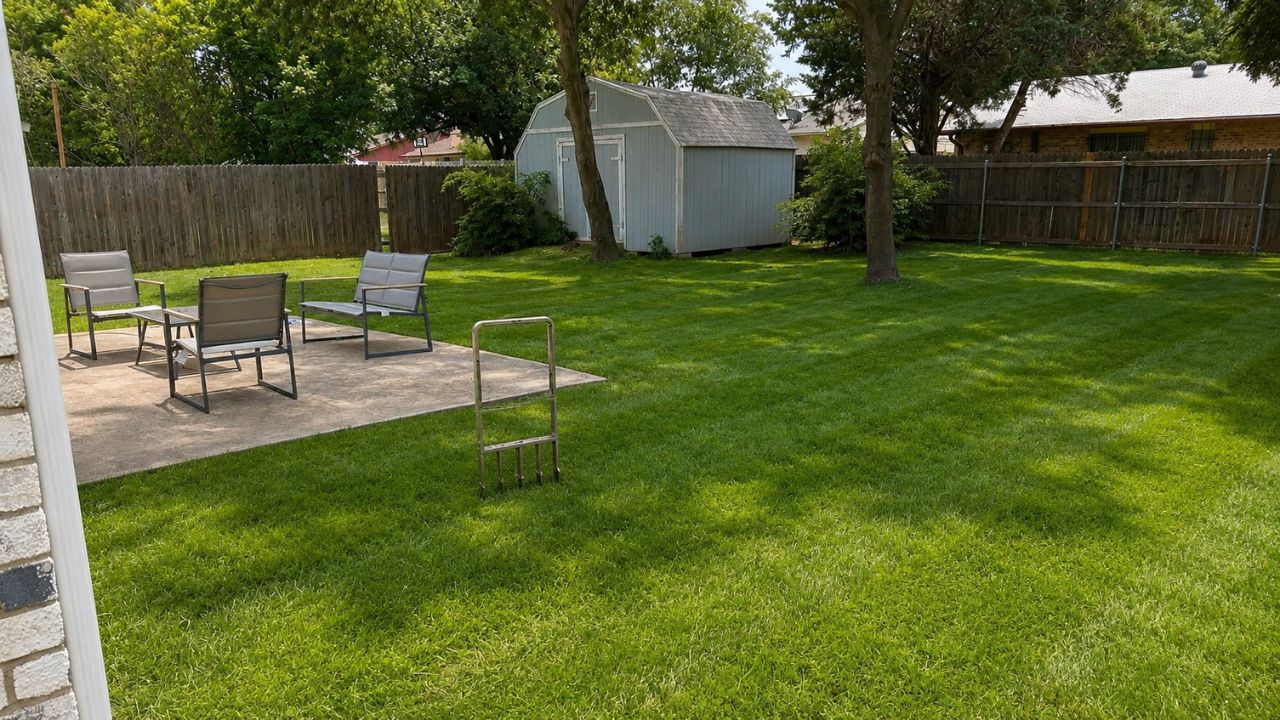
The property was a standard Hanmer residential lot — about 1,600 square feet of lawn total across front, side, and back. From the street it looked like a lawn that just needed some attention. Up close, the screwdriver told the real story.
The Compaction — Severe
The screwdriver stopped at barely one inch across most of the backyard. The front was slightly better — about one and a half inches. But the side yard — the section that had completely refused to grow — I couldn’t get the tip in at all in several spots. Severe compaction on what I could tell was a dense clay sub-layer that had been building up for years.
Here’s what this means practically: every time Susan overseeded, the seed was landing on a surface where roots couldn’t penetrate more than an inch or two down. In Hanmer’s clay soil, that means a plant with no buffer against heat, drought, or winter stress. Every overseeding attempt had been predestined to fail — not because of the seed, not because of the watering, but because the soil underneath wasn’t physically capable of supporting established grass.
I’ve documented this pattern in detail across hundreds of Sudbury properties in the most common thing I find under dead Sudbury lawns — compaction is the central issue in the overwhelming majority of cases. The fertilizer the first company had sold Susan was being applied to a lawn where roots couldn’t access it properly. The premium seed the second company had sold her was being spread on a surface where it had no realistic chance of establishing.
The Side Yard — Not a Shade Problem
The third company had told Susan the side yard was a shade problem. I walked it carefully.
There was partial shade from a mature tree — but not the total shade that prevents cool-season grass from growing entirely. I’ve seen lawns in comparable shade conditions in Greater Sudbury that were healthy and well-established.
What I found was different. The side yard had a hardpan layer — a dense, impermeable layer of compacted clay about two inches down — that had been created over years of foot traffic along a path between the houses. This hardpan was completely sealing the soil. No water was penetrating. No roots were going deeper than an inch.
The shade wasn’t the problem. The hardpan was the problem. Shade-tolerant grass varieties — which is what the third company had presumably been thinking of recommending — would fail in that soil just as thoroughly as standard cool-season turf had.
The Drainage
The thin patches developing in the back had a drainage component I found when I checked the grade carefully. The back of the property sloped slightly toward the house rather than away from it — which meant water from rain events was moving toward the foundation area rather than away from it. The soil near the back of the house was staying wetter than the rest of the lawn, creating waterlogged conditions that the grass roots couldn’t tolerate.
Not a severe drainage problem — but enough to create chronic stress in that zone. The grass was thin at the back because the soil was intermittently waterlogged, not because the grass variety was wrong or the fertilizer was insufficient.
When I called Susan to go through the assessment, I worked through each finding specifically. The compaction everywhere. The hardpan in the side yard. The drainage issue near the back of the house. I explained what each one was doing to the grass and why the previous treatments hadn’t worked.
She was quiet for a moment after I finished. Then she said: “So nobody actually looked at the soil?”
No. Nobody had.
She said: “Okay. Tell me what we need to do.”
For context on what a proper assessment covers and what separates it from a surface-level look, I’ve detailed it in what professional lawn care actually means in Sudbury and how to spot the difference. What Susan had experienced with the three previous companies is exactly what inadequate assessment looks like in practice.
What the Property Looks Like Now

We did the work in late June. The sequence followed the standard restoration approach I use on properties with severe compaction — I’ve documented this in detail in what almost every struggling Sudbury property has in common.
For the main lawn areas — front and back — we did aggressive core aeration to break the compaction, incorporated quality topsoil, and overseeded immediately after aeration with seed going directly into the holes for maximum soil contact. The drainage grade at the back of the house was corrected to direct water away from the foundation rather than toward it.
The side yard needed more significant work. The hardpan layer had to be mechanically broken — we used a tiller to go through it and then incorporated topsoil to improve the soil structure. Then sod rather than seed, because the coverage area was too large for overseeding to produce results quickly enough and because Susan had been waiting two years already.
The full soil preparation sequence I follow on jobs like this is detailed in how I replaced a Sudbury homeowner’s dead lawn in 4 days — same methodology, applied to Susan’s specific situation.
Susan followed the watering schedule carefully. I’ve covered what new sod and overseeded areas need in what happens if you don’t water new sod in Sudbury’s first two weeks. She set reminders, watered consistently, and by mid-August the whole property was showing strong, even growth — including the side yard that had been essentially bare for three years.
She texted me a photo in August. Then she sent me a follow-up message that I want to share because I think it captures something important:
“Three companies in two years and none of them told me what you told me in one visit. I wish I’d found you first.”
I told her the same thing I tell everyone in that situation: she’d found us now, and the lawn didn’t know or care about the two years. It only knew what was happening from this point forward.
She’s on the fall aeration schedule — annual maintenance that will keep the compaction from rebuilding. The full fall preparation sequence is in how to prepare your Sudbury lawn for winter — the October checklist.
The Thing About the Note
I’ve thought about Susan’s note a few times since that Tuesday morning in Hanmer.
She’d written it because she’d been let down enough times that she felt she needed to ask explicitly for honesty before someone even looked at her lawn. That’s a reasonable response to two years of paying for treatments that didn’t work because nobody had actually diagnosed what was wrong.
What strikes me is that the honesty she was asking for isn’t special. It shouldn’t be remarkable. It should be the baseline for what anyone pays a lawn care professional to do — come out, look at the actual soil, identify the actual cause, tell you what it is and what to do about it. Surface-level treatments without soil diagnosis isn’t lawn care. It’s guessing with someone else’s money.
If you’ve had the same experience — companies that have looked at your lawn without looking at your soil, treatments that didn’t work, advice that didn’t help — reach out. I’ll come out, do the screwdriver test, check the drainage, look at the actual condition of the soil, and tell you exactly what I find. No vague answers. No selling you something before I know what you actually need.
📞 Call or text me: 705-507-6787
Or fill out the free quote form here — I get back to everyone same day.
— Ryan Lingenfelter
Owner, Cutting Edge Lawn & Landscaping
Garson, Ontario
Related Articles
- The One Thing I Always Find Under a Dead Sudbury Lawn
- What Professional Lawn Care Actually Means in Sudbury — How to Spot the Difference
- 1,000 Lawn Jobs in Greater Sudbury — What Almost Every Property Has in Common
- I Replaced a Sudbury Homeowner’s Dead Lawn in 4 Days
- What Happens If You Don’t Water New Sod in Sudbury’s First Two Weeks
- How to Prepare Your Sudbury Lawn for Winter — October Checklist
- Why I Keep Notes on Every Sudbury Lawn I Work On
- Core Aeration Services in Greater Sudbury
