
I’m Ryan Lingenfelter — owner of Cutting Edge Lawn & Landscaping in Garson, Ontario.
A customer in Val Caron sent me a message in early May. She’d been getting quotes for her backyard — the lawn had been struggling for a few years and she was ready to do something definitive about it. She’d gotten a quote from a sod installer, a quote from me, and a quote from an artificial turf company that had been running ads on social media.
The turf quote was significantly higher than both lawn quotes. But the company had given her a strong pitch — no mowing, no watering, looks green year round, fifteen-year warranty, kids and pets love it. She was seriously considering it.
Before she signed, she forwarded me the quote to take a look at.
I’m not in the artificial turf business. I install natural grass. So I want to be upfront about that before I tell you what I found — I have an obvious interest in steering people toward sod. I’m going to try to be as fair as I can anyway, because she asked for my honest take and she deserved one.
Here’s what I noticed in the fine print, what I told her, and what I think every Sudbury homeowner should understand before they consider artificial turf.
What Was Actually in the Fine Print
The quote was for approximately $14,000 for her backyard — about 1,800 square feet. The pitch focused on lifetime savings on water and lawn care, the fifteen-year warranty on the turf product, and the elimination of mowing.
Here’s what the fine print said that the pitch didn’t.
The fifteen-year warranty covered the turf product — not the installation. The sub-base, the drainage layer, the edging, and the infill were all covered under a separate, shorter warranty with different terms. If the sub-base shifted — which it can in Sudbury’s freeze-thaw cycle — the product warranty wouldn’t cover the repair because the substrate wasn’t warranted by the turf manufacturer.
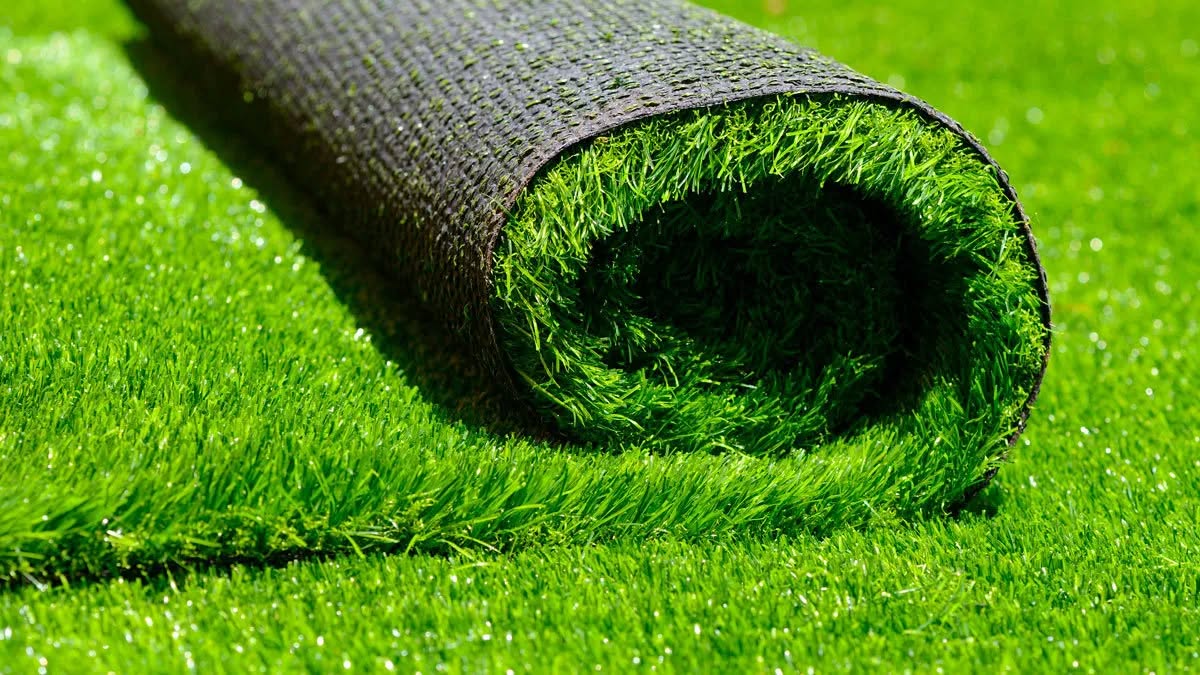
The infill required replacement every five to seven years. Artificial turf isn’t just the grass fibres — it requires an infill material (typically crumb rubber, sand, or a mix) that keeps the fibres upright and provides cushioning. That infill breaks down over time, compacts, and needs to be replenished. The quote mentioned this in a small note at the bottom. The replacement cost wasn’t included in the original price.
The turf required regular maintenance. The no-maintenance pitch is one of the most persistent myths about artificial turf. The fine print included a maintenance schedule: regular brushing to keep fibres upright, rinsing to manage odour (especially with pets), treatment for moss and algae growth — because yes, algae grows on artificial turf in Ontario’s humid summers — and periodic infill top-ups. Not the same as mowing, but not zero maintenance either.
The heat clause. This was the one I found most interesting. The warranty included a clause noting that the company was not liable for damage or discomfort resulting from heat retention in the turf surface. Artificial turf in direct sun can reach 60 to 70 degrees Celsius on a hot day — significantly hotter than natural grass. With children using the backyard, this was directly relevant to her situation.
The removal clause. If she ever wanted to remove the turf — for resale, for a renovation, for a change of mind — removal and disposal of synthetic turf is a specialized job. The quote noted that removal was not included in the warranty and would require a separate contractor quote.
None of these things made the product dishonest or the company fraudulent. These are standard terms. But they weren’t in the sales pitch. They were in the fine print.
What Artificial Turf Actually Costs Over Time in a Sudbury Climate
The sales pitch for artificial turf is usually built on a lifetime cost calculation. You pay more upfront, but you save on water, fertilizer, lawn care, and mowing over fifteen years.
That calculation can be accurate in a dry climate with high water costs and year-round outdoor use — parts of southern British Columbia, California, Australia. In Sudbury, the numbers look different.
Water is not expensive in Greater Sudbury relative to many parts of Canada. The savings from eliminating lawn watering over fifteen years are real but not dramatic.
Mowing savings are real — but only if you were paying for lawn care. A homeowner who cuts their own lawn saves zero dollars on mowing by switching to artificial turf.
Fertilizer savings are real — but on Sudbury’s clay-heavy soil, the highest-return investment is aeration, not fertilizer. A homeowner who was spending $600 a year on fertilizer programs that weren’t working wasn’t actually benefitting from that spending anyway.
The infill replacement cost every five to seven years — two or three times over a fifteen-year product life — adds back a significant chunk of the claimed savings.
And in Sudbury’s climate, artificial turf has one specific challenge that warm-climate sales pitches don’t mention: freeze-thaw cycles. The sub-base under artificial turf has to be installed with drainage and freeze-tolerance in mind. In Sudbury, where we can go from -30 to +5 and back multiple times in a single winter, a sub-base that shifts even slightly causes visible rippling and lifting in the turf surface. Correcting it requires pulling up the turf, re-levelling the base, and re-installing — a significant cost that the warranty may or may not cover depending on the terms.
I’m not saying the numbers never work out in favour of artificial turf. For some properties and some homeowners, they do. I’m saying the honest calculation in a Sudbury climate is more complicated than the social media ads suggest.
When Artificial Turf Actually Makes Sense in Sudbury
I told the Val Caron homeowner the same thing I’ll tell you: there are situations where artificial turf is genuinely the right call in Sudbury. I’m not anti-artificial turf categorically. I’m anti-misleading-pitch.
Here are the situations where I think the case for artificial turf in Sudbury is legitimate.
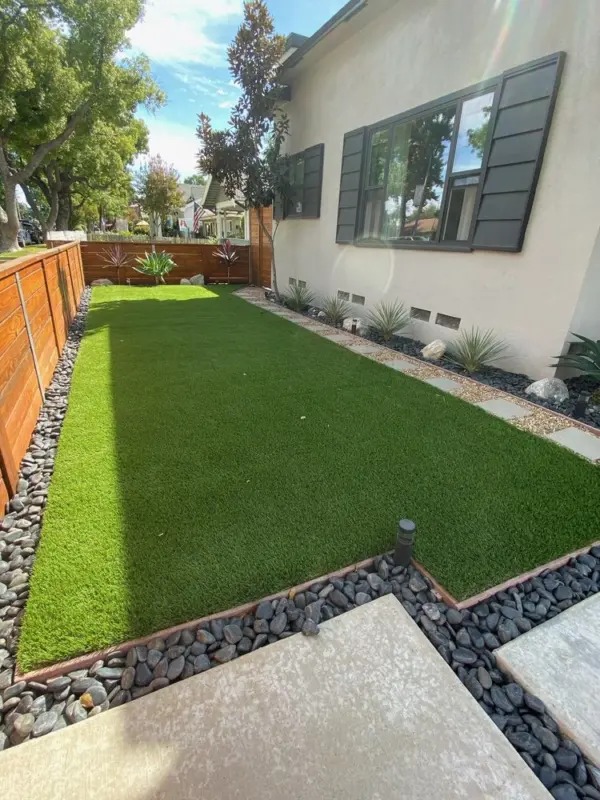
Areas where grass simply won’t grow. Dense shade under a heavy canopy where no grass variety performs well. Tight side yards with no sun. Narrow strips between structures where maintenance is difficult. These are places where you’re not giving up a working natural lawn — you’re solving a space that was never going to be lawn anyway.
Pet-specific areas. A dedicated dog run or pet area where the turf is specifically designed for that use — with proper drainage for urine, antimicrobial infill, and the understanding that it will need regular rinsing and periodic replacement — can be a practical solution for some homeowners.
Commercial or rental properties where maintenance cost is the primary driver. A rental property where you’re paying for lawn care service and you want to eliminate that cost permanently — the numbers can work depending on the property size and the lawn care cost you’re replacing.
Rooftop terraces, patios, or areas with no soil access. Artificial turf over a deck or concrete area where there’s no ground to plant in is a legitimate application that doesn’t compete with natural grass at all.
What artificial turf is not well-suited for in Sudbury: a family backyard where kids play barefoot in summer heat, a large open lawn that gets full sun, or a property where the main problem is soil compaction or drainage — because those problems exist under the sub-base too and will affect the installation.
What I Told Her — And What She Decided
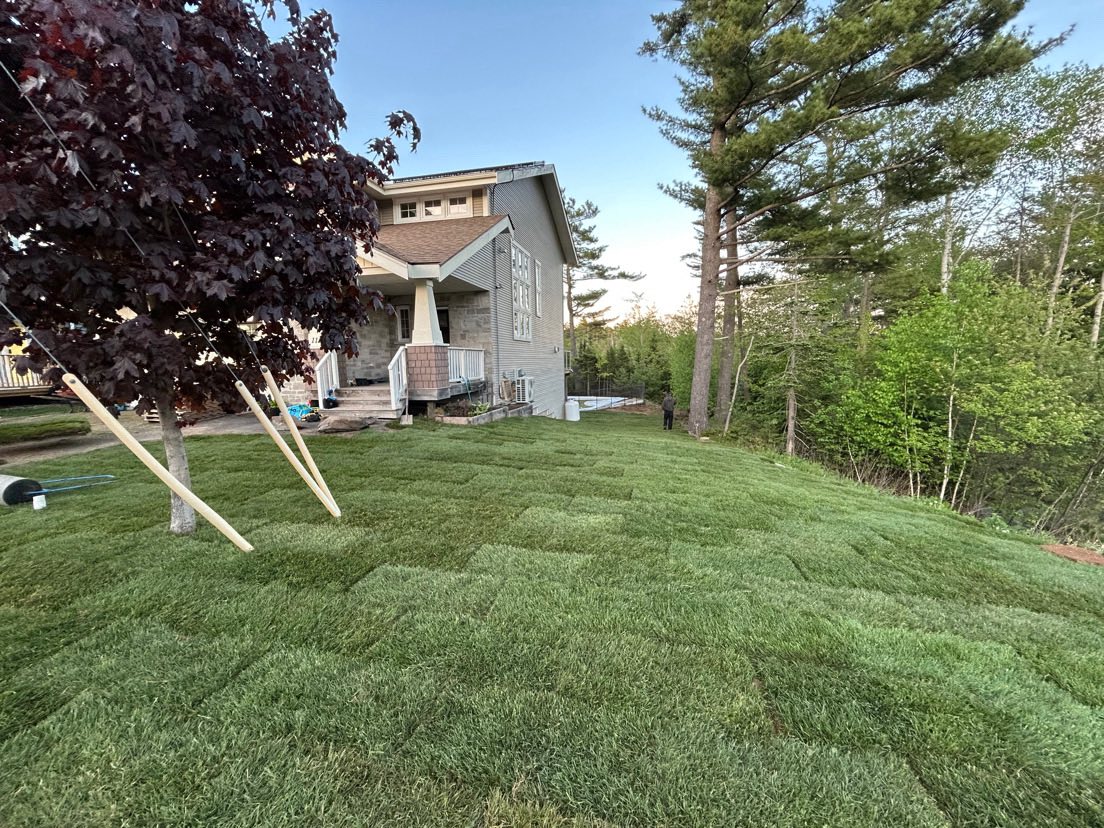
I told her everything I’ve told you here. The fine print items I’d noticed. The honest cost calculation for Sudbury. The situations where artificial turf makes sense and the situations where it doesn’t.
Then I told her what I actually thought about her specific property.
Her backyard was struggling because of grub damage and compaction — two fixable structural problems. The lawn wasn’t dead because the conditions couldn’t support grass. It was dead because specific problems had never been treated. Fix the grubs, aerate, lay sod on the damaged sections, and she’d have a natural lawn that performed well for a fraction of the artificial turf cost.
She decided to go with sod.
I want to be honest about my bias here: I recommended what I sell. But I also genuinely believe it was the right recommendation for her property, her budget, and her situation. A $4,200 sod installation on a lawn that had fixable structural problems is a better outcome than a $14,000 artificial turf installation on a property where the underlying issues — freeze-thaw effects on the sub-base, heat retention for her kids, the hidden maintenance costs — would have surfaced within a few seasons.
If your situation is different from hers — if you have a shade problem that grass can’t solve, a pet area that needs a dedicated solution, or a commercial property where the maintenance economics genuinely work — artificial turf might be the right call and I’ll tell you that honestly if you ask me.
If your lawn is struggling because of compaction, grubs, or drainage — the same structural problems I fix on lawns across Greater Sudbury every season — natural grass done right is almost certainly the better answer.
📞 Call or text me directly: 705-507-6787
Or fill out the free quote form here and I’ll get back to you same day.
We service Garson, Val Caron, Hanmer, Lively, Chelmsford, Azilda, Capreol, and all of Greater Sudbury.
— Ryan Lingenfelter
Owner, Cutting Edge Lawn & Landscaping
Garson, Ontario
Frequently Asked Questions
Is artificial turf a good idea in Sudbury Ontario?
It depends on the application. Artificial turf makes practical sense in Greater Sudbury for areas where natural grass genuinely won’t grow — dense shade, narrow side yards, areas with no soil access — and for dedicated pet areas with proper drainage. For standard backyards and open lawns, Sudbury’s freeze-thaw climate creates sub-base challenges, and the heat retention of synthetic turf in summer sun is a real concern for properties where children play. Most struggling Sudbury lawns have fixable structural causes — compaction, grubs, drainage — that make natural grass the better long-term solution once those causes are addressed.
How much does artificial turf cost in Sudbury compared to sod?
Artificial turf installation in Greater Sudbury typically runs $6 to $12 per square foot installed depending on the product and sub-base requirements — a 1,500 square foot backyard would cost $9,000 to $18,000. Quality sod installation runs $0.85 to $1.20 per square foot installed — the same 1,500 square foot lawn costs $1,275 to $1,800 for sod. The artificial turf pitch is built on long-term savings on water and maintenance, but in Sudbury’s climate the honest calculation includes infill replacement costs, potential sub-base correction from freeze-thaw movement, and the limited water cost savings in a region where water is relatively affordable.
Does artificial turf hold up to Sudbury winters?
The turf fibres themselves handle cold reasonably well. The main challenge in Sudbury’s climate is the sub-base. Our freeze-thaw cycles — multiple transitions from -30 to above freezing in a single winter — can cause sub-base shifting that creates visible rippling or lifting in the turf surface. A properly installed sub-base with adequate drainage and freeze-tolerance mitigates this, but it’s a real consideration that warm-climate artificial turf installers don’t always account for in their quotes and warranties. Ask specifically about sub-base warranty and freeze-thaw coverage before signing.
Does artificial turf get hot in Sudbury summers?
Yes — artificial turf in direct sun can reach 60 to 70 degrees Celsius on a hot day, significantly hotter than natural grass which stays much closer to ambient air temperature through evapotranspiration. For backyards where children play barefoot this is a genuine concern, especially during Sudbury’s July heat stretches. Shaded areas or properties with limited direct sun are less affected. Some artificial turf products include cooling technology that reduces heat retention, but it doesn’t eliminate the differential between synthetic and natural surfaces.
What maintenance does artificial turf actually require?
Artificial turf is lower maintenance than natural grass but not zero maintenance. It requires regular brushing to keep fibres upright, periodic rinsing especially in pet areas, treatment for moss and algae growth which develops in Ontario’s humid summers, and infill replenishment every five to seven years as the infill compacts and degrades. The total maintenance burden is lower than a natural lawn but meaningfully higher than the “no maintenance” pitch that most artificial turf companies lead with.
When should I choose sod over artificial turf for my Sudbury lawn?
Choose natural sod when the lawn is struggling because of fixable structural problems — compaction, grubs, drainage issues — rather than because the conditions genuinely can’t support grass. A lawn that’s dead because of grub damage or years without aeration is not evidence that natural grass won’t work on your property. It’s evidence that specific problems haven’t been treated. Fix those problems and natural grass performs well in Sudbury’s climate at a fraction of the cost of artificial turf installation.
Ryan Lingenfelter is the owner of Cutting Edge Lawn & Landscaping in Garson, Ontario. Since 2020, his crew has provided full lawn care and landscaping services across Greater Sudbury — Garson, Val Caron, Hanmer, Lively, Chelmsford, Azilda, and Capreol. Licensed, insured, BBB A+ rated, and ThreeBest Rated for lawn care services in Sudbury.
📞 Phone: 705-507-6787
📍 Service Area: Greater Sudbury, Ontario
🔗 Free Quote: cuttingedgelawn.ca/quote
Related Services
Continue Reading
- Sod vs Seed in Sudbury — Which One Is Right for Your Lawn?
- Sod Replacement in Sudbury — When to Replace vs When to Repair
- How Much Does Lawn Care Actually Cost in Sudbury?
- What Sudbury Landscaping Companies Charge in 2026
