

Let’s say I bought a house in Sudbury tomorrow. Hanmer, Chelmsford, Garson, wherever. And when I walk the backyard for the first time, I see what I see on a lot of properties I quote — long, patchy grass, bare spots, thatch buildup, maybe some standing water in a low corner, weeds filling in wherever the real grass gave up.
I’ve been on enough of these properties since 2020 to know exactly what I’d do. Not what I’d guess. Not what I’d try. What I’d actually do, in order, without wasting a season or throwing money at the wrong things first.
This is that plan.
Step 1 — Walk It Before You Touch It

The single biggest mistake people make with a neglected lawn is starting work before they understand what they’re actually dealing with. They rent an aerator, buy a bag of seed, spread it around, and wonder why nothing held. The problem usually isn’t the seed or the technique — it’s that they skipped the assessment.
Before I’d do anything physical to that lawn, I’d spend twenty minutes walking the entire property and asking specific questions.
Where is the water going? After a rain, where does water pool, where does it run, and where does it drain quickly? Drainage is the hidden reason behind more failed Sudbury lawns than anything else. You can aerate and overseed a low spot perfectly and still fail every single time if water is sitting there for two days after every rain.
How deep is the soil? I’d push a screwdriver into the ground in multiple spots — front, back, problem areas, healthy areas. Sudbury sits on Canadian Shield bedrock, and topsoil depth varies dramatically even within a single lot. Hitting rock at five inches in one corner and twelve inches in another changes the plan completely. The screwdriver test takes thirty seconds per spot and tells you more than looking at the surface ever will.
What’s alive versus what’s dead? I’d pull on the brown grass in a few different areas. Dormant grass holds when you pull. Dead grass comes out with no resistance. The repair-versus-replace decision depends on this number — if more than half the lawn is genuinely dead, you’re looking at a different approach than if it’s mostly thin and stressed.
What’s the weed situation? Some weeds are cosmetic. Some — creeping charlie, ground ivy, heavy clover infestation — tell you the grass has been losing for a long time and the soil conditions are favouring weeds over turf. That matters for sequencing.
Only after I understood what I was actually working with would I start making decisions about what to do first.
Step 2 — Test the Soil pH Before Spending a Dollar on Anything Else

This is the step most Sudbury homeowners skip entirely, and it’s the reason a lot of lawn care money gets wasted on fertilizer and seed that can’t perform in the conditions they’re being applied to.
Sudbury soil is naturally acidic — the Canadian Shield geology and the legacy of decades of smelter sulfur dioxide deposition have left us with soil pH that runs lower than the 6.0 to 7.0 range that cool-season grasses actually prefer. On a neglected property that hasn’t had any pH management in years, you could easily be sitting at 5.0 to 5.5 or lower. At that pH, the grass can’t efficiently uptake the nutrients in the soil regardless of how much fertilizer you apply. You’re feeding the lawn through a blocked filter.
A soil pH test costs a few dollars at any garden centre and takes five minutes. If the result comes back below 6.0 — which on a neglected Sudbury property it very likely will — lime application before any other amendment is the highest-leverage thing you can do. Lime takes time to work through the soil, which is exactly why you do it first, not as an afterthought after the fertilizer already failed.
I’d also note whether the soil feels heavy and clay-like or lighter and sandier. Properties in areas like Lively tend toward lighter, faster-draining soil that behaves differently from the heavier clay common through much of Garson, Hanmer, and Val Caron. The specific soil type changes the watering and fertilization approach in ways that matter if you want the work to actually hold.
Step 3 — Do the Spring Cleanup Properly, Not Quickly
A neglected lawn has almost always accumulated a thatch layer — dead organic material sitting between the soil surface and the living grass blades. On a property that’s been ignored for a few seasons, that thatch layer can be an inch or more thick. Thatch at that level blocks water, blocks fertilizer, and blocks air from reaching the soil. Seed spread on top of heavy thatch doesn’t germinate — it sits on top of a mat of dead material and either dries out or rots.
Before aeration, I’d power-rake the entire lawn to remove the thatch layer. This is harder work than mowing and it produces an alarming amount of material — the first time I power-raked a heavily thatched lawn in Garson I filled three full compost bags off a medium-sized backyard. That’s all material that was sitting between the soil and the grass, preventing anything from working properly.
After the power-rake: clear everything. Debris, dead leaves packed into corners, anything sitting on the surface. A proper spring cleanup on a neglected property takes significantly longer than on a maintained one, and it genuinely changes what’s possible for the rest of the season. The properties that look dramatically better by August are almost always the ones where the spring cleanup was done thoroughly, not rushed through in an afternoon.
Step 4 — Core Aerate. Then Core Aerate Again Next Year. And the Year After.

If there’s one service I’d never skip on a neglected Sudbury property, it’s core aeration. Not because it sounds good on a service list. Because of what Sudbury soil actually does without it.
The freeze-thaw cycles our winters put soil through — freeze solid, partially thaw, refreeze, repeat — compact the soil more aggressively than what you see in most of Southern Ontario. A neglected lawn that hasn’t been aerated in several years has soil that’s often packed hard enough that water runs off the surface rather than penetrating, roots can’t push deep enough to access moisture during summer heat, and seed broadcast on top has nowhere to establish contact with soil and fails to germinate.
Core aeration physically removes plugs of soil — typically half an inch diameter, two to three inches deep — across the entire lawn surface. Those holes allow air, water, and nutrients to penetrate directly to the root zone. They give overseeded grass somewhere to land, make soil contact, and actually establish. On a compacted Sudbury lawn, aeration before overseeding is the difference between the seed taking hold and the seed failing.
On a neglected property, I’d aerate in late May — once soil temperatures are consistently above 8°C and the grass is in active growth. I’d aerate again the following spring without exception. And the year after. Annual aeration isn’t optional on Sudbury properties — it’s what keeps everything else working year over year on Canadian Shield soil.
Step 5 — Overseed With the Right Mix for Sudbury, Not Whatever’s Cheapest at the Hardware Store
After aeration, I’d overseed — but not with whatever’s on sale. Grass seed is not interchangeable, and the cheap contractor mixes that fill the bottom shelves at most hardware stores are heavy on annual ryegrass. Annual ryegrass germinates fast and looks good briefly, then dies at the end of its first season. You’re back to square one the following spring.
For a Sudbury property, I want a mix built around Kentucky bluegrass and fescues — specifically turf-type tall fescue and creeping red fescue. These are perennial, they handle our freeze-thaw winters, they establish root systems that go deeper than annual varieties, and they hold up through Sudbury summers without requiring constant irrigation. If there are shaded areas — under trees, along the north side of the house — I’d use a shade-tolerant mix heavy on fescue specifically for those zones. Matching the seed to the specific conditions of each area is what makes overseeding actually work rather than looking green for three weeks and disappearing.
Timing matters too. The late May to early June window after aeration is the primary one. The second window — late August to mid-September — is the other opportunity, and on a seriously neglected property I’d use both in year one to maximize coverage before the first winter.
Step 6 — Decide Honestly Which Areas Need Sod Instead of Seed
Not every section of a neglected lawn can be fixed with overseeding. Some sections are genuinely past the point where seed is the right call — and trying to seed them anyway is how people spend two seasons and several hundred dollars on a problem that needed a different solution from the start.
The situations where I’d go straight to sod installation rather than seed: areas that are completely bare with compacted pale soil and no living grass present, low spots where water pools and then seed rots before germinating, sections where I’m hitting rock at four inches or less and the soil depth isn’t sufficient for seed to establish through a Sudbury summer, and any area larger than roughly ten square feet that’s been bare for more than one season. Bare areas that have been empty for a full year or more already have weed seeds waiting in the soil. Seeding those areas gives weeds a germination window that sod doesn’t.
The sod versus repair decision is one I’d make area by area, not as a single choice for the whole lawn. Some sections seed beautifully. Some sections need sod. Making the right call by area rather than making one blanket decision is what separates a restoration that works from one that’s still fighting the same battles three years later.
Step 7 — Set Up a Fertilizer Program That Matches Sudbury’s Season, Not Someone Else’s
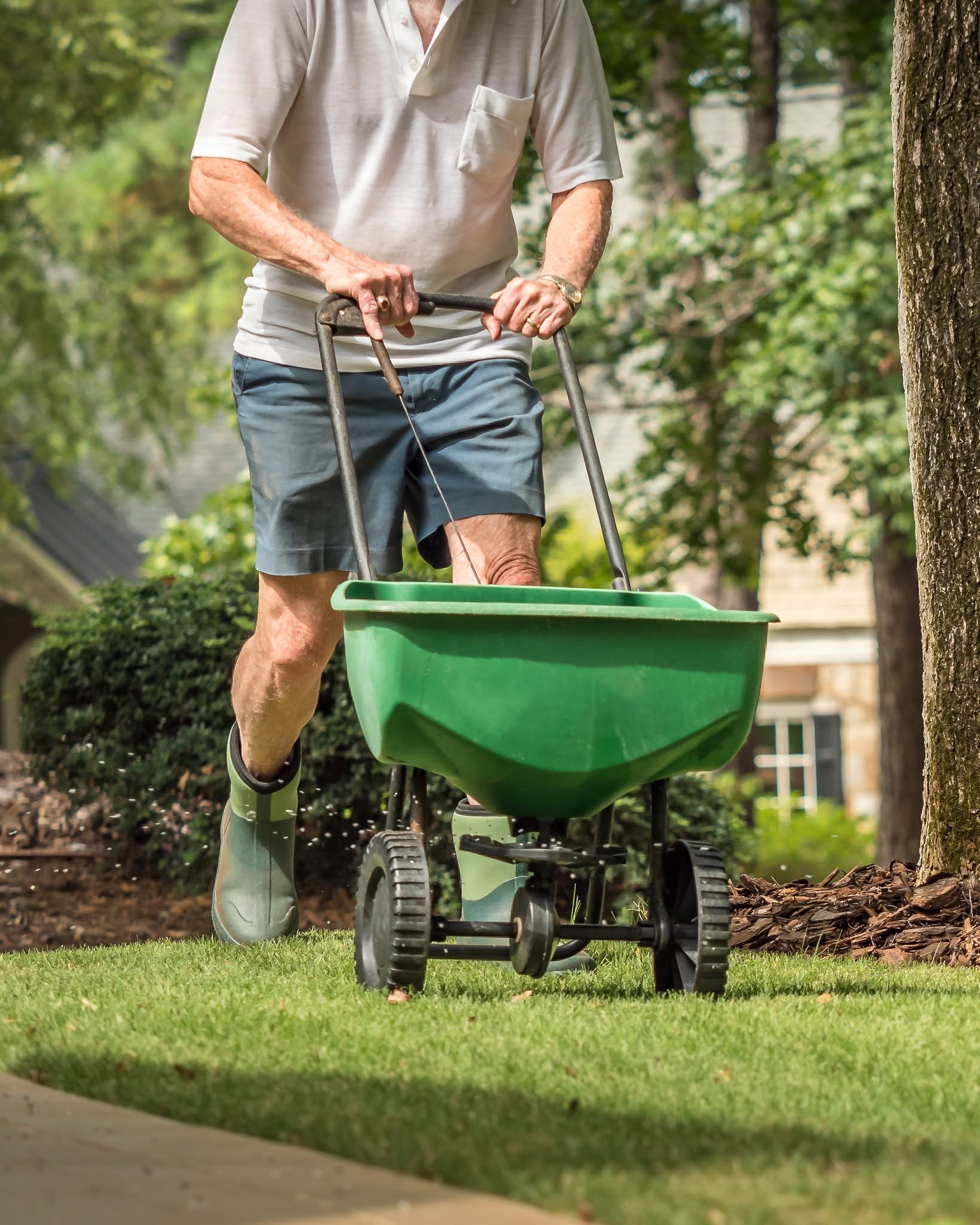
Once the cleanup, aeration, and seeding are done, I’d put a proper fertilization program in place. Not a single application, and not the schedule on the back of a bag that was written for someone in Southern Ontario.
First application: no earlier than mid-May, once soil temperature is consistently above 8°C and the grass is in active growth. Applying fertilizer to cold or waterlogged soil — which is what you have in early April in Sudbury — sends product running off before the grass can use any of it.
Second application: late June or early July with a balanced summer formula. Not high nitrogen in summer heat — that pushes top growth at the expense of root development and makes the lawn more vulnerable to stress.
Third application: mid-August, starting to shift toward a root-building formula as the season moves toward fall.
Fourth application: late September to early October — the fall winterizer. This is the application most Sudbury homeowners skip entirely, and it’s actually the most important one. The fall application goes into the root system and builds the energy reserve the grass uses to survive our winters and push out aggressively the following spring. Skipping the fall feed is one of the most reliable ways to guarantee a weaker lawn coming out of every winter.
For a typical neglected property in its first recovery season, that full four-visit program is not optional — it’s the fuel that makes everything else work.
What the First Season Actually Looks Like
I want to be realistic here, because I think people often expect a neglected lawn to look great by July if they do everything right in May. That’s not usually how it goes, and unrealistic expectations lead to people abandoning a program that was actually working.
By June on a properly treated neglected lawn: the thatch is gone, the soil is open, the new seed is germinating in the aeration holes. The lawn looks rough but is clearly doing something. Weed pressure may actually look worse temporarily because the weed seeds that were already in the soil are also germinating in the open conditions. This is normal and expected.
By August: the new grass is establishing. Thin areas are filling in. The overall colour is improving as fertilizer programs take hold. The lawn doesn’t look great yet, but it looks meaningfully better than it did in spring and the trajectory is clear.
By the following May: this is when the work from year one really shows. A lawn that was properly aerated, overseeded, and fertilized through its first recovery season comes out of a Sudbury winter noticeably better than it went in. Roots are deeper. Density is higher. The bare patches have either filled in or you’ve already made the sod decision on the ones that couldn’t. This is the point where most clients tell me the property looks like a completely different lawn than the one they moved into.
That’s what a real neglected lawn recovery in Sudbury looks like — not a magic fix in the first season, but a clear, consistent improvement that results in a lawn you’re actually happy with by year two.
If you just moved into a Sudbury property and you’re looking at the yard thinking you don’t know where to start — that’s exactly the call I’m here for. I’ll come walk the property, tell you honestly what I see, and give you a plan with real numbers. No pressure, no upsell on things you don’t need.
— Ryan Lingenfelter
Owner, Cutting Edge Lawn & Landscaping
Garson, Ontario
📞 705-507-6787
🌐 Free Quote — No Obligation
