

I’ve been doing this long enough that most questions I get on a property visit are ones I’ve heard before. How often should I water? Why does my lawn go brown in July? What’s the white stuff growing in the corner? I’ve got answers ready because I’ve seen the same situations repeat across hundreds of properties in Greater Sudbury.
But a couple of summers ago I drove out to a property in Capreol for a quote call — older home, big yard, mature trees along the back fence — and the homeowner asked me something that stopped me mid-sentence.
We were standing in the backyard looking at a section of lawn that had been struggling for years. I’d done my walk, checked the soil, looked at the thatch. I was starting to explain what I thought was going on when she cut in and asked: “But why does it only happen in this exact spot? The rest of the yard is fine. What’s different about right here?”
I paused. Because she was right. And I didn’t have the answer yet.
That question sent me down a path that changed how I assess problem areas on any property. And what I eventually figured out — for her lawn and for dozens of others since — is something I think every Sudbury homeowner with a stubborn problem spot should understand.
Why I Paused — and What I Actually Did Next

My honest first reaction was that I’d been too quick to assume I knew the answer. I’d looked at the struggling area, seen compacted soil and thin grass, and started moving toward the standard explanation — compaction, poor drainage, Sudbury clay. All of which was true. But she’d asked a more specific question than that.
The rest of her yard was on the same clay soil. It had the same freeze-thaw history. It got the same rainfall. So why was this one section — maybe twenty feet by fifteen feet in the back left corner — always the problem area no matter what she tried?
I went back and looked more carefully. I mean really looked — not a quick scan but a slow, deliberate examination of that specific area compared to the rest of the yard.
I checked the grade — where water flowed after rain. I looked at where the tree roots from the spruce along the back fence were running. I pushed the soil in multiple spots inside the problem area and multiple spots outside it and compared the resistance. I looked at the sun exposure across different times of day by checking where the shadows from the house and the trees fell.
What I found was not one problem. It was three things happening in the same spot at the same time — and the combination of all three was what made that corner behave completely differently from the rest of the yard.
What I tell customers now: if you have a spot that keeps failing no matter what you do, the answer is almost never one thing. It’s usually a combination of factors converging in that location. The job is to find all of them — not just the most obvious one.
What Was Actually Going On in That Corner
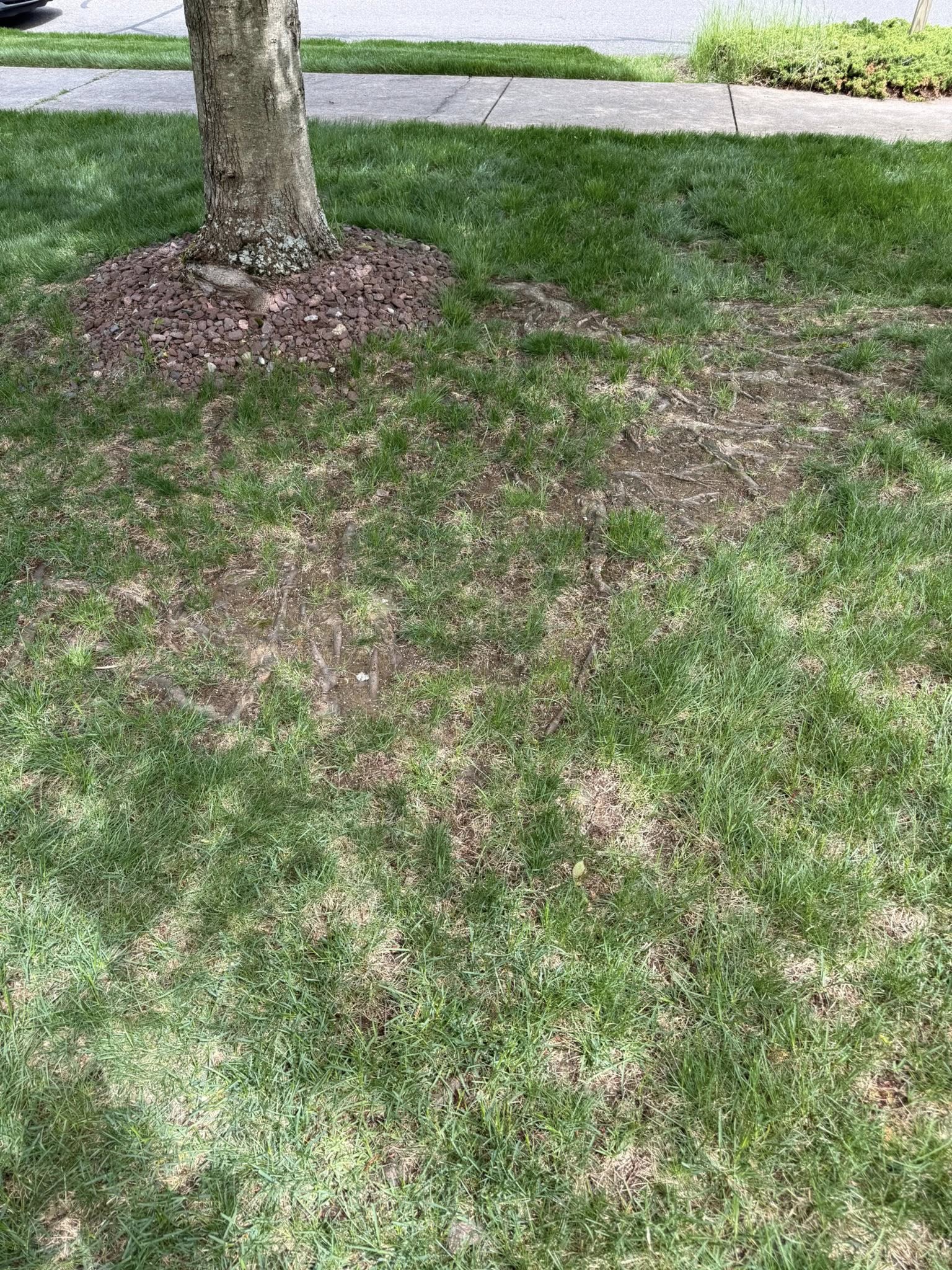
Here’s what I found when I looked carefully at that Capreol property.
First: the grade ran toward that corner. The yard had a very slight slope — barely visible to the eye — that directed water flow toward the back left. After heavy rain, that corner received runoff from most of the backyard in addition to its own rainfall. The soil was staying wet significantly longer than the rest of the yard. And wet soil on Sudbury clay compacts faster and drains slower — so every rain event was making the underlying problem worse.
Second: the spruce roots. The mature spruce trees along the back fence had root systems extending well into the lawn area. Spruce roots are shallow and aggressive — they run horizontally right below the surface and compete intensely with grass for water and nutrients. In that corner, the grass wasn’t just dealing with compaction and excess moisture. It was competing with established tree roots for every nutrient in the soil and losing.
Third: afternoon shade. The combination of the house on one side and the spruce trees on the back meant that corner got maybe three hours of direct sun on a good day. The grass variety growing there — a standard sun mix that had been seeded years ago — wasn’t suited for that light level. It was a shade problem masquerading as a soil problem.
Any one of those three things alone would have made that area challenging. All three together meant that whatever the homeowner applied on the surface — fertilizer, seed, water — was working against those three underlying conditions every single time. No wonder it never improved.
This is exactly the kind of multi-factor problem that a proper lawn walkthrough and assessment is designed to catch. Surface treatments don’t fix layered problems — you have to find every layer first.
How We Actually Fixed It — and What That Looked Like

Once I understood what was actually going on, the fix became clear. It wasn’t complicated — but it was specific to what that corner needed, not a generic lawn treatment.
Drainage first. We core aerated the entire problem area heavily — double passes — to break up the compaction and open channels for water to move through the soil instead of pooling at the surface. If you want to understand what that process involves and what it costs, I’ve written about core aeration pricing and process for Sudbury properties in detail. We also added a shallow topsoil berm along the edge of the problem area to redirect runoff away from the corner rather than into it. Simple grading fix, made a real difference.
Tree root competition. We can’t remove spruce roots without damaging the trees, and the homeowner wanted to keep the trees. So instead we worked with the competition rather than against it — top dressing with a thin layer of quality compost to add organic matter and nutrients above the root zone, giving the grass a better growing medium in the top few inches where it could actually access it before the spruce roots pulled it down.
Right grass for the conditions. We overseeded the entire corner with a shade-tolerant mix — heavy on creeping red fescue and chewings fescue, which are specifically suited for low-light conditions and root competition. The original grass variety had never been suited to that spot. No amount of care was going to make a sun grass thrive in three hours of daily light.
We did all of this in late August — which is actually ideal timing for this kind of repair work in Sudbury. The soil was warm, the heat of summer had broken, and the new seed had six weeks to establish before first frost. By October that corner had the best grass coverage it had seen in years. The following spring it came back strong.
Tip you can use right now: if you have a problem area that keeps failing, write down everything that’s different about that spot compared to the rest of your yard. Sun exposure, drainage, nearby trees, foot traffic, soil feel. The answer is usually in the differences — not in what’s the same.
The Bigger Thing Her Question Taught Me

I’ve thought about that question a lot since that job in Capreol. Why does it only happen in this exact spot?
What she was really asking — without knowing she was asking it — was: have you looked carefully enough to actually understand my specific lawn, or are you about to give me the same general answer you give everyone?
That’s a fair question. And it pushed me to be more thorough.
The truth is that lawns in Greater Sudbury are not all the same, even on the same street. Properties in Capreol have different soil histories than properties in Val Caron. A yard with mature trees has completely different dynamics than an open suburban lot. A low-lying property near a drainage swale behaves differently in spring than a property on higher ground. The general principles of lawn care apply everywhere — but the specific answer for any given lawn comes from actually looking at that lawn.
I’ve learned to slow down on problem areas. To resist the pull toward the obvious explanation and ask whether there’s something more specific going on. Most of the time the obvious explanation is part of the answer. Occasionally, like in Capreol, it’s only one piece of a more layered picture.
And I’ve learned that homeowners who ask specific, careful questions about their own property are usually the ones who get the best results — because they push their lawn care provider to look harder and think more carefully. That woman in Capreol probably got a better outcome because she stopped me and asked that question instead of just nodding along.
If your lawn has a spot that’s been frustrating you for more than one season — a corner that never responds, an area that keeps dying no matter what you do — that’s worth a proper conversation. Not a quick glance and a generic recommendation. A real look at what’s specifically going on in that location.
That’s what I do on every property I visit. And if you want me to come out and do it on yours — whether it’s in Capreol, Garson, Hanmer, Val Caron, or anywhere across Greater Sudbury — give me a call.
📞 Call or text: 705-507-6787
Or fill out the free quote form at cuttingedgelawn.ca — I get back to everyone the same day.
We serve Capreol, Garson, Val Caron, Hanmer, Cheney Manor, Lively, Chelmsford, Azilda, and all of Greater Sudbury.
— Ryan Lingenfelter
Owner, Cutting Edge Lawn & Landscaping
Garson, Ontario
Related Articles
- The First Thing I Do When I Pull Up to a New Property in Sudbury
- How Much Does Core Aeration Cost in Sudbury?
- What I Wish I Had Told My Very First Sudbury Customer
- Core Aeration Services in Greater Sudbury
