

I got a text message at 1:45pm on a Wednesday in early June. It was from a customer in Lively — a guy who does his own lawn care but follows me for tips and occasionally asks questions. The message had three photos attached and one line of text.
“Ryan what is happening to my lawn. This wasn’t here this morning.”
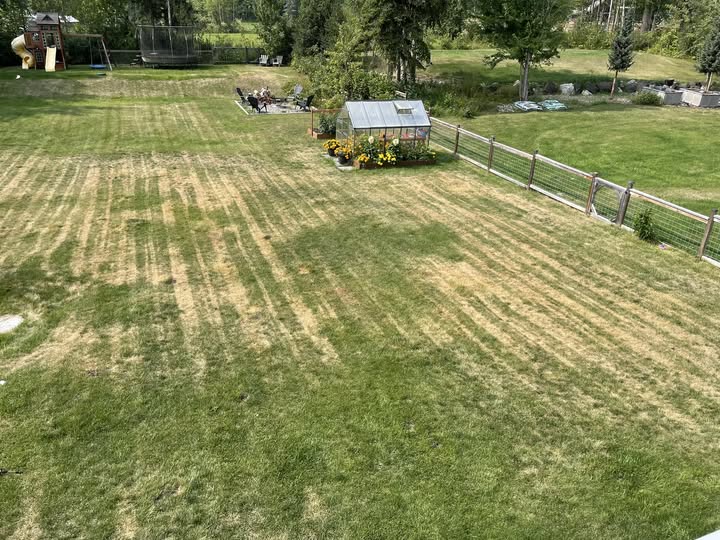
I opened the photos. Long brown stripes running across his front lawn, roughly the width of a fertilizer spreader, in a pattern that went back and forth across the property. The stripes were sharply defined — green grass on either side, dead brown grass in bands following exactly the path a spreader would walk.
I knew what I was looking at before he even explained anything. But I asked him to walk me through his morning anyway, because I wanted to confirm it and because I knew this was a teaching moment — not just for him, but for a lot of people who make the exact same mistake every spring and early summer in Sudbury.
Here’s what happened, why it happened so fast, and what to do if it happens to you.
What I Found When I Got There
I drove out to Lively that afternoon. By the time I arrived — around 3pm — the damage had progressed even further than what was in the photos from 1:45.
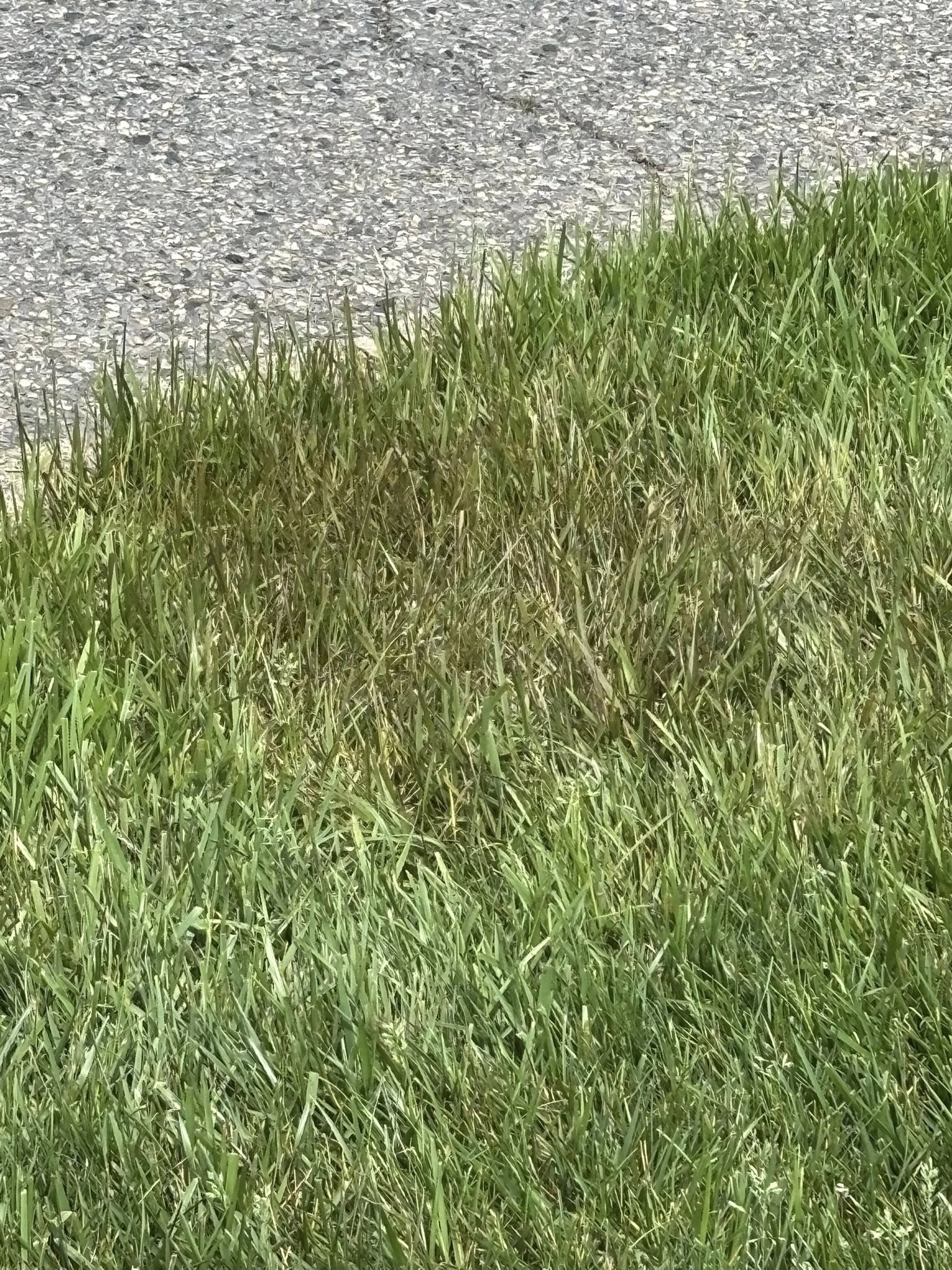
The stripes were unmistakable. Roughly 18 inches wide, running the full length of his front lawn in parallel bands, with about a foot of green grass between each brown stripe. In some areas the brown had gone almost black — that crispy, scorched look that’s different from drought stress or disease. Drought stress fades a lawn to a dull tan-grey uniformly. This was sharp-edged, striped, and in the worst spots the grass blades themselves looked burned, almost like they’d been touched with something hot.
He told me his morning: up at 7am, lawn looked great — he’d actually mowed it the day before and it looked, in his words, “the best it had looked all spring.” Around 8am he put down a granular weed-and-feed fertilizer he’d bought at a hardware store in Sudbury, using a push spreader. He watered it in afterward, like the bag instructed. Went to work. Came home at lunch and found this.
Five hours. From perfect lawn to visibly burned stripes.
I asked him a few specific questions, and his answers confirmed exactly what I suspected. What temperature was it that morning, and what time did he apply the product? It was already warm by 8am — he guessed around 18 to 20 degrees, heading toward a forecasted high in the upper twenties. Did he check the spreader setting against the bag instructions, or just use whatever setting was already on the spreader from a previous use? He admitted he hadn’t checked — the spreader was set from when he’d used it for grass seed earlier in spring, and he didn’t think to adjust it for the fertilizer.
That was the whole story, right there. Wrong setting, warm temperature, and watering it in at exactly the wrong moment. All three things combined into textbook fertilizer burn.
Why Fertilizer Burns Grass So Fast
I want to explain the actual mechanism here, because once you understand it, the speed of this damage makes complete sense — and you’ll never look at a bag of fertilizer the same way again.
It’s About Salt Concentration, Not Heat
Most granular fertilizers are essentially salts — nitrogen, phosphorus, and potassium in salt forms that dissolve in water and get taken up by the grass roots. In normal application rates, the concentration of these salts in the soil solution around the grass roots is low enough that the grass absorbs water and nutrients together without issue.
When fertilizer is applied too heavily — because the spreader setting is wrong, because of overlap on turns, or because someone dumps extra product on an area thinking “more is better” — the salt concentration in the soil water spikes. Water moves from areas of lower salt concentration to higher salt concentration, which is the basic principle of osmosis. When the soil water around the roots becomes more concentrated than the water inside the grass plant’s cells, water gets pulled out of the plant and into the soil — backwards from the direction it’s supposed to go.
The grass cells lose water rapidly. This is functionally the same as drought stress, except it happens from the inside out and happens far faster, because the plant is actively losing water instead of just failing to take it up. The grass blades dehydrate, the cell walls collapse, and the tissue dies. That’s the brown, crispy, burned appearance.
Why Watering It In Made It Worse, Not Better
This is the part that surprises people. The instinct — and often the instruction on the bag — is to water fertilizer in after application. Under normal application rates, that’s correct. Watering dissolves the granules and moves the nutrients into the soil where the roots can access them.
But when the application rate is too high, watering it in dissolves all that excess fertilizer into the soil water immediately, creating that high-concentration solution right at the root zone all at once. Without water, an over-application of dry granules sitting on the surface would still cause some damage from direct contact with grass blades, but it would be slower and more limited because the salts wouldn’t be fully dissolved and distributed through the root zone. Watering an over-application speeds up and intensifies the osmotic damage.
Why It Happens in Stripes
The striping pattern is the signature of a spreader-related issue, and it tells you exactly where to look for the cause. Spreaders distribute product in a pattern that’s heaviest directly under the spreader and tapers off toward the edges of the throw pattern. If you don’t overlap your passes correctly, you get gaps with too little product. If you overlap too much — or if the spreader setting is too high for the product you’re using — you get double or triple coverage in the overlap zones.
Sharp, parallel, evenly-spaced brown stripes with green grass between them is almost always overlap-related over-application. The stripes are where the spreader passed twice, or where the setting was simply too generous for the product’s concentration.
The Conditions That Made It Worse That Day
The over-application was the root cause. But the conditions that day turned what might have been mild stress on a cooler, cloudier morning into severe burn within hours.
Temperature
Early June in Sudbury can swing widely day to day, but on the day this happened, temperatures were already climbing into the high teens by mid-morning with a forecast in the upper twenties. Warmer temperatures increase the rate of water loss from grass blades through transpiration — the natural process where plants release water vapour through small pores in their leaves. When the osmotic pull from over-fertilized soil is already drawing water out of the plant, and transpiration is simultaneously pulling water out through the leaves at an elevated rate due to heat, the grass is losing water from two directions at once. That’s the combination that turns “stressed” into “burned” within a few hours instead of a day or two.
Sun Exposure
His front lawn faces south with no shade from trees or structures for most of the day. Direct sun exposure compounds the heat effect and increases transpiration further. A shaded lawn under the same over-application would likely show damage too, but more slowly and probably less severely.
Timing of Watering
He watered immediately after application, around 8:30am, then left for work. The sun had several hours to work on a lawn that now had a fully dissolved, high-concentration fertilizer solution sitting in the root zone, with rising temperatures and direct sun pulling moisture out of the grass continuously through the late morning. By the time he got home at lunch, the damage that had started within an hour or two of application had progressed to full visible burn.
If he’d applied the same amount of product but it had been an overcast, 12-degree day, the damage likely would have been less severe and slower to appear — possibly showing up as yellowing over a day or two rather than crisp brown stripes within five hours. The over-application was the cause. The weather conditions were the accelerant.
How We Fixed It and What the Lawn Looks Like Now

Here’s what I told him to do, and what we did together over the following weeks.
Step One: Flush the Soil Immediately
The first thing — and we did this the same afternoon, even though some damage had already occurred — was to water the affected areas heavily. Not the light watering-in that started the problem, but a deep, thorough soaking, repeated over the following two days. The goal is to dilute and flush the excess salts out of the root zone through the soil profile, away from where the remaining living roots can be affected further.
This won’t bring back grass tissue that’s already dead, but it stops the damage from spreading further into the root system and gives whatever roots survived a chance to recover.
Step Two: Assess What’s Actually Dead
About a week later, we did the same tug test I describe in my article on reading lawn damage — grab the brown grass and pull gently. In the lighter-affected stripe edges, the crowns had survived and new growth was already starting to come through. In the centre of the worst stripes, the crowns were dead and that grass wasn’t coming back on its own.
This is actually good news in a fertilizer burn situation compared to some other types of lawn damage. The burn typically affects the blades and, in moderate cases, the crowns — but it doesn’t usually destroy the deeper root system the way grub damage does. Even in the worst stripes on his lawn, there was viable root structure a couple inches down. That meant overseeding directly into the damaged stripes had a good chance of working, rather than needing sod patches.
Step Three: Light Raking and Overseeding
We raked the dead stripe areas lightly to remove the dead blade material and roughen the soil surface slightly — enough for seed contact without disturbing the surviving root structure underneath. Then overseeded those specific areas with the same Kentucky bluegrass and ryegrass blend I use for spring overseeding.
Because it was early June and we were just past the ideal aeration window, we didn’t do a full aeration pass — just direct seeding into the damaged stripes with light raking for soil contact. Watered consistently for the following three weeks, same as new seed anywhere.
The Result
By early July — about a month after the burn — the stripes were filling in. The ryegrass component had germinated within about ten days and given visible green coverage in the damaged areas. By late July, you genuinely had to look closely to find where the stripes had been. By the following spring, there was no visible trace at all.
He got lucky in one sense — the burn, while dramatic-looking, wasn’t severe enough to kill the root system entirely in most of the affected area. A more severe over-application, or the same over-application on an even hotter day with more sun exposure, could have killed the grass down to bare soil and required sod patching to fix properly. I’ve seen that happen too.
How to Avoid This — What I Tell Every Customer
This kind of damage is completely preventable, and the prevention is simple once you know what to watch for.
Always Check the Spreader Setting Against the Specific Product
Spreader settings aren’t universal. A setting that’s correct for grass seed is almost never correct for fertilizer, and settings vary between fertilizer products depending on their concentration. Every bag has a recommended spreader setting, usually as a number or range corresponding to common spreader brands. Check it every single time, even if you’ve used the spreader before for something else.
Don’t Apply on Hot, Sunny Days
The ideal time to apply granular fertilizer in Sudbury is on a cooler day, overcast if possible, with no extreme heat forecast for the following 24 to 48 hours. Early morning or evening application, when temperatures are lower, reduces the risk significantly even if the application rate is slightly off. If the forecast shows a hot, sunny day, wait for a better window.
Overlap Carefully, or Don’t Overlap at All
When walking with a spreader, the throw pattern from each pass should just barely meet the edge of the previous pass — not overlap significantly. If you’re unsure about your spreader’s throw width, do a test pass on a driveway or walkway first to see how far the product actually travels, then space your lawn passes accordingly.
Water Lightly, Not Heavily, Immediately After Application — Then Monitor
If you’ve applied at the correct rate, watering in is fine and recommended. But apply a light watering rather than a heavy soak immediately after, and then check the lawn over the following 24 hours. If you start seeing any unusual colour changes — even mild yellowing — in the hours after application, that’s your signal to start flushing with heavier watering before it progresses to full burn.
When in Doubt, Use Less
If you’re ever unsure between two spreader settings, choose the lower one. Under-applying fertilizer means your lawn gets less of a nutrient boost than it could have — a minor, easily-corrected issue. Over-applying means burn, dead grass, and weeks of repair. The downside of under-application is mild. The downside of over-application is what happened to this lawn in five hours.
If This Has Happened to Your Lawn
If you’ve put down fertilizer recently and you’re seeing stripes, patches, or sections of grass turning brown and crispy within hours or a day or two — especially if the pattern follows what looks like a spreader path — this is almost certainly what you’re dealing with.
Flush the area with heavy watering right away, even if some damage has already occurred. Wait about a week, then do the tug test on the affected areas to see how much of the root system survived. In most cases, light raking and overseeding into the damaged areas — paired with consistent watering for a few weeks — brings the lawn back within a month or two.
If the damage is severe or covers a large portion of the lawn, or if you’re not sure whether the roots survived, I’m happy to come out and take a look. In rare cases of very severe burn, the same replace vs repair thinking I use for winter damage applies here too — though in my experience, fertilizer burn is repairable far more often than it requires replacement.
And if you’d rather not deal with fertilizer application yourself going forward, that’s a service we offer as part of our regular lawn care program — full breakdown of everything we do is here. Professional application means correct rates, correct timing, and no Wednesday afternoon texts with photos of brown stripes.
Call or text: 705-507-6787
Or fill out the free quote form on the site.
We cover Garson, Val Caron, Hanmer, Lively, Chelmsford, Azilda, Capreol, and surrounding areas.
— Ryan Lingenfelter
Cutting Edge Lawn & Landscaping
Garson, Ontario
705-507-6787
