
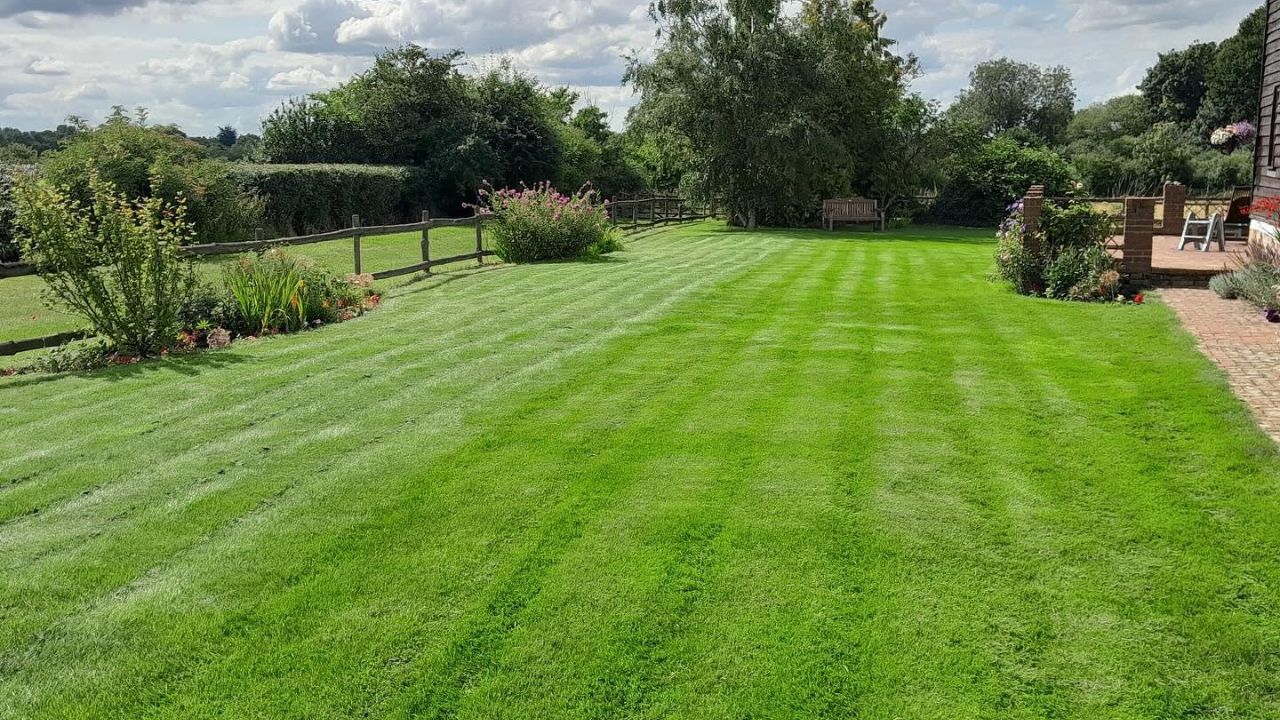
By Ryan Lingenfelter · Cutting Edge Lawn & Landscaping, Garson, Ontario · June 2026
I spend most of my working life telling homeowners what happens when lawn maintenance gets skipped. I explain it in articles. I explain it on quote visits. I walk people through the week-by-week progression of what neglect does to a Sudbury lawn in summer.
This past season I decided to find out firsthand — on my own property, with my own grass, deliberately. I let my Garson lawn go for six weeks without cutting, without watering, and without any intervention. I documented what happened every week. And at the end of it I brought it back and documented that process too.
Some of what I found confirmed exactly what I tell clients. Some of it surprised me. All of it gave me a more specific and accurate understanding of what six weeks of neglect actually does to a Greater Sudbury lawn — which means I can now talk about it from direct experience rather than professional inference.
Here’s the full record.
Why I did it — and what I was actually trying to find out

The idea started with a conversation I had with a client in Val Caron earlier this season. She’d gone on a three-week vacation and come home to a lawn that was worse than she’d expected — not just long, but stressed and patchy in ways she didn’t anticipate. I’d written about that scenario in the article on what happens to a Sudbury lawn when the homeowner goes on vacation for three weeks, but I was working from pattern recognition across other people’s properties rather than from a controlled observation of a single property I knew deeply.
I wanted to know some specific things. How fast does a well-maintained lawn in Greater Sudbury actually degrade when maintenance stops? Is the degradation linear — the same amount of change each week — or does it accelerate? Which aspects of the lawn hold up longest and which fail first? And how long does recovery actually take when you come back to it — not an estimate, but an actual measured timeline on a known property?
My property in Garson was the right test case. I know the soil conditions, the drainage, the root depth, and the thatch level because I maintain it myself. It had been aerated in late May as usual. The thatch was under half an inch. The roots were at four to five inches from the spring aeration and consistent management. The cutting height had been three inches through June. It was, by my own assessment, a lawn in good condition going into the experiment.
I chose mid-June as the start date — right at the beginning of what would typically be the most actively growing period — and set an end date six weeks later in late July. No cutting. No supplemental watering beyond what rain provided. No fertilizer. No intervention of any kind. I walked the property every Friday evening and wrote down exactly what I saw.
My neighbour thought I’d lost my mind. I told him it was research. He remained unconvinced.
What happened week by week — the honest record

Here’s what I observed, week by week, as accurately as I can record it.
Week one — June 15 to June 22. The lawn grew about three quarters of an inch. By day seven it was at three and three quarter inches. Colour was unchanged — healthy mid-green throughout. No visible stress. The edges had started to soften slightly where they met the driveway, but nothing that would read as neglected to a casual observer. The lawn looked like it was simply due for a cut. No weeds had appeared that weren’t already there before the experiment started.
Week two — June 22 to June 29. Growth continued. By day fourteen the lawn was at approximately five inches in the main open sections. Slightly shorter — four to four and a half inches — in the partially shaded section near the fence line on the north side of the property. The colour was still reasonable but I noticed the first hint of the pale yellow-green shift in the sunniest sections — not dramatic, but present. The shade section remained darker. The edges were noticeably ragged by this point. Dandelion plants that had been present before the experiment were now significantly larger — two weeks of unchecked growth had allowed them to broaden their leaf coverage substantially.
Week three — June 29 to July 6. This was the week where the lawn started reading as visibly unmaintained rather than just long. Growth had slowed slightly as the heat increased — we had a warm stretch through late June and early July. The main sections were at six to six and a half inches. The grass in the sunny open section was showing the blue-grey tint I associate with moisture stress — the same signal I described in the article on what I notice in the first 60 seconds on any Sudbury property. This was the first sign of active stress rather than just visual decline from lack of cutting. We’d had five days without significant rain.
The weed situation had changed materially. The dandelions were now substantially larger and had moved toward setting seed. I found three plantain rosettes I hadn’t noticed before the experiment — they’d been present but small enough to go unnoticed when the grass was being cut regularly. At six inches of grass height, the plantain was still hidden. But I knew it was there now.
Week four — July 6 to July 13. The heat stretch continued. Growth slowed significantly — the grass was putting energy into moisture retention rather than upward growth. I measured the main section at about seven inches. The sunniest strip along the south fence — the section that gets the most afternoon exposure — had gone from blue-grey to pale yellow in two spots, each about a square metre. These were the areas where the roots were shallowest on this property — a spot where I’d had some grub activity two seasons ago that I’d treated and recovered, but where the root depth had never fully matched the rest of the lawn.
The first dandelions had gone to seed. The seed heads were visible above the grass canopy. Whatever weed seeds landed during this period would complicate next season regardless of what I did now.
Week five — July 13 to July 20. Rain returned — two significant events over the week. The blue-grey stress in the open sections resolved within forty-eight hours of the first rain. The two yellowing spots near the south fence improved but remained noticeably paler than the surrounding grass. The roots in those spots had been pushed to their stress limit during the dry stretch and were recovering but hadn’t fully bounced back.
The lawn height had reached eight inches in the tallest sections. It was now definitively over the city’s 20-centimetre grass height bylaw threshold. A bylaw complaint could have been issued. I had fortunately briefed my immediate neighbours about the experiment before starting — I’d have had a harder time explaining a bylaw notice otherwise. The full details of Greater Sudbury’s grass height bylaw are in the article on Sudbury lawn care news mid-2026.
Week six — July 20 to July 27. The lawn had self-limited in height. Once grass reaches a certain height in summer conditions, growth rate slows significantly as the plant shifts toward reproduction rather than vegetative growth. The main sections were holding at eight to eight and a half inches. The shade section was at about seven. The two pale spots near the south fence were at six inches — slower growing because the stressed grass was putting less energy into upward extension.
The base of the grass in the tallest sections had been in shade for four to five weeks. When I parted the blades at ground level, the crowns and lower stems were white or pale yellow — the etiolated colour of plant material that hasn’t seen light. This was new relative to week one. The lower canopy had been in effective darkness since about week three.
Six weeks in, the property looked like an abandoned lot rather than an unmaintained lawn. The visual difference between week one and week six was larger than I’d expected. The functional difference — root depth, soil condition, thatch — was smaller than the visual difference suggested.
What surprised me — the things I didn’t expect to find

Several things about the six-week observation were genuinely different from what I’d expected going in.
The lawn held up better structurally than I expected. The visual deterioration was significant. But when I did the pull test at week six — pulling a small plug of turf and checking root depth — the roots were still at three and a half to four inches in the main sections. I’d expected more root regression than I found. The spring aeration and the root depth it had produced going into the experiment provided a buffer that lasted through six weeks of no maintenance. A lawn going into this experiment with roots at one to two inches would have shown significantly more structural degradation.
This confirmed something I tell clients but hadn’t directly tested: the preparation work done in spring produces resilience that lasts through summer stress events. The aeration that happened in late May was still protecting the lawn’s root structure six weeks later. The article on the best time to aerate a Sudbury lawn covers exactly why the late May window sets up the lawn for summer resilience — this experiment gave me direct evidence of that window’s downstream value.
The weed progression was faster than I’d anticipated. I expected weeds to worsen during the experiment. I didn’t expect them to worsen as fast as they did. Dandelions went from present-but-managed to seed-setting in three weeks. The plantain I found in week three established from essentially nothing to visible rosettes in six weeks. The lesson: weed management is not just about eliminating existing plants. It’s about maintaining turf density that closes the surface to new establishment. Six weeks of unkempt turf at eight inches is not eight inches of dense lawn. The lower canopy is in shade, the ground surface has open areas, and the conditions for weed seed germination are much better than on a properly maintained lawn.
The recovery time was longer than I tell clients. I’ve been telling homeowners who come back from extended vacations that the lawn can be back to normal in two to three weeks with proper step-down cutting and care. After doing this experiment and documenting the actual recovery, I’d revise that estimate. Three to four weeks for the main sections. Five to six weeks for the stressed south fence strip. Eight weeks before the pale etiolated base growth that had been in shade for four weeks was fully replaced by healthy new growth throughout the plant. The full recovery time for a six-week Sudbury lawn in summer conditions is closer to six to eight weeks than two to three. I’m updating what I tell clients accordingly.
The shade section outperformed the open sections by more than I expected. The partially shaded north fence section stayed greener, stressed less during the dry stretch, and showed less colour degradation throughout the experiment than the full-sun sections. This makes sense — shade reduces moisture evaporation and temperature stress — but the magnitude of the difference was larger than I’d anticipated. In full sun, six weeks of no watering during a July heat stretch produced visible stress and spot dieback. In partial shade on the same property, the same six weeks produced a lawn that was long and unkempt but substantially greener and more structurally intact than the open sections.
What I did to bring it back — and how long it actually took

The recovery process started on July 28 — day 43 of the experiment.
Day one — step cut to five inches. The one-third rule means I couldn’t take an eight-inch lawn to three inches in a single cut without causing significant shock to the root system. I cut to five inches on day one. Bagged the clippings — at eight inches with lower stems that had been in shade, the cut material was too much to leave on the lawn. The lawn looked better immediately after the first cut, but the lower stems that had been etiolated were now exposed. The visible lawn surface was paler and more yellow-white than it would be after a second cut.
Watered deeply that evening — the first supplemental watering in six weeks. Ran it long enough to wet the soil to five inches.
Day four — step cut to four inches. The lawn had responded well to the first cut and the watering. New growth was already visible at the cut tips. I took it from five to four inches. The colour was improving — the new growth coming in above the cut line was greener than the etiolated lower stems. The shade section looked notably better at this stage than the open sections — the recovery rate was faster in the areas that had experienced less stress.
Applied a light balanced fertilizer — zero phosphorus in the middle number as required under Greater Sudbury’s bylaw — to support the recovery growth.
Day eight — cut to three inches. This was the final step-down cut. The lawn was at four inches and growing well. Taking it to three inches was now within the one-third rule. The main sections looked like a maintained lawn again at this point — the etiolated base growth was largely replaced by healthy new growth from above the cut line. The south fence strip was still noticeably paler than the surrounding grass.
Weeks two through four — normal maintenance resumes. Weekly cuts at three inches. Deep watering twice per week on permitted bylaw days. The main lawn recovered visually to near-normal appearance by day twenty-one. The weed situation required attention — the dandelions that had gone to seed during the experiment needed spot treatment, and I found more plantain in the previously thin areas than I’d had before the experiment started. Weed treatment at day fourteen, follow-up at day twenty-eight.
Weeks five and six — south fence strip recovery. The two stressed spots from the July dry stretch took longer than the main lawn. By week five they were at about 70 percent recovery — green but not yet at the density of the surrounding turf. A light overseed at the end of week four helped. By week six they were at about 85 percent. Full recovery — indistinguishable from the surrounding grass — took until week eight.
The total recovery timeline: Main lawn sections — three weeks to normal visual appearance, four weeks to full functional recovery. Stressed sections — six to eight weeks. Weed pressure increase — ongoing into next season regardless, because some of those dandelion seeds landed and will germinate next spring.
The most important finding from the recovery: The step-down cut sequence is not optional. I know this intellectually and recommend it constantly. Doing it myself on an eight-inch lawn reinforced how much the quality of the recovery depends on the step-down approach versus a single aggressive cut. A single cut from eight to three inches on day one would have produced yellowing across the full lawn for two weeks, stressed the root system during an already stressed period, and produced a slower overall recovery than the three-step approach I used. Take the extra days. The step-down sequence is worth it every time.
For homeowners dealing with a lawn that’s gotten long from vacation or other reasons, the full guide to bringing an overgrown Sudbury lawn back is in the article on lawn repair in Sudbury — which covers the decision between patching, reseeding, and more significant intervention depending on how far the decline went. And if you want to avoid the situation entirely next summer, the mid-vacation cut service I offer means you come home to a manageable lawn rather than an experiment in neglect.
📞 705-507-6787 | Get a free quote online
— Ryan Lingenfelter
Owner, Cutting Edge Lawn & Landscaping
Garson, Ontario · 705-507-6787
