

I went out to Azilda in early June last year to look at a property that a homeowner — I’ll call her Patricia — had been working on for four years.
She’d called me because the lawn wasn’t getting better. Not dramatically worse, but not better either. Year after year, she put time and money into it and the result was the same thin, patchy, unremarkable lawn she’d started with.
When I arrived, she didn’t just walk me around the property. She brought out a notebook.
She’d been keeping track. The products she’d used, the dates she’d applied them, the watering schedule she followed. She showed me photos on her phone going back three seasons. She had a system. She was organized. She was clearly someone who took this seriously and followed through.
I spent about thirty minutes listening to her describe what she did — the spring fertilizer, the summer feeding, the weed control schedule, the overseeding she did every fall. She even showed me the bags she’d been using, stored neatly in the garage.
Then I walked the property and did what I always do — the screwdriver test, a slow look at the grass in each section, a check of the drainage, a look at the mower deck setting.
When I came back to where she was standing, I had to tell her something she wasn’t expecting.
Everything she’d been doing was reasonable. None of it was wrong, exactly. But all of it was aimed at the surface of a problem that lived underground — and that’s why four years of consistent effort had produced almost no change.
What Patricia Was Actually Doing

Before I tell you what was wrong, let me describe her routine accurately — because she wasn’t doing things carelessly.
Every spring in late April, she applied a slow-release granular fertilizer with a spreader, following the bag instructions exactly. She watered it in properly.
In June, she applied a second fertilizer — the “summer feeding” step from the same program — to keep the lawn green through the hot months.
When she saw dandelions, she applied a broadleaf herbicide. Not wholesale — spot treatment on the visible weeds. Carefully done.
Every September, she overseeded the thin spots. She prepared the seed bed by raking, spread quality seed, covered it lightly, and kept it moist for three weeks. Some of it germinated. Most of the germination didn’t survive to the following spring.
She watered every evening after work — fifteen to twenty minutes, which felt like enough to her.
And she cut the lawn herself, every week, at what she thought was a normal height.
This is a reasonable lawn care routine. Most of the individual steps she was following are steps you’d find in any general lawn care guide. The problem wasn’t that any single thing was wrong. The problem was that the entire routine was addressing the lawn as if the soil underneath it was fine — and it wasn’t.
What I Found When I Actually Looked at the Soil
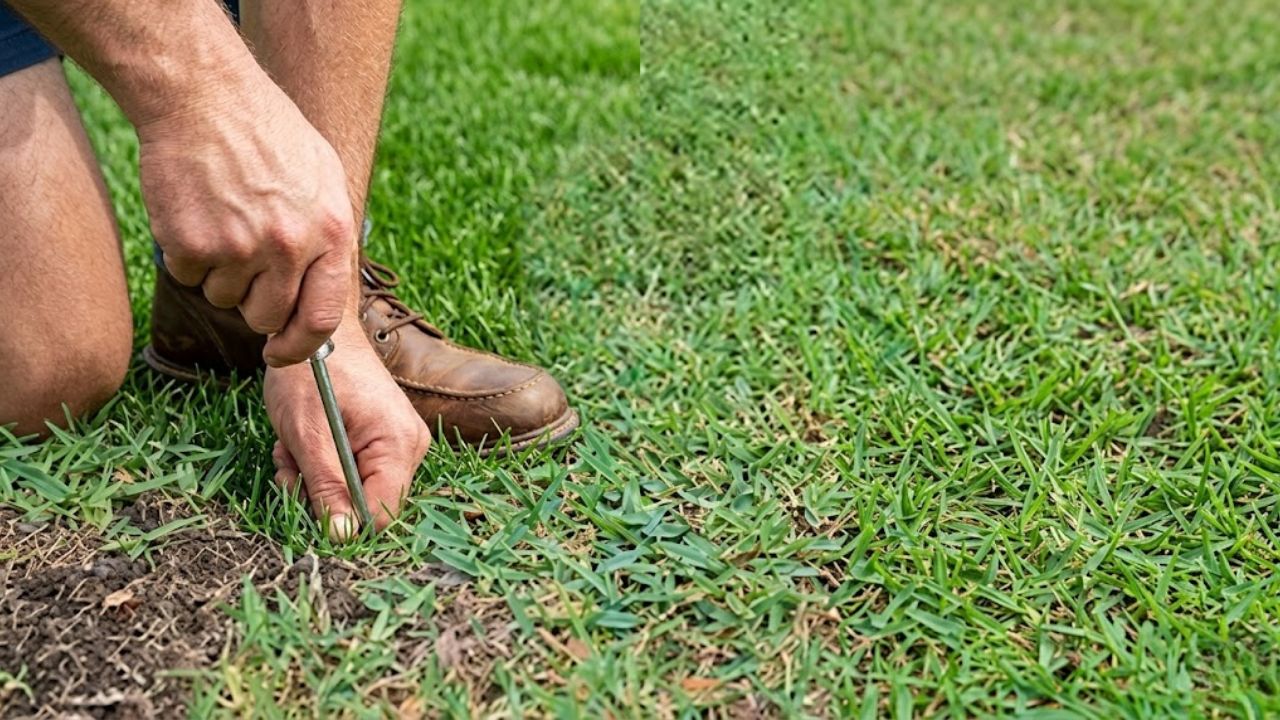
The screwdriver stopped at just over an inch in most of the yard. In two spots along the back it wouldn’t go past half an inch.
That’s severe compaction. On Sudbury’s clay-heavy soil — and Azilda sits on some of the heaviest clay in the Greater Sudbury area — four winters of freeze-thaw cycles without aeration produces soil that is essentially impermeable. Water can’t soak through it properly. Roots can’t push down into it. Nutrients sit on the surface and wash away or get taken up by whatever shallow root system exists in the top inch of soil.
I asked Patricia if the property had ever been aerated. She thought about it and said she wasn’t sure — maybe before she moved in, she didn’t know.
Then I asked to see her mower. She took me to the garage. The deck was set to the second notch from the bottom. She’d been cutting at about 1.75 inches — a common setting people use because they like the look of a neatly trimmed short lawn.
Two problems. Severe compaction. Cutting height that was producing shallow roots even in the thin topsoil layer that did exist.
Here’s what those two problems had been doing to everything she was putting into the lawn for four years.
The fertilizer she applied every spring sat on the surface of compacted clay. Some of it washed away with the first heavy rain. Some of it got taken up by the shallow root system already there — producing the brief green-up she mentioned seeing in May that faded by July. None of it penetrated to any meaningful root depth because there was no pathway through the compacted surface.
The weed control knocked back the dandelions she could see. Then new dandelion seeds found the same compacted clay conditions they thrive in and re-established within weeks. The condition that made weeds competitive — compacted soil where grass roots can’t go deep — was still completely intact. Killing the visible weeds without fixing the soil is like bailing a boat without plugging the hole.
The overseeding she did every fall failed to establish reliably because seed dropped on compacted Sudbury clay without aeration doesn’t get the soil contact it needs to germinate well. The seed that did germinate produced seedlings with shallow roots in hard clay — and those seedlings didn’t survive their first summer drought.
The evening watering — fifteen to twenty minutes on compacted clay — was producing surface moisture that evaporated or ran off before it reached any meaningful depth. The clay surface stayed moist overnight, which was creating the fungal pressure contributing to some of the thin patches. Deep watering wasn’t happening because the water had nowhere to go.
The mowing height was ensuring that any grass that did grow stayed shallow-rooted — cutting at 1.75 inches means the plant keeps diverting energy into regrowing blade rather than extending roots. In Sudbury’s clay soil in July, grass with roots only in the top inch of soil dries out completely during a dry stretch. That’s the browning she saw every summer.
Four years of consistent, careful effort — all of it producing limited results because the foundation the lawn was sitting on had never been addressed.
What I Actually Told Her — The Full Honest Version

I told Patricia that her lawn wasn’t getting better because everything she’d been doing was treating the symptoms of a soil problem — not the soil problem itself.
The fertilizer, the weed control, the overseeding — these all make sense as a lawn care routine on healthy, well-structured soil. On severely compacted Sudbury clay, they produce temporary or no results because they can’t reach where they need to go.
I told her that the single most important thing she could do — and the thing that would make everything else she was already doing actually work — was annual core aeration. Not complicated. Not expensive. But foundational. I explained exactly why in the same terms I use in my core aeration timing guide here — Sudbury clay compacts severely every winter, and without aeration, nothing else penetrates.
Then I told her to raise her mower deck to 3 inches and leave it there. The relationship between cutting height and root depth is direct — at 1.75 inches she was keeping the grass permanently shallow-rooted, and shallow roots on Sudbury clay dry out in July regardless of how much fertilizer or water you apply. I covered this in detail in my $35 lawn fix article — cutting height is the highest-impact free change most Sudbury homeowners can make.
I told her to switch her watering to mornings and use the cycle-and-soak approach — two shorter sessions with an hour between them rather than one light session in the evening. Evening watering on heavy Azilda clay keeps the surface wet overnight, which is exactly the condition that promotes the fungal problems she’d been seeing. Morning watering lets the grass dry during the day. I explain the full approach in my Sudbury lawn watering guide here.
And I told her to keep the overseeding — but to do it after the aeration, not before. Seed dropped into fresh aeration holes on Sudbury clay establishes at a dramatically higher rate than seed dropped on the compacted surface. The same seed she’d been using every fall would produce far better results if the soil preparation happened first.
She listened to all of this carefully. Then she said something that stuck with me: “So I’ve been spending money fixing things that weren’t actually broken.”
That’s exactly right. The fertilizer program wasn’t the problem. The weed control approach wasn’t the problem. The overseeding wasn’t the problem. The soil underneath all of it was the problem — and it had never been addressed.
What Her Lawn Looked Like One Season Later

We aerated her property in late May. She raised the mower deck immediately. She switched to morning watering on the cycle-and-soak schedule. She overseeded in early September right after a second aeration pass.
She sent me a photo in late September. The difference was visible. The thin spots that had resisted four years of overseeding had filled in noticeably after one fall seeding into fresh aeration holes. The browning she’d seen every July hadn’t happened — the deeper roots from correct cutting height held through the dry stretches. The dandelion pressure was lower because thicker, healthier grass was crowding out the weed germination spots.
Not a perfect lawn yet — one season of correct practice doesn’t reverse four years of compaction overnight. But the trajectory had completely changed. For the first time in four years, the lawn was visibly better at the end of the season than it had been at the beginning.
Patricia kept her fertilizer program, by the way. Same products, same schedule. Just applied them to an aerated lawn where they could actually reach the root zone. The products she’d been using for four years without results started producing results because the barrier preventing them from working had been removed.
That’s the lesson. On Sudbury’s clay soil, the product is rarely the problem. The soil structure underneath the product is the problem. Fix the foundation and everything you were already doing starts working the way it was supposed to.
If Your Lawn Isn’t Responding to the Effort You’re Putting In
Patricia’s story is common. Not because Sudbury homeowners are doing things carelessly — most of the ones I meet are genuinely thoughtful about their lawns. It’s common because the generic lawn care advice available online and on product packaging was written for conditions that don’t match Sudbury’s clay soil, and nobody explains that the first step has to be fixing the soil before any surface treatment will work.
If you’ve been following a consistent lawn care routine for two or more seasons and the lawn isn’t getting better — the routine probably isn’t the problem. The soil underneath it probably is.
The fastest way to find out is the screwdriver test. Push a flathead screwdriver into your soil in a few spots around the problem areas. If it stops before three or four inches anywhere, compaction is limiting everything else you’re doing. Aeration is the first step — not the fertilizer, not the seed, not the weed control. Those all come after.
If you want someone to walk your specific property and tell you honestly what’s holding your routine back — that’s exactly what I do on every quote call.
📞 Call or text me directly: 705-507-6787
Or fill out the free quote form here and I’ll get back to you same day.
We service Garson, Val Caron, Hanmer, Lively, Chelmsford, Azilda, Capreol, and all of Greater Sudbury.
— Ryan Lingenfelter
Owner, Cutting Edge Lawn & Landscaping
Garson, Ontario
Frequently Asked Questions
Why isn’t my lawn improving even though I fertilize and water regularly in Sudbury?
The most common reason is that severe soil compaction is preventing fertilizer and water from reaching the root zone. On Sudbury’s clay-heavy soil, compaction builds up every winter through freeze-thaw cycles. Without annual core aeration to open the surface, fertilizer sits on top of the clay and washes away or gets taken up by whatever shallow root system exists in the top inch of soil. Water runs off rather than soaking in. The treatments aren’t wrong — the compacted soil is preventing them from working. Aerate first, then fertilize and water into the opened soil.
Is evening watering bad for Sudbury lawns?
Yes — particularly on the heavy clay soil common in areas like Azilda and Chelmsford. Clay drains more slowly than loamy soil, so evening watering leaves the surface wet overnight. Combined with cool nighttime temperatures, this creates ideal conditions for fungal diseases that produce the circular brown patches many Sudbury homeowners see in late summer. Morning watering before 8am lets grass dry during the day and dramatically reduces fungal pressure. Switching from evening to morning watering on Sudbury clay often produces visible improvement within two to three weeks.
Why does grass seed fail to establish on my Sudbury lawn every year?
On compacted Sudbury clay, overseeding without aeration first produces poor germination because the seed doesn’t get proper soil contact. The seed sits on the surface of the compacted clay rather than in the soil, and the germination rate is significantly lower than on prepared soil. Overseeding after core aeration — where the aeration holes provide direct soil contact and moisture retention — produces dramatically better results with the same seed. The timing matters too — late August in Sudbury produces better germination than spring seeding because new grass has weeks of cool weather to establish before summer heat arrives.
How does mowing height affect lawn health on Sudbury clay soil?
Cutting height directly determines root depth — longer blades mean deeper roots, shorter blades mean shallower roots. On compacted Sudbury clay, grass cut at 1.5 to 2 inches develops roots only in the top inch or two of soil. When July heat dries out that surface layer, those roots have nothing to pull from and the grass goes brown regardless of how much fertilizer or water is applied. Cutting at 3 inches gives the plant enough leaf surface to produce energy for deeper root development. On Sudbury clay, the difference between a 2-inch and 3-inch cutting height shows clearly in July performance.
What is the correct order of lawn care steps in Sudbury?
The right order for most Sudbury properties is: aeration first to open the compacted clay, then overseeding into the aeration holes for direct soil contact, then fertilizer so nutrients reach the root zone through the aeration channels, then weed control on whatever survives the improved growing conditions. Doing these steps in the wrong order — fertilizing compacted soil, seeding without aeration, killing weeds without fixing the conditions that favour them — produces limited results because each step depends on the soil work that should have come first.
Does core aeration actually make a difference on Azilda lawns?
Yes — and the difference is typically more dramatic on Azilda and Chelmsford properties than almost anywhere else in Greater Sudbury because these areas have some of the heaviest clay soil in the region. Properties in Azilda that have never been aerated, or haven’t been aerated in years, often show dramatic improvement after the first aeration — not because anything was added, but because the soil could suddenly accept water, nutrients, and root growth after being opened up. Annual aeration on Azilda’s clay is maintenance, not optional.
Ryan Lingenfelter is the owner of Cutting Edge Lawn & Landscaping in Garson, Ontario. Since 2020, his crew has provided full lawn care and landscaping services across Greater Sudbury — Garson, Val Caron, Hanmer, Lively, Chelmsford, Azilda, and Capreol. Licensed, insured, BBB A+ rated, and ThreeBest Rated for lawn care services in Sudbury.
📞 Phone: 705-507-6787
📍 Service Area: Greater Sudbury, Ontario
🔗 Free Quote: cuttingedgelawn.ca/quote
Related Services
- Core Aeration Services in Sudbury
- Grass Cutting Services
- Sod Installation in Sudbury
- Property Cleanup Services
Continue Reading
- When Should You Actually Aerate Your Sudbury Lawn?
- The $35 Fix That Saved a Sudbury Lawn
- How to Water Your Sudbury Lawn the Right Way
- Every Sudbury Neighbourhood Has a Different Lawn Problem
- 5 Lawn Care Mistakes Sudbury Homeowners Make Every Spring
