
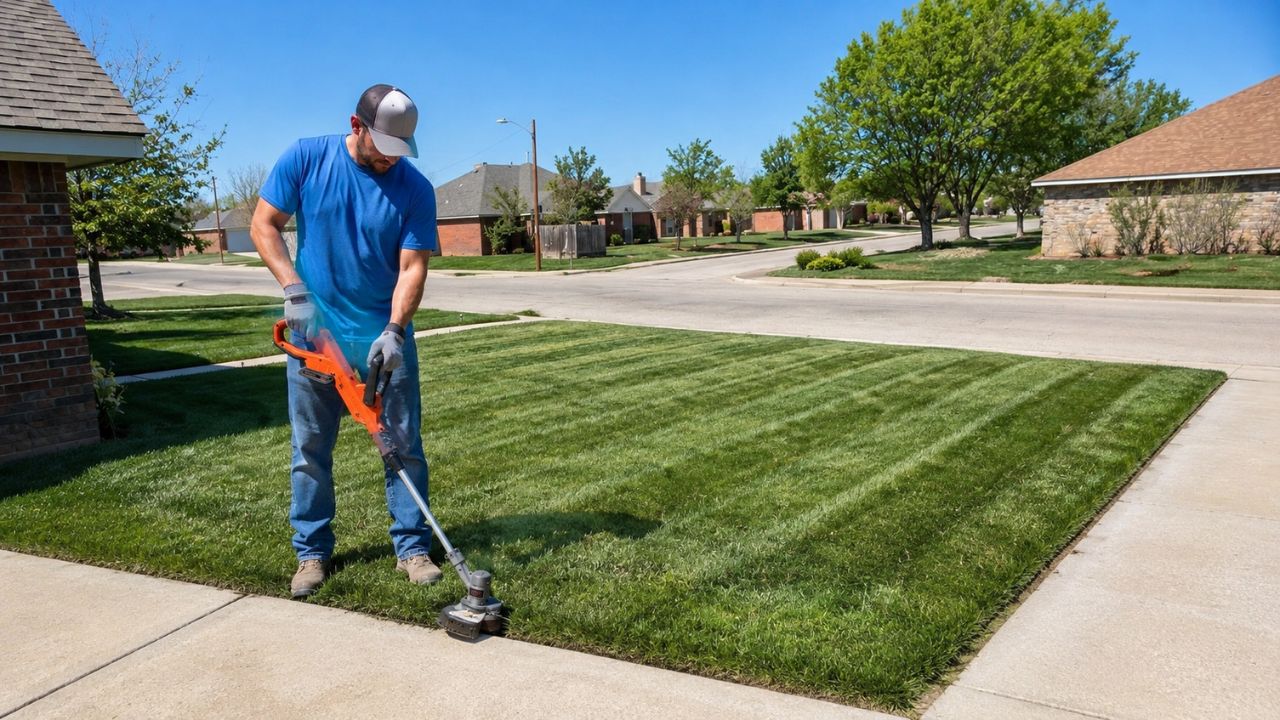
I’ll tell you something I notice on almost every property I walk for a quote.
The lawn itself might be decent. The grass is green, it’s been cut reasonably often, there’s nothing catastrophically wrong with it. But it looks unfinished. Rough around the edges — literally. The grass is creeping over the driveway by two inches. The border along the garden bed is a ragged fringe. The sidewalk edge hasn’t been touched since last fall.
A lawn without proper edges is like a haircut with clean sides but a ragged neckline. The main work is done but the detail isn’t, and the detail is what people actually see.
I’m Ryan Lingenfelter, owner of Cutting Edge Lawn & Landscaping in Garson, Ontario. Since 2020, I’ve maintained properties across Greater Sudbury — Garson, Val Caron, Hanmer, Lively, Chelmsford, Azilda, Capreol, Cheney Manor. Edging is included on every single cut we do, and I’ve done it on hundreds of properties in this area. Here’s exactly how to do it properly — and why it matters more than most homeowners realize.
What Edging Actually Is — And What It Isn’t
There’s a lot of confusion between edging and trimming. They’re different jobs with different tools and different results, and understanding the difference changes how you approach both.
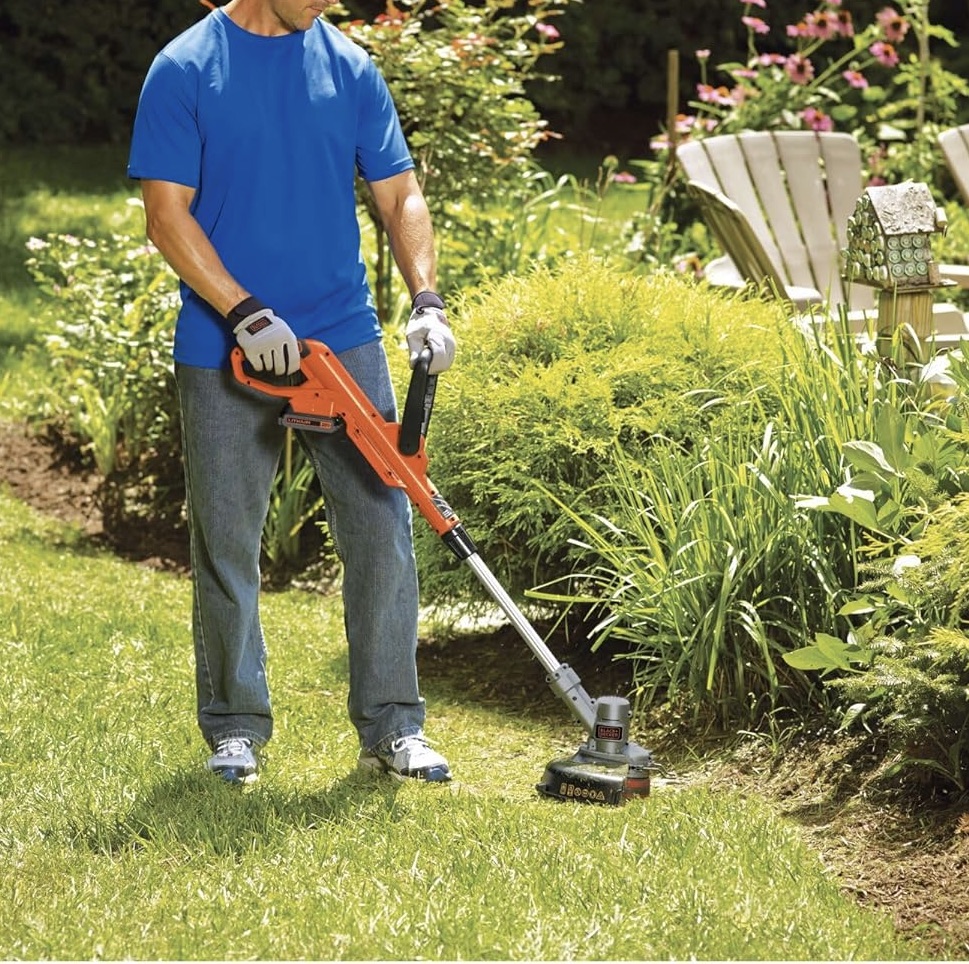
Edging is cutting a clean vertical line between your lawn and a hard surface — the driveway, the sidewalk, a concrete path, interlock. You’re defining a sharp border where the grass ends and the pavement begins. Done properly, edging creates a clean shadow line that reads as intentional from the street.
Trimming is using a string trimmer to cut grass in areas the mower can’t reach — around fence posts, tree bases, garden bed borders, under deck edges. Trimming is horizontal work. Edging is vertical work. They require different body positions, different techniques, and ideally different tools.
Most homeowners do some version of trimming and call it edging. The result looks okay close up but doesn’t have the definition of a true edged line. From the street — which is where first impressions happen — the difference is visible.
After working on properties from Cheney Manor to Val Caron, I can tell you that the single biggest visual upgrade on an average Sudbury lawn is crisp edging along the driveway and sidewalk. It takes twenty minutes. It makes the whole property look like someone professional is taking care of it.
The Right Tools for Sudbury Conditions
Tool choice matters more here than most generic lawn advice acknowledges. Sudbury’s clay soil and the way our lawns grow into pavement has specific implications for what works and what doesn’t.
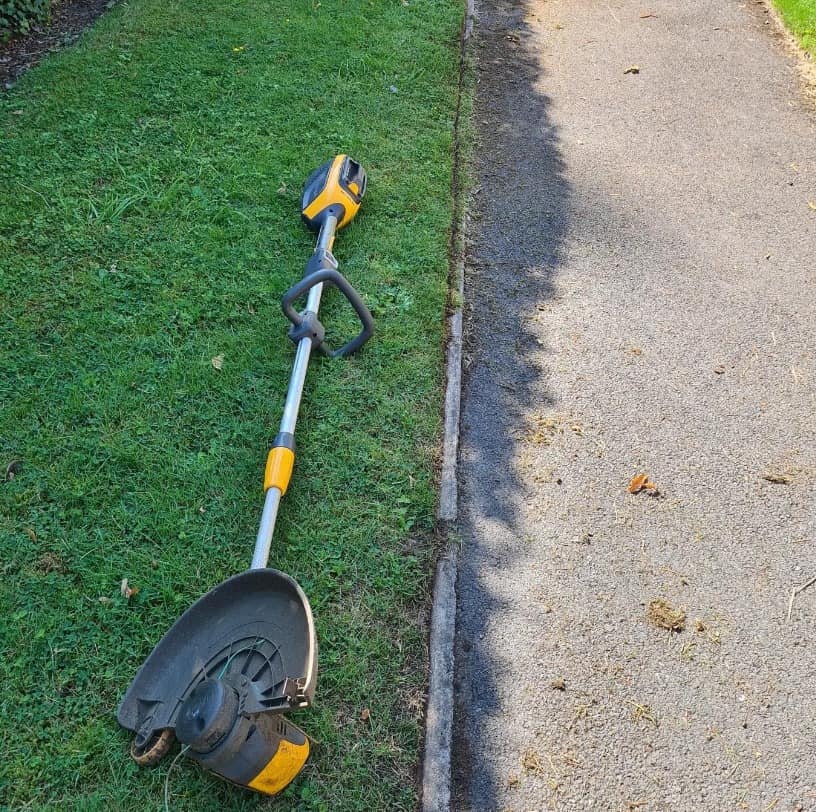
Stick edger (dedicated lawn edger): This is the right tool for driveway and sidewalk edges. It has a fixed vertical blade that cuts a consistent depth — usually 2 to 3 inches — straight down between the grass and the pavement. On Sudbury’s clay soil, where grass rhizomes grow aggressively sideways into pavement cracks, a stick edger cuts through those root runners cleanly. A string trimmer held at an angle tries to approximate the same result but can’t match the consistency or depth of a dedicated edger.
Battery-powered stick edgers have gotten much better in recent years. A decent battery edger runs $120 to $200 and handles a standard Sudbury residential lot on a single charge. If you’re serious about your edges, it’s worth having.
String trimmer for everything else: Garden bed borders, fence lines, around trees, along the base of walls — these get the string trimmer held at the appropriate angle. For a clean vertical cut along a garden bed edge, tilt the trimmer head 90 degrees so the line cuts downward rather than horizontally.
One homeowner in Garson was using his string trimmer for everything — trying to create driveway edges by holding it at an angle. The result was wavy and inconsistent every time. I lent him my stick edger for one pass and he called me the next day to say he was going to buy one. The difference was that obvious.
Manual half-moon edger: On very overgrown edges that haven’t been done in months — or on first-time edges in spring after winter heave — a manual half-moon edger cuts through the established grass mat at the pavement edge before you do the fine work. It’s physical but effective on thick, established Sudbury lawn borders.
Step-by-Step: Driveway and Sidewalk Edges
This is the technique I use on every property, every visit. It’s straightforward once you understand the goal.
Step 1 — Mow first, edge second. Always cut the lawn before edging. Mowing kicks clippings and debris around. If you edge first and then mow, the mower disturbs your clean edge line. Mow, then edge, then trim, then blow off hard surfaces. That sequence produces the cleanest result.
Step 2 — Walk the edge before you start. Look at where the grass is creeping onto the pavement. On most Sudbury properties in late spring and early summer, grass grows aggressively sideways — 2 to 3 inches of creep onto the driveway is common after a few weeks without edging. Know where the actual pavement edge is under the grass before you start cutting.
Step 3 — Set your depth consistently. On a stick edger, the blade should cut 2 to 3 inches into the soil. Deep enough to get below the root runners, shallow enough that you’re not digging a trench. On first passes in spring on established Sudbury clay lawns, you may need to go slightly deeper to cut through thick root mats that have built up over winter.
Step 4 — Walk at a steady pace. The most common mistake I see on DIY edging is inconsistent walking speed. Walk too fast and the blade skips. Walk too slow and you dig a hole. Steady pace, consistent depth, straight line. Look 6 feet ahead of where you’re cutting rather than directly down at the blade.
Step 5 — Clear the cut material. After edging, there’s a strip of cut grass and soil along the driveway edge. Blow it back onto the lawn or sweep it up — don’t leave it on the driveway. On Sudbury properties with clay soil, that debris is dense and doesn’t blow away easily the way it does on sandier soils. A leaf blower on low directed toward the lawn moves it cleanly.
Step 6 — The corner detail. Where the driveway meets a garden bed or a fence corner, the edger can’t turn a tight radius. Finish those corners with a pair of long-handled lawn shears or careful string trimmer work. Corners are where the difference between a professional job and a DIY job shows up most clearly.
Garden Bed Borders — The Detail Most People Rush
Driveway edges get all the attention, but the border between lawn and garden beds is where I spend the most time on most properties. It’s also where I see the most variation in quality.
A clean garden bed border does two things. It looks intentional — there’s a defined line between the grass and the bed that reads as maintained rather than overgrown. And it reduces the amount of grass creeping into the bed over time, which means less hand-weeding later.
The technique here is different from driveway edging. Garden bed borders are usually curved or irregular, so a stick edger isn’t always practical. I use a string trimmer held vertically — line pointing straight down — and walk the border cutting a consistent vertical line between the grass and the bed edge. On clay-heavy Sudbury soil where grass spreads aggressively, this cut needs to go down 2 to 3 inches to get below the runners.
One thing I always tell homeowners: a slight inward bevel on the bed border is better than a straight vertical cut. If you tilt the trimmer slightly toward the bed, the cut edge leans away from the grass rather than straight down. This creates a clean visual line and reduces the rate at which grass runners re-establish into the cut area. On Sudbury clay where grass spreads faster than it does on lighter soils, this small detail extends how long your edge looks clean between maintenance visits.
A homeowner in Hanmer with an extensive perennial garden — probably 40 feet of garden bed borders — had given up on trying to keep the edges clean herself. After we established clean borders on the first visit, maintenance edging on subsequent cuts took about 15 minutes total. The initial work is the hard part. Maintenance is fast once the edges are defined.
How Often to Edge in Sudbury — and When to Skip It
Edging frequency in Sudbury follows the grass growth cycle. May and June — fast growth — the edges need doing every cut. July and August — slower growth in dry stretches — you can often go two cuts before the edges need full attention. September picks up again and edges need weekly attention through the end of the mowing season.
On my regular maintenance schedule, I edge every visit through May and June, then assess in July and August. If the edge line is still clean from the previous visit, I’ll trim and blow without full re-edging. If the grass has crept back onto the pavement, it gets edged again.
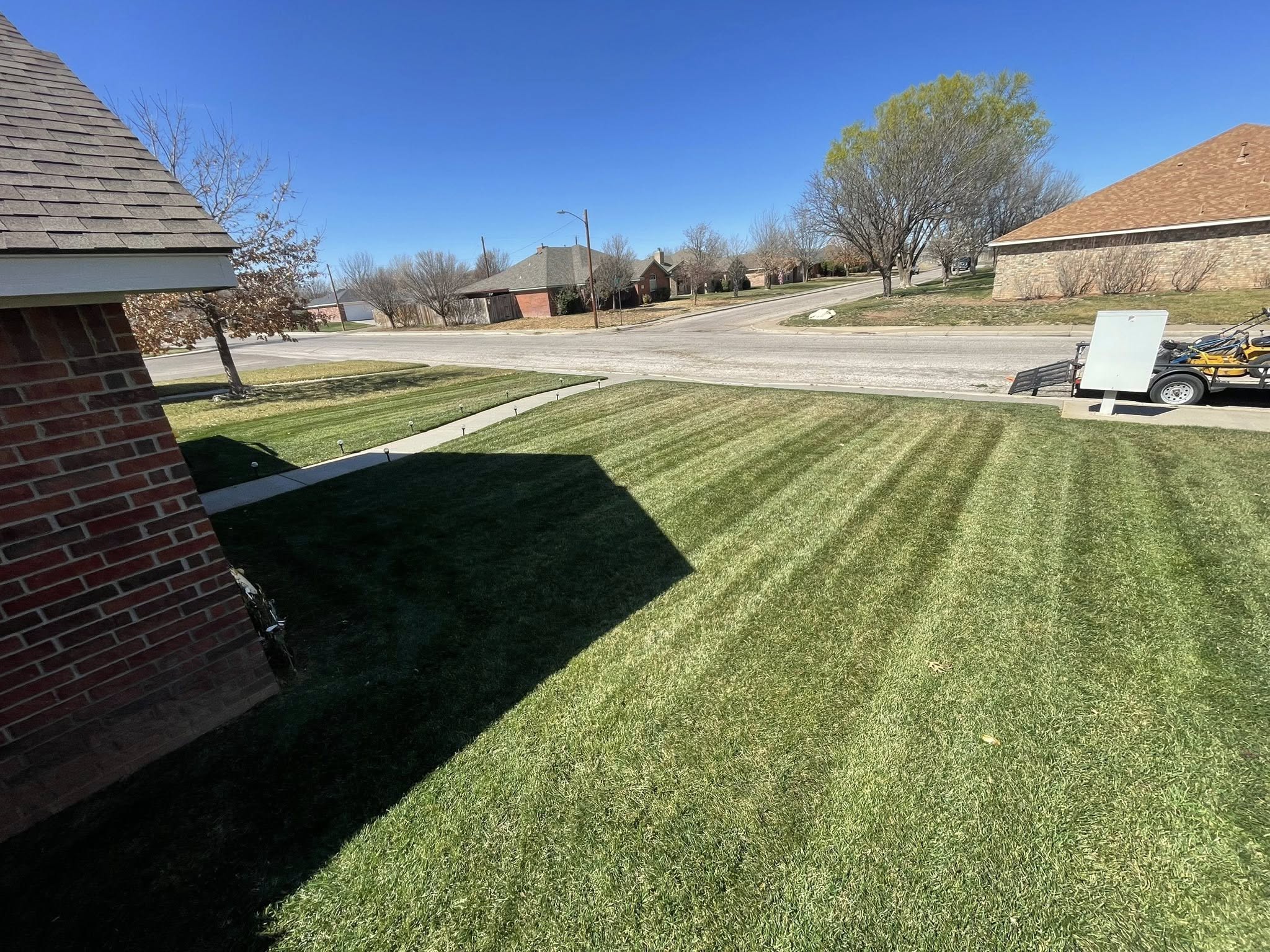
The spring first-edge of the season is always the most work. Over winter, Sudbury’s freeze-thaw cycles heave the soil at the pavement edge — grass roots get pushed laterally and the edge that looked clean in October is a mess by May. The first edge of spring on most Sudbury properties requires a deeper, slower pass than maintenance edging through the season. Sometimes a manual half-moon edger first to cut through the heaved-up mat, then the stick edger to define the final line.
I also recommend edging after any significant rainfall in late spring. Sudbury clay absorbs a lot of moisture and the grass grows explosively after a good rain in May or June. An edge that looked fine on Monday can be 1.5 inches onto the driveway by Friday after a heavy rain mid-week.
The One Mistake That Makes Edging Look Amateur
After six years of doing this professionally in Sudbury, the single most common edging mistake I see homeowners make is inconsistent depth.
They start at one end of the driveway edging at 2 inches depth, drift to 1 inch in the middle, and go back to 2 inches at the far end. From the street, that variation reads as a wavy, inconsistent line rather than a clean edge. It looks worse in certain light conditions — especially early morning and late evening when the shadow from the edge is more visible.
The fix: pick your depth at the start and commit to it for the entire run. Check it at the beginning, middle, and end of each pass. Consistent depth produces a consistent shadow line. That shadow line is what makes the edge look professional from any distance.
If you’re hiring lawn care and edging is included in every visit — which it is with us — watch the edges after the first visit. If they’re consistent and clean, that’s the standard being maintained. If they’re wavy or the depth varies noticeably, that’s a signal worth raising with whoever is maintaining the property. Edging is a detail service. Details either get done properly or they don’t.
If you want proper edging included on every cut — no add-ons, no extra charges — give me a call. It’s part of what we do on every property, every visit, across all of Greater Sudbury.
📞 705-507-6787
🔗 Get a Free Quote
📍 Serving Greater Sudbury — Garson, Val Caron, Hanmer, Lively, Chelmsford, Azilda, Capreol, Cheney Manor
— Ryan
Frequently Asked Questions
How often should I edge my lawn in Sudbury?
Edge every cut through May and June when Sudbury’s grass grows fastest. Through July and August you can assess between cuts — if the edge line is still clean, skip full edging and just trim. September picks up again and edges need weekly attention through the end of the season. The spring first-edge is always the most intensive — freeze-thaw heaving through winter pushes grass roots sideways and the edges need a deeper pass to re-establish the line.
What’s the best tool for lawn edging in Sudbury?
A stick edger for driveway and sidewalk borders — it cuts a consistent vertical line at a consistent depth that a string trimmer held at an angle can’t match. Battery-powered stick edgers run $120 to $200 and handle a standard Sudbury residential lot on a single charge. For garden bed borders and areas where a stick edger can’t navigate curves, a string trimmer held vertically cuts a clean edge line. A manual half-moon edger is useful for the spring first-edge when frozen and heaved soil has built up a thick mat at the pavement edge.
Why does my lawn keep growing over the driveway edge in Sudbury?
Sudbury’s clay soil and our aggressive spring growth cycle produce fast lateral spreading in cool-season grasses. In May and June, grass rhizomes spread sideways rapidly — especially after rain on clay soil that’s been warming all spring. The fix is consistent edging every cut through the fast-growth period, cutting deep enough (2 to 3 inches) to get below the root runners. Once the edges are established and maintained consistently, the spread rate slows because the runners are being cut back before they can re-establish.
Should edging be included in a lawn care service in Sudbury?
Yes — a complete grass cutting service should include mowing, edging along all hard surfaces, string trimming around obstacles, and cleanup of clippings from pavement. Edging is not an add-on to a proper cut; it’s part of what makes the difference between a lawn that looks maintained and one that just looks mowed. If your current lawn care service doesn’t edge every visit, that’s worth clarifying before the next cut.
How deep should lawn edging cuts be in Sudbury?
2 to 3 inches on most Sudbury residential properties. Deep enough to cut through the lateral root runners that spread grass onto pavement — which on clay soil can extend several inches sideways. Shallow enough that you’re not digging a drainage trench along your driveway. First-edge of spring on established Sudbury clay lawns often needs to go slightly deeper due to winter heaving. Subsequent maintenance edges through the season can stay at the standard 2-inch depth once the line is defined.
Ryan Lingenfelter is the owner of Cutting Edge Lawn & Landscaping in Garson, Ontario. Since 2020, his crew has provided full lawn care services across Greater Sudbury — Garson, Val Caron, Hanmer, Lively, Chelmsford, Azilda, and Capreol. Cutting Edge is licensed, insured, BBB A+ rated, and ThreeBest Rated for lawn care services in Sudbury.
📞 Phone: 705-507-6787
📍 Service Area: Greater Sudbury, Ontario
🔗 Free Quote: cuttingedgelawn.ca/quote
Helpful Lawn Care Services in Sudbury
- Grass Cutting Services
- Property Cleanup Services
- Core Aeration for Healthy Lawns
- Sod Installation in Sudbury
- Mulch & Decorative Stone
- Hedge Trimming Services
Continue Reading
- I’ve Cut 500+ Sudbury Lawns — Here’s What $39 Grass Cutting Actually Gets You
- I’ve Cut Grass on 500+ Sudbury Properties — Here’s Why Most Homeowners Are Doing It Wrong
- The May Mistake That’s Killing Sudbury Lawns by July
