
A homeowner in Lively called me a while back comparing two quotes she’d received — one priced per cut, one priced by the hour — and she genuinely couldn’t tell which one was the better deal without doing some math she didn’t really want to do on a Tuesday afternoon. So I did it with her on the phone, and the answer wasn’t as obvious as either of us expected going in.
I’m Ryan Lingenfelter, owner of Cutting Edge Lawn & Landscaping in Garson, Ontario. Since 2020, I’ve priced work both ways at different points across Greater Sudbury — Garson, Val Caron, Hanmer, Lively, Chelmsford, Azilda, Capreol — and I want to walk through exactly how each model actually works, where each one tends to favour the homeowner, and how to do the comparison yourself when you’re looking at two quotes that aren’t structured the same way.
How Per-Cut Pricing Actually Works
Per-cut pricing is the most common model for residential mowing in Sudbury, and it’s the structure we use at Cutting Edge. You’re quoted a flat price for a complete cut on your specific property — mow, edge, trim, cleanup — and that price stays the same every visit regardless of exactly how long it takes that particular week.
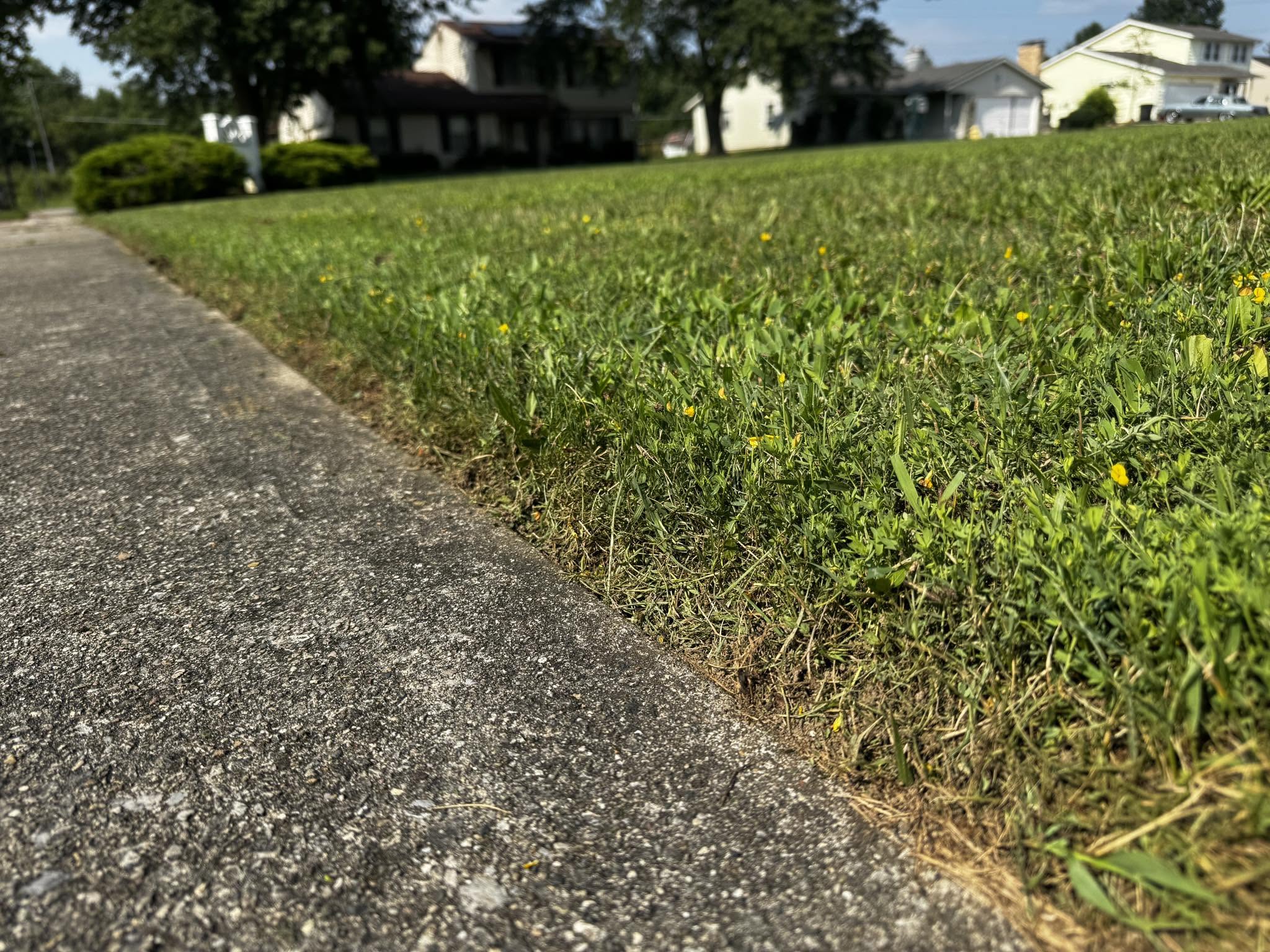
I covered the real numbers for this in detail in the 2026 Sudbury mowing price guide here, but the short version is that a small lot runs roughly $39 to $55 per cut, a medium lot $55 to $80, and a large lot $80 to $120, with the price set primarily by square footage and confirmed before service starts.
The advantage of this model is predictability. You know exactly what each visit costs going in, and that number doesn’t change based on whether the grass grew a bit faster that particular week or whether there was extra debris to clear. The company is essentially betting that the price they’ve set covers the average time a typical visit takes over a season — some visits take a little less time than the price reflects, some take a little more, and it generally evens out.
How Per-Hour Pricing Actually Works
Per-hour pricing flips that structure — you’re charged for the actual time spent on your property that visit, typically billed in increments of fifteen minutes to half an hour, sometimes with a minimum charge to cover the time and cost of getting a crew or equipment to a small job in the first place.
This model shows up more often for irregular or one-off work — a single cleanup-style cut on an overgrown property, an estimate where the scope genuinely isn’t clear until someone’s actually there working, or smaller operations that haven’t standardized square-footage-based pricing the way larger companies typically do. Hourly rates for residential lawn work in the Sudbury area generally run somewhere in the range of $45 to $75 per hour depending on the company, the equipment being used, and whether it’s a single worker or a crew.
The advantage of hourly pricing is that it can genuinely reflect the actual work done on a property that varies significantly week to week — a property with mature trees might need real extra time after a windy week, while the same property might take half the usual time during a dry August stretch when growth slows down. In theory, you’re only ever paying for the time actually spent, not for an averaged estimate.
The Math That Actually Determines Which One Saves Money
This is where the comparison gets specific rather than theoretical, and it depends almost entirely on how consistent your property’s mowing time actually is from visit to visit.
Take a standard medium-sized Sudbury lot that typically takes about an hour to fully service — mow, edge, trim, cleanup. At a per-cut price of $65, you’re paying $65 regardless of whether that particular visit takes 50 minutes or 75 minutes. At an hourly rate of $60 per hour, that same hour-long visit costs roughly $60 — slightly less than the flat per-cut price in this specific scenario.

But here’s where it flips. If that same property occasionally takes 90 minutes — after a stretch of fast May growth, or following a windy week with extra debris — the per-cut price stays at $65 while the hourly bill jumps to roughly $90 for that visit. Over a full season, the per-cut model essentially insures you against the occasional longer visit, while the hourly model exposes you to that variability directly, both the savings on shorter visits and the extra cost on longer ones.
For a property with highly consistent mowing time every single visit — flat, open lot, no significant obstacles, stable growth pattern — hourly pricing can come out slightly cheaper over a season, since you’re not paying the built-in buffer that a flat per-cut price includes for occasional longer visits. For a property with real week-to-week variability — mature trees dropping debris, irregular shape with lots of trimming, inconsistent growth from uneven sun and shade — per-cut pricing tends to work out better over a full season, since the flat price smooths out the expensive weeks.
The Hidden Factor — Predictability vs. Total Cost
The math above assumes you’re purely optimizing for the lowest total seasonal cost, but that’s not actually the only thing that matters to most homeowners, and it’s worth being honest about that.
Per-cut pricing gives you a number you can budget around for the whole season without surprises. You know in May what every visit through October will cost, and that certainty has real value even if it occasionally means paying slightly more than the bare-minimum hourly cost for a particularly fast visit. For homeowners managing a fixed monthly budget, or those who simply don’t want to think about variable invoices showing up through the season, this predictability is worth something on its own, separate from the raw dollar comparison.
Hourly pricing can save real money on a consistent, easy property, but it also means your invoice can vary from visit to visit in a way some homeowners find mildly frustrating even when the average works out favourably. It also puts more weight on trusting the company’s reported time, since you’re not in a position to independently verify exactly how long a fifty-minute visit actually took.
What to Actually Ask When Comparing Two Quotes
If you’re looking at one quote priced per cut and another priced by the hour, here’s how to make the comparison fair rather than just picking whichever number looks smaller at a glance.
Ask the hourly company for their honest estimate of how long your specific property typically takes, then multiply that by their rate to get a comparable number to the flat per-cut quote. Ask whether that hourly estimate includes edging, trimming, and cleanup, or whether those are billed as additional time on top of the mow itself — this is a common place where an hourly quote can end up costing more than it first appeared. Ask the per-cut company exactly what’s included in their flat price for the same reason, since I’ve seen flat-rate quotes that look attractive until you discover edging or cleanup is a separate add-on. I covered the full set of questions worth asking any lawn care company, regardless of pricing model, in the professional lawn care article here.
And ask about how either model handles a genuinely abnormal visit — a significantly overgrown lawn after a vacation, storm debris, anything well outside the normal scope. A clear answer about what happens in that situation, under either pricing structure, tells you more about how the company actually operates than the base price does on its own.
If you want a straight per-cut quote for your specific Sudbury property, with everything — mow, edge, trim, cleanup — included in one number, give me a call. I’ll tell you exactly what it costs before anything is scheduled.
📞 705-507-6787
🔗 Get a Free Quote
📍 Serving Greater Sudbury — Garson, Val Caron, Hanmer, Lively, Chelmsford, Azilda, Capreol
— Ryan
Frequently Asked Questions
Is per-hour or per-cut lawn mowing pricing cheaper in Sudbury?
It depends on how consistent your property’s mowing time is. For a lawn with stable, predictable mowing time every visit, hourly pricing can come out slightly cheaper over a season since you’re not paying a buffer for occasional longer visits. For a property with real week-to-week variability — mature trees, irregular shape, inconsistent growth — per-cut pricing tends to work out better over a full season, since the flat price absorbs the occasional longer, more expensive visit without an extra charge.
What is the average hourly rate for lawn mowing in Sudbury?
Hourly residential lawn care rates in the Greater Sudbury area generally run somewhere between $45 and $75 per hour depending on the company, the equipment used, and whether it’s a single worker or a full crew. This model is more common for irregular, one-off, or first-visit cleanup-style work rather than standard ongoing maintenance, which is usually priced per cut.
What does per-cut lawn mowing pricing include in Sudbury?
A complete per-cut price should include the mow, perimeter edging, trimming around obstacles, and cleanup of clippings from hard surfaces — not just the mow alone. Standard per-cut pricing in Greater Sudbury for 2026 runs roughly $39 to $55 for a small lot, $55 to $80 for a medium lot, and $80 to $120 for a large lot. Always confirm exactly what’s included in a flat per-cut quote, since some companies bill edging or cleanup as separate add-ons.
How do I compare an hourly lawn care quote to a per-cut quote in Sudbury?
Ask the hourly company for their honest time estimate for your specific property, then multiply that estimate by their hourly rate to get a number comparable to the flat per-cut quote. Confirm whether that time estimate includes edging, trimming, and cleanup, or whether those are billed separately on top of the base mowing time — this is where an hourly quote can end up costing more than it first appears.
Does per-cut pricing change if my lawn grows faster in Sudbury?
No — that’s the core feature of per-cut pricing. The flat price stays the same regardless of whether a particular visit takes more or less time than average, including during Sudbury’s fast May and June growth period when lawns often need cutting more frequently but each individual cut still costs the same agreed price. This predictability is one of the main reasons homeowners choose per-cut pricing over an hourly model.
Ryan Lingenfelter is the owner of Cutting Edge Lawn & Landscaping in Garson, Ontario. Since 2020, his crew has provided full lawn care services across Greater Sudbury — Garson, Val Caron, Hanmer, Lively, Chelmsford, Azilda, and Capreol. Cutting Edge is licensed, insured, BBB A+ rated, and ThreeBest Rated for lawn care services in Sudbury.
📞 Phone: 705-507-6787
📍 Service Area: Greater Sudbury, Ontario
🔗 Free Quote: cuttingedgelawn.ca/quote
Helpful Lawn Care Services in Sudbury
- Grass Cutting Services
- Core Aeration for Healthy Lawns
- Property Cleanup Services
- Sod Installation in Sudbury
- Mulch & Decorative Stone
- Hedge Trimming Services
Continue Reading
- How Much Should You Pay for Lawn Mowing in Sudbury? 2026 Price Guide
- What “Professional Lawn Care” Actually Means in Sudbury — And How to Spot It
- Lawn Fertilization Cost in Sudbury 2026 — Real Prices & Local Tips