
By Ryan Lingenfelter · Cutting Edge Lawn & Landscaping, Garson, Ontario · May 2026
This spring I went out and quoted 47 lawns across Greater Sudbury. Garson, Val Caron, Hanmer, Lively, Chelmsford, Azilda, Capreol — all over the map. Some were small city lots. Some were larger rural properties. Some homeowners had been taking care of their lawn themselves for years. Others had been paying someone else and weren’t happy with the results.
Every property is different. Different soil, different grade, different amount of sun, different history of how it’s been maintained. But after 47 visits in the span of a few weeks, the same problems kept showing up over and over again — on different streets, in different parts of the city, on lawns that looked completely different from each other on the surface.
Here’s what I found, and why I think it matters if you own a lawn in Sudbury.
Problem one — thatch nobody knew was there

The most common thing I found on quote visits this spring wasn’t bare patches or weeds. It was thatch — a layer of dead grass stems, roots, and organic debris that builds up between the soil surface and the living grass above it.
A thin layer of thatch — under half an inch — is actually fine. It insulates the soil and retains some moisture. But when it gets past half an inch, it starts working against the lawn. Water hits it and runs off instead of soaking through. Fertilizer gets trapped in it instead of reaching the soil. Grass roots start growing into the thatch layer instead of into the ground, which makes them vulnerable to heat and drought because there’s no moisture reservoir underneath them.
Of the 47 lawns I visited, I’d estimate more than thirty of them had a thatch layer thick enough to be causing problems. Most of those homeowners had no idea. The lawn looked okay from a distance — a bit dull maybe, not as thick as they’d like — but nothing that screamed “there’s a problem here.” Thatch is one of those things you only see when you get down on your knees and part the grass with your fingers, which most homeowners don’t do and most lawn care companies don’t bother with either.
The fix for thatch depends on how thick it is. Light thatch — half an inch to three quarters — comes out well with core aeration, which breaks it up and introduces soil microbes that accelerate decomposition. Heavier thatch — an inch or more — sometimes needs dethatching first, either with a rake on smaller areas or a power dethatcher on larger ones, before aeration makes sense.
I told every homeowner I found it on. Some of them were surprised. A few of them pushed back a little — their lawn had looked fine for years, why was this suddenly a problem? The honest answer is it probably had been building for years. Thatch doesn’t appear overnight. It accumulates slowly, and the effects show up gradually — the lawn gets a little duller, a little thinner, a little less able to bounce back from heat or drought. By the time it looks noticeably bad, the thatch has usually been a problem for two or three seasons already.
Problem two — cuts that were too short for too long

The second thing I kept seeing was lawns that had been cut too short, consistently, over multiple seasons. Not scalped in one dramatic cut — just maintained at a height that was lower than what the grass in this climate can handle long-term.
In Greater Sudbury, I recommend keeping lawns at three inches minimum through the growing season. On heavier clay soils — which are common in parts of Hanmer, Val Caron, and some older neighbourhoods — three and a half inches is better. The longer blade shades the soil, which keeps it cooler and retains more moisture. Longer grass also means deeper roots, because the plant’s root depth is proportional to its blade length. A lawn cut to two inches has shallow roots. Shallow roots mean the lawn dries out faster, browns sooner in summer, and has less resilience against weeds moving in.
On these quote visits I was regularly seeing lawns maintained at two inches or lower. Some homeowners told me they preferred it short because it looked neater. Some told me that’s just how the previous company cut it and they’d never thought to question it. A few had been doing it themselves for years, cutting as short as they could because they thought less height meant less frequent cutting.
The consequences were visible on most of these lawns — thin turf, strong weed presence especially along the edges and in open areas, and the characteristic pale yellow-green colour that grass gets when it’s been stressed consistently over time. These weren’t bad lawns. They were lawns that had been cut in a way that made it harder for the grass to compete, and the weeds had taken advantage of every weak spot.
Fixing it is straightforward but it takes patience. Raise the cutting height. Keep it there. Give the grass three or four full cuts at the new height before you expect to see a difference. Most lawns I’ve raised the height on show visible improvement within four to six weeks — thicker, greener, and noticeably more weed-resistant along the margins where the turf starts to crowd out the competition.
Problem three — compaction that had gone years without being addressed

The third pattern I kept running into was compaction. Specifically, lawns that had never been aerated — or hadn’t been aerated in so long it amounted to the same thing.
I asked every homeowner on these quote visits whether they’d had their lawn aerated in the last two years. Roughly two thirds said no, they hadn’t — and a significant number of those said they’d never had it done at all, or weren’t sure what aeration was.
That’s not a criticism. Aeration isn’t something that gets talked about the way fertilizing or watering does. It’s not visible in the same way. You don’t see the compaction building up the way you see a weed or a bare patch. It just gradually gets harder for the grass to do what it’s supposed to do, and the lawn gets slowly worse in a way that’s easy to attribute to other causes.
The lawns I found with significant compaction all had certain things in common. The soil was hard to the touch even after rain. The grass was thin in the high-traffic areas — paths people walked regularly, the stretch along the driveway, the area near the back door. Puddles formed after rain and sat longer than they should have. Fertilizer applications didn’t seem to do much, because the nutrients couldn’t move through the dense soil to the root zone effectively.
In Sudbury specifically, compaction is a bigger issue than in areas with lighter, sandier soils. We have a lot of clay-influenced soil across Greater Sudbury, and clay compacts under weight and traffic in a way that looser soils don’t. Add to that the freeze-thaw cycle we deal with every spring and fall — which puts real mechanical stress on the soil structure — and you have conditions that accelerate compaction compared to what you’d find further south.
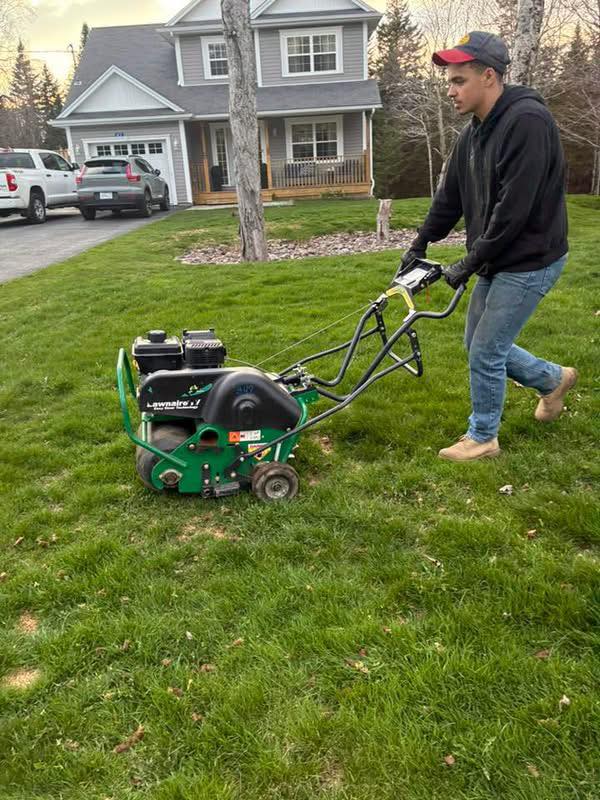
The good news is that aeration works quickly on compacted lawns. I’ve done before-and-after work on properties in Sudbury where a single aeration and overseed in late May produced a visibly thicker, greener lawn by mid-July. The grass was always capable of it. The soil just needed to be opened up.
What I told almost every single homeowner
After 47 visits, I found myself saying the same thing on almost every property — not exactly the same words, but the same idea.
The lawn you have right now is not the lawn you have to keep.
Most of the homeowners I visited had been living with a lawn that underperformed year after year. Some of them had spent money on fertilizer that didn’t seem to do much. Some had reseeded bare patches that came back thin the following season. Some had tried different lawn care companies and gotten similar results from all of them. And most of them had started to quietly assume that this was just what their lawn was — that the property had bad soil, or that the neighbourhood had too much shade, or that the previous owners had done something irreversible.
In almost every case, that wasn’t true. The problems I found — thatch, cutting height, compaction — are all fixable. None of them require ripping the lawn out and starting over. None of them require expensive treatments or specialty products. They require the right sequence of basic work done at the right time, followed by consistent maintenance that actually matches what the grass in this climate needs.
That’s what I try to explain on every quote visit. Not just what the job will cost, but what’s actually going on and why the approach I’m recommending addresses it. If I’m recommending aeration, I want the homeowner to understand why — not just take my word for it. If I’m telling them to raise their cutting height, I want them to understand the reasoning so they can make an informed decision.
A homeowner who understands their lawn makes better decisions about it. That makes my job easier and it means better results for the property over time.
If your lawn has been underperforming — here’s where to start
Based on what I saw across 47 properties this spring, here’s the sequence I’d recommend for most Sudbury lawns that haven’t been getting proper attention:
- Get the thatch assessed first. Part the grass with your fingers down to the soil surface and look at what’s in between. More than half an inch of dense grey-brown material means thatch is a factor.
- Book aeration for late May to mid-June. This is the window in Greater Sudbury. It addresses compaction directly and also helps break down thatch. Follow it with overseeding while the channels are open.
- Raise the cutting height to three inches minimum and hold it there for the full season. Don’t drop it in July because the lawn looks long. Especially don’t drop it during a hot dry stretch.
- Water deeply once a week in July and August rather than lightly every few days. You want moisture at root depth, not just on the surface.
- Fertilize in late May after the soil is warm — not in early April when it still freezes at night. Timing matters more than the product.
If you’re in Greater Sudbury and you want me to come out and take a proper look at your lawn — tell you what’s actually going on, not just give you a number — give me a call. I’ll walk the property with you, show you what I’m seeing, and give you an honest assessment of what it needs and what it’ll take to get there.
📞 705-507-6787 | Get a free quote online
— Ryan Lingenfelter
Owner, Cutting Edge Lawn & Landscaping
Garson, Ontario · 705-507-6787
