
By Ryan Lingenfelter · Cutting Edge Lawn & Landscaping, Garson, Ontario · June 2026
If you’ve typed “landscaping near me” into a search engine recently and you’re in Greater Sudbury, you’ve seen a mix of results — some local companies you’ve heard of, some you haven’t, some Google ads from operators whose physical location may be anywhere. The search result page doesn’t tell you who actually does good work in this region, what their recent projects look like, or whether they’ll be available when you need them.
I’ve been doing landscaping work across Greater Sudbury since 2020. I’ve also talked to a lot of homeowners who’ve had bad landscaping experiences — projects started and not finished, work that failed within a season, quotes that bore no resemblance to the final invoice. Most of those situations were preventable with different evaluation at the start.
Here’s what to look for before you call anyone — the specific things that separate operators who will do good work in this region from ones who won’t.
What “landscaping” actually means in Greater Sudbury — and why scoping matters before calling

The word landscaping covers an enormous range of work, and the companies that do it well in Greater Sudbury have different specialisations. Knowing what scope of work you need before you start calling helps you reach the right type of operator rather than getting quotes from companies whose expertise doesn’t match your project.
Lawn installation and restoration. Sod installation, overseeding, soil preparation, grading for lawn establishment. This is work I do regularly across Greater Sudbury and it requires specific knowledge of local soil conditions, timing, and sourcing — the suppliers who carry quality sod for this climate, the preparation sequence that gives sod the best chance of establishing on Greater Sudbury’s clay-influenced soil. A landscaping company that mostly does hardscaping may not have the same lawn-specific depth, and vice versa. The full guide to what good sod work involves in this region is in the article on buying sod in Sudbury — knowing this before you call helps you evaluate whether a company’s answers match what good practice actually looks like here.
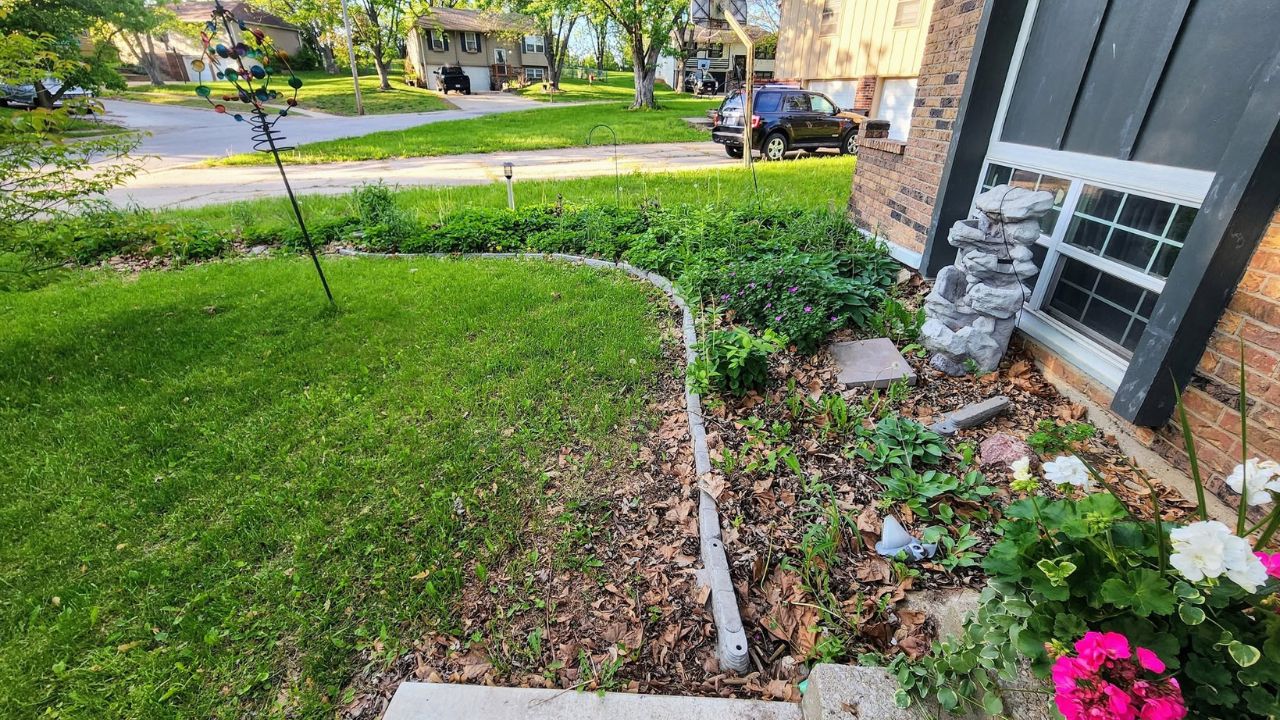
Softscaping — planting, beds, mulch, shrubs. Garden bed installation, planting design, mulch application, hedge installation. This is a different skill set from lawn work, and companies that excel at planting design may not be the same ones best suited for lawn grading and sod work.
Hardscaping — interlock, retaining walls, patios, pathways. This is the highest-skill and highest-risk category of landscaping work. Done correctly, it lasts decades. Done incorrectly — inadequate base preparation, wrong materials for our freeze-thaw conditions, poor drainage design — it fails within one to three winters and costs significantly more to repair than it would have to do correctly the first time. Greater Sudbury’s climate is particularly punishing on poorly executed hardscape, because our freeze-thaw cycle exerts continuous mechanical stress on anything installed in or on the ground.
Property cleanup and seasonal maintenance. Spring and fall cleanup, ongoing bed maintenance, hedge trimming. This is the most accessible category — lower skill threshold, lower consequences for quality variation, easier to replace if a relationship doesn’t work out.
Know which category your project falls into before you start calling. Different categories require different evaluation criteria, and mixing them up — calling a softscaping company about a retaining wall project, or a hardscaping specialist about lawn installation — wastes everyone’s time and often produces quotes that don’t reflect actual expertise in the relevant area.
The portfolio question — what to look at and what to ignore

Almost every landscaping company in Greater Sudbury has a portfolio of some kind — photos of past work on a website, Facebook page, or Instagram profile. How to evaluate a portfolio is not obvious, and the things most homeowners focus on aren’t always the most informative things.
What to look for:
Photos that show the full process, not just the finished result. Before photos, during photos, and after photos tell you significantly more about a company’s work than glamour shots of a completed project. The before-and-after comparison tells you where they started and what they achieved. The during photos tell you something about how they approach preparation — whether base work is visible in patio photos, whether soil preparation is documented in sod installation photos, whether the work in progress looks organised and careful or rushed.
Projects in Greater Sudbury specifically. Landscaping that performs well in Barrie or Kitchener may not perform as well in our climate and our soil. Photos taken in the same region tell you something about the company’s familiarity with local conditions. Ask directly where their most recent projects were located — a company that works primarily in and around Greater Sudbury is applying local experience to your project in a way that a company regularly commuting from further afield may not be.
Multiple projects over multiple seasons. A portfolio with twenty different completed projects over three or four years is more informative than a portfolio with five projects, all completed in the same spring. Quantity over a longer period suggests consistent operation. A portfolio heavy with recent work but thin on earlier history might indicate either a newer company or one that had significant turnover or gaps in their operation.
What to discount:
Glamour photography of single showcase projects. High-quality photos of an exceptional project tell you what the best work looks like — they don’t tell you what a typical project looks like. A company that shows you exclusively their showpiece work without including more typical residential projects is curating heavily. Ask to see projects of similar scope and budget to yours, not just the most impressive things in the portfolio.
Before-and-after comparisons where the “before” was clearly extreme. A project that started as complete neglect and ended in a showcase renovation is impressive. It doesn’t tell you how the company handles a project that started at a reasonable baseline — which is probably closer to your situation.
The site visit — what a serious landscaper does before quoting and what a less serious one skips

For any landscaping project over about $500, a proper quote should follow an in-person site visit — not a phone conversation, not an online form, not a satellite map measurement. What happens during that site visit is one of the most informative indicators of how the company will actually approach the work.
What a serious operator does on a site visit:
Asks about the history of the property before looking at anything. What’s been done to the space previously? What problems have existed? What did the previous attempt at this look like and what happened to it? History informs diagnosis, and diagnosis should precede any recommendation. A company that starts talking solutions before they’ve understood the history of the space is selling rather than assessing.
Checks conditions that aren’t visible from the surface. On a lawn installation or grading project, this means checking soil depth, drainage patterns, and grade — the checklist I described in the article on the one thing I check before accepting any new lawn customer. On a hardscaping project, it means checking drainage in the area where the base will be installed — a patio base installed over poor drainage without correction will heave within one to two winters in Greater Sudbury’s freeze-thaw conditions. On a planting project, it means checking soil pH and condition before recommending plants — putting the wrong plants into the wrong soil produces the same result as putting the right plants in at the wrong time.
Takes notes and produces a scope document. A site visit that ends with “I’ll send you a quote” and nothing else is a visit where the operator didn’t engage deeply enough to take notes. A site visit that produces notes, a sketch, or a list of what they found and what they’d propose — even informally — is one where actual assessment happened.
Red flags in a site visit:
Arriving late without communication. This is a behaviour pattern that tends to recur throughout a project if it shows up before work starts.
Measuring and leaving without meaningful conversation. A site visit that’s primarily about square footage measurement rather than property understanding produces a quote without the context to interpret it accurately.
Making recommendations before completing the assessment. “You definitely need X” before they’ve looked at the relevant conditions is a sales statement, not a professional judgment.
The quote itself — what it should contain and the gaps that tell you something

A written landscaping quote for any project over $1,000 should contain specific information that lets you evaluate what you’re actually buying — not just a total price. Here’s what should be in a serious quote and what the absence of each element tells you.
Itemised scope of work, not just a total. What specifically will be done, in what sequence, and what materials will be used. “Patio installation — $4,500” tells you almost nothing about what’s included. “Excavation to X depth, compacted granular base to provincial standards, interlock pavers of [specific product and colour], polymeric sand fill, edge restraint — $4,500” tells you what you’re actually buying and gives you something to compare across quotes. A quote without itemised scope either contains things you can’t evaluate or excludes things you’d assume are included — and you won’t know which until the invoice doesn’t match your expectations.
Materials specified by product, not just category. “Mulch” can mean anything from quality cedar to recycled wood chips of unknown origin. “Topsoil” can mean screened topsoil from a quality local supplier or what was skimmed off a construction site. If materials are specified vaguely, ask for specifics before accepting the quote. The difference in quality and longevity between comparable-seeming materials in landscaping can be substantial.
Timeline and payment schedule. When will work start, how long will it take, and when are payments due? A quote without timeline information is a quote where the contractor hasn’t committed to scheduling. Full upfront payment before work begins is a red flag — a standard arrangement is a deposit at contract signing, progress payments tied to milestones, and final payment on completion.
What happens if something unexpected is found. Good quotes include a clause about how the contractor will handle discoveries mid-project — unexpected drainage problems, buried debris, soil conditions that differ from what was visible at the site visit. A quote that has no language about this is a quote where the homeowner has no framework for managing change orders, which is how unexpected costs become disputes.
Insurance confirmation. I covered this specifically in the article on my lawn care insurance bill doubled this year and what it means for customers — the same principle applies to landscaping projects and applies more urgently because the scale of potential liability on a larger project is greater than on a routine cutting visit. Any landscaping project that involves equipment, excavation, or hardscape installation should be covered by the contractor’s commercial general liability insurance, and you should ask for the certificate before signing.
Comparing quotes across these dimensions — scope, materials, timeline, change order process, insurance — gives you a much more complete picture than comparing totals. Two quotes with the same total price may be extremely different in what they’re actually offering, and two quotes with meaningfully different totals may be more similar in actual value than the numbers suggest once you’ve understood what each one includes.
If you’re looking for landscaping work in Greater Sudbury and want a quote that includes all of the above — written scope, specified materials, clear timeline, insurance confirmation — give me a call. I’ll come look at the property and tell you honestly what I see before telling you what it’ll cost.
📞 705-507-6787 | Get a free quote online
— Ryan Lingenfelter
Owner, Cutting Edge Lawn & Landscaping
Garson, Ontario · 705-507-6787
