
By Ryan Lingenfelter · Cutting Edge Lawn & Landscaping, Garson, Ontario · May 2026
I got a call in late August from a homeowner in Greater Sudbury. He was frustrated — and I understood why. His lawn had looked genuinely good in May. Thick, green, even. He’d been proud of it. He’d done everything he thought he was supposed to do. And by the third week of August it was brown in patches, thin everywhere else, and had two sections that weren’t coming back no matter how much he watered.
He wanted to know what happened.
When I walked the property, I could see it clearly. The lawn hadn’t failed suddenly. It had been set up to fail from early spring — by a combination of three things that are easy to miss because none of them look like problems when the weather is cool and the grass is growing strong. It’s only when the heat comes and the stress builds that the cracks show. By then it’s usually too late for that season.
This is the full story of that lawn — what went wrong, why it went wrong, and what you can do to make sure it doesn’t happen to yours.
What the lawn looked like when I first saw it in May

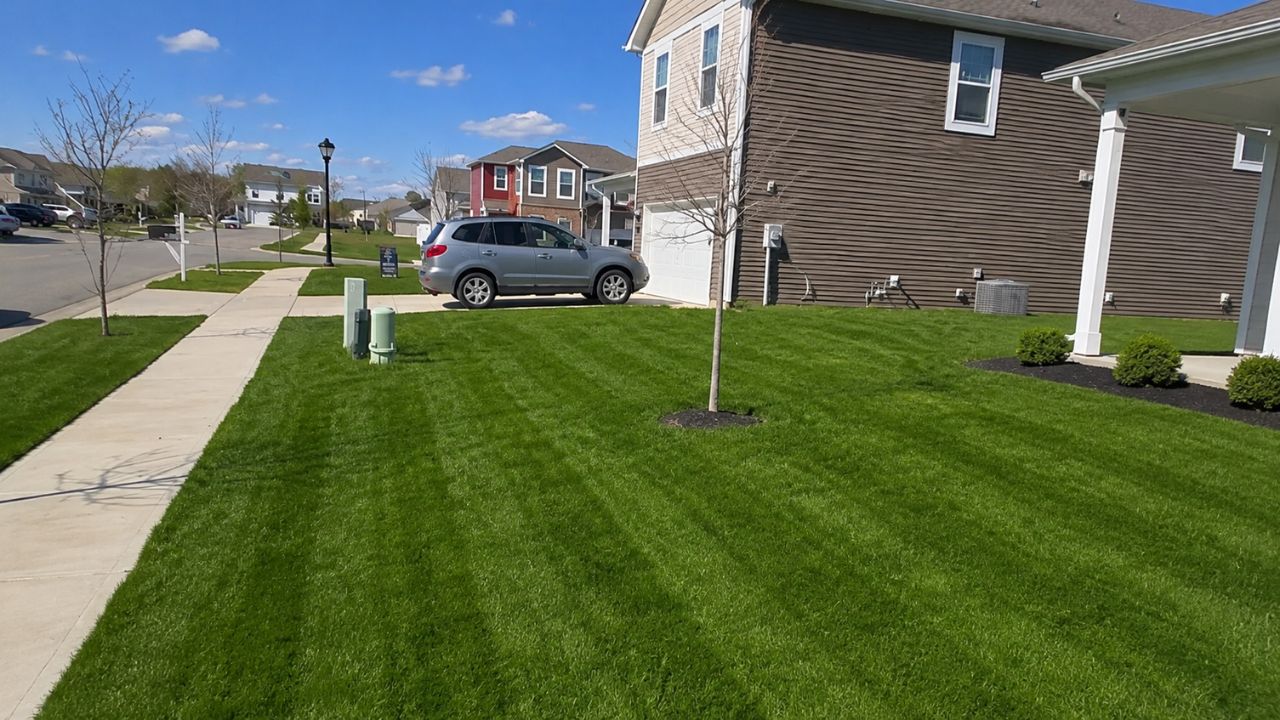
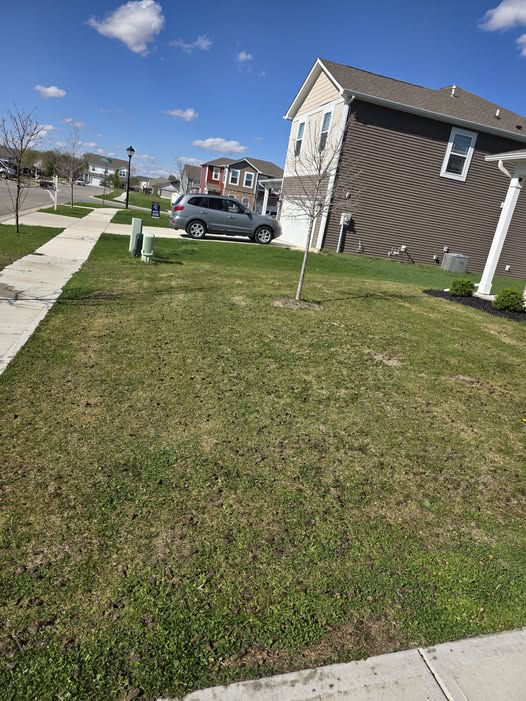
The homeowner sent me photos from May when he called in August. Looking at them, I could see why he’d felt good about the lawn. It was green, reasonably dense, and evenly coloured across most of the yard. The edges were clean. There were no obvious bare patches or weed pressure. On the surface, it looked like a lawn that was in good shape heading into summer.
But May in Greater Sudbury is forgiving. The temperatures are mild, the nights are still cool, the soil holds moisture well after snowmelt, and grass grows aggressively in those conditions almost regardless of what’s happening underneath. A lawn with serious underlying problems can look fine — even good — in May because the conditions are doing most of the work for it. The grass doesn’t need deep roots or loose soil or good drainage when the weather is cool and rain is regular. It only needs those things when the heat arrives and the stress begins.
What the May photos didn’t show me — but what I could see clearly when I walked the property in August — was what was going on below the surface. And that’s where the whole story was.
The three things that were quietly wrong from the start
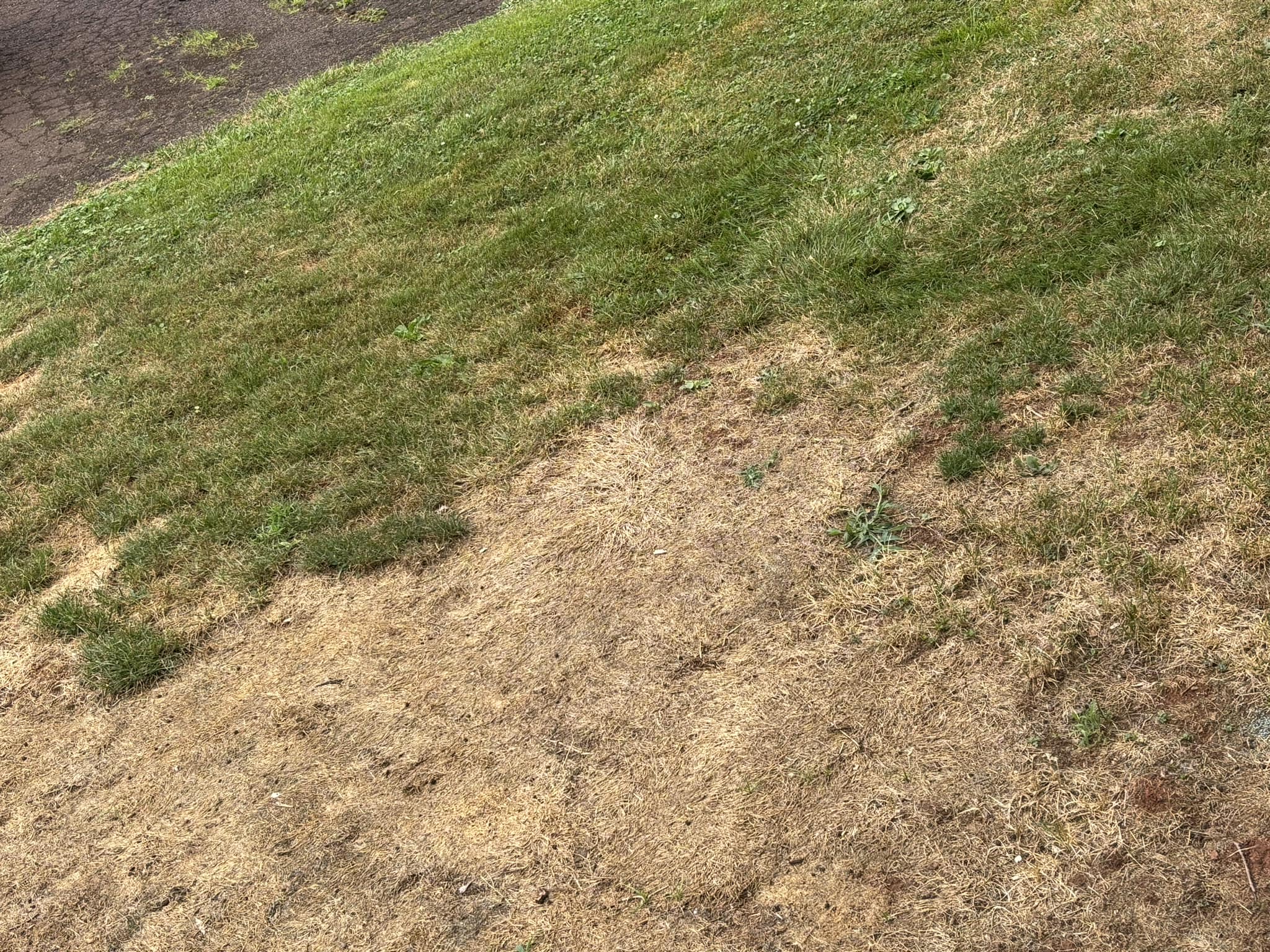
When I got on my knees and looked at that lawn properly in August, three problems were visible that had almost certainly been present since spring.
First: the thatch layer was over an inch thick. I parted the grass and measured it — a dense, matted layer of dead organic material sitting between the soil and the living grass above it. Thatch at that depth acts like a sponge that never fully drains. In spring it holds moisture and the grass grows into it happily. In July when the heat hits, that same layer dries out fast and becomes almost hydrophobic — water hits it and runs off the surface instead of soaking through to the root zone. The grass above it essentially gets cut off from its water supply even when the homeowner is watering regularly. He told me he’d been running his sprinkler every other day in July. Most of that water never reached the roots.
Second: the roots were shallow. I pulled a small plug of turf from one of the dead sections and held it up. The root system was maybe an inch and a half deep — two inches at most. Healthy grass in Sudbury should have roots pushing four to six inches into the soil. Shallow roots are almost always a compaction problem. The soil underneath that lawn was dense enough that the roots couldn’t penetrate it, so they spread horizontally near the surface instead of going deep. Shallow roots mean the grass can only access moisture in the top inch or two of soil. When the surface dries out in August heat, there’s nothing left to draw from.
Third: the cutting height had been too low all season. The homeowner told me his neighbour cut the lawn for him a few times when he was travelling and had been keeping it at about two inches. Two inches is too short for Sudbury in summer. At that height the grass can’t shade its own root zone, the soil heats up faster, moisture evaporates faster, and the plant is under constant stress trying to regrow the blade it needs to photosynthesize. Combine a short cutting height with shallow roots and a thick thatch layer and you have a lawn that is one hot week away from serious damage all season long.
None of these three things were catastrophic on their own in May. Together, in August, they were.
What happened in July that pushed it over the edge
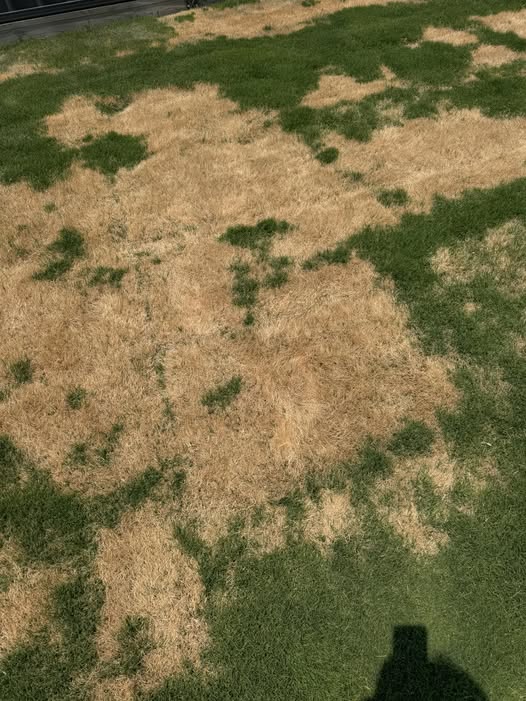
Greater Sudbury had a stretch in mid-July last year — about eleven days — where the temperature sat above 30 degrees Celsius and there was almost no rain. That kind of stretch happens most summers here. It’s not unusual. A lawn in good condition handles it. A lawn with the three underlying problems I described handles it very badly.
Here’s what that eleven-day stretch did to this particular lawn:
The thatch layer dried out completely within the first three days. Once it was dry, it repelled water. The homeowner increased his watering frequency — going from every other day to daily — but the water was running off the surface and down the driveway instead of reaching the roots. He thought he was watering. The grass was dying of drought six inches from where the sprinkler was hitting.
The shallow roots had no reservoir to draw from. Grass with deep roots can access moisture that stays in the lower soil layers even during hot dry stretches. This lawn had no access to that. By day five of the heat stretch the grass in the sunniest parts of the yard was already showing stress — that blue-grey tint that means the plant is losing more water than it’s taking in. By day eight it had started to go dormant in the worst sections. By day eleven two areas had gone past dormancy into actual dieback — the crowns of the grass plants had cooked and the grass was not coming back from those spots on its own.
The low cutting height accelerated all of it. Short grass in that heat had almost no ability to protect itself. It was already stressed from being kept too short all season. The heat was the final load on a structure that had been weakened for months.
When the rain came back in late July the rest of the lawn recovered slowly. The two dead sections did not. By August those patches were bare soil with some dried thatch on top, and whatever was growing back was weeds taking advantage of the open ground.
How to make sure this doesn’t happen to your lawn
The good news about everything I’ve described is that all three of the underlying problems are preventable — and fixable if you catch them before the heat arrives. Here’s exactly what I’d do on a lawn like this one, and what I’d recommend to any Sudbury homeowner who wants their lawn to hold up through July and August:
Deal with the thatch before summer. If your thatch layer is over half an inch — check by parting the grass and looking at the material between the soil and the base of the living blades — it needs to be addressed. Core aeration in late May breaks up light thatch and introduces soil microbes that decompose it naturally. Thatch over an inch thick may need power dethatching first. Either way, get it done before the heat comes. A lawn with a managed thatch layer handles summer drought completely differently than one where the thatch has been building for years.
Aerate every year in late May to mid-June. This is the direct fix for compaction, and compaction is what causes shallow roots. When you aerate, you pull cores of soil out of the ground and create channels that roots can grow into. A single properly timed aeration followed by overseeding can add two to three inches of root depth over a single growing season. That extra root depth is what allows the lawn to access deep soil moisture during the dry stretches that hit every July in Greater Sudbury.
Never cut below three inches from June through August. I tell every client this and I mean it. Three inches minimum through the heat of summer. The blade length shades the root zone, slows moisture evaporation from the soil surface, and keeps the plant in a healthier metabolic state so it can handle stress. If someone else is cutting your lawn while you’re away — a neighbour, a family member, anyone — tell them the height before you leave. This is the single easiest thing you can do to protect your lawn in summer and it costs nothing.
Water deeply once a week, not lightly every day. When you water lightly and frequently you keep the top inch of soil moist, which encourages the roots to stay shallow because that’s where the water is. When you water deeply once a week — long enough that moisture reaches four to six inches down — you train the roots to go deep where the consistent moisture is. Deep-rooted grass survives hot dry stretches that kill shallow-rooted grass. The goal is not to keep the surface wet. The goal is to get water to where the roots need to be.
Watch for the early warning signs in July. When grass starts showing that blue-grey tint instead of its normal green, it’s telling you it’s running low on water. When you walk across it and the blades don’t spring back up, it’s under heat stress. These are not emergencies if you catch them early — a deep watering at that stage usually pulls the lawn back. If you ignore them for a week and the colour goes from blue-grey to yellow-brown, you’re closer to the line where some of that grass won’t recover.
The homeowner I described at the start of this article had a good lawn in May. He genuinely did. It just had problems underneath it that May conditions hid completely. The same problems are sitting underneath a lot of lawns in Greater Sudbury right now — and the summer stretch that reveals them is coming every year whether the lawn is ready or not.
If you want to make sure your lawn is actually ready — not just looking good in the cool weather — give me a call. I’ll walk the property, check the thatch, assess the compaction, and tell you exactly what it needs before July gets here.
📞 705-507-6787 | Get a free quote online
— Ryan Lingenfelter
Owner, Cutting Edge Lawn & Landscaping
Garson, Ontario · 705-507-6787
