

I want to tell you about a job in Lively that, halfway through, had the homeowner texting me photos asking what the hell was going on.
The lawn looked destroyed. Raked-up bare patches everywhere. Soil exposed. The nice-looking green parts they’d had before — gone. And from where they were standing, it looked like we’d made everything worse.
They weren’t wrong about what it looked like. They were wrong about what it meant.
I’m Ryan Lingenfelter. I run Cutting Edge Lawn & Landscaping out of Garson, Ontario. I’ve been doing lawn care across Greater Sudbury since 2020, and this case study is one I keep coming back to — because it’s the clearest example I’ve seen of why understanding the process matters as much as trusting the person doing the work.
What the Lawn Looked Like When I First Showed Up
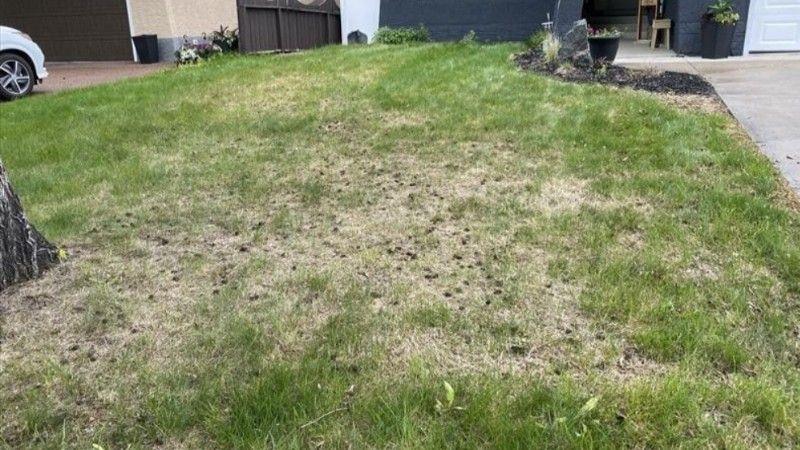
The property was a mid-sized residential lot — standard Lively neighbourhood, detached home, front and back lawn. The homeowner had lived there for a few years and maintained it themselves — mowing, occasional watering. On the surface it looked fine. Green in most spots. No obvious disasters.
But when I walked it, the real story came through fast.
The soil was compacted hard. I pushed a screwdriver into it and it barely went in two inches before hitting resistance. There was a thick thatch layer — probably half an inch or more — sitting between the grass blades and the soil. The root system underneath was shallow and weak because water and nutrients couldn’t get through all that built-up material. In the shadier corner near the fence, moss had moved in and taken over a solid section of turf.
The green they were seeing? A lot of it was surviving on the surface, not actually thriving. It looked okay from the road. It wasn’t okay.
I’ve seen this pattern on dozens of Sudbury-area lawns. What looks like healthy turf is often moss filling in where grass has already failed — and until you get down and actually assess the soil, you don’t know how bad the foundation is.
What We Actually Did — And in What Order

Before I touched anything, I explained the full plan to the homeowner. I want clients to know what’s coming — because the process of fixing a neglected lawn always looks bad before it looks good, and I’d rather have that conversation upfront than answer panicked texts halfway through.
Here’s what we did, in order:
Step 1: Full property cleanup and dethatch. We raked out the thatch layer across the entire lawn. This was the step that caused the most visual shock. Thatch that’s been building up for years comes out in thick mats. When we were done, there were sections of lawn that looked almost bare — because the “green” that had been there was sitting on top of dead material, not growing out of healthy soil.
Step 2: Moss removal. The shaded corner near the fence had a heavy moss mat. We pulled it out completely. What was underneath was dark, compacted, slightly acidic soil — exactly the conditions moss loves and grass hates. Removing the moss without fixing those conditions would just mean moss comes back. We noted that area for a lime application later.
Step 3: Core aeration. Once the surface was cleared, we ran the aerator across the entire lawn. Core aeration pulls plugs of compacted soil out of the ground, opening up channels for water, air, and nutrients to reach the root zone. On a lawn this compacted, this was the single most important step. The soil plugs get left on the surface and break down on their own — they look messy for a week or two, but they act as a light top dressing as they decompose.
Step 4: Overseeding. With the thatch gone, the soil broken up, and the channels open from aeration, we overseeded the entire lawn — heavier coverage in the bare and thin areas. Seed dropped directly into aeration holes has dramatically better germination rates than seed scattered on a compacted surface. The shaded corner got a shade-tolerant mix. The rest got a standard cool-season blend suited to Sudbury’s climate.
Step 5: Lime application in the moss zone. To shift the soil pH in that corner back toward conditions where grass can compete, we applied lime. This isn’t a one-time fix — pH correction takes time — but it starts moving things in the right direction.
The Text That Came In Three Days Later

“Ryan — I don’t want to be that client but this looks really bad. Did something go wrong?”
I get some version of this on almost every full restoration job I do. And I get it — you hire someone to fix your lawn, you expect it to start looking better, not worse. When you’re standing at your kitchen window looking at what appears to be a destroyed yard, it’s hard to connect that image to “this is working.”
I called them back and walked through exactly what they were seeing:
The bare patches were bare because we’d pulled out dead thatch that was masking poor turf underneath. That material was never coming back. Leaving it in place would have kept the lawn looking green on the surface while the actual grass underneath continued to struggle.
The aeration plugs scattered across the lawn looked like a mess but were breaking down and adding organic matter back to the surface.
The overseeded areas needed seven to fourteen days to germinate — and they needed consistent moisture to do it. Nothing visible yet didn’t mean nothing was happening.
By the end of the call they were settled. Sometimes people just need someone to explain what they’re looking at.
What It Looked Like Six Weeks Later

Six weeks after we finished, I drove by to take a look. The homeowner had followed the aftercare instructions — watering consistently, staying off the new seed while it established, holding off on the first mow until the new grass was at the right height.
The lawn was thick and green across the entire front. The previously bare patches had filled in. The shaded corner near the fence — the one that had been solid moss — had new grass growing through it. Not fully dense yet, that corner will take another season of attention, but the moss was gone and grass was establishing in its place.
The aeration plugs had broken down completely. The surface was smooth. The soil underneath, when I pressed my finger into it, gave way — no longer the brick-hard compaction we’d started with.
From the road, it looked like a completely different property. Because it was.
What This Job Actually Teaches You About Lawn Restoration
There are a few things I want you to take from this, whether you’re planning to hire someone or do the work yourself:
Green on the surface doesn’t mean healthy underneath. Thatch, moss, and shallow roots can make a lawn look fine from a distance while the foundation is quietly failing. The only way to know what you’re actually dealing with is to get down and look at the soil.
Real restoration looks worse before it looks better. Removing thatch, pulling moss, aerating — all of it exposes what was hiding. That’s the point. You can’t fix what you can’t see, and you can’t build a healthy lawn on a dead foundation.
Timing and aftercare matter as much as the work itself. The best aeration and overseeding job in the world fails if you don’t water the new seed consistently for the first two weeks. Understanding what your lawn has been through — whether it’s winter damage, compaction, or years of neglect — helps you understand what it needs going forward, not just right now.
The shaded, mossy corner is always the hardest part. It always takes longer, it always needs more attention, and it usually needs a different approach than the rest of the lawn. pH correction, shade-tolerant seed, and patience. There’s no shortcut for that corner.
Thinking About a Full Lawn Restoration in Sudbury?
If your lawn looks like the before photos on this job — or even if it just looks okay on the surface but you know something’s off underneath — reach out. I’ll come out and give you an honest assessment of what’s going on and what it’ll actually take to fix it.
I’m not going to sell you a full restoration if you don’t need one. But if you do need one, I’m going to tell you that straight — and I’m going to tell you upfront that it might look rough halfway through, and exactly why that’s a good sign.
I service all of Greater Sudbury — Lively, Garson, Val Caron, Hanmer, Chelmsford, Azilda, Capreol and more. Call or text me directly, or request a free quote through the website.
— Ryan Lingenfelter
Owner, Cutting Edge Lawn & Landscaping
Garson, Ontario | 705-507-6787
