
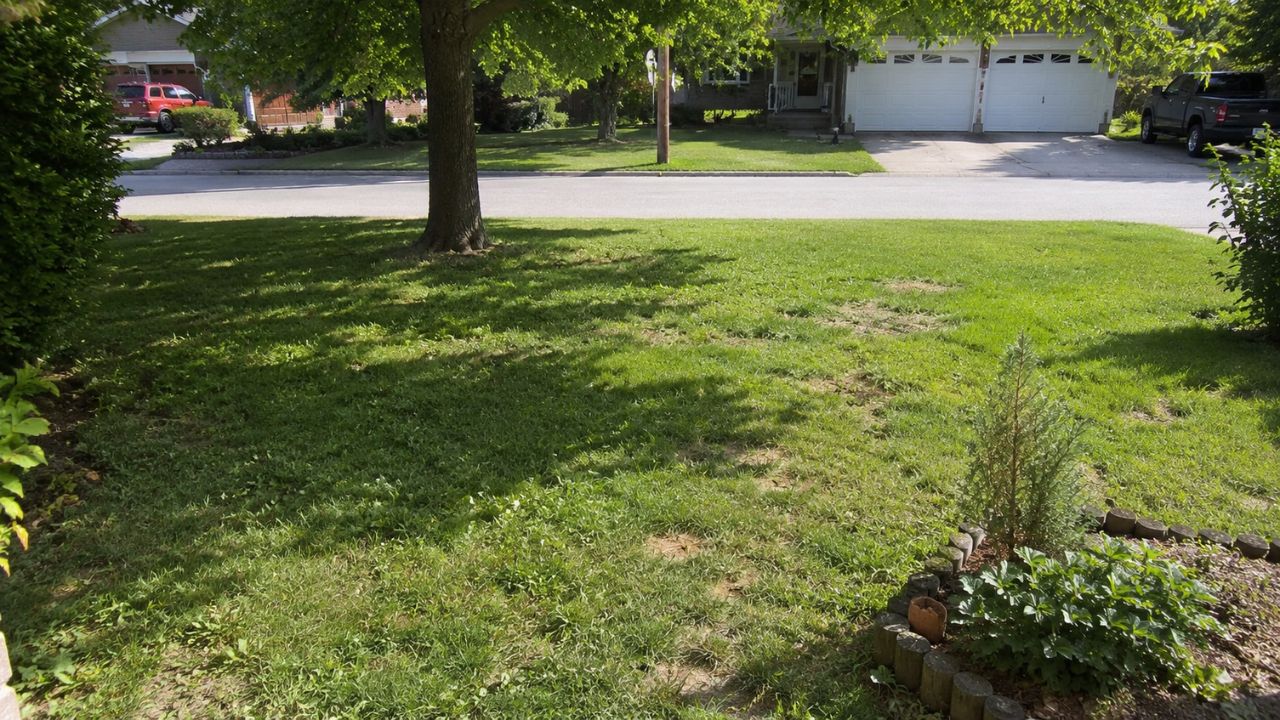
A few weeks ago I got a call from a homeowner in Lively. He’d been away most of the summer — work contract out of town, came back in late August — and he wanted me to come out and take a look at his lawn before he decided what to do with it.
I pulled up and sat in the truck for a second before I got out. The grass was eight inches tall in some spots, completely bare in others. There was a thick line of creeping Charlie running along the entire fence line. The low spot near the back corner had gone to moss. The edges along the driveway hadn’t been cut since May and the grass had flopped over onto the concrete.
He came out to meet me and the first thing he said was: “I know. I know. Just tell me how bad it is.”
That’s the conversation I want to have with you in this post. Not to scare anyone — but because I think a lot of homeowners genuinely don’t know what one ignored summer does to a lawn in our climate. And knowing what happens, in what order, and why — that’s what helps you make a smart decision about what to do next.
So here’s exactly what happens to a Greater Sudbury lawn when nobody is paying attention from May to August.
The First Thing That Goes Wrong — Usually by Mid-June

Most homeowners think the first problem with an ignored lawn is that it gets long. That’s true — but the length itself isn’t the real damage. The real damage is what happens inside the grass plant when it’s allowed to grow unchecked for weeks.
When grass grows tall without being cut, it puts all its energy into vertical growth — reaching for light, producing seed heads, trying to complete its reproductive cycle. Root development slows down. The plant is doing one thing: getting taller. And when grass is focused on going up instead of going deep, the root system stalls.
By mid-June on an ignored Sudbury lawn, you’ve already got shallow-rooted grass that’s going to struggle with summer heat. The plants look tall and green from the street — but they’re actually weaker than a properly maintained lawn at half the height.
The second thing that happens by mid-June is weed establishment. Dandelions that weren’t spot-treated in May have gone to seed and spread. Creeping Charlie and clover — which move fast in open, low-competition conditions — have started pushing into the thin spots. Every day the lawn goes uncut, weed pressure increases. Weeds are opportunists. An ignored lawn is exactly the environment they’re built for.
I was on a property in Val Caron last September where the homeowner had been away all summer. The front lawn was 60% dandelion by the time I got there. Not because dandelions appeared from nowhere — they’d been there in small numbers in spring. Three months without any control and they’d taken over. That’s how fast it moves in our growing season.
What this means practically: six weeks of no attention in early summer creates a weed problem that takes a full season to correct. It’s not a one-visit fix. Consistent early control — even just mowing regularly — is what keeps weeds from establishing to that level.
What Summer Heat Does to a Lawn That’s Already Behind
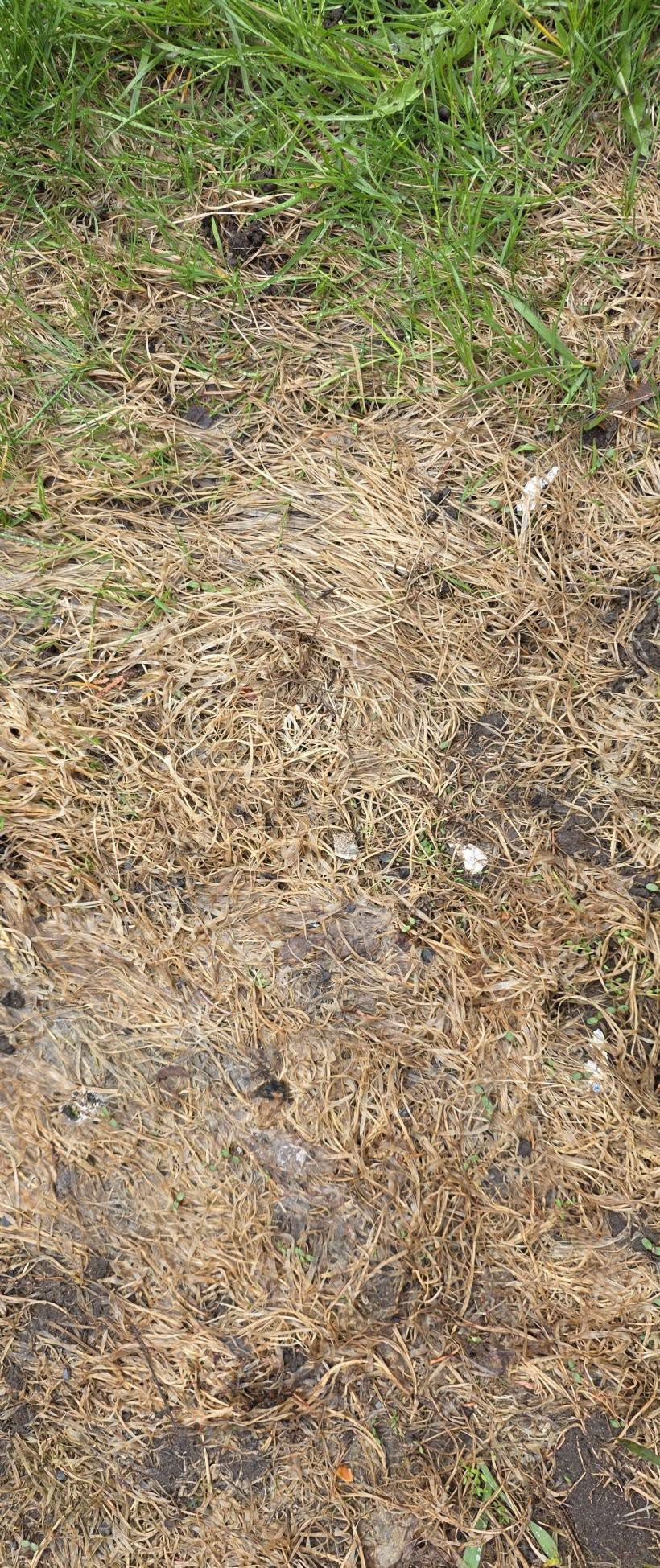
July in Sudbury isn’t Southern Ontario hot — but we get our stretches of 28 to 32 degree days, and those stretches hit an ignored lawn very differently than a maintained one.
Here’s what’s happening by July on a lawn that hasn’t been touched since May. The grass is tall and has shallow roots. The soil underneath — Sudbury clay — has been compacting through June rain events without any aeration to counteract it. The thatch layer, which builds up when clippings aren’t managed, has thickened and is now blocking moisture from penetrating properly.
When the first real heat stretch hits, that lawn has almost no defenses. Shallow roots can’t reach moisture below the surface. The thickened thatch layer acts as a barrier — water either runs off or evaporates from the thatch before reaching the soil. The grass goes into heat stress fast, and without any maintenance to help it recover, it stays in stress.
What you see on the surface is brown patches. The homeowner comes home, sees brown patches, and assumes the grass died. Sometimes it has — sometimes it’s dormancy, which is the grass protecting itself by going brown and waiting for better conditions. The problem is that without intervention, dormant grass in a compacted, thatch-heavy lawn often doesn’t recover properly even when conditions improve.
The Lively homeowner I mentioned at the start had about a third of his backyard in this state — brown, dormant-looking patches that had been in stress since early July. Some of it came back after we treated it. Some of it didn’t. The patches that were gone for good were the ones where the soil underneath had compacted to the point where roots had completely given up.
If you know you’re going to be away for a stretch of summer, the single most protective thing you can do beforehand is a core aeration in late May. Aerated soil handles summer stress dramatically better than compacted soil — the channels stay open, water gets through, roots go deeper before the heat arrives. It’s cheap insurance against exactly this kind of damage.
What the Lawn Looks Like by Late August — The Full Picture

By late August on a fully ignored Sudbury lawn, you’re usually looking at a combination of problems layered on top of each other. This is what I typically find when I walk a property that’s been unattended all summer.
Extreme thatch buildup. Three to four months of unmanaged clippings and dead material have built a thatch layer that in some spots is two inches thick. That layer is now a barrier to everything — water, fertilizer, new seed, air. Nothing gets through it effectively.
Severe compaction. Summer rain events on unmanaged clay soil, with no aeration to counteract it, have pressed the ground hard. In the low spots where water pooled regularly, the soil is almost concrete-firm. I’ve pushed a screwdriver into late-August neglected lawns in Hanmer and had it stop at a quarter inch.
Weed dominance in thin areas. Any area where the grass thinned out in summer — heat stress patches, shaded spots, areas near tree roots — has been colonized by whatever weed had seeds in the area. Creeping Charlie, clover, crabgrass along the edges, moss in the shaded corners. These aren’t superficial. They’ve had all summer to root in.
Dead and dormant zones. Some areas have grass that’s dormant and will recover with intervention. Some areas have grass that’s genuinely dead — root system gone, nothing to come back from. Telling the difference requires getting down and looking at the crown of the plant. If there’s still some green at the base where the blade meets the soil, it’s dormant. If it’s brown all the way to the ground and pulls out easily with no resistance, it’s dead.
Scalping risk. Eight-inch grass cannot be cut back to three inches in one pass without causing severe scalping damage. You have to come down gradually — cut off a third, wait a few days, cut again. Most homeowners don’t know this and take it all off in one pass, which shocks the already-stressed plants and kills sections that might have recovered otherwise.
This is exactly why I always do a full property walk before touching anything on a neglected lawn — the same process I described in detail in what I do when I pull up to a new property. You need to understand the full picture before you start, because the wrong first move on a stressed lawn makes recovery harder.
What Recovery Actually Costs — and What’s Realistic

This is the part where I try to be as honest as I can, because I think people deserve a straight answer rather than a vague “it depends.”
For a typical Greater Sudbury property that’s been ignored for one full summer, here’s what recovery realistically looks like — and what it costs in 2026.
If the damage is moderate — thatch buildup, some weeds, some thin areas, but no large dead zones — recovery is very achievable in one season with the right program. What that typically involves:
- Gradual height reduction over two to three cuts — $120 to $180 total
- Power dethatching to remove the thatch layer — $180 to $280
- Core aeration to break up compaction — $150 to $220
- Overseeding into the thin areas — $180 to $320 depending on coverage needed
- Starter fertilizer application — $75 to $110
- Weed control for established weeds — $90 to $150
Total for moderate recovery: roughly $800 to $1,200 in materials and labour, done properly in late August to mid-September. That’s the window — fall is actually the best time to do recovery work in Sudbury because soil is warm, heat stress is over, and new seed has time to establish before frost.
If the damage is severe — large dead zones, heavy weed dominance across most of the lawn, soil compacted to the point of no grass coverage — you’re looking at a conversation about whether targeted overseeding and recovery is realistic, or whether a partial or full sod installation makes more sense for the worst areas. Sod gives you an instant result with no germination risk, and for dead zones larger than a few hundred square feet, it’s often the more cost-effective path when you factor in the multiple seasons of recovery work the alternative requires.
For the Lively homeowner, we landed somewhere in the middle. The front lawn recovered well with aeration, overseeding, and a weed control visit. The back — which had the worst compaction and the large dead zone near the low spot — got a partial sod installation on the dead section and overseeding on everything else. By mid-October it looked like a completely different yard.
If you want to understand what a full lawn recovery project costs in detail, I walked through a real Sudbury project breakdown — numbers and all — on the lawn care cost breakdown page.
The honest takeaway: one ignored summer is recoverable. It costs real money and takes real effort, but a Sudbury lawn that’s been neglected for one season can almost always be brought back within one to two seasons with the right approach. Two or three ignored summers is a different conversation — at that point you’re often looking at a full renovation rather than a recovery.
If You’re Looking at Your Lawn Right Now and Recognizing It
I’m not writing this to make anyone feel bad about a summer that got away from them. Life happens. People travel, work gets busy, things come up. I’ve seen it on properties all across Greater Sudbury — Capreol, Lively, Hanmer, Val Caron, Chelmsford — and it’s more common than most people think.
What matters now is what you do next. And the best time to start recovery work on a Sudbury lawn that’s had a rough summer is right now — late summer and early fall, before the window closes.
If you want me to come out, walk the property, and give you a straight read on what you’re actually dealing with and what it’ll take to fix it — give me a call. No obligation, no pressure. Just an honest assessment from someone who does this every day.
📞 Call or text: 705-507-6787
Or get a free quote online at cuttingedgelawn.ca
We serve Lively, Garson, Val Caron, Hanmer, Capreol, Cheney Manor, Chelmsford, Azilda, and all of Greater Sudbury.
— Ryan Lingenfelter
Owner, Cutting Edge Lawn & Landscaping
Garson, Ontario
Related Articles
- The First Thing I Do When I Pull Up to a New Property in Sudbury
- Core Aeration Services in Greater Sudbury
- Sod Installation in Sudbury — What the Day Actually Looks Like
- What I Wish I Had Told My Very First Sudbury Customer
- When to Overseed Your Lawn in Sudbury — The Exact Window
