
By Ryan Lingenfelter · Cutting Edge Lawn & Landscaping, Garson, Ontario · June 2026
I’ve assessed a lot of struggling lawns across Greater Sudbury over six seasons. Thatch problems, compaction, drainage failures, wrong cutting height — I’ve documented most of the common causes in detail across this site, and the patterns repeat often enough that I usually have a working hypothesis within the first sixty seconds on a property.
This season I walked onto a property that broke that pattern. It was, without question, the worst-condition residential lawn I’ve assessed across all six seasons of working in this region. And the cause — once I finally identified it — was not what I expected when I first arrived, not what the homeowner expected, and not something I’d specifically encountered before in quite this combination.
I want to walk through this one in detail, because the diagnostic process itself is instructive — including the part where my first hypothesis was wrong.
What the property looked like when I arrived
The call came from a homeowner who had purchased the property the previous fall — an older home in an established Greater Sudbury neighbourhood that had been a rental property for several years before the sale. He’d seen the lawn under snow cover during the winter viewings and hadn’t been able to assess its condition before purchasing. By the time spring arrived and the snow cleared, what he found was, in his words, “not a lawn — a problem.”
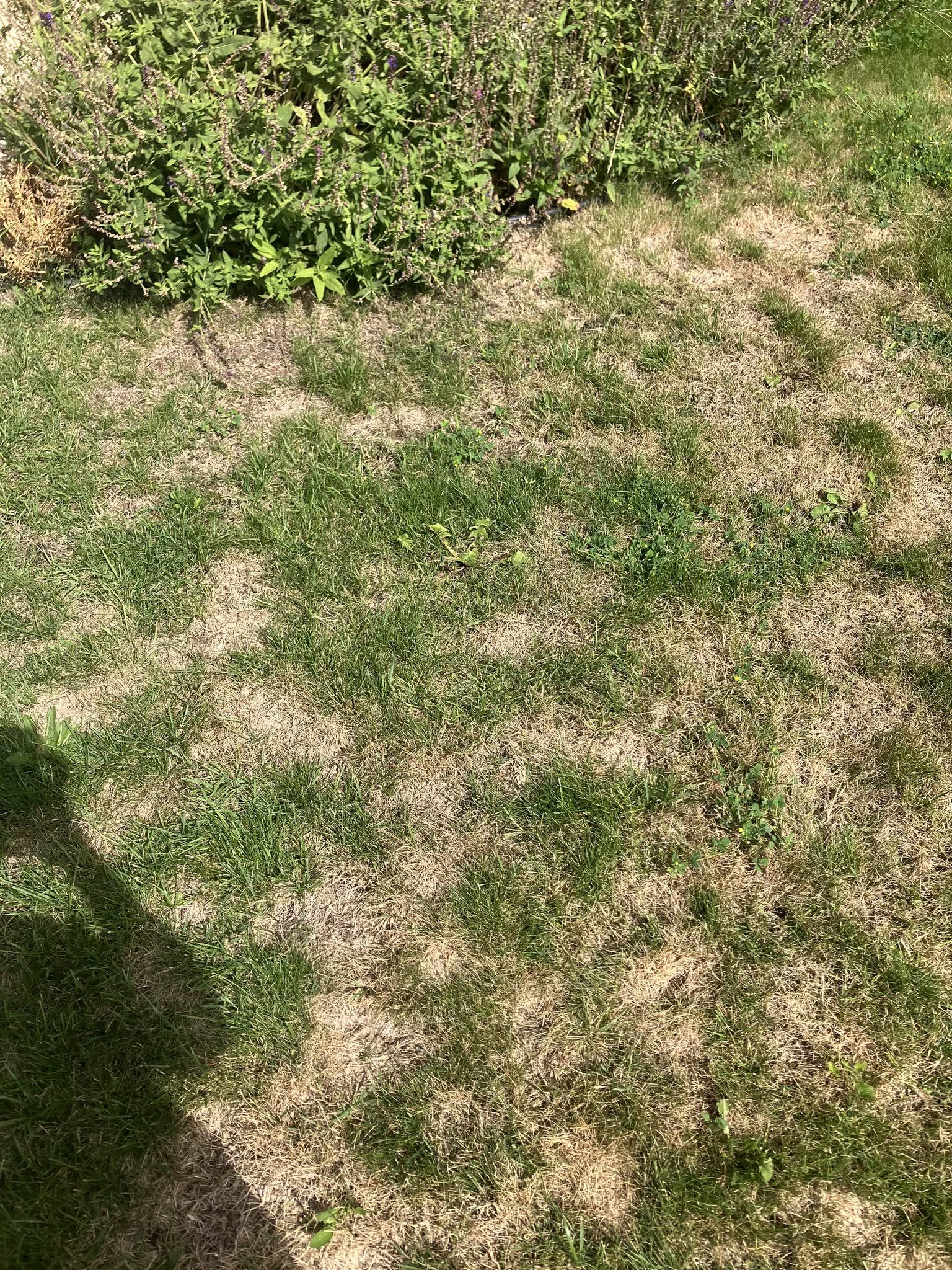
When I arrived, the description was accurate. Roughly sixty percent of the total lawn area was completely bare soil — not thin, not struggling, bare. Of the remaining forty percent with any vegetation, perhaps half of that was actual grass and the other half was a mix of broadleaf weeds and what appeared to be volunteer growth from whatever seeds had found their way into the bare patches. The grass that was present was uneven in height, suggesting it hadn’t been cut on any consistent schedule for at least one full previous season, possibly longer.
There were areas where the soil surface itself looked unusual — slightly discoloured in patches, with a texture that didn’t match typical Greater Sudbury topsoil even accounting for the bare condition. Several spots had a faint sheen when wet that I don’t normally see on residential lawns. The overall scale of the problem — the sheer percentage of bare ground on an established residential lot — was beyond anything else I’d assessed this season or in previous seasons.
My initial reaction, walking the property, was that I was looking at the cumulative result of years of complete neglect combined with whatever a rental property tenant turnover does to a lawn — minimal care, no aeration, no overseeding, possibly pet damage from multiple tenants’ animals over several years. That was a reasonable hypothesis given what I was seeing. It also turned out to be incomplete in a way that mattered enormously for how to actually fix the problem.
What I assumed was causing it — and why I was wrong
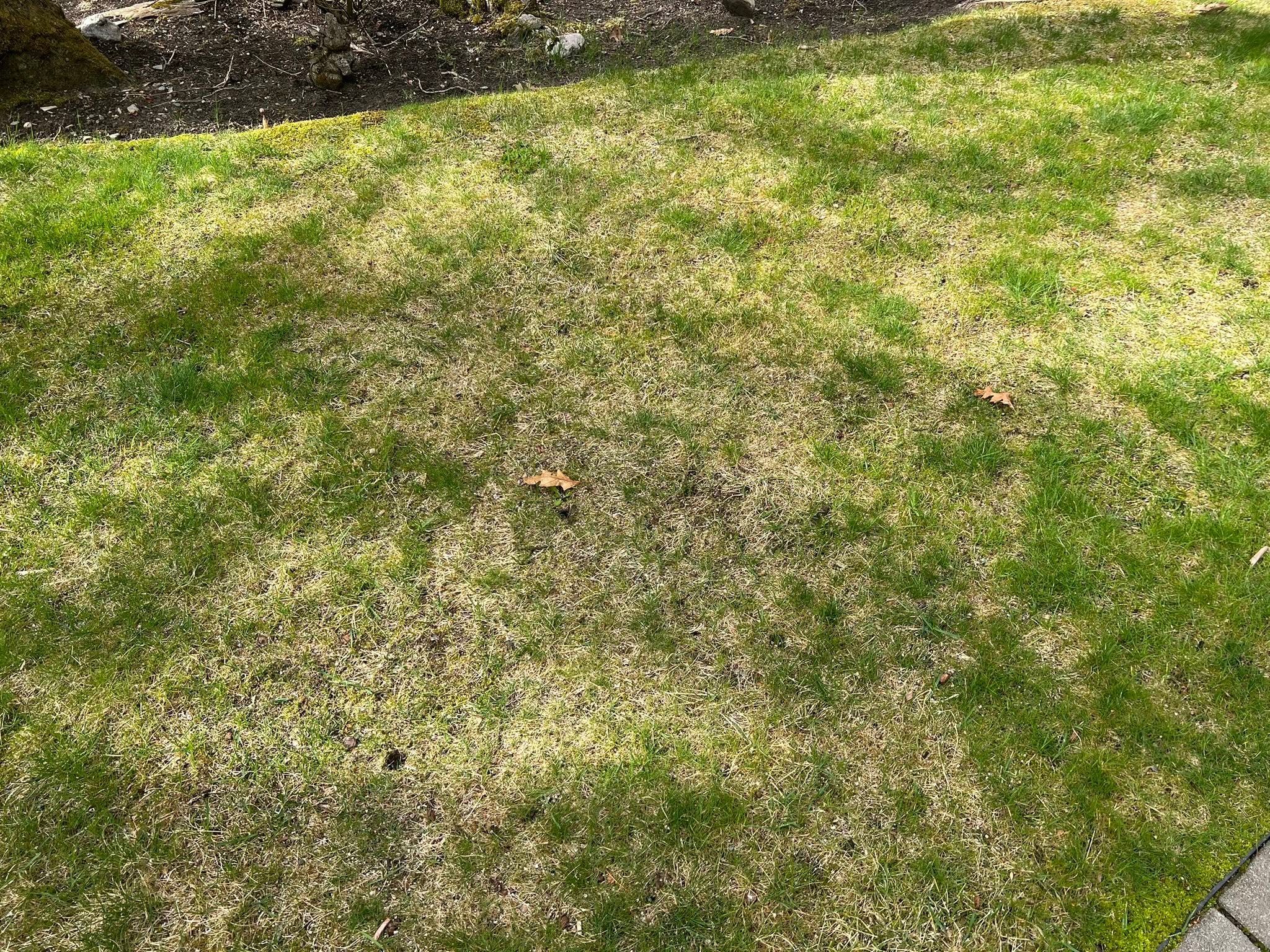
I started the standard assessment sequence. Heel press test across multiple sections — and found something unusual immediately. The compaction wasn’t uniform in the way I typically find on a neglected property. Some sections were severely compacted, consistent with years of poor maintenance and traffic. Other sections, including some of the bare areas, were surprisingly soft — not waterlogged-soft in the drainage-problem sense I’ve documented elsewhere, but soft in a way that didn’t match typical compacted hardpan either.
I checked the thatch in the sections that did have grass cover — moderate, not severe, nothing that would explain the scale of bare ground I was seeing elsewhere on the property. I pulled root samples from the struggling grass sections — shallow, consistent with cutting height and compaction issues, but again, not severe enough on its own to explain sixty percent total bare ground.
My working hypothesis at this point was a combination story: years of neglect, inconsistent rental tenant care, possibly some grub damage given the scale of the dead sections, and general compaction and thatch issues compounding on top of each other. This is a reasonable diagnostic conclusion for a property in this condition — it’s the kind of multi-factor explanation that does account for a lot of severe lawn decline cases I’ve seen across Greater Sudbury.
But something didn’t fit. The pattern of bare ground didn’t match a gradual decline pattern. Gradual neglect-driven decline tends to thin out in a more uniform, creeping pattern — grass gets progressively weaker and patchier over time, with edges between healthy and unhealthy sections that are somewhat gradual. What I was looking at had sections that transitioned abruptly — healthy-looking grass on one side of a line, completely bare soil on the other, with almost no gradient between them. That’s not the signature of gradual neglect. That’s the signature of something that happened at a specific point in time, in a specific pattern, rather than something that developed slowly.
I mentioned this observation to the homeowner and asked directly: did anything specific happen to this property that you’re aware of — work done, anything applied to the lawn, equipment used — at any point before you purchased it?
He didn’t know. He’d bought the property as-is from the previous owner, who had been managing it as a rental for the final several years before selling. But he offered to check with his real estate agent, who might have records or knowledge from the listing process, and to ask the neighbours, who’d been on the street longer than the previous owner had held the rental.
What was actually causing it — the discovery that changed the whole diagnosis
Two days later he called me back with information from a neighbour who’d lived on the street for over twenty years. The previous owner, in the final year before selling the rental property, had hired an unlicensed contractor to do a significant amount of work in the backyard — installing a small shed and doing some drainage work along one side of the property. According to the neighbour, that work had involved heavy equipment being driven across significant portions of the lawn over several days, and at some point during the project, several containers of what the neighbour believed was a petroleum-based product — possibly used oil, possibly something else entirely — had been stored on the property and, the neighbour suspected, had leaked or been improperly disposed of into specific sections of the yard.
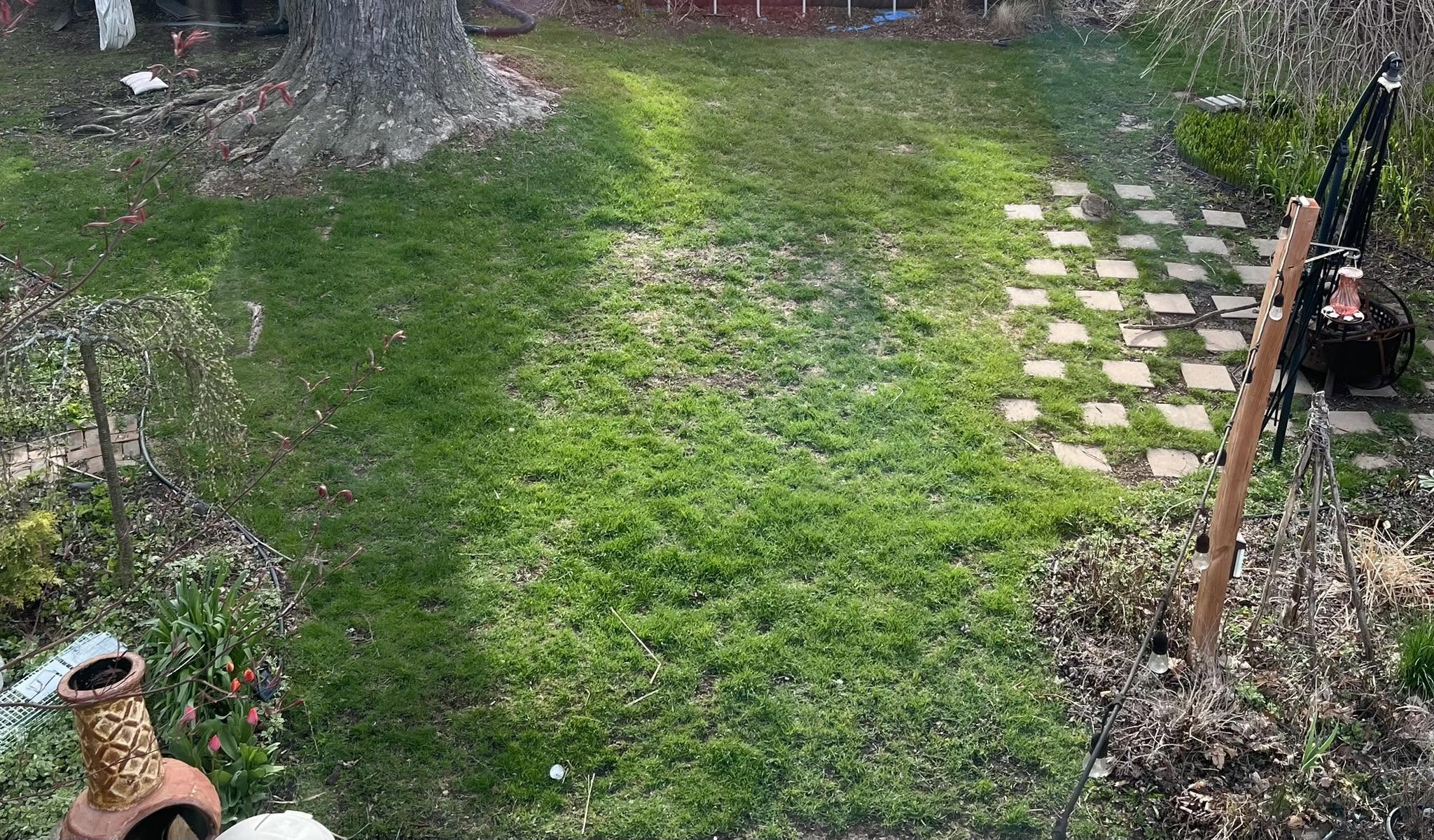
This explained the pattern I’d been unable to account for. The abrupt transitions between healthy and dead grass weren’t a gradual decline boundary — they were the edges of contamination zones from whatever had been spilled or improperly handled during that construction project. The discoloured soil patches and the faint sheen I’d noticed when sections were wet weren’t typical Greater Sudbury topsoil characteristics — they were consistent with petroleum contamination affecting the soil’s appearance and texture.
Petroleum products in soil are directly toxic to grass roots and to the soil microbial community that supports plant growth. Hydrocarbon contamination coats soil particles, displaces oxygen in the root zone, and in many cases creates conditions that are actively hostile to seed germination and root development — which explained why the bare sections had stayed bare through an entire growing season rather than at least partially recovering with weed growth the way abandoned but uncontaminated soil typically does. The volunteer weed growth that was present was concentrated specifically in the sections that weren’t part of the contamination pattern — consistent with this explanation rather than contradicting it.
This wasn’t a lawn care problem in any sense that fertilizer, aeration, or overseeding could address. It was an environmental contamination issue that required a fundamentally different category of response — one that started with soil testing for petroleum hydrocarbon content, not the standard pH and nutrient panel I normally recommend.
What we did about it — and what this case taught me about diagnosis
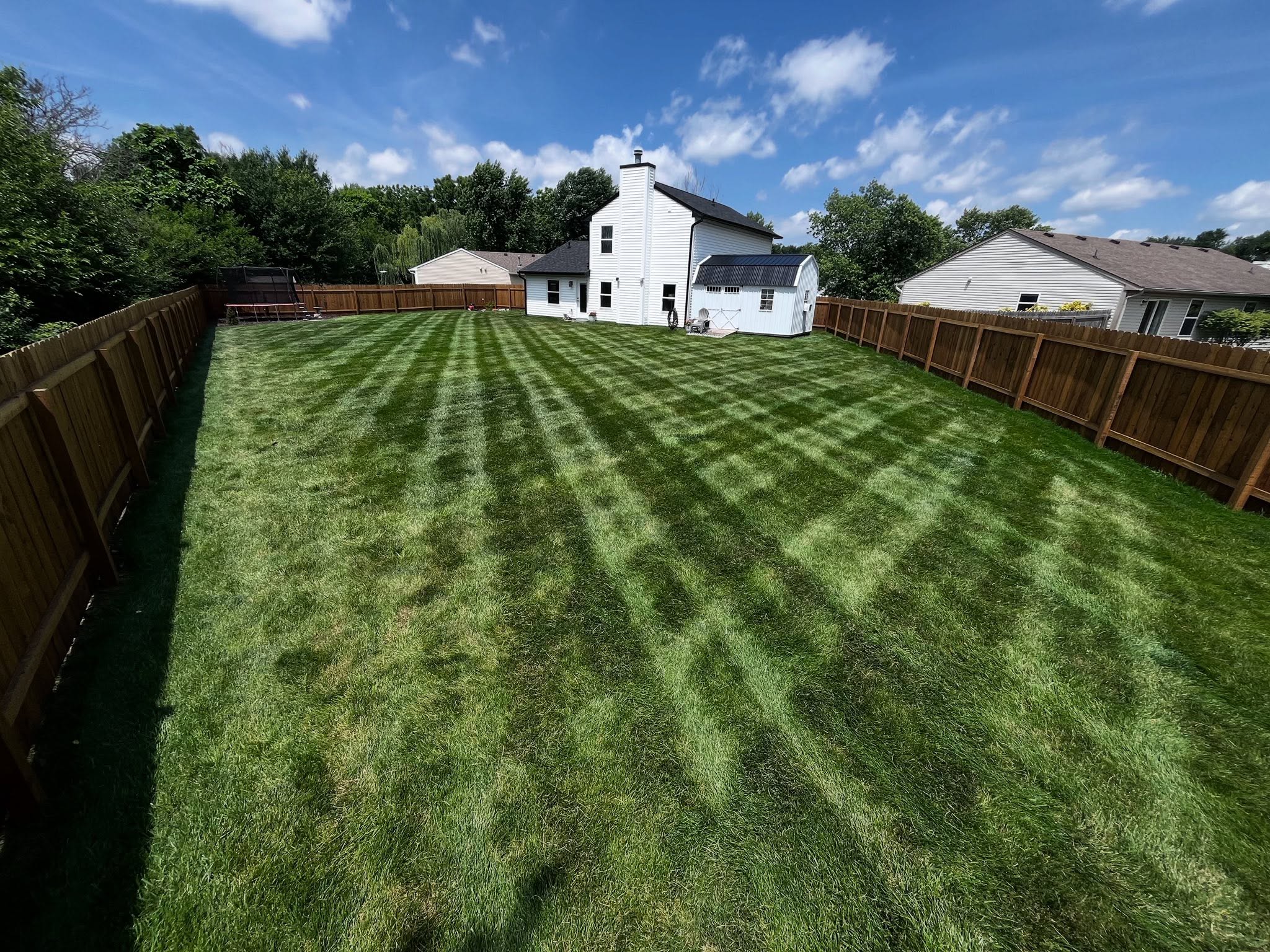
I told the homeowner directly that this was now beyond the scope of standard lawn care and that he needed environmental soil testing before any restoration work began — both to confirm whether contamination was actually present at levels of concern, and to understand the extent and depth of any contamination before deciding on a remediation approach. I provided contact information for environmental testing services in the region rather than proceeding with any lawn work myself, because applying seed, fertilizer, or sod to soil that might still contain contaminants would be wasting his money on a problem that hadn’t actually been addressed.
The soil testing, completed by an environmental consultant a few weeks later, confirmed elevated petroleum hydrocarbon levels in three distinct zones of the property, consistent with the neighbour’s account and with the pattern I’d observed visually. The contamination was significant enough in two of the three zones to require soil excavation and replacement rather than any form of remediation that could happen in place — the affected soil needed to be removed to a licensed disposal facility and replaced with clean fill before any planting could reasonably be expected to succeed.
This was a substantially larger and more expensive project than the homeowner had anticipated when he first called me about a “bad lawn.” It involved an environmental consultant, a licensed excavation contractor, proper disposal documentation, and ultimately a full soil replacement and sod installation across the affected sections — a process that took most of the summer rather than a single spring service visit. Once the contaminated soil was removed and replaced with clean fill, the sod installation followed the standard process I’ve described in the article on buying sod in Sudbury, and established normally because the underlying soil was finally capable of supporting it.
What this case taught me about diagnosis, which I think is worth sharing:
The standard diagnostic sequence I use across hundreds of Greater Sudbury properties — colour read, edge quality, heel press, thatch check, root pull — is built to identify the common causes of lawn decline, and it correctly identifies the overwhelming majority of cases I encounter. But it’s built on an assumption that the cause is biological or mechanical — compaction, thatch, watering, cutting height, drainage. It’s not built to flag contamination, because contamination is rare enough that it isn’t part of the standard hypothesis set.
What saved this diagnosis from staying wrong was paying attention to the pattern that didn’t fit — the abrupt transitions rather than gradual decline, the unusual soil appearance — and being willing to say “this doesn’t fully add up” rather than forcing the observations into the standard explanation just because the standard explanation usually works. If I’d proceeded with the multi-factor neglect-and-compaction theory and recommended a standard restoration program — aeration, topdressing, overseeding — it would have failed, because none of those interventions address soil contamination. The homeowner would have spent money on a service that couldn’t work, and the actual problem would have remained unaddressed.
I think about this case any time I’m assessing a property that’s worse than the standard explanations seem to account for. Most of the time, severe lawn problems in Greater Sudbury really are compaction, thatch, drainage, and cutting height — the causes I’ve documented across most of the articles on this site, including the comprehensive overview in the complete 2026 Sudbury lawn care homeowner reference. But on the rare occasion when the pattern genuinely doesn’t fit, the right response isn’t to force a familiar diagnosis onto an unfamiliar problem. It’s to keep asking what doesn’t add up until you find an explanation that actually accounts for everything you’re seeing.
If you have a lawn that’s struggling in ways that don’t seem to match the typical Greater Sudbury problems — and especially if you’ve noticed unusual soil characteristics, abrupt transitions between healthy and dead areas, or you know your property has a history involving construction work, equipment storage, or anything unusual — it’s worth having that conversation explicitly before assuming standard lawn care will fix it.
📞 705-507-6787 | Get a free quote online
— Ryan Lingenfelter
Owner, Cutting Edge Lawn & Landscaping
Garson, Ontario · 705-507-6787
